Food Genre
Seafood
A cross-regional look at Seafood from across Japan.
Region(multiple selection allowed)
68 items

Catfish Tempura
Namazu Tempura
Catfish tempura is a dish passed down in the water-rich eastern Gunma region around Tatebayashi City and Itakura Town, where the Tone River and Watarase River flow. The area once had even more rivers, ponds, and marshes than today, and catfish, alongside eel and carp, became a familiar freshwater fish in daily life. The fish is finely minced down to the bone and deep-fried in a crisp batter, giving it a fluffy white-fish texture and mild flavor. Itakura Town was once lined with many freshwater fish wholesalers, and the dish became a local specialty served to visitors of Raiden Shrine (雷電神社) and Takatori Tenmangu (高鳥天満宮). Today, local freshwater fish restaurants still serve tempura and tataki-age (minced-and-fried catfish) made with wild-caught catfish, and Tatebayashi City promotes itself as “the town of catfish” for tourism, keeping this freshwater fish food culture centered on the Tatebayashi area alive.
Echizen Crab
Echizen Crab
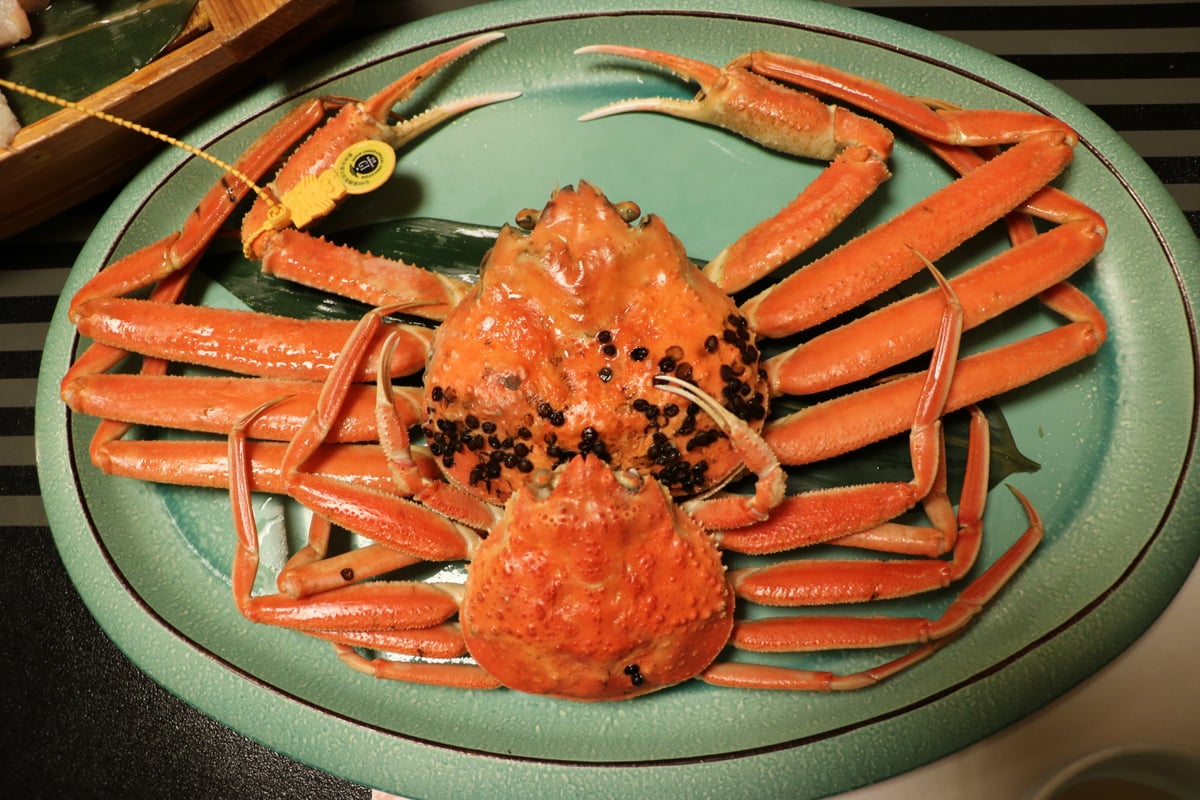
Echizen Crab is the brand name given to male snow crabs (zuwaigani) landed at ports in Fukui Prefecture. It covers crabs landed at Echizen Port (Echizen Fishing Port) in Echizen Town, as well as at Mikuni Port in Sakai City, Tsuruga Port, Obama Port, and others. A yellow tag attached to a leg is proof of the brand, bearing the GI (Geographical Indication) mark, the name of the fishing boat, and other information. Echizen Crab landed at Mikuni Port has been presented to the Imperial Household since 1922 (Taisho 11), and it is known as 'the only crab presented to the Imperial Household.' In 2018, it became the first crab in Japan to be registered under the national Geographical Indication (GI) protection system. The fishing season opens on November 6 each year, and males are landed until March 20 of the following year. Female snow crabs are called 'Seiko-gani,' and the uchiko (ovaries) inside the shell and the sotoko (eggs) carried on the belly are prized. Echizen Town is also home to the Echizen Crab Museum, where visitors can learn about Echizen Crab, and the crab is one of the signature winter delicacies of the Echizen Coast.
Hitsumabushi (Nagoya-Style Chopped Eel Rice)
Hitsumabushi
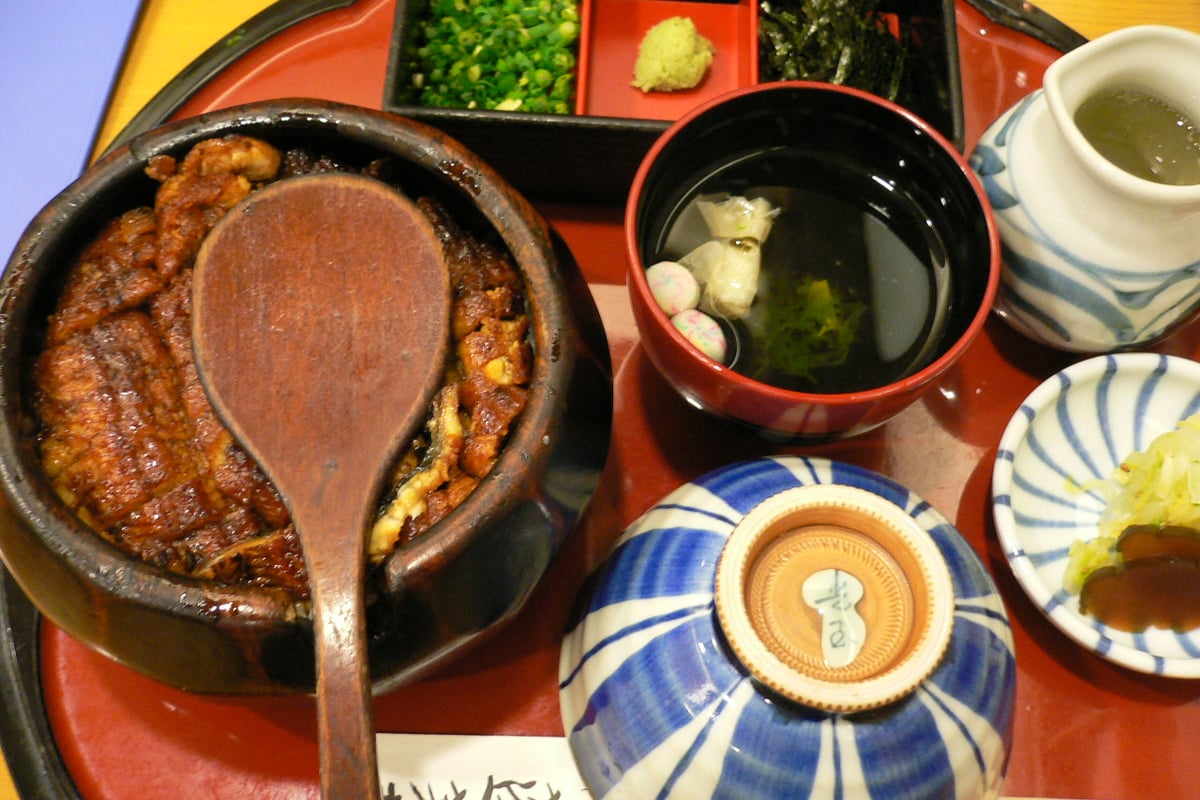
Hitsumabushi is a local dish that originated in Nagoya City, Aichi Prefecture, in which finely chopped grilled eel (unagi kabayaki) is mixed into white rice and served in an ohitsu (a wooden rice tub). Its greatest appeal is that a single serving can be enjoyed in several different ways: the first bowl is savored plain to taste the eel itself, the second is topped with condiments, the third is turned into a chazuke-style dish with dashi or tea poured over it, and the fourth is eaten however one likes. It is said to have been devised in the Meiji era by Atsuta Horaiken in Atsuta Ward, Nagoya City, which began using wooden ohitsu instead of ceramic bowls to prevent breakage during deliveries. Ibasho, in Nishiki 3-chome, also claims to be its birthplace, and the two shops differ on when the dish was actually established. The hiragana name 'hitsumabushi' itself is a registered trademark of Atsuta Horaiken, and today it is widely loved by tourists as one of Nagoya's signature local dishes.
Namerou
Namerou
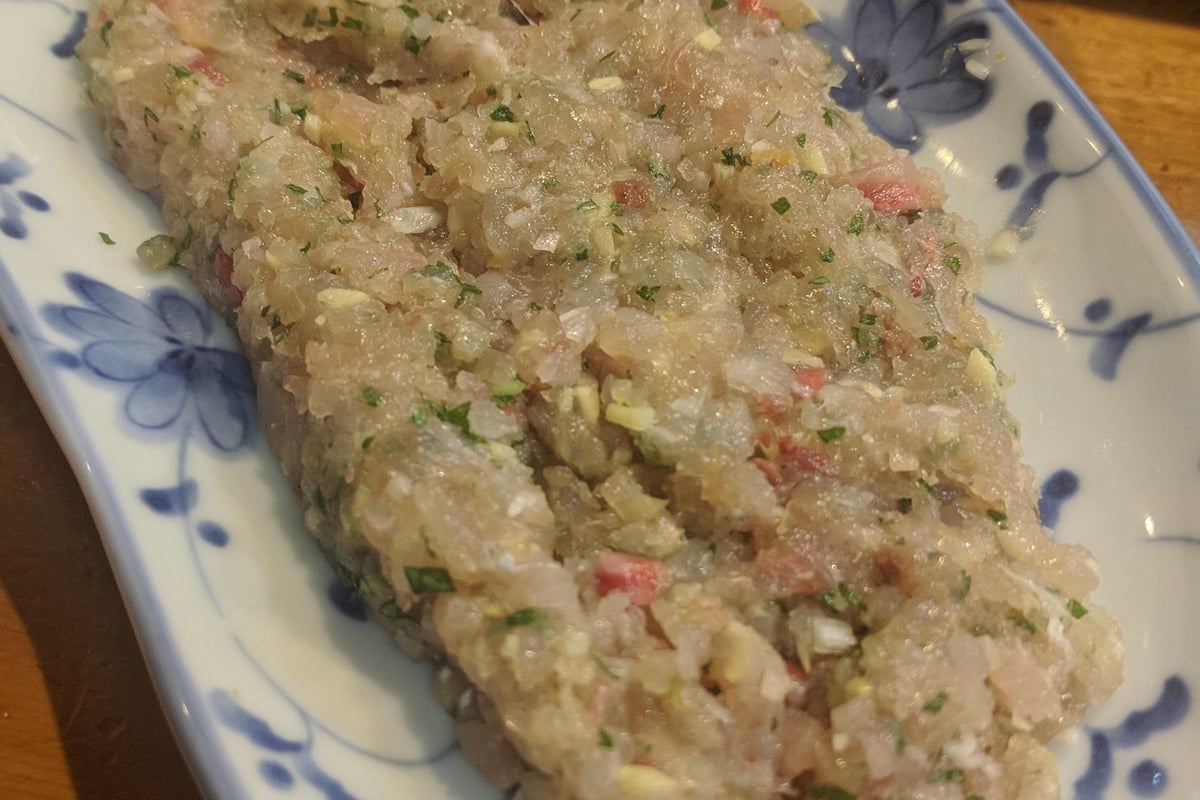
Namerou is a fisherman's dish handed down along the coast of the Boso Peninsula in Chiba Prefecture. Oily fish such as horse mackerel (aji) or sardines are combined with miso, green onion, ginger, and other aromatics, then minced with a knife until the mixture turns sticky. It is said to have originated as a dish fishermen could prepare quickly aboard a rocking boat—miso was used instead of soy sauce because soy sauce would spill, while miso keeps well. The name is said to come either from the dish being 'so delicious you want to lick (nameru) the plate clean,' or from the sticky minced fish clinging to the plate so that you 'have to lick it to finish it.' Today Namerou is enjoyed not only as a home-cooked dish but also as a standard item at diners and izakaya throughout the Boso region—a simple yet deeply flavorful dish where the richness of the oily fish and the fragrance of the aromatics shine.
Yobuko Squid
Yobuko Ika
Yobuko Ika refers to ikizukuri (live sashimi) made from squid such as yariika (spear squid) caught in the Genkai Sea around Yobuko, Karatsu City, Saga Prefecture, and served while still alive and nearly transparent. Yobuko Port sits close to prime fishing grounds in the Genkai Sea and is known as a fishing town where fresh squid is landed daily; squid dishes have developed here alongside the local morning market culture. The squid, which barely moves on the plate and is so transparent that the pattern of the dish shows through, is prized by visitors as proof of its freshness. The yariika squid mainly used is also registered as a 'Pride Fish,' a designation recommended by fishing industry representatives nationwide to represent their region. After enjoying the sashimi, it is customary to eat the remaining ears and legs deep-fried as tempura or grilled with salt, leaving nothing to waste — making it the signature dish that supports Yobuko's reputation as the 'town of squid.'
Sangayaki
Sangayaki
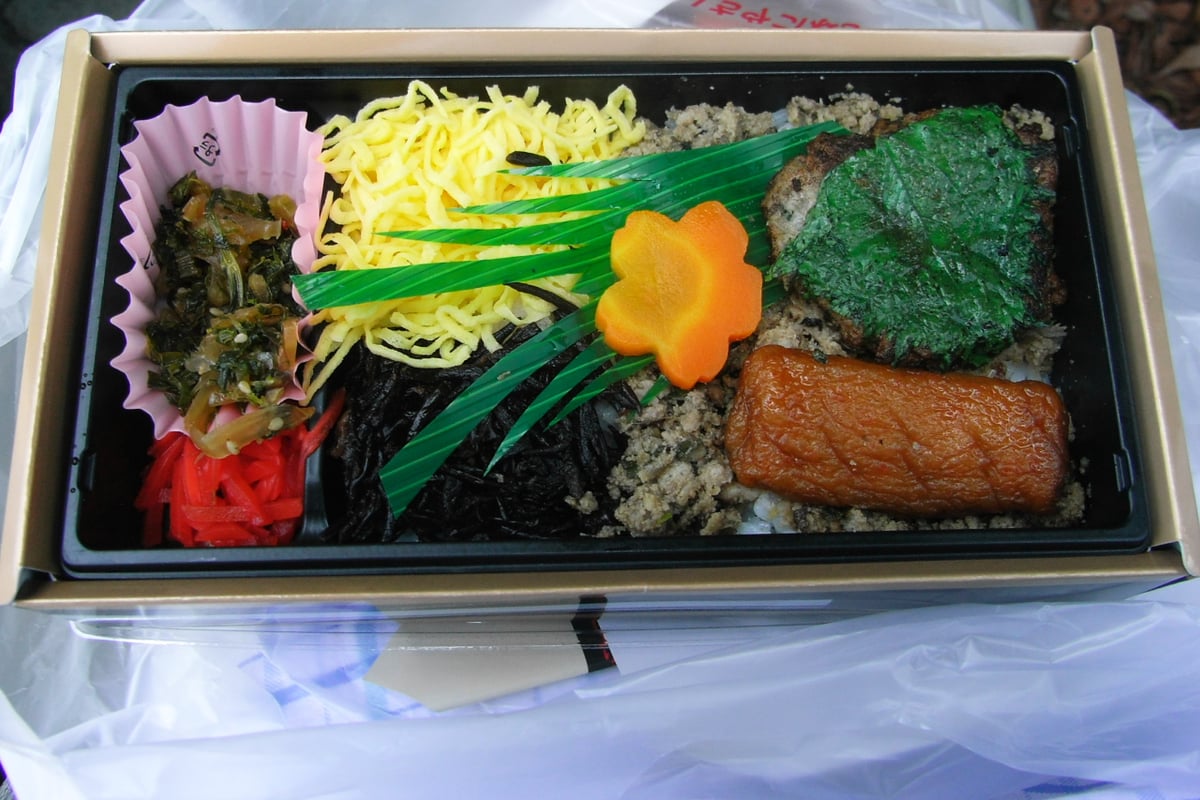
Sangayaki is a dish in which Namerou, a local specialty of the Boso Peninsula, is packed into abalone or scallop shells and grilled. It is said to get its name from the practice of fishermen taking the Namerou they had prepared offshore up into the mountains for work, where they cooked it over a fire in a mountain hut—hence 'sanga-yaki,' or 'mountain-house grill.' Unlike raw Namerou, cooking it adds a savory aroma and improves keeping quality, making it a valued meal for busy fishermen and mountain laborers alike. Today it is easily made at home in a frying pan or on a grill, and it is also served at restaurants throughout the Boso region using shells as serving dishes—a dish enjoyed for a savoriness quite different from that of raw Namerou.
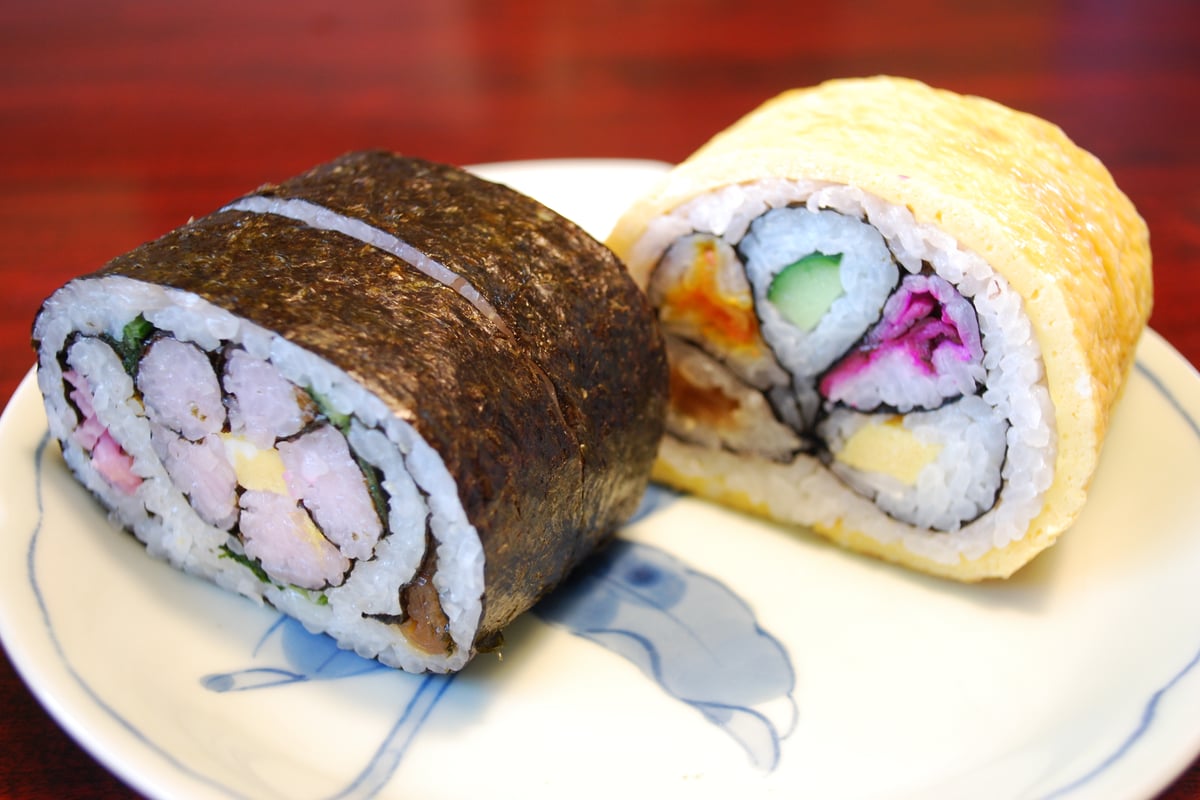
Futomaki Matsurizushi
Futomaki Matsurizushi
Futomaki Matsurizushi is a signature local dish of Chiba Prefecture, handed down in the Boso Peninsula (the Awa and Kazusa regions). Its defining feature is that when the rolled sushi is sliced, the cross-section reveals pictures of flowers, animals, characters, and more. It is said there are over 100 different designs, each passed down uniquely by region and household. Its history is said to trace back to the Kansei era (1789-1801) in the late Edo period, with one theory holding that its roots lie in 'mehari-zushi,' brought to Boso by fishermen who had relocated from Kishu. It was once made as a hospitality dish for celebratory gatherings such as village festivals, weddings, and children's birth celebrations that brought together large groups of people, and in 2007 it was selected as Chiba Prefecture's representative in the Ministry of Agriculture, Forestry and Fisheries' '100 Local Dishes of Rural and Fishing Villages' and '100 Furusato Onigiri.' Today it remains a beloved celebratory sushi, enjoyable to look at as well as to eat, indispensable for ceremonial occasions and annual events.
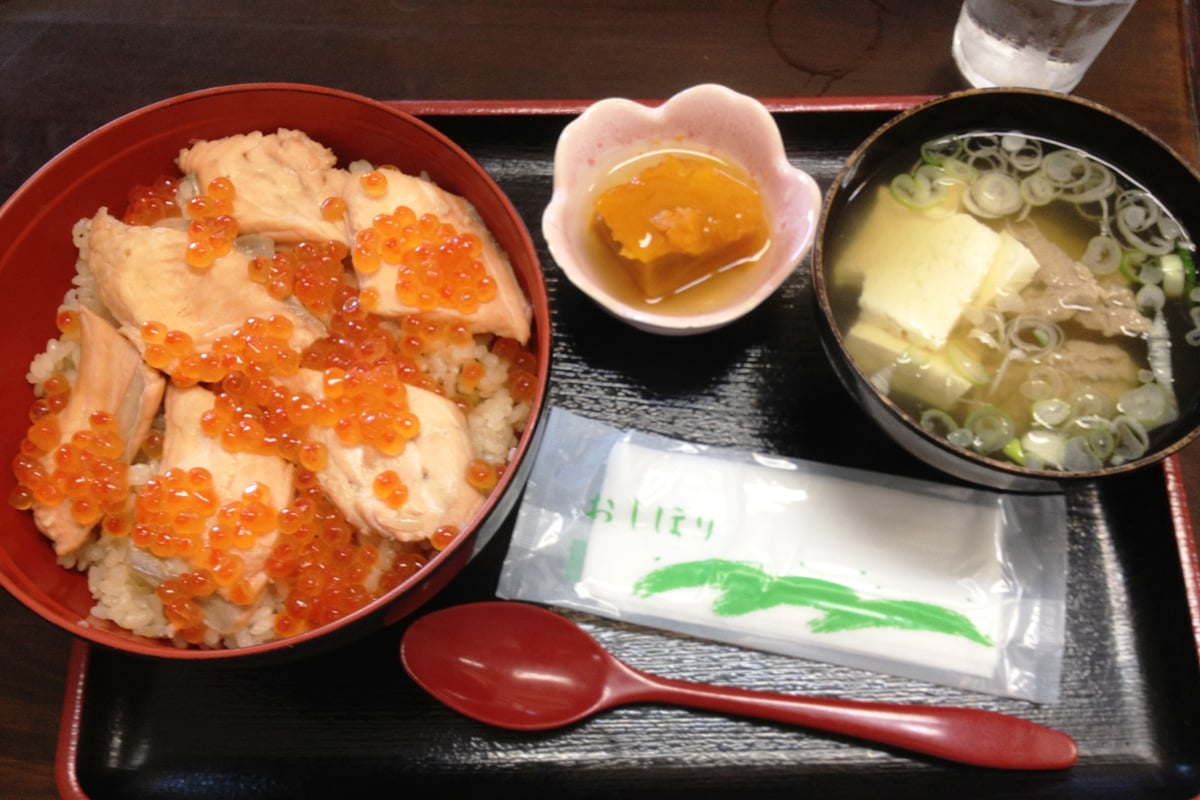
Harako Meshi (Salmon and Roe Rice)
Harako Meshi
Harako meshi is an autumn local dish originating in the Arahama district of Watari Town, Miyagi Prefecture, in which rice is cooked in a broth made by simmering salmon meat, and then topped with flaked salmon and glossy salmon roe (harako) dipped in the same broth. It is said to have originated when, during an era when beach seine salmon fishing thrived near the mouth of the Abukuma River, fishermen would prepare it as a meal for themselves after a large catch. An episode is recorded that during the Edo period, when Date Masamune, who ruled Watari, visited to inspect flood-control works on the Abukuma River, local fishermen presented him with harako meshi, which he greatly enjoyed. It is also said that after returning to his castle, he spoke of its delicious taste to those around him, which became the catalyst for it to become known as a specialty of Watari. 'Harako' refers to the roe inside a salmon's belly, that is, its 'belly child' (hara-ko). As a seasonal delicacy available only from around September to November, when salmon migrate upstream, it is served at restaurants throughout the prefecture, centered on Watari Town.
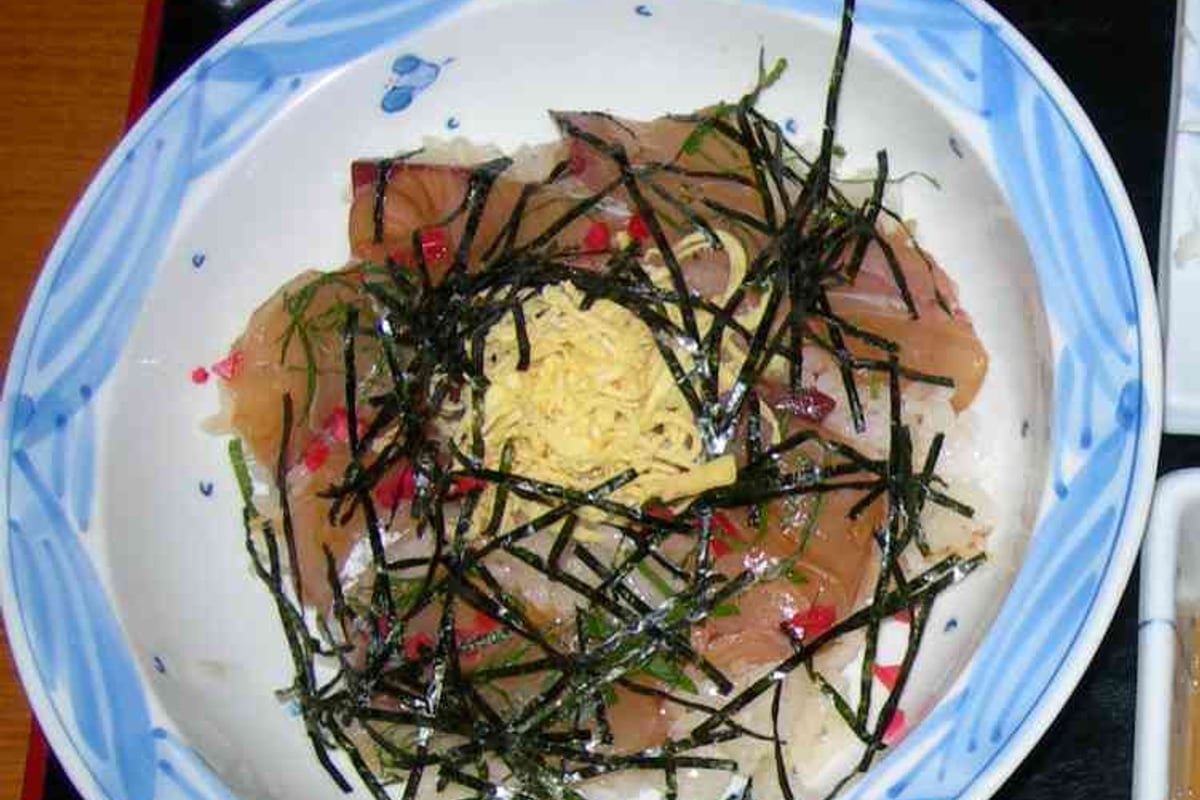
Tekone-zushi (Hand-Mixed Bonito Sushi)
Tekone Zushi
Tekone-zushi is a fishermen's dish that represents the Shima region of Mie Prefecture. Red-fleshed fish such as bonito (katsuo) is marinated in a soy sauce-based sauce and mixed with vinegared rice. It is often finished with a scattering of finely shredded ginger or shiso (perilla) leaves, which makes it refreshing to eat. It is said to have begun as a dish that fishermen in Wagu, Shima-cho, Shima City made so they could eat quickly aboard bonito fishing boats. It is said to have come to be called 'tekone-zushi' because it was made by mixing it by hand (te) as if kneading (koneru). In the Meiji era it spread to fishermen's households and the local community, and it has been handed down as a feast for festivals and guests. In the Showa era it became a representative local dish of the Shima region and also came to be served to tourists visiting Ise-Shima. Today it is offered as a specialty at restaurants in Ise, Toba, and Shima. In fiscal 2025 (Reiwa 7), it was recognized as one of the Agency for Cultural Affairs' '100-Year Foods.'
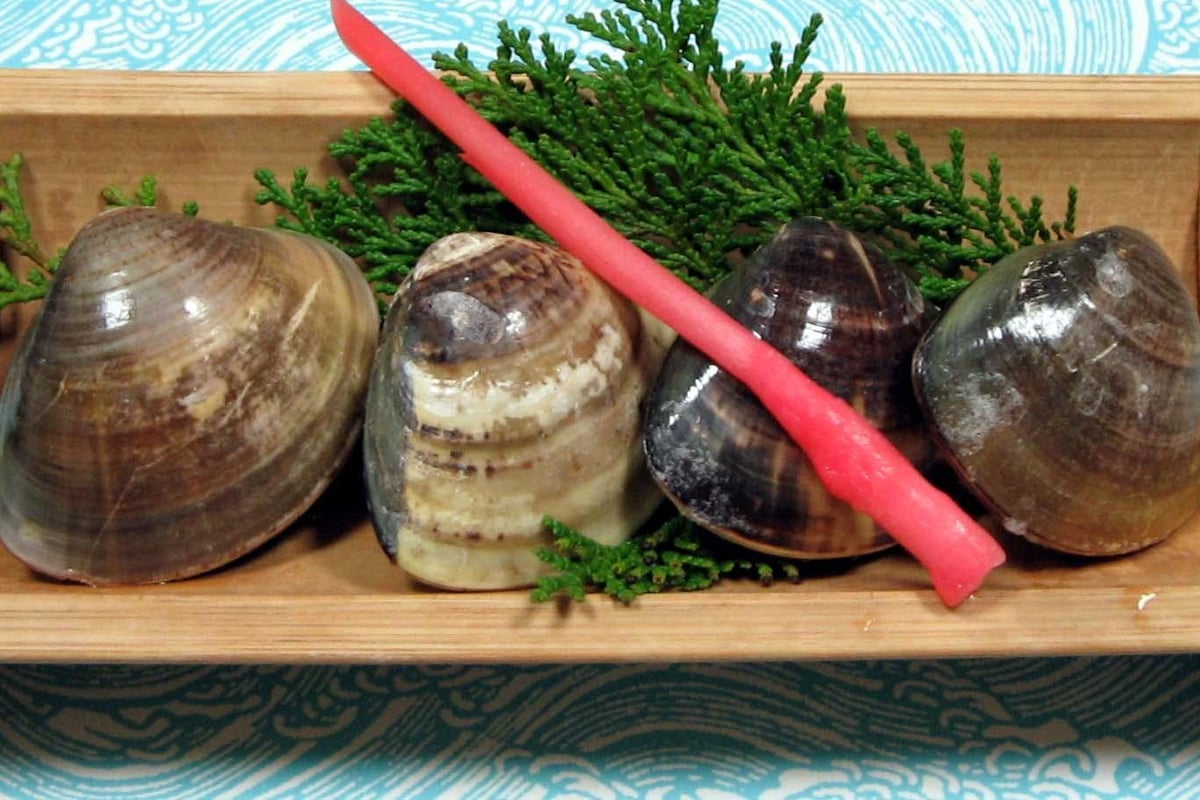
Kuwana Hamaguri (Kuwana Clams)
Kuwana Hamaguri Clams
Kuwana hamaguri refers to the clams harvested off Kuwana City, Mie Prefecture, and the dishes made with them. Kuwana lies at the river mouths where the three Kiso rivers, the Kiso, Nagara, and Ibi Rivers, flow into Ise Bay. Because the clams grow in nutrient-rich fishing grounds where fresh river water and seawater meet, they are large and plump, with a rich flavor. They are a species native to Japan, the Japanese hard clam (Meretrix lusoria), and are also called 'ji-hamaguri' (local clams) in the area. In the Edo period, Kuwana prospered as a post town on the Tokaido, and grilled clams (yaki-hamaguri) were a specialty popular with travelers. They were so widely known that the wordplay 'sono te wa Kuwana no yaki-hamaguri' was born. Shigure hamaguri (clams simmered in soy sauce), simmered down in tamari soy sauce and other seasonings, is also a representative specialty of Kuwana. The catch once fell drastically, but fishers have continued their efforts to restore the resource. In fiscal 2024 (Reiwa 6), 'Kuwana Yaki-hamaguri' was recognized as one of the Agency for Cultural Affairs' '100-Year Foods.'
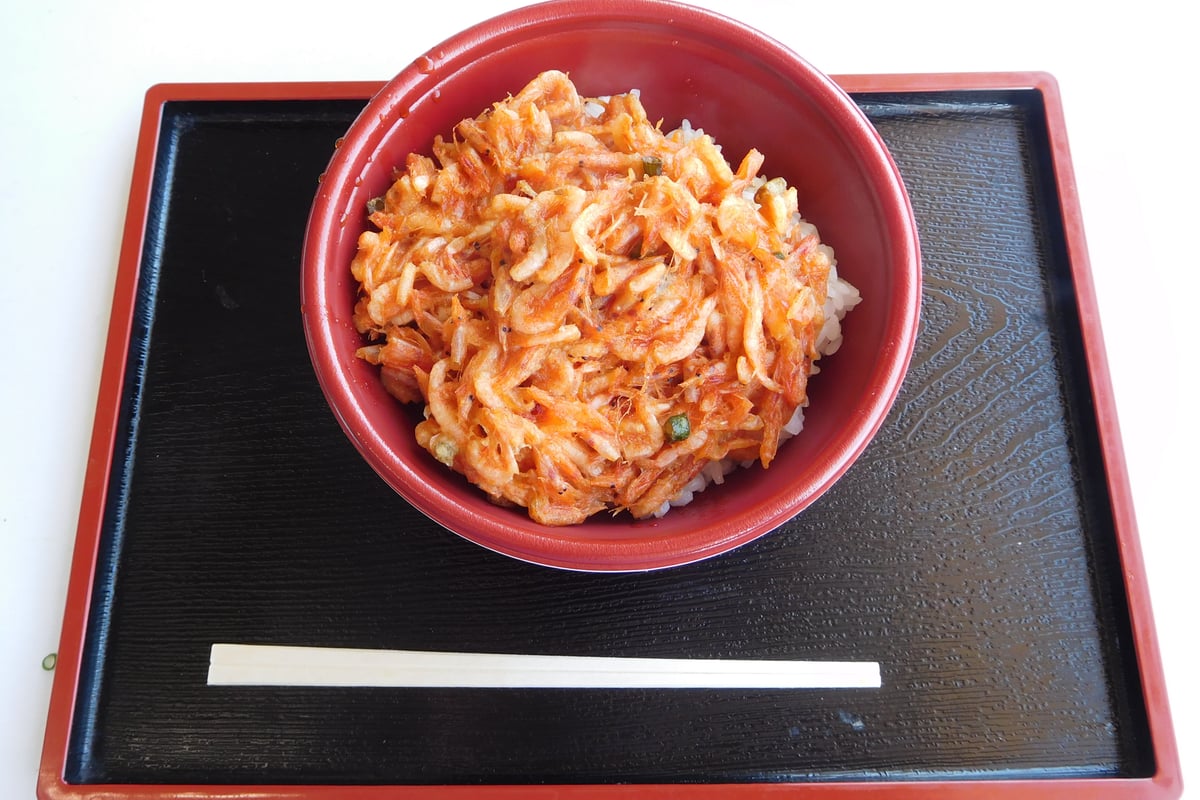
Sakura Shrimp Kakiage
Sakura Ebi Kakiage (Sakura Shrimp Tempura Fritters)
Sakura shrimp kakiage is a specialty of Shizuoka Prefecture made with plenty of sakura shrimp caught in Suruga Bay, fried until crisp with only a light amount of batter. Sakura shrimp are small, translucent, cherry-blossom-pink shrimp, and Suruga Bay is the only place in Japan where they are landed as a fishery. The ports where they are landed are limited to Yui Port in Shimizu Ward, Shizuoka City, and Oigawa Port in Yaizu City. Fishing takes place twice a year, in spring and autumn, and is said to be carried out on only about 40 days in total per year. The fishery began in the Meiji period, reportedly when fishermen from Yui happened to catch a large haul of sakura shrimp in their nets. In the producing areas of Yui and Kanbara, besides kakiage (mixed tempura fritter), people have also eaten 'okiagari,' raw sakura shrimp simmered with tofu and green onions. Inside the crunchy batter, the shrimp are tightly packed, offering both a fragrant aroma and sweetness. It is also standard to enjoy it as kakiage-don (a rice bowl) or on top of soba or udon noodles.
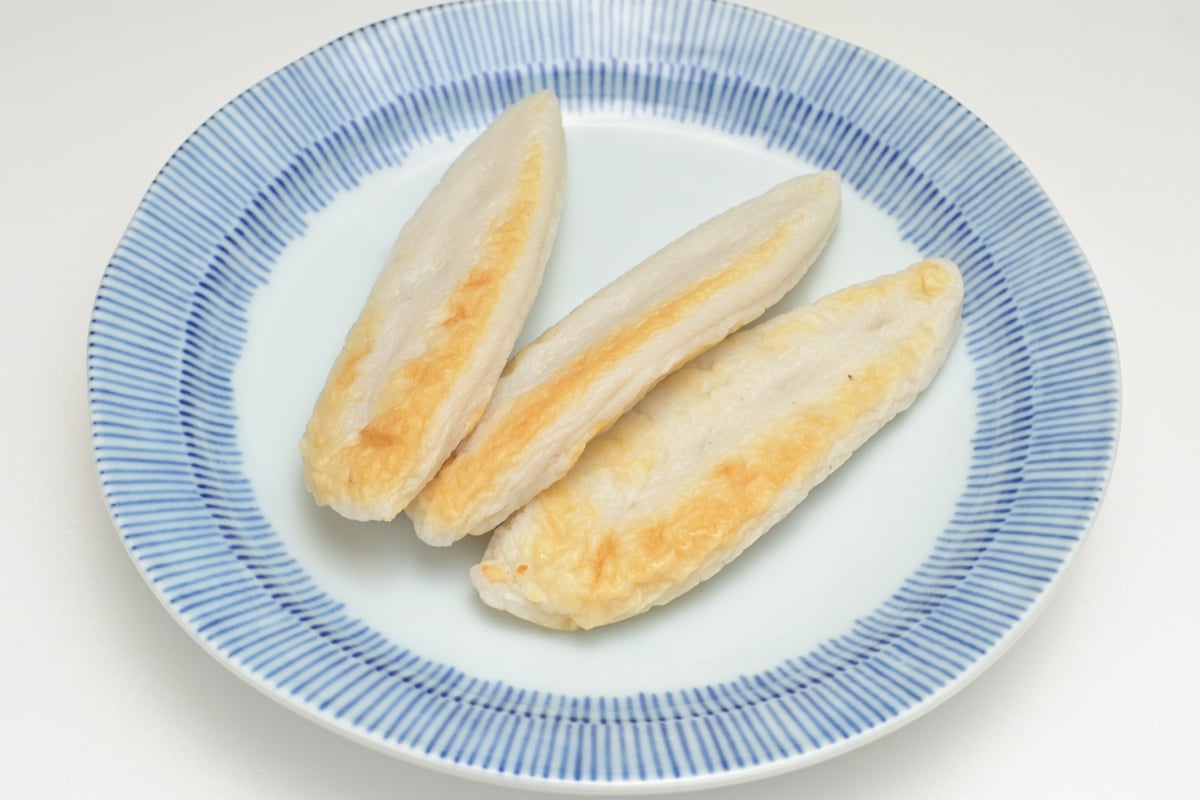
Sasa Kamaboko (Bamboo-Leaf Fish Cake)
Sasa Kamaboko
Sasa kamaboko is a fish cake shaped like a bamboo-grass leaf and grilled, made from pureed white fish — a local specialty representing Sendai. It is said to have originated in the mid-Meiji 30s (around 1900), when a series of large flatfish catches occurred along the coast from Yuriage to Mount Kinka; because transportation and storage capacity were insufficient at the time, grilled fish cakes were made to keep the surplus flatfish from going to waste. Because of its shape, it was originally called 'palm-shaped kamaboko' or 'tongue-shaped kamaboko' (berokamaboko), but it came to be called 'sasa kamaboko' because its shape resembled the bamboo-grass leaves depicted in the 'bamboo and sparrow' family crest of Date Masamune, the founder of the Sendai Domain. This name is said to have become standardized in the Showa era. While flatfish, a high-grade fish, was originally the main ingredient, as catches declined, white fish such as walleye pollock has become the main ingredient today. Low in fat and calories while rich in high-quality protein, it is a classic Sendai souvenir, with more than 40 producers said to exist within Miyagi Prefecture.
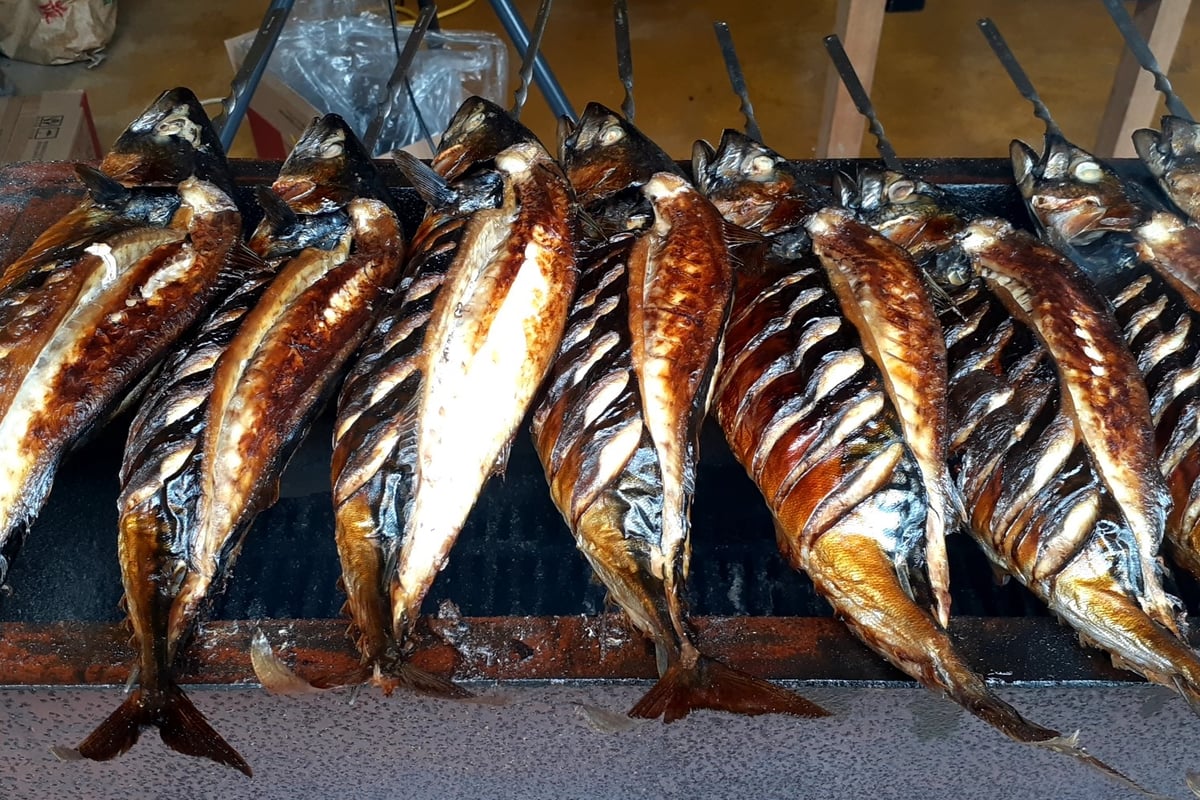
Hamayaki Saba (Whole Grilled Mackerel)
Hamayaki Saba
Hamayaki Saba is a specialty of the Wakasa region of Fukui Prefecture, made by skewering a whole mackerel and grilling it. Mackerel spoils easily, but grilling makes it keep longer, so it has long been enjoyed in Obama City, which faces Wakasa Bay, where mackerel was caught in abundance. In the past, to preserve freshness, mackerel is said to have been grilled on the beach right after being landed. The grilled mackerel is usually eaten with ginger soy sauce. Since ancient times, Wakasa was a Miketsukuni (a province that supplied food to the imperial court), delivering seafood to the capital, and Obama is known as the starting point of the Saba Kaido (Mackerel Road), along which mackerel was carried to Kyoto. In Obama City's shopping streets, there are long-established shops that display Hamayaki Saba grilled right at the storefront. Hamayaki Saba, which is delicious even when cold, also gave rise to the pressed sushi 'Yaki Saba Sushi,' which has become one of Fukui's representative souvenirs.
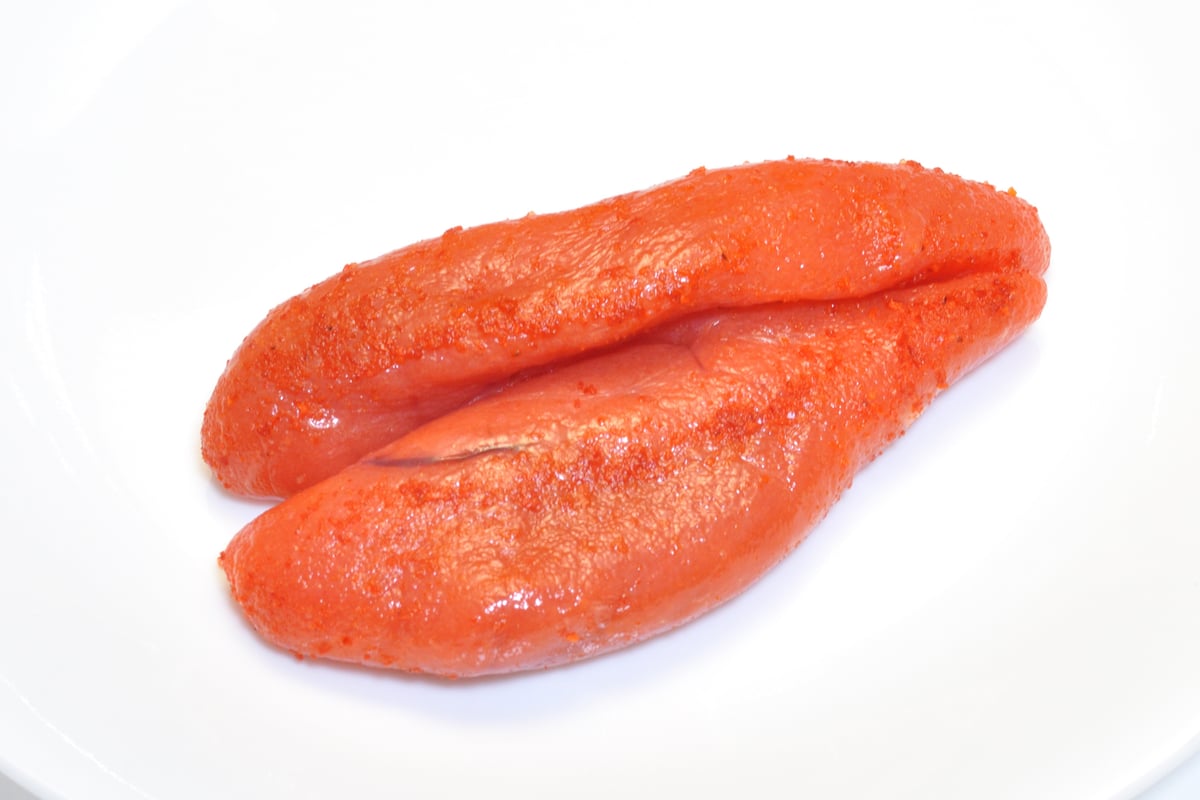
Karashi Mentaiko (Spicy Marinated Pollock Roe)
Karashi Mentaiko
Karashi mentaiko is a processed marine product representative of Fukuoka and Hakata, made by marinating the roe of Alaska pollock in a chili-based seasoning liquid. The custom of eating pollock roe with chili has its roots on the Korean Peninsula, and Kawahara Toshio, who spent his childhood in Busan, could not forget the taste of the 'mentai' (chili-marinated pollock roe) he had eaten there. After returning to Japan, he spent years researching how to adapt it to Japanese tastes and eventually perfected his own version. Fukuya, a shop founded in Hakata's Nakasu district in 1948, became the first in Japan to sell karashi mentaiko as a commercial product in 1949, and it has since become known nationwide as a food that symbolizes Fukuoka. Beyond being eaten simply with rice, it is widely used as a filling for pasta and rice balls and as a seasoning, and it remains a hugely popular souvenir from Fukuoka among visitors from Japan and abroad.
Kobako-gani
Kobako-gani
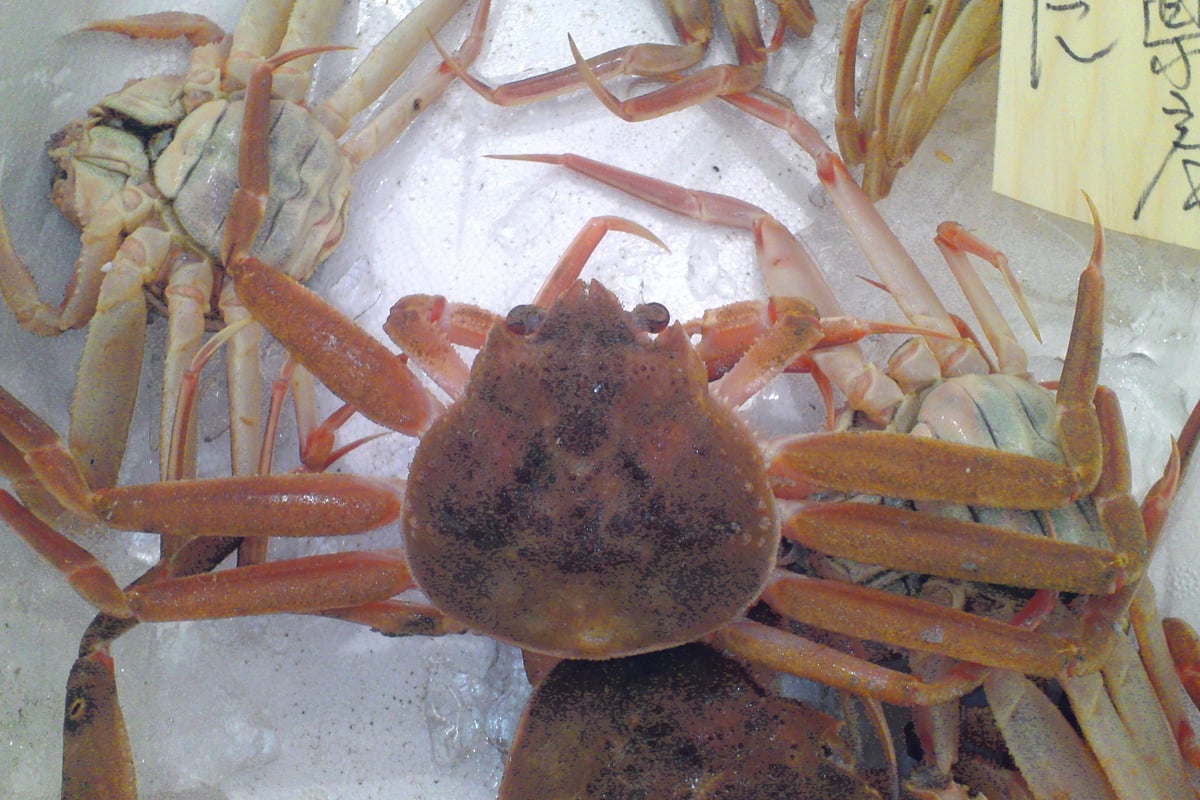
Kobako-gani is the local Ishikawa name for female snow crab, and while its shell is only about half the size of the male 'Kano-gani,' its appeal lies in the abundant immature roe called 'uchiko' along with crab miso packed inside the shell, and the mature roe called 'sotoko' carried under its belly. There are several theories about the origin of the name: that the rounded shape of its shell resembles a 'kobako,' a tea-ceremony incense box; that it comes from the local dialect word 'kobaku,' meaning 'cute'; and that the novelist Muro Saisei was involved in naming it. To protect the resource, the fishing season is short, running only from the opening on November 6 to around December 29, and during this period alone, crowds flock to Omicho Market and restaurants throughout the city to enjoy this winter tradition of Kanazawa. With its rich uchiko and sotoko and the delicate sweetness of its meat, it offers a charm distinct from that of Kano-gani.
Kujira no Tare (Dried Whale Meat)
Kujira no Tare
Kujira no Tare is a preserved food handed down since the Edo period in Wada, Minamiboso City, Chiba Prefecture. Palm-sized, thinly sliced pieces of Baird's beaked whale meat are marinated in a special sauce made from soy sauce, sugar, and other seasonings, then dried in the sun. Wada Port, home to the Wada-ura area, is known as the only coastal small-type whaling base in the Kanto region, and Baird's beaked whales are landed there every year during the fishing season from late June to late August. Drying concentrates the meat's umami, and when lightly grilled, the fragrant soy-based sauce and the whale meat's distinctive rich red-meat flavor come through. Enjoyed locally as a snack and an accompaniment to sake, it is also a dish that developed from local wisdom for using whale meat without waste. In recent years it has also become available by mail order from roadside stations and specialty shops, and it remains a beloved souvenir representing Wada-ura.
Kuro Hanpen (Black Fish Cake)
Kuro Hanpen (Black Fish Cake)
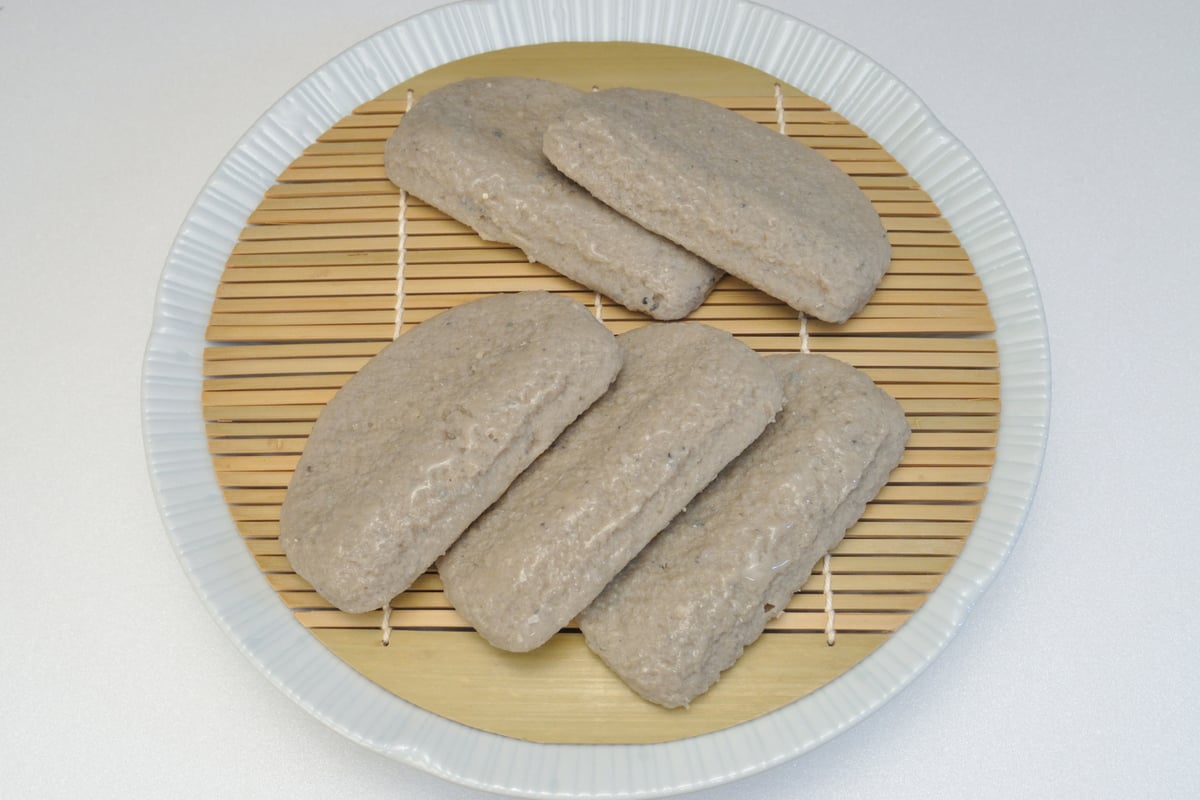
Kuro hanpen is a fish-paste product (nerimono) of Shizuoka Prefecture made by grinding blue-backed fish such as mackerel, horse mackerel, and sardine into paste, bones and skin included, and then boiling it. Because the whole fish is kneaded in, it has a grayish, blackish color. It is shaped like a half-moon, and each piece has traditionally been shaped one at a time using a mold. It is said to have originated in Yaizu and is now eaten throughout Shizuoka Prefecture. Within the prefecture, 'hanpen' means kuro hanpen, which is different from the white, fluffy hanpen. It can be eaten in many ways: as is, grilled, or simmered. 'Kuro hanpen fry,' coated in breadcrumbs and deep-fried, is a standard side dish at home and in supermarkets. It is also an essential ingredient of Shizuoka oden, enjoyed sprinkled with dashi-ko (powdered fish flakes) and aonori (green laver). It also appears in school lunches and is loved across generations, from children to adults.
Mutsugoro no Kabayaki (Grilled Mudskipper)
Mutsugoro no Kabayaki
Mutsugoro no Kabayaki is a local dish eaten along the Ariake Sea coast in Saga Prefecture. The mutsugoro (mudskipper) is a rare fish found in Japan only in the Ariake Sea and part of the Yatsushiro Sea; because it can breathe through both its gills and its skin, it is able to crawl across the tidal flats. The fish is skewered live and first grilled plain over charcoal, then repeatedly dipped into and slowly grilled in a sweet-savory sauce made of sugar, soy sauce, and sake, and can be eaten whole, head to tail. The fishing season runs from April to August, with the best time to eat it limited to the summer months of May through August, and this seasonal delicacy has been passed down in homes and restaurants along the Ariake Sea coast. During the spawning season of May to July, males can be seen repeatedly jumping to court females, making the mudskipper a local tourism draw not only as a dish but also as a creature of the tidal flats.
Osaka-zushi (Hako-zushi and Battera)
Osaka-zushi (Hako-zushi and Battera)
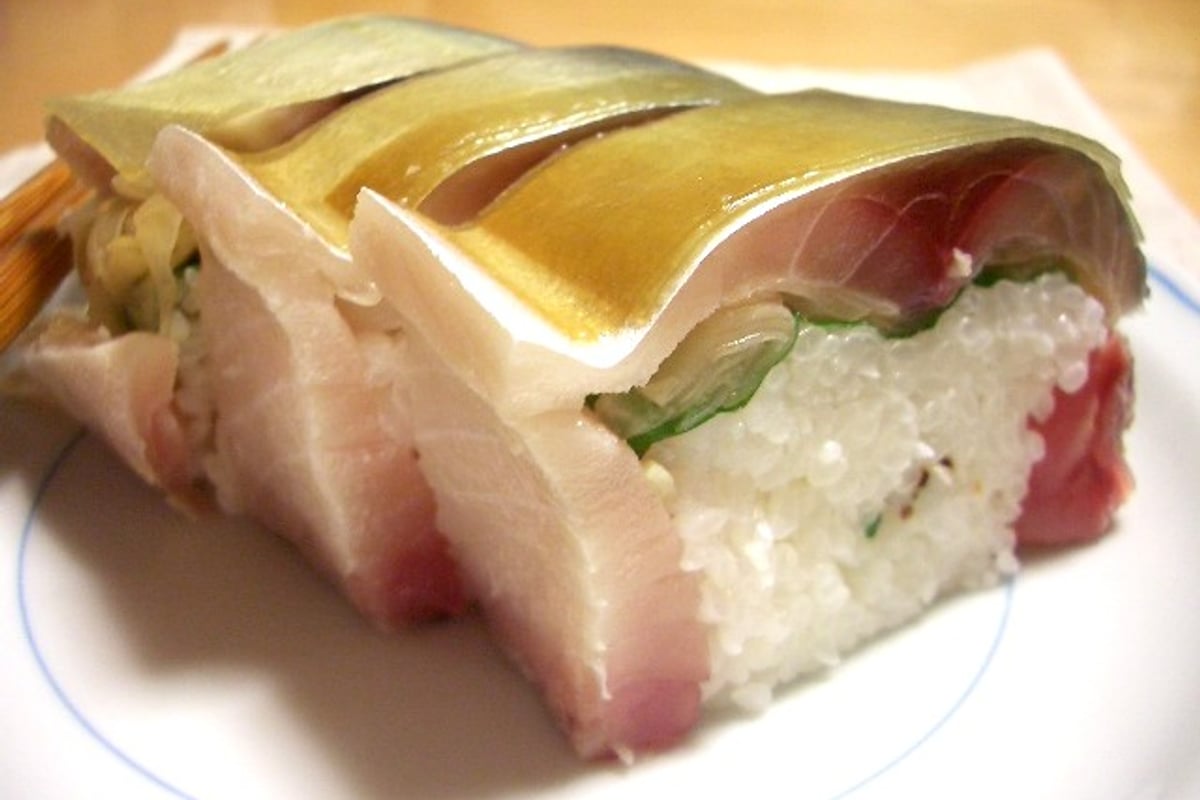
Osaka-zushi is a general term for the sushi that has been made in Osaka, including pressed sushi, rolled sushi (makizushi), and steamed sushi (mushi-zushi). In contrast to the nigiri sushi of Edo, the mainstream in Osaka was oshizushi (pressed sushi), in which sushi rice and toppings are packed into a wooden frame or box and pressed firm. The leading example is hako-zushi (box-pressed sushi), which is pressed in a wooden box and cut into bite-size pieces. Yoshino Sushi (吉野寿司) in Senba, founded in 1841 (Tenpo 12), is said to have devised a colorful hako-zushi using sea bream, shrimp, conger eel (anago), and other toppings in the Meiji era. Also called '2-sun-6-bu kaiseki,' this hako-zushi was favored by the masters of Senba's merchant houses (danna-shu). Another specialty is battera, made by layering vinegar-cured mackerel and shiraita kombu (thin white kelp sheets) and pressing them together. It is said to have been devised in 1891 (Meiji 24) by 寿司常 in Minami-Senba, and its name derives from a Portuguese word meaning small boat. Because it is pressed firm to remove the air, it keeps well, and it has long been valued as a boxed lunch for theatergoers and as a gift to bring when visiting.
Sanma-zushi (Pacific Saury Sushi)
Sanma Zushi (Pacific Saury Sushi)
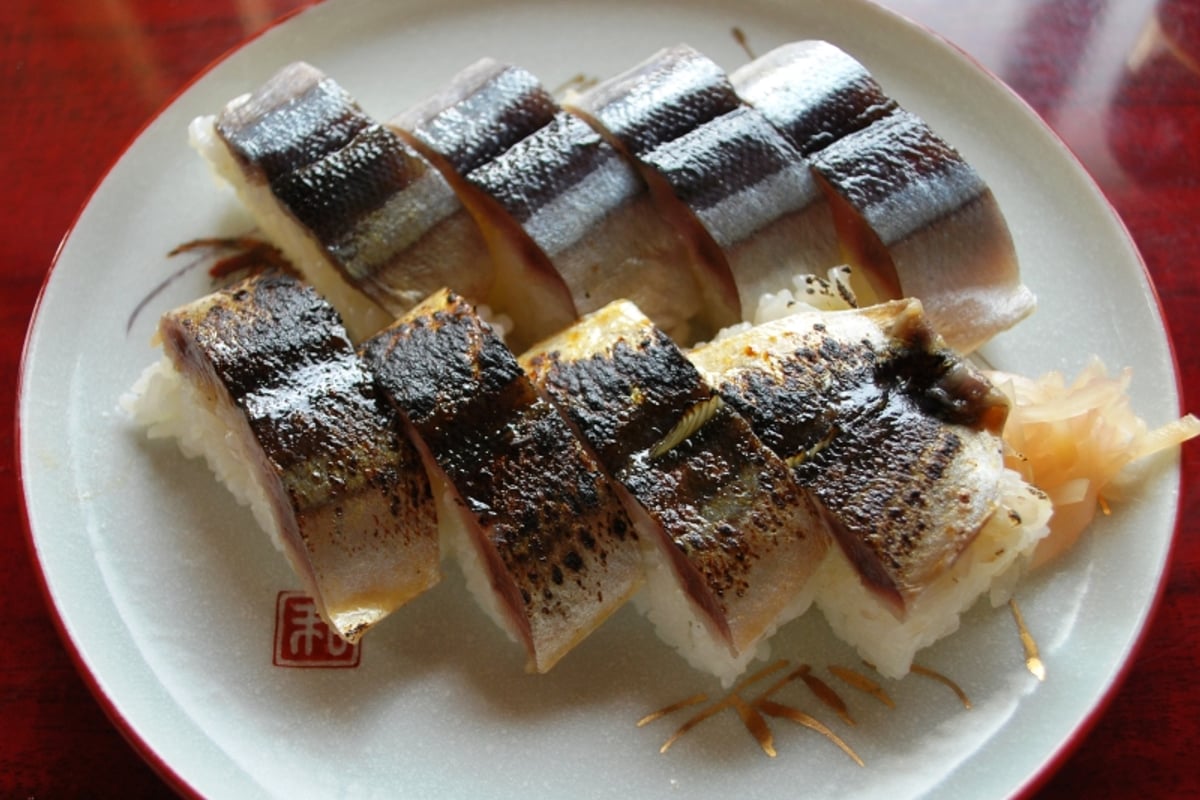
Sanma-zushi is a local dish handed down in the Higashi-Kishu area, including Kumano City and Owase City, along the Kumano-nada coast in southern Mie Prefecture. Lean Pacific saury (sanma) caught in the Kumano-nada Sea is cut open, salted, and cured in citrus vinegar such as mikan citrus juice. It is then laid on vinegared rice and made into pressed sushi. It has been made as an indispensable feast for days when people gather, such as New Year, celebrations, and festivals. At Ubuta Shrine (産田神社) in Kumano City, a ritual called Hohan (奉飯), in which children are fed sanma-zushi with the bones left in to pray for their healthy growth, is well known. Locally, it is customary to serve it with karashi mustard paste rather than wasabi or ginger. Sanma-zushi has been handed down all along the Kumano-nada coast from the Shima Peninsula to Wakayama Prefecture, and it is also popular in southern Wakayama Prefecture.
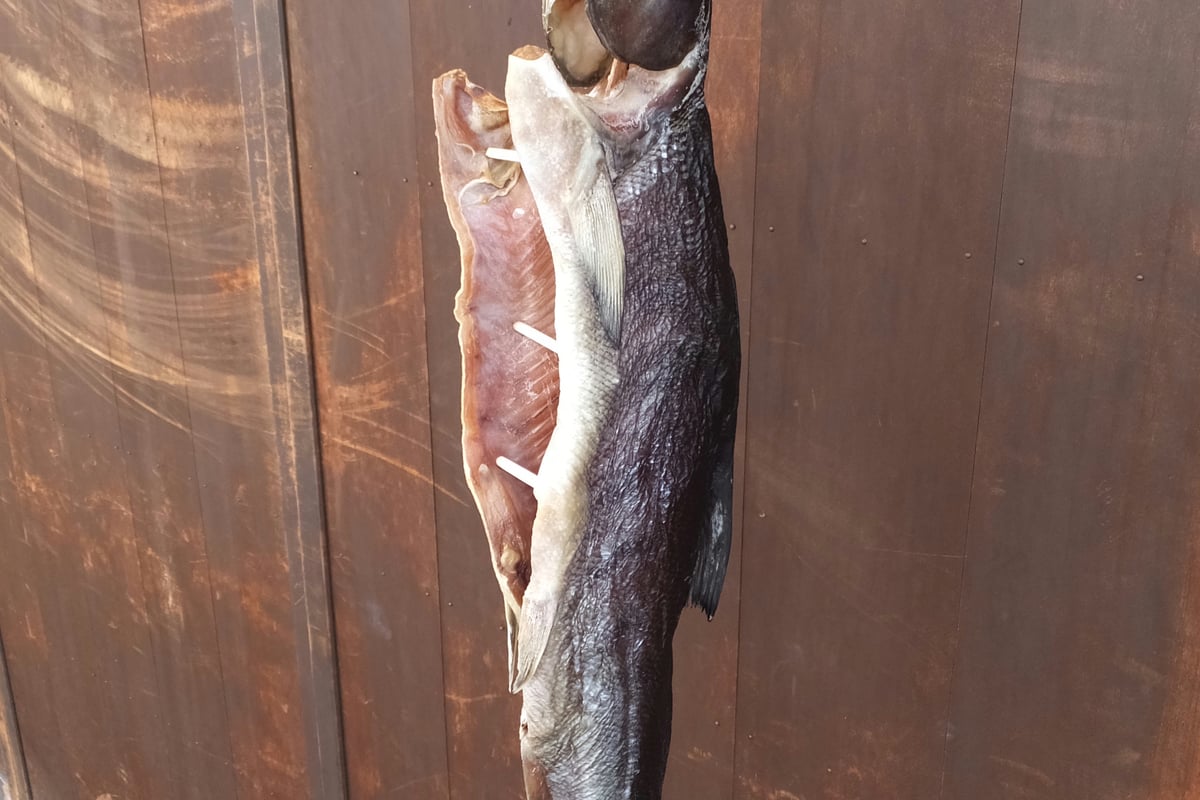
Shiobiki-zake (salt-cured salmon)
Murakami Shiobiki-zake
Shiobiki-zake is a processed salmon product handed down in Murakami City, Niigata Prefecture, made by rubbing salt into salmon caught in autumn and drying it in the cold wind. In Murakami, salmon is called 'iyoboya' in the local dialect, and the city has been closely tied to salmon since ancient times — salmon from the Miomote River is said to have been presented to the imperial court in the capital as early as the Heian period. In the Edo period, Aoto Buheiji, a samurai of the Murakami domain, focused on salmon's homing instinct and succeeded in what is regarded as the world's first natural hatching and propagation of salmon. In the castle town of Murakami, where seppuku (ritual disembowelment) was abhorred, a unique method of cutting called tomebara, in which the belly is split while leaving part of it connected, is still practiced today. From late autumn to early winter, the moist wind blowing in from the Sea of Japan slowly dries the flesh, producing a tender, mellow umami. In Murakami, it is an indispensable year-end fish (toshitori-zakana) for New Year's Eve. Some long-established shops in the city hang large numbers of salmon from their ceilings, conveying the culture of this salmon town to the present day.
Wappa-meshi (Rice Steamed in a Bentwood Container)
Wappa-meshi (Rice steamed in a bentwood container)
Wappa-meshi is a local dish made by packing dashi-cooked rice into a round 'wappa' container of bent cedar or cypress wood, topping it with ingredients such as seafood or mountain vegetables, and steaming it in a wooden steamer. In Fukushima Prefecture, Aizuwakamatsu City is widely known as its birthplace, while in Iwaki City, on the Pacific coast, a version of Wappa-meshi generously topped with fresh local seafood known as Joban-mono is served to tourists and loved as a local dish for enjoying the bounty of the sea. The wooden container absorbs excess steam, keeping the rice fluffy rather than sticky, and combined with its colorful appearance, it is popular both as a meal for special occasions and as a souvenir. Even within the same name 'Wappa-meshi,' the mountain vegetables and mushrooms that take center stage in Aizu and the sea urchin, surf clams, and local fish that take center stage in Iwaki show a different character in each region — a depth that is part of the richness of Fukushima's Wappa-meshi culture.
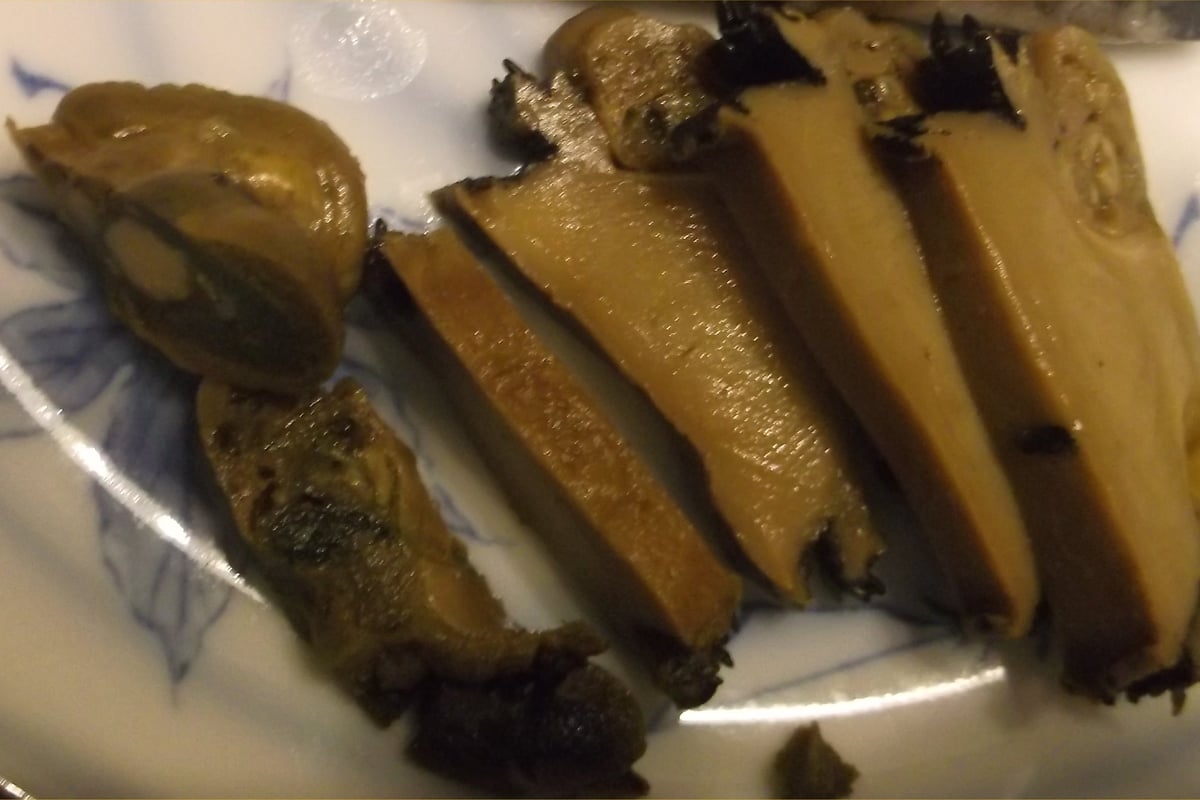
Awabi no Nigai (Soy-Simmered Abalone)
Awabi no Nigai (Simmered Abalone)
Awabi no Nigai is a specialty of Yamanashi Prefecture in which abalone is simmered in soy sauce and then steeped in the simmering liquid to absorb its flavor. It is known as a processed seafood product born in landlocked Koshu (Kai Province). According to tradition, it began in the Edo period when abalone landed at Numazu on Suruga Bay was packed into barrels with soy sauce, loaded onto horseback, and carried over mountain passes. During the long journey the soy sauce soaked in just right, and by the time it reached Kai it had reached the perfect flavor. It was praised by the samurai serving at Kofu Castle and eventually became known in Edo as well. There is also a story that Takeda Shingen used it as field rations, but this is only one of several theories. Today, some long-established makers use domestic black abalone and finish it with the liver still attached. The classic way to enjoy it is sliced thin like sashimi, and it is prized for celebrations such as New Year and weddings and as a gift.
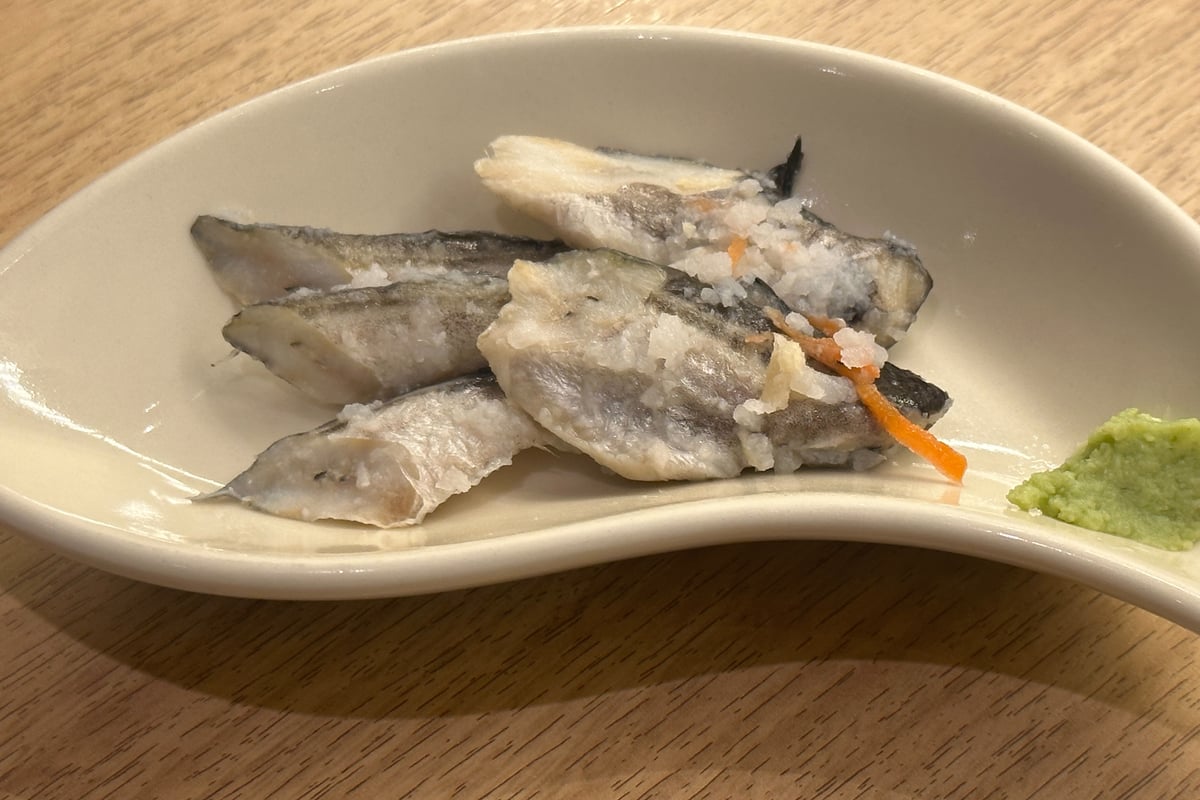
Hatahata-zushi
Hatahata-zushi
Hatahata-zushi is a signature narezushi (fermented sushi) of Akita Prefecture, made by layering hatahata (Japanese sandfish) — Akita's official prefectural fish — with rice, rice malt (koji), and vegetables in a wooden barrel and allowing the mixture to undergo lactic fermentation. Salted hatahata are desalted, then layered in a barrel in alternating layers with koji-mixed rice, vegetables such as carrot, and kelp, weighted down with a heavy stone, and left to ferment slowly for about three to four weeks. Hatahata is said to have earned the name 'hatahata-gami,' after an old word evoking thunder, because it appears in great schools along the coast during its spawning season, when thunder often rumbles over the sea. In Akita, the fish is so deeply woven into daily life that people traditionally say 'the New Year cannot be welcomed without hatahata.' The dish's flavor — the sweetness of koji blended with the tang of fermentation and the umami of the fish — remains an indispensable part of the New Year's Eve and New Year's holiday feast to this day.
Hokki-meshi (Surf clam rice)
Hokki-meshi (Surf clam rice)
Hokki-meshi is a rice dish cooked with large, richly sweet surf clams (hokkigai) landed at Matsukawa-ura (lagoon) in Soma City, Fukushima Prefecture. The waters off Soma and Futaba are mineral-rich fishing grounds where surf clam fishing has flourished since the Meiji era. The dish combines Soma's high-quality rice—the area is also known as a rice-growing region—with locally caught surf clams, and is said to have originally been enjoyed as a quick 'fisherman's meal' eaten aboard boats between hauls by busy fishermen. The rice, fragrant from soaking up the clams' umami, offers the sweetness and crunchy texture of the clams, and is served at eateries and direct-sale market cafeterias around Matsukawa-ura. As a dish that makes the most of the bounty of Matsukawa-ura, Fukushima's only lagoon, it has become a staple menu item for welcoming visitors locally, and quite a few restaurants serve it as a seasonal offering.
Kodai no Sasazuke (Vinegar-cured Small Sea Bream)
Kodai no Sasazuke
Kodai no Sasazuke is a specialty of Obama City, Fukui Prefecture, in which small sea bream caught in Wakasa Bay are filleted in the three-piece style (sanmai oroshi), lightly cured with salt and vinegar, and packed into small cedar kegs. The main raw material is a small form of yellowback sea bream (kidai) known as 'renkodai'. Scales and fine bones are carefully removed from sea bream about 10 cm long, and the fillets are lightly salted and then marinated in vinegar or seasoned vinegar. After being packed into the keg, the fish is finished with bamboo grass leaves (sasa). The skin glows a vivid pink and the flesh is a translucent white or pale amber, so its beauty is part of the appeal. The method is said to have been established in Obama during the Meiji era, and it developed through the town's ties with Kyoto, a major center of consumption. In 2017 (Heisei 29), it was registered under the national Geographical Indication (GI) protection system as 'Wakasa Obama Kodai Sasazuke'. Today, the Obama Sasazuke Association, a cooperative of manufacturers in Obama City, preserves and passes on the traditional flavor.
Koi no Umani (Simmered Carp)
Koi no Umani
Koi no Umani is a local dish from the Oitama region of inland Yamagata Prefecture, centered on Yonezawa City, in which carp is sliced into rounds and simmered until sweet and savory in soy sauce, sugar, and sake. In the inland Oitama region, far from the sea and short on seafood, freshwater carp has long served as a valuable source of protein. It is said that the foundation of this food culture, which continues today, was laid in the late Edo period when Uesugi Yozan, the 9th lord of the Yonezawa Domain, encouraged carp farming. After the Russo-Japanese War, sugar became easier to obtain, and the sweet-savory seasoning used today is said to have taken hold from that time. The carp is simmered until even the bones turn soft, and aside from the gallbladder, virtually the whole fish, from head to tail, can be eaten. It is an essential dish for celebratory occasions such as New Year, Obon, and weddings, prized as a lucky food because the Japanese word for carp, 'koi,' echoes the word 'koi,' meaning 'come.' Even today, 'Yonezawa Koi' carp raised around Yonezawa City is protected as a regional brand alongside Yonezawa beef and Tateyama apples.
Lake Hamana Eel
Hamanako Unagi (Lake Hamana Eel)
Lake Hamana Eel is a specialty farmed around Lake Hamana in western Shizuoka Prefecture and enjoyed throughout the Hamamatsu City area as kabayaki and other dishes. Lake Hamana is considered the birthplace of eel farming in Japan. It is said to have begun in 1900 (Meiji 33), when 服部倉治郎, a river-fish merchant who had been researching eel farming in Tokyo, judged Lake Hamana to be a suitable site and built eel-farming ponds there. Glass eels (shirasu-unagi), the young eels, were caught in the area, and the region was also blessed with a mild climate and abundant groundwater, so it developed into a major production area. Eels from Lake Hamana are prized for their rich fat and soft, plump flesh. In July 2026 (Reiwa 8), 'Hamanako Unagi' was registered under the Geographical Indication (GI) protection system. In downtown Hamamatsu and around Kanzanji Onsen, there are many eel restaurants, including long-established shops founded in the Meiji era. Besides unaju and unadon, you can also enjoy shirayaki, eel grilled without sauce.
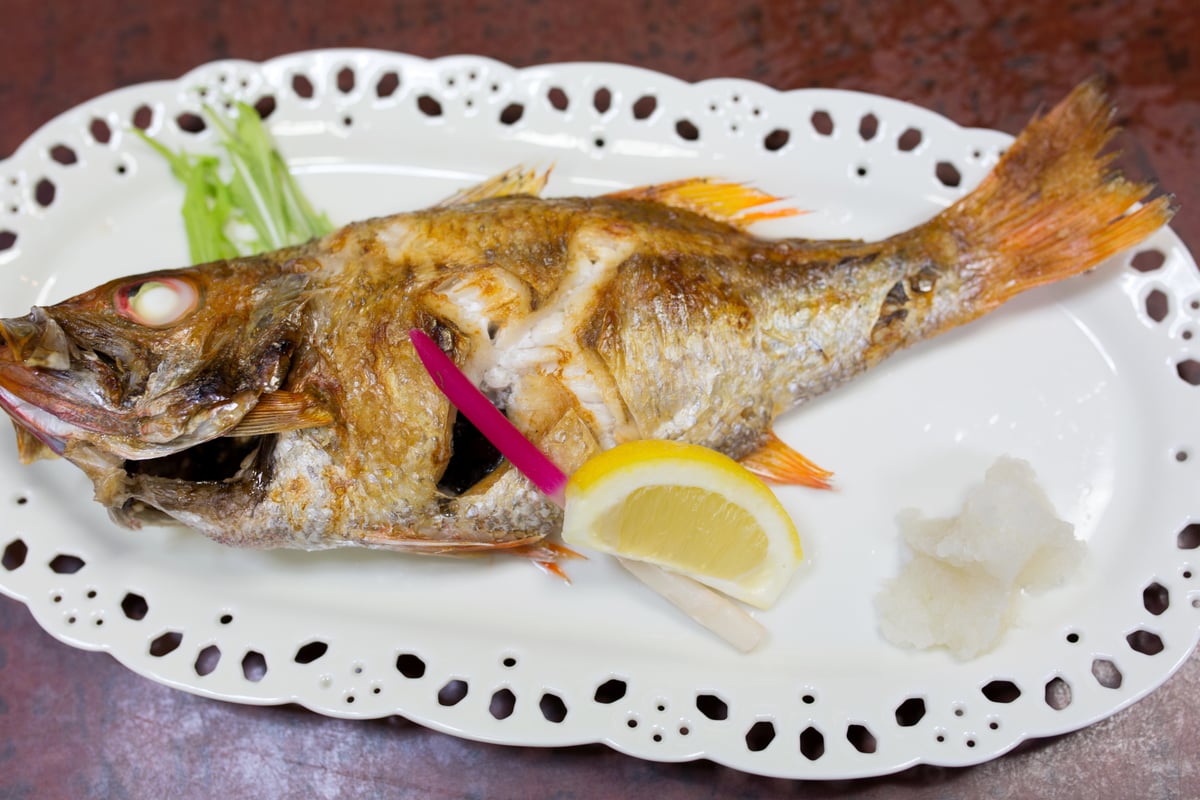
Nodoguro Dishes
Nodoguro ryori
Nodoguro dishes showcase 'nodoguro,' a prized fish landed in the waters off Kanazawa, Ishikawa Prefecture, prepared in a variety of ways including salt-grilling, sashimi, shabu-shabu, and rice cooked in a small pot. Its official Japanese name is akamutsu, but it is popularly known as 'nodoguro' (literally 'black throat') because the back of its mouth appears black when opened. Despite being a white-fleshed fish, it carries rich fat, earning it the nickname 'the toro of white fish,' and in Kanazawa it has long been regarded as an auspicious fish served on occasions such as New Year's and memorial services. Once a familiar fish that appeared on ordinary dinner tables along the Sea of Japan coast, it gained nationwide popularity after being featured on television, and in recent years its price has risen, making it a premium fish today. Restaurants around Omicho Market offer a variety of specialty preparations, including rice cooked in a small pot with a whole nodoguro and elaborate kaiseki courses.
Okyuto
Okyuto
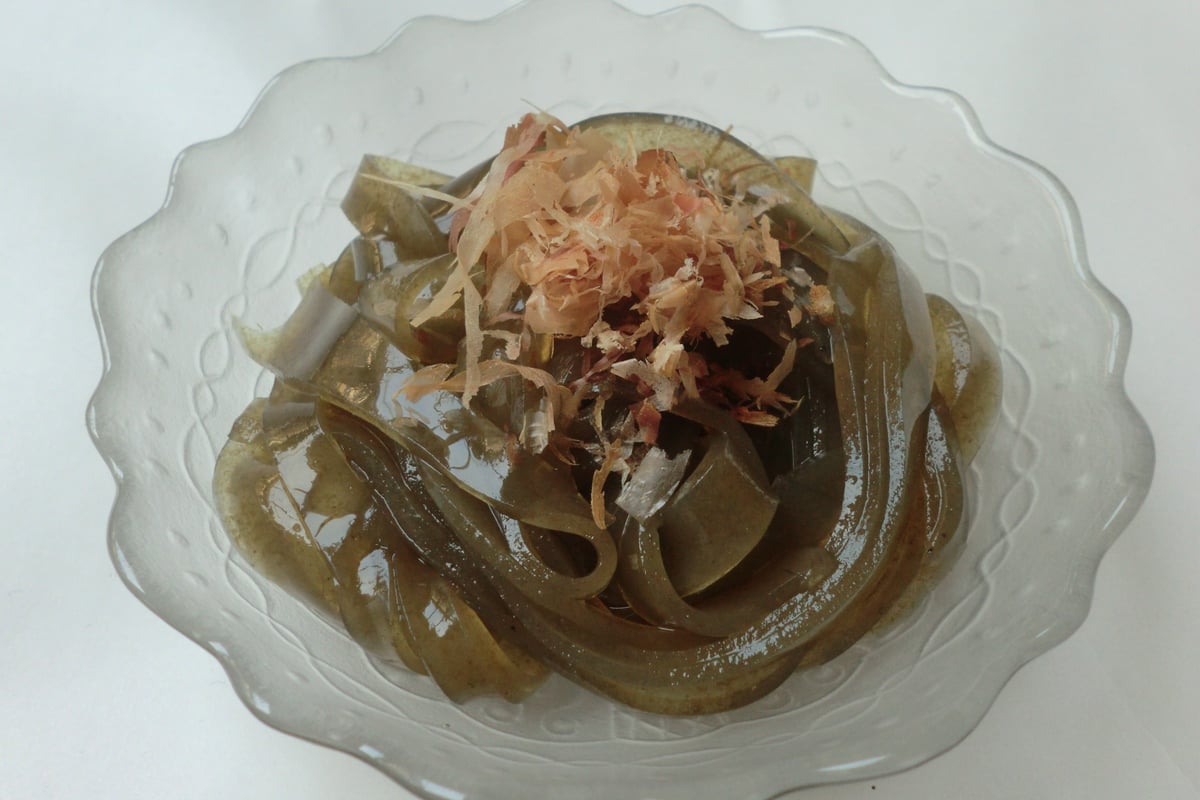
Okyuto is a local dish, made mainly in Fukuoka City, in which egonori seaweed is boiled down and set into a jelly-like block. Cherished since the Edo period as an essential part of Hakata's breakfast table, it was once sold every morning before the war by peddlers carrying baskets on shoulder poles, known as 'okyuto sellers.' It has a distinctive springy texture and a subtle seaweed aroma, and is typically topped with ginger, bonito flakes, or chopped scallions, then eaten with soy sauce or vinegared soy sauce. Because it is low in calories and rich in dietary fiber, it has recently drawn attention as a diet food, and can be found easily at convenience stores and supermarkets. It is also served in school lunches, making it a dish that symbolizes Fukuoka's food culture as it is passed down to younger generations.
Sasa-zushi (Bamboo-Leaf Sushi)
Sasa-zushi
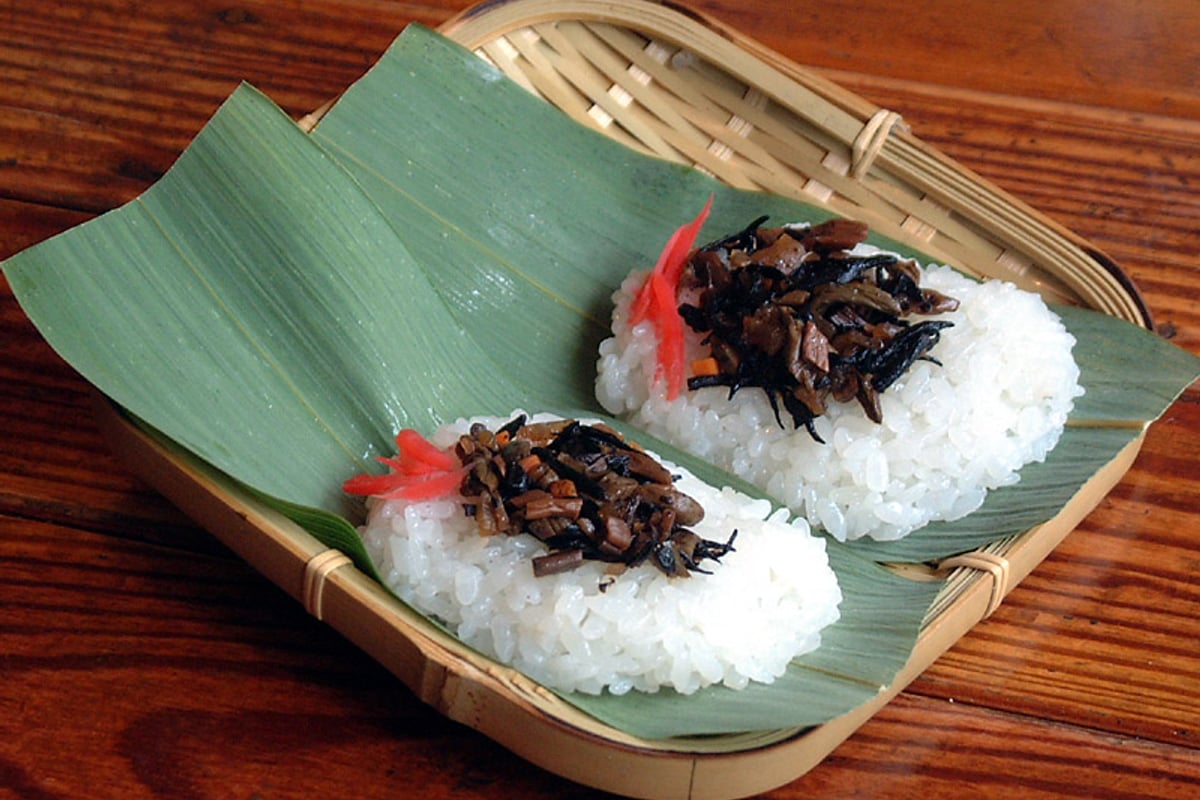
Sasa-zushi is a local dish of the Joetsu region of Niigata Prefecture in which bite-sized portions of vinegared rice are placed on kumazasa (Sasa veitchii) bamboo-grass leaves and colorfully topped with ingredients such as mountain vegetables, shredded thin omelet (kinshi tamago), and flaked salmon (soboro). It is made mainly in Myoko City, Joetsu City, and Itoigawa City, and Sasa-zushi of the same lineage is also handed down in the Hokushin area of northern Nagano Prefecture. Because the leaves are folded into the shape of a mi (winnowing basket), a farming tool, to hold the rice, some areas of the Joetsu region call it 'mizushi.' As for its birth, there is a story that Uesugi Kenshin's troops in the Sengoku (Warring States) period used sasa leaves in place of dishes to serve rice in the mountains, and another that it was presented to Kenshin on his way to the Battles of Kawanakajima. However, both are handed down as legends. Sasa leaves are said to have antiseptic properties, and because it can be easily picked up and eaten by hand, it has been passed down as a feast for special occasions such as Obon and festivals. Today it is also sold at sushi restaurants, farm produce stands, and tourist facilities.
Mozuku (Okinawan Seaweed)
Mozuku
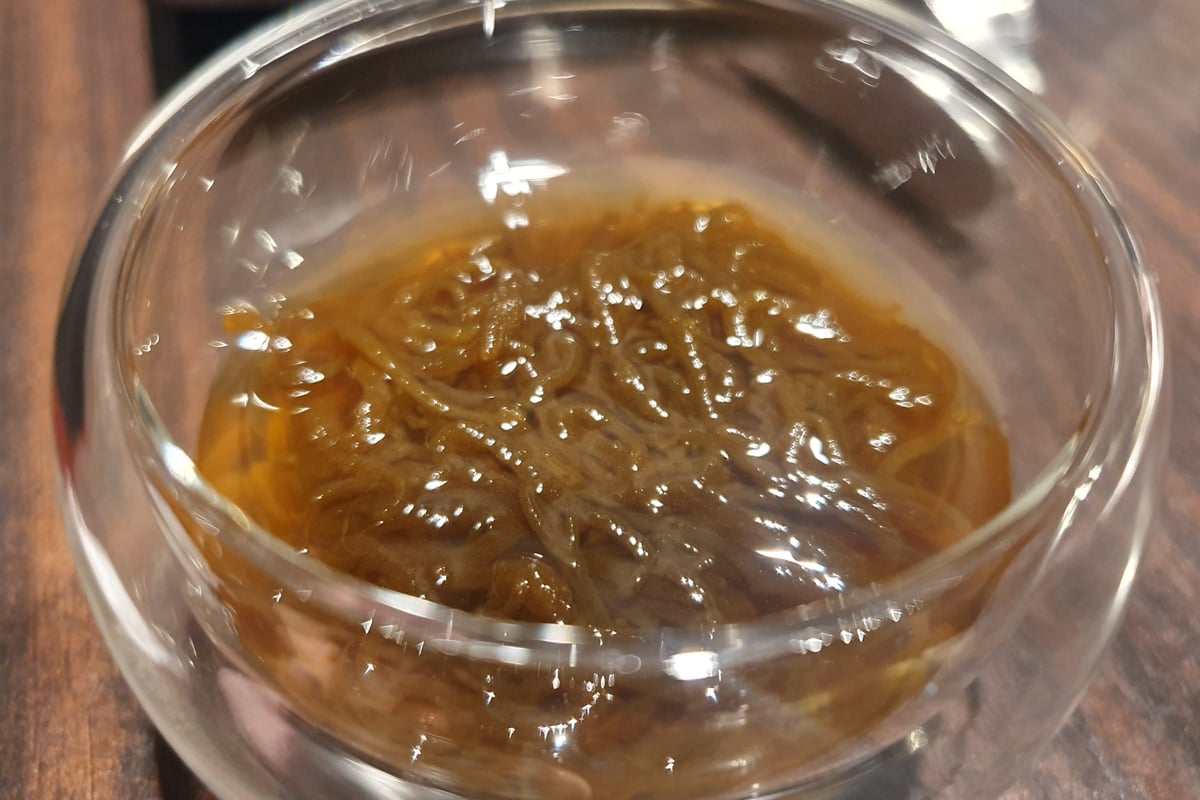
Mozuku is a thin, thread-like brown seaweed that grows in the waters around Okinawa, used in a wide range of dishes such as vinegared salads, tempura, and soups — one of Okinawa's signature seaweed ingredients. In particular, 'Okinawa mozuku,' the variety cultivated in Okinawa, is said to take its name from its habit of growing attached to other seaweed (the Japanese word mozuku literally meaning 'to attach to seaweed'), and it is known for its firm, springy bite and smooth texture. Full-scale technology for farming mozuku in Okinawa Prefecture began development in the 1970s, and after the first successful harvest of farmed mozuku in 1977, production spread to fishing cooperatives across the prefecture. Today, Okinawa Prefecture accounts for more than 99% of Japan's total mozuku production, making it the country's leading production area by far. Beyond vinegared salads, dishes such as mozuku don (mozuku simmered with egg or stir-fried and served over rice) have been served in school lunches and are cherished by locals, and it is now firmly established as a household dish as well.
Nagara River Ayu Dishes
Nagaragawa Ayu Ryori
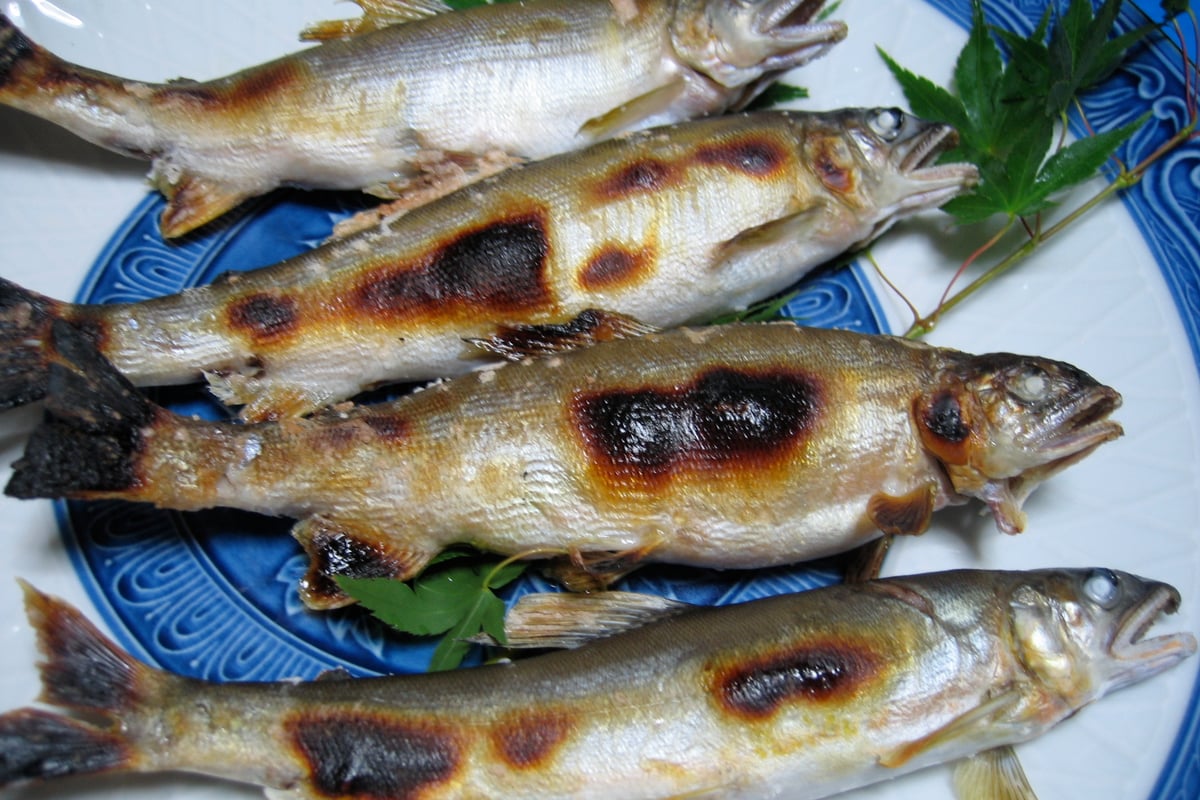
Nagara River Ayu Dishes are a local specialty of Gifu City featuring wild ayu (sweetfish) caught in the clear Nagara River, served grilled with salt, as sashimi, or as narezushi (fermented sushi). Cormorant fishing (ukai), with roughly 1,300 years of history, is still practiced on the Nagara River today; because the ayu caught in the cormorants' beaks are killed instantly, their flesh stays firm with remarkable freshness, and they have long been prized as a top-quality delicacy. Historical records show people engaged in cormorant fishing as early as 702 (Taiho 2) in the Nara period, and the Heian-period dictionary Wamyō Ruijushō notes that Mino Province (present-day Gifu City) had a village called Ukai-no-sato (cormorant fishers' village). Oda Nobunaga protected the cormorant fishers, and Tokugawa Ieyasu is said to have had ayu-zushi made in Gifu carried all the way to Edo. Today, restaurants and inns specializing in ayu cuisine still line the banks of the Nagara River, drawing many visitors during the cormorant fishing season from May to October.
Namazu Ryori (Catfish Cuisine)
Namazu Ryori (Catfish Cuisine)
Namazu ryori is a local specialty of the water-rich lowlands of eastern Saitama Prefecture, between the Arakawa and Edogawa rivers, made with the freshwater fish namazu (catfish). Yoshikawa City in particular is known as the 'hometown of namazu,' and a variety of preparations have been passed down there, including tempura, kabayaki (grilled and glazed), and 'tataki,' in which the flesh is minced, mixed with miso, and deep-fried. Yoshikawa prospered through river transport on the Nakagawa and Edogawa rivers connecting it to Edo, and river-fish merchants gathered there, making namazu, alongside eel, a local specialty so celebrated that people used to say, 'Don't leave Yoshikawa without eating catfish and eel.' In the Kitakawabe district of Kazo City as well, catfish tempura and other dishes rooted in the river-fish food culture of the Tone River basin remain popular, and can now be enjoyed at the dining hall of a roadside station. Known for its white, delicate flesh and distinctive texture, namazu ryori requires skillful preparation and is a Saitama delicacy typically finished by the hands of specialist river-fish restaurants.
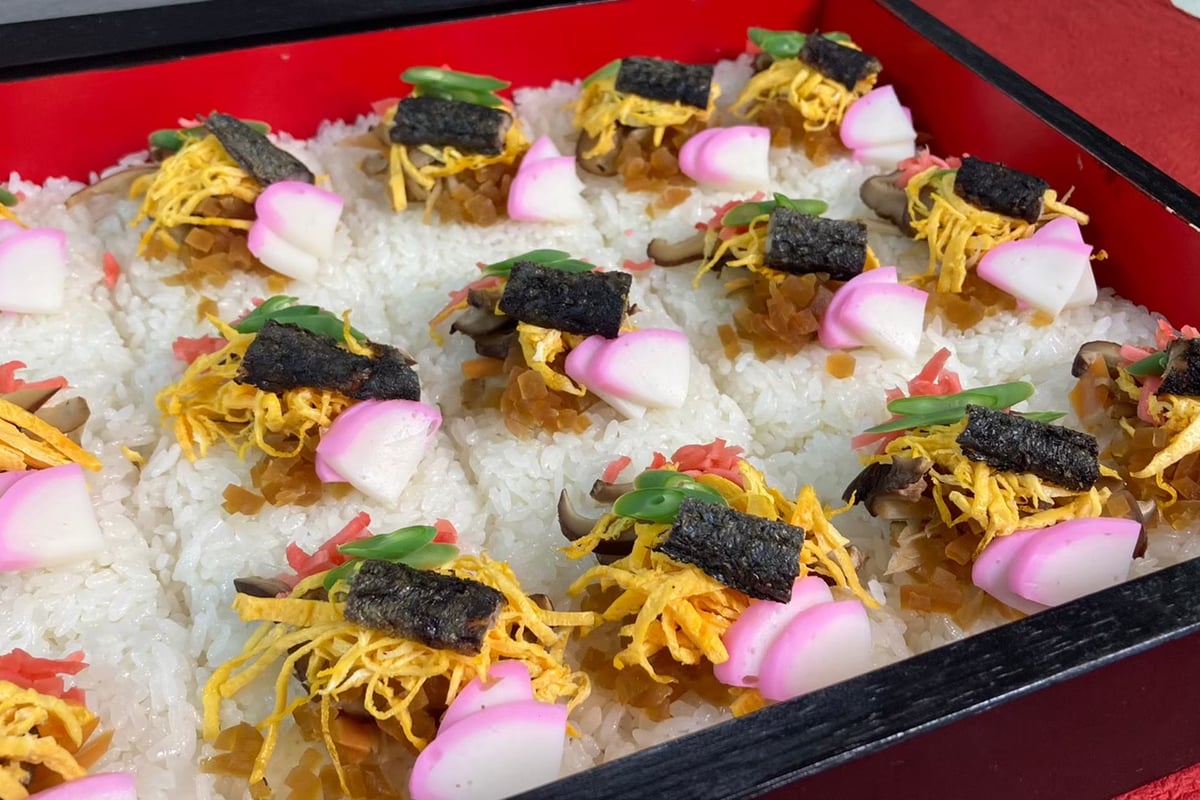
Sukozushi (Suko-Style Box Sushi)
Sukozushi
Sukozushi is a box-style sushi that has been passed down for about 500 years in the Suko area of Shiroishi Town, Saga Prefecture. Vinegared rice is packed into a shallow wooden box called a 'morofuta,' and topped colorfully with ingredients such as kabayaki-style grilled mudskipper (mutsugoro), shiitake mushrooms, burdock root, narazuke pickles, red pickled ginger, and thin shredded egg crepe (kinshi tamago). It is said to have originated when the local lord of Suko worked hard to improve the quality of rice for the farmers, and in gratitude the villagers made sushi using the bounty of the sea and mountains and presented it to him. Since then, the recipe has been handed down from mother to child and from child to grandchild, and it has been cherished as a dish for festivals, celebrations, temple visits, and for welcoming daughters home for a visit. In recent years mudskipper has become harder to obtain, so shrimp or gizzard shad (konoshiro) are sometimes used instead, but the dish is treasured as a local heritage, and efforts to pass it on continue, including through school cooking classes.
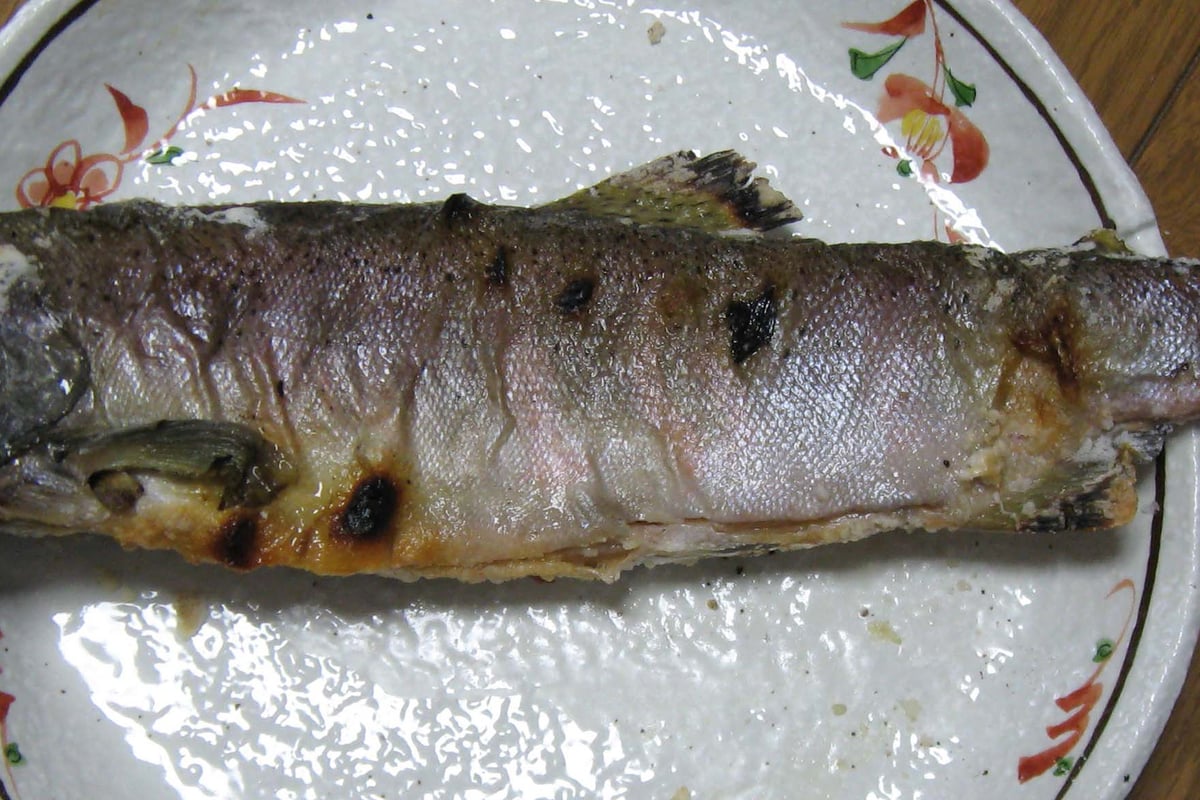
Biwamasu Ryori (Lake Biwa Trout Cuisine)
Biwamasu Ryori
Biwamasu (Lake Biwa trout) is a species of salmon endemic to Lake Biwa, a rare fish that spends its entire life in fresh water without ever descending to the sea. It is enjoyed prepared in many ways — as sashimi, salt-grilled, in nanban-zuke (vinegar-marinated fried fish), or as vinegared dishes — and its defining trait is the high-quality richness of its fat, which has earned it the nickname 'jewel of Lake Biwa.' Its season runs from around June to early September, with the fat content peaking from early summer to summer as it prepares to spawn, and locally it is most often eaten as sashimi. From October to November, its spawning season, fishing is banned to protect the resource, making it a rare lake fish available only during a limited period and drawing strong popularity both within and outside the prefecture. Local ways of preparing it are also passed down, including 'kokera-zushi,' traditional to the former Minamihama district of Biwa Town, and 'ameno-io gohan,' a rice dish cooked with the fish.
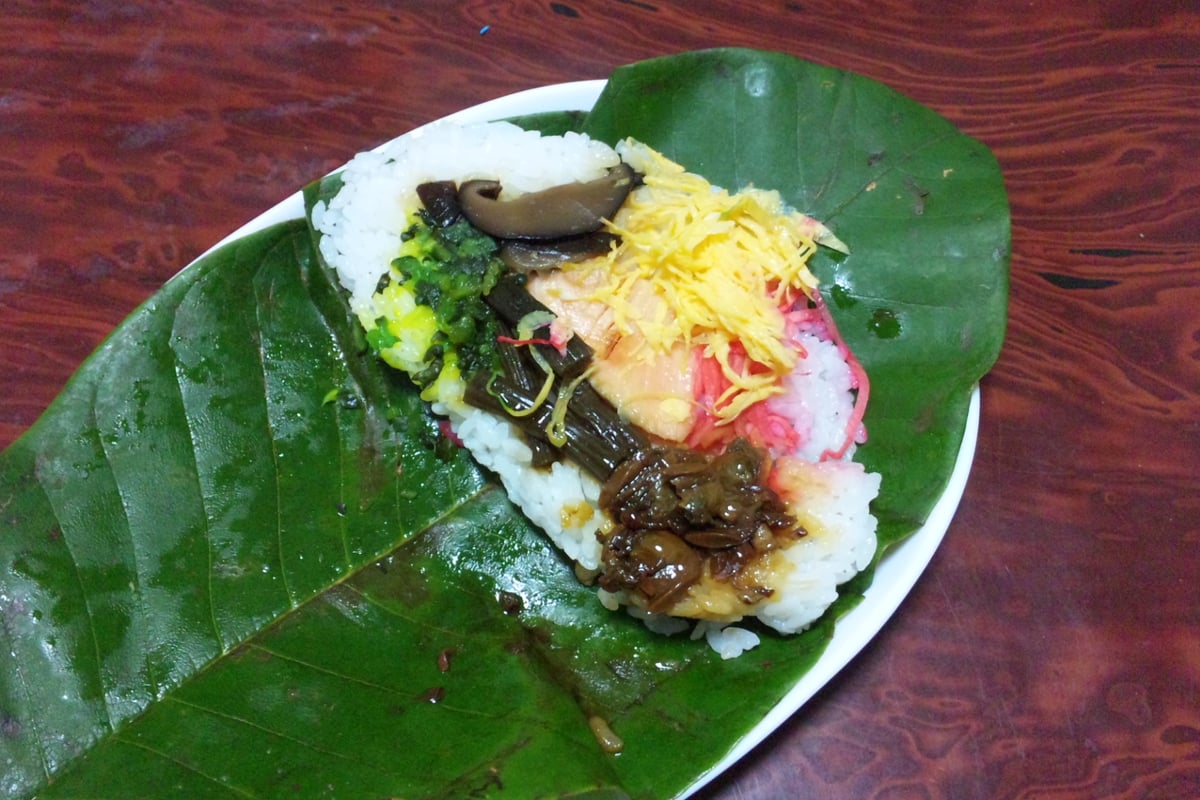
Hoba Zushi
Hoba Zushi
Hoba Zushi is an early-summer local dish from the southern Hida region through the Tono and Chuno regions, in which vinegared rice and toppings are wrapped in the large leaves of the hoba (magnolia) tree. Because hoba leaves have antibacterial and antifungal properties, the food inside resists spoiling, and the leaf can also double as a plate — making it a practical meal to carry along during rice-planting and other farm or forestry work. Preparation varies by area: in the Tono region, many households pile on seven or eight colorful toppings, such as river fish simmered in sweet soy sauce, vinegared mackerel, thin egg strips, and red pickled ginger, while in the Hida region a simpler style using just myoga (Japanese ginger) and vinegared rice is also common. It is typically made from mid-May to late June, when hoba leaves are in season, and is also enjoyed as a festive dish for local matsuri and celebrations.
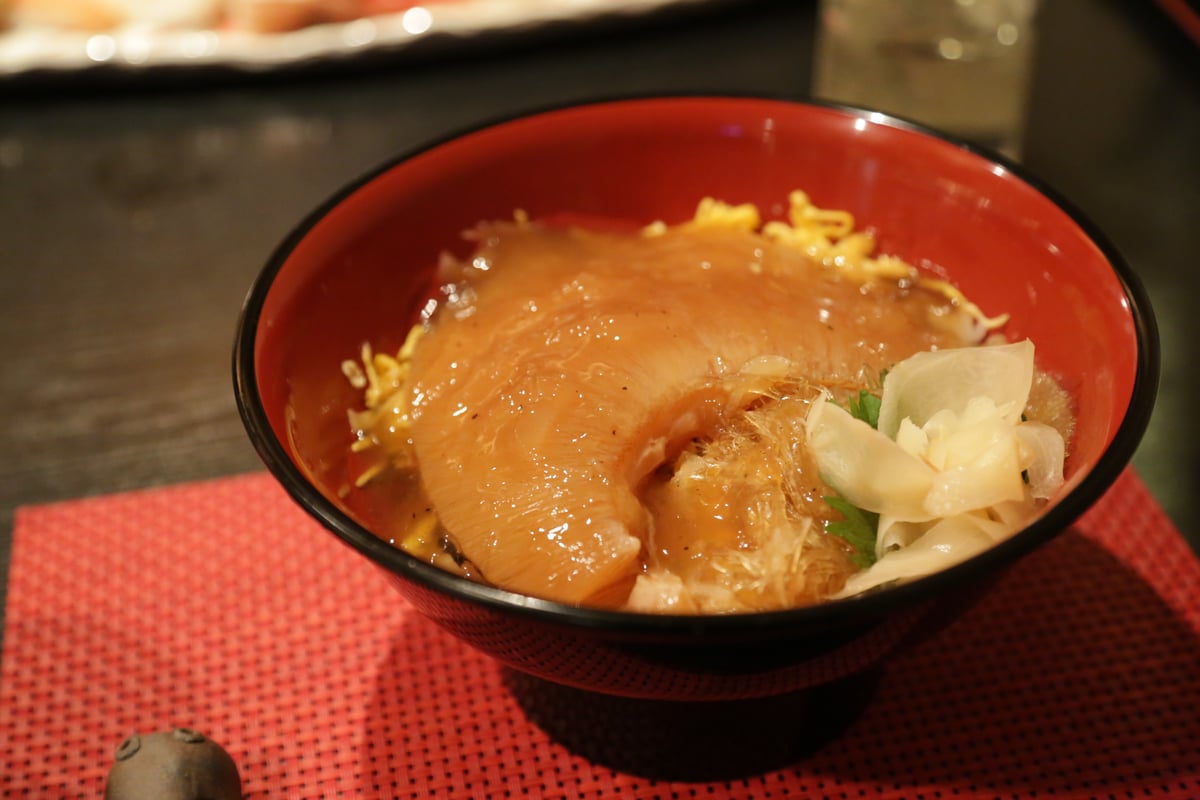
Kesennuma Shark Fin Cuisine
Kesennuma Shark Fin Cuisine
Kesennuma boasts Japan's largest shark landings, thanks to the rich fishing grounds off the Sanriku coast, with roughly 90% of the sharks landed nationwide gathering at Kesennuma Port — earning it recognition as 'Japan's top shark fin producing town.' The origins of shark fin processing trace back to the late Edo period, when a fur merchant in the city is said to have noticed that shark fins could be sold profitably in Yokohama and begun manufacturing and selling them. During the Meiji era, a processing industry developed that used shark meat as a raw material for fish-paste products such as chikuwa and kamaboko, and the fins themselves were initially treated as a byproduct known simply as 'samehire.' It was not until the latter half of the Showa 50s (late 1970s to early 1980s) that Kesennuma's shark fin gained recognition as a nationally known brand, spurred by the spread of mail-order sales. The blue shark is the main species used, with the dorsal, pectoral, tail, and pelvic fins all processed without waste, and the sight of fins being sun-dried has become a familiar winter scene in Kesennuma. Beyond braised whole fins, the dish is also enjoyed in local specialties such as shark fin rice bowls and shark fin sushi.
Saku Carp
Saku Koi (Saku Carp)
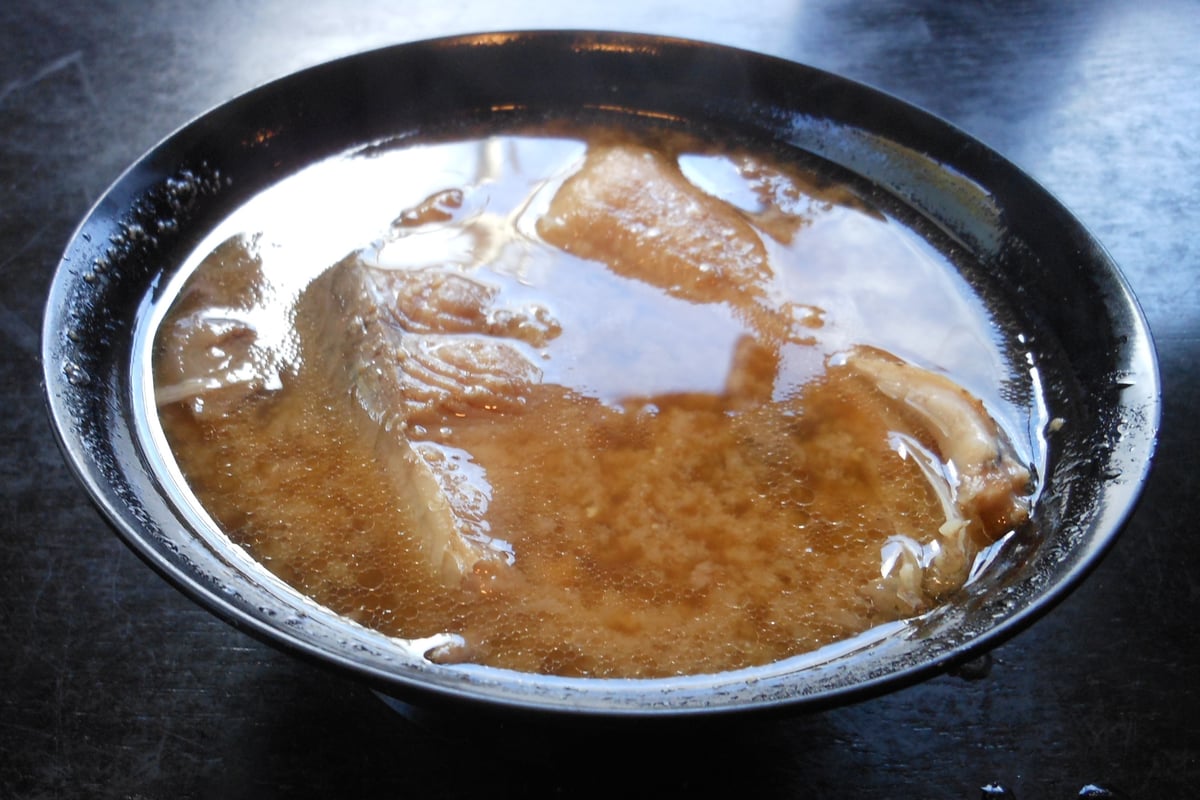
Saku Carp (Saku-goi) refers both to the edible carp raised in the Saku area of eastern Nagano Prefecture and to the local carp dishes made with them. It is said to have begun when a merchant from the Sakurai district of Saku City brought back 'Yodo-goi' (Yodo carp) from the Yodo River in Osaka during the Tenmei era of the Edo period. Because they are raised in the cold, clear water of the Chikuma River, the carp grow slowly and are shipped after about three years, longer than in other production areas. The flesh is firm with little odor and a moderate amount of fat. From the Meiji period onward, production increased through methods such as raising carp in rice paddies, and in the early Showa period the name was unified as 'Saku Carp.' Traditional ways of eating it include 'koikoku,' carp cut into round slices and simmered in miso; 'umani,' simmered in a sweet-savory sauce; and 'arai,' thin slices firmed up in cold water. It is still treasured by the people of Saku as a feast for New Year and celebrations.
Tenmusu (Shrimp Tempura Rice Ball)
Tenmusu
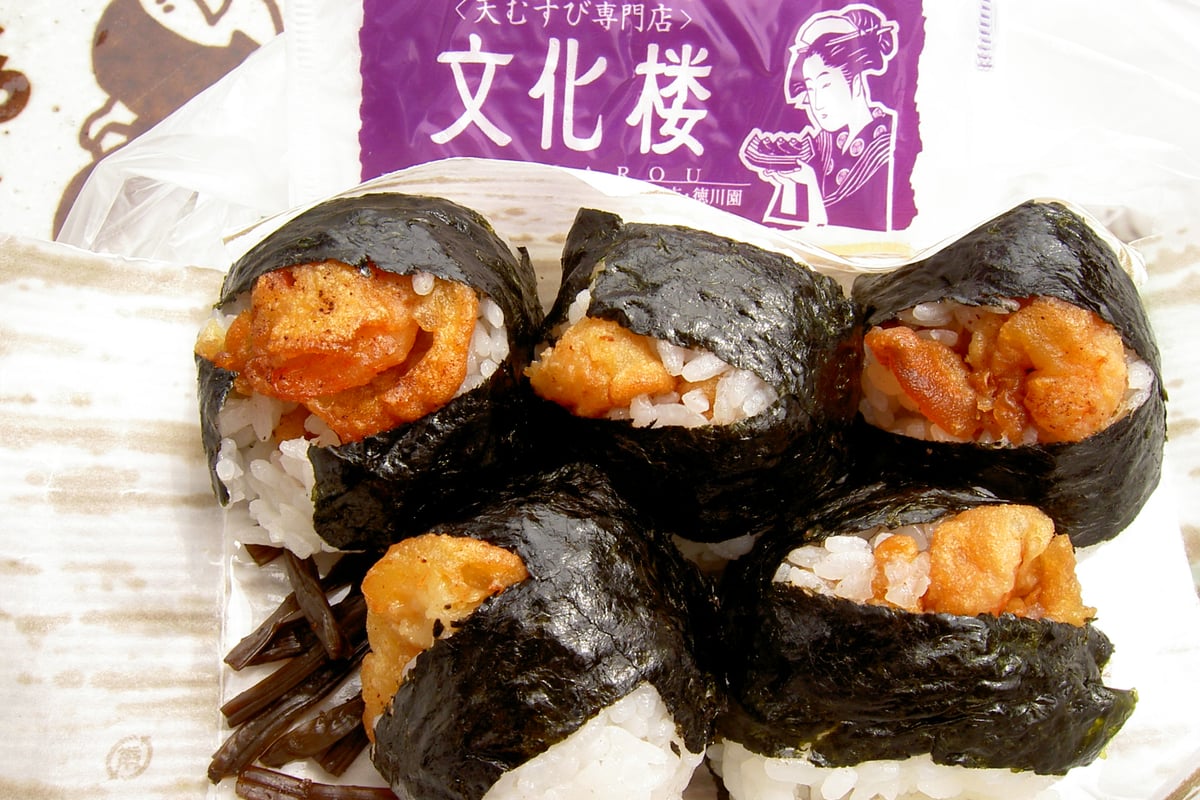
Tenmusu is a bite-sized rice ball built around a piece of small shrimp tempura, prized for the combination of tempura lightly seasoned with tentsuyu (tempura dipping sauce) or salt and fluffy steamed rice. It is said to have originated in Tsu City, Mie Prefecture, where Yone Mizutani, the founding proprietress of a tempura restaurant, began tucking kuruma prawn tempura into rice balls for her husband's busy workday lunches. Around 1980, a branch of the Tsu restaurant Senju opened in Osu, Nagoya, and word of mouth among celebrities and tourists spread, and before long the dish came to be known nationwide as a 'Nagoya specialty.' Easy to eat and just the right size for one or two bites, it is also popular as a souvenir and a light snack.
Umibudo (Sea Grapes)
Umibudo (Sea Grapes)
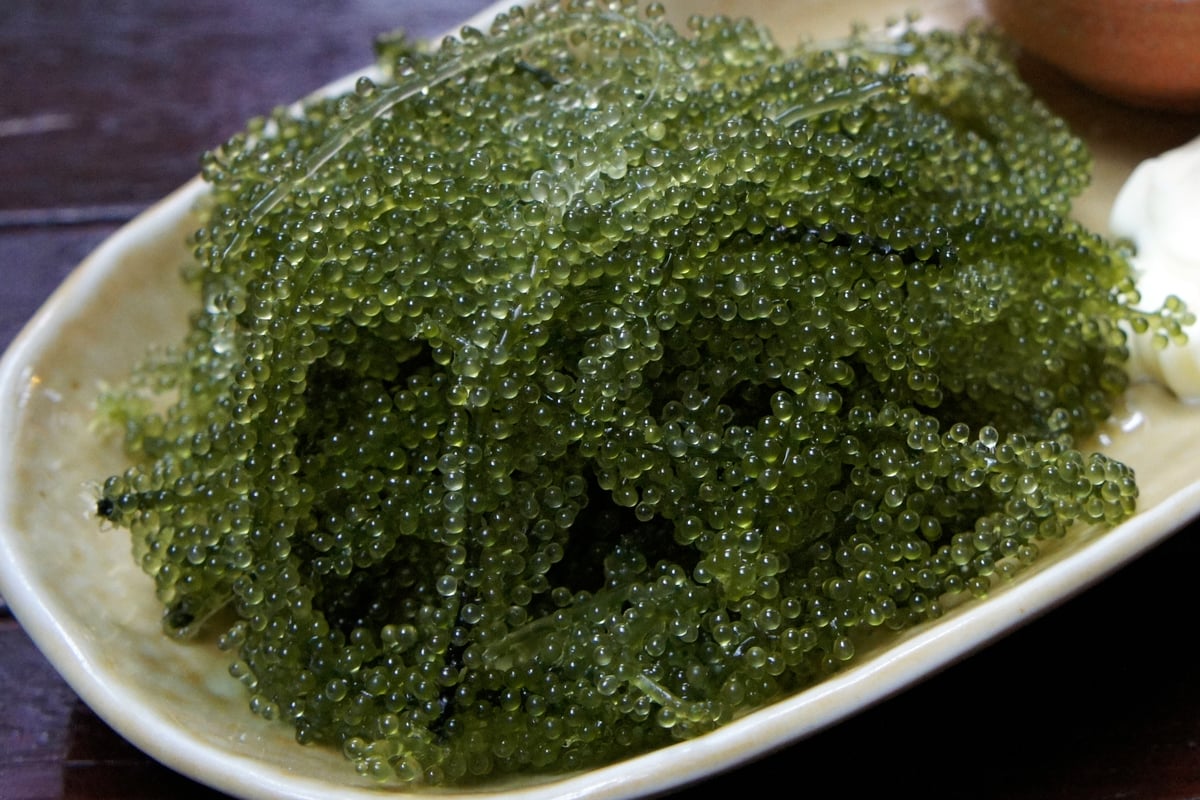
Umibudo (scientific name Caulerpa lentillifera) is a seaweed in which tiny green beads, about 1 to 2 millimeters across, cluster along a stem like a bunch of grapes — a signature Okinawan seafood prized for its popping texture and briny, ocean flavor. Around 1994, the Onna Village Fisheries Cooperative introduced land-based aquaculture techniques that had been under research at the Okinawa Prefectural Fisheries Experiment Station, achieving the prefecture's first full-scale success in farming umibudo. This breakthrough spurred the spread of farming across Okinawa's main island, and umibudo has since grown into one of Okinawa's leading farmed marine products, ranking after mozuku and kuruma prawns. It is enjoyed on its own with sanbaizu (a mixed vinegar sauce) or soy sauce, and also served over rice bowls or alongside sashimi, and it has won popularity among tourists under the nickname 'green caviar.' Because the beads shrivel once freshness is lost, careful temperature control after harvest is essential to preserving its quality and flavor.
Ebi-mame (Shrimp and Soybeans)
Ebi-mame
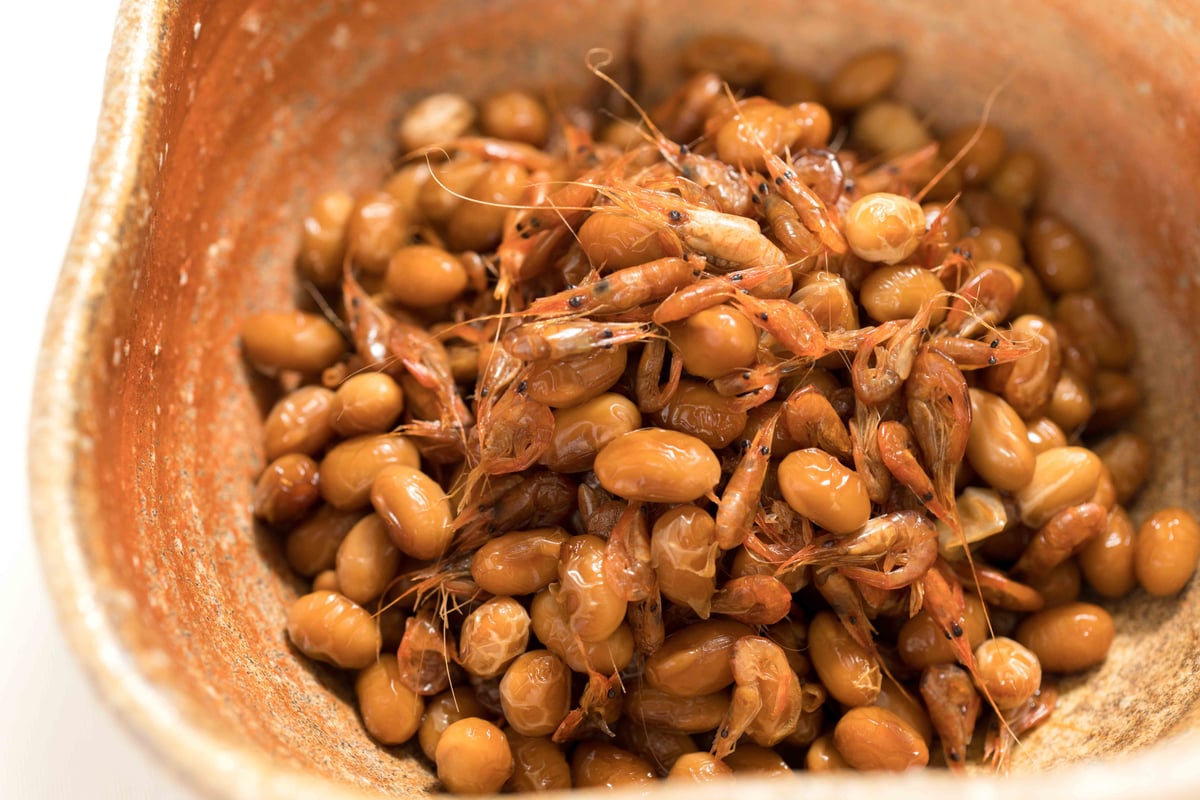
Ebi-mame is a local dish of Shiga Prefecture made by simmering small freshwater shrimp called suji-ebi, caught in Lake Biwa, together with soybeans in a sweet-savory broth. It has long been made in households throughout the prefecture, including in Omihachiman and Hikone, and is cherished as an easy way to take in calcium and protein. Soybeans and azuki beans have been cultivated on the ridges between rice paddies in Shiga Prefecture since ancient times, and dishes using soybeans have traditionally been served at celebratory gatherings such as weddings, memorial services, and festivals. The dish carries a wish for longevity — 'may we live diligently (mame) until our backs bend like a shrimp's' — and it is an essential dish for New Year and other festive occasions. It remains a beloved home-cooked dish today, sometimes even appearing in school lunches, with the flavor passed down from parent to child.
Echizen Uni (Salted Sea Urchin)
Echizen Uni (Salted Sea Urchin)
Echizen Uni is 'shio-uni' (salted sea urchin), made by salting and maturing the gonads of bafun sea urchins caught along the Echizen Coast of Fukui Prefecture. It is also written as 汐うに or 塩雲丹. In the Edo-period book Nihon Sankai Meisan Zue (Illustrated Famous Products of Japan's Mountains and Seas), it was praised as 'the finest of all shiokara (salted delicacies)'. Together with Mikawa's konowata and Hizen's karasumi, it is counted among Japan's three great delicacies (chinmi). The bafun sea urchin used as the raw material is a small urchin with a shell only a few centimeters across, and around 100 urchins are said to be needed to make 100 g of the product. The roe is firmed with salt to draw out moisture, kneaded into a paste, and then matured. Its hallmarks are rich umami, the aroma of the sea, and a smooth texture, and even a tiny amount delivers deep flavor. The current method is said to have been devised in the late Edo period by Tennoya (now Tentatsu), an official purveyor to the Fukui Domain. The catch of bafun sea urchins in the prefecture is very small, and it remains a precious delicacy that still relies on handwork.
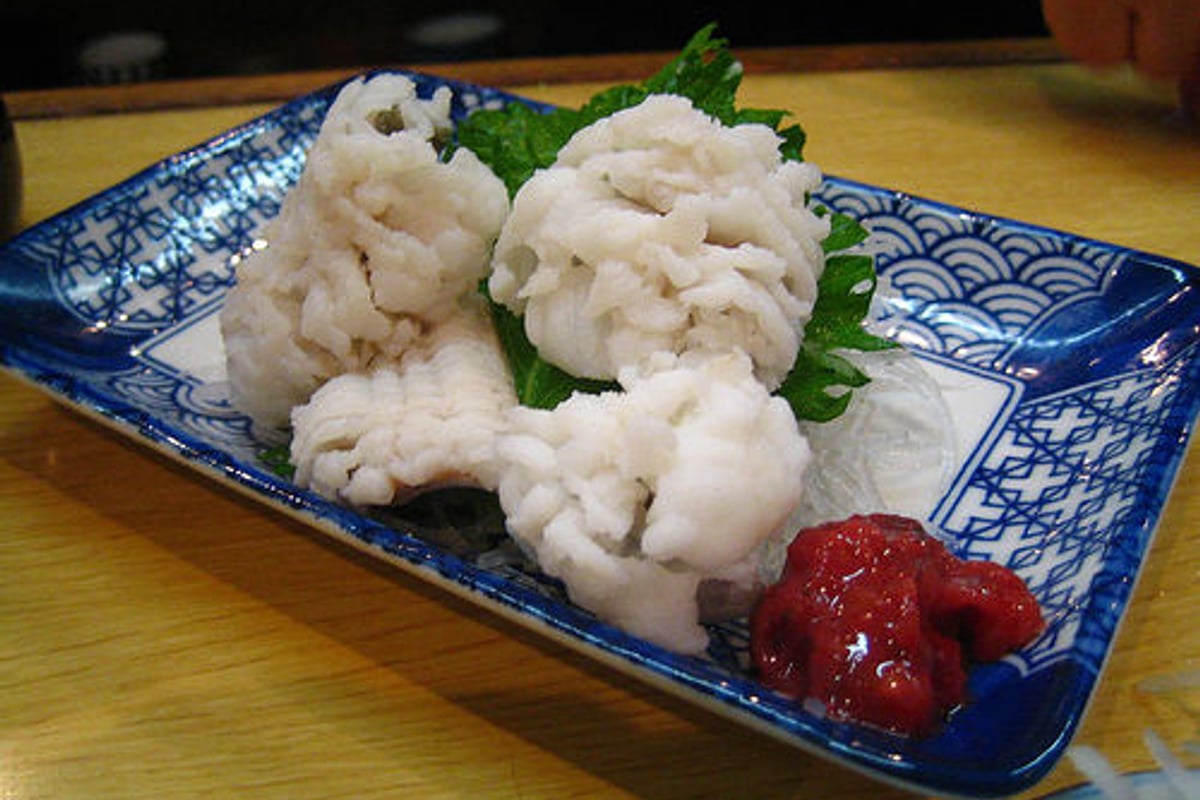
Hamo Ryori (Conger Pike Eel Cuisine)
Hamo Ryori
Hamo Ryori is a summer local dish of Kyoto in which conger pike eel (hamo), in season from the rainy season through midsummer, is prepared using the distinctive technique known as honekiri (bone-cutting). Even in landlocked Kyoto, hamo could be transported alive thanks to its strong vitality, making it a valued source of protein since the era before refrigeration existed. Because hamo has so many small bones that it cannot be eaten without honekiri, this technique developed into a symbol of a chef's skill, and in Kyoto it is said that "mastering honekiri makes a chef full-fledged," making it one of the most important stages of a chef's training. Preparations range widely, from hamo no otoshi — blanched hamo served with plum paste — to teriyaki, hamo shabu-shabu, and simmered dishes, and because hamo comes into season around the time of the Gion Festival, the festival is also nicknamed the "Hamo Festival," reflecting how indispensable this flavor is to a Kyoto summer.
Warasubo Dishes
Warasubo
Warasubo dishes are a Saga Prefecture specialty made from the warasubo, a rare fish found in Japan only in the Ariake Sea. A member of the goby family, the warasubo has degenerated eyes and an eel-like, elongated body with an upward-opening mouth lined with fang-like teeth, which has earned it the nickname 'Alien of the Ariake Sea' after a monster from the movies. It burrows into the soft mud of the tidal flats, and during its peak season from May to October it is served in miso soup, as sashimi, or simmered; at other times of year it is gutted, dried, and eaten deep-fried or lightly grilled. Despite its unusual looks, its white flesh carries a strong umami flavor and has long been a familiar local ingredient. In recent years, changes to the tidal flat environment such as the reclamation of Isahaya Bay have reduced catches, and the fish is now listed as Vulnerable on the Ministry of the Environment's Red List of Threatened Species.
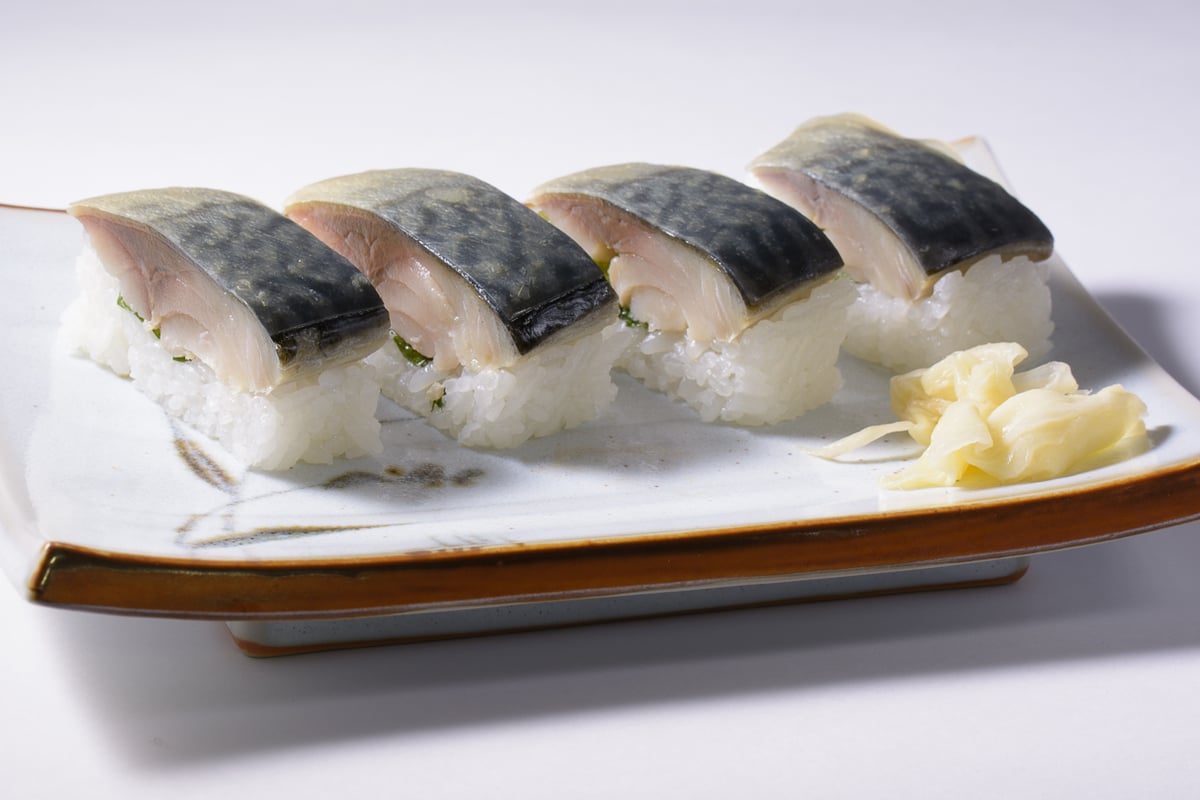
Kyo Sabazushi (Kyoto Mackerel Sushi)
Kyo Sabazushi
Kyo Sabazushi is a local sushi of Kyoto in which salt-cured mackerel is placed atop vinegared rice shaped into a bar and wrapped in kelp. It developed as a valuable opportunity to eat fresh seafood in landlocked Kyoto, and is said to have originated from mackerel caught in Wakasa Bay that was salted and carried on foot along the route known as the "Saba Kaido" (Mackerel Road) to Kyoto, becoming perfectly seasoned by the time it arrived. Even today, with refrigeration technology fully developed, the custom of eating it as a feast for "hare" (celebratory) occasions — including Kyoto's three great festivals, the Aoi Matsuri, Gion Matsuri, and Jidai Matsuri, as well as autumn festivals across the region — continues to be passed down, and it is cherished as a special dish served at home and at festival gatherings. There are two styles: "bo-zushi," pressed and shaped into a bar, and "sugata-zushi," which uses a whole mackerel as is, and each shop's individuality shows in how it is prepared.
Jako Sansho (Dried Baby Sardines with Sansho Pepper)
Jako Sansho
Jako Sansho is a tsukudani (food simmered in soy sauce) made by simmering chirimen-jako (boiled and dried baby anchovies) together with fresh sansho peppercorns in a sweet-savory mixture of soy sauce, mirin, and sake. It is one of the obanzai (everyday Kyoto home dishes) indispensable to a Kyoto table. Also known as "chirimen sansho," it has long been enjoyed as an accompaniment to rice, in ochazuke, and as a snack with sake. Originally made in individual households as something like a small gift to share with neighbors and visitors, it became widely known as a staple Kyoto souvenir after being commercialized in the mid-Showa era. Its distinctive appeal lies in the deep, layered flavor created by the sharp bite and refreshing aroma of the fresh sansho peppercorns balanced against the savory richness of the chirimen-jako, and part of the enjoyment is comparing the different blends offered by each shop.
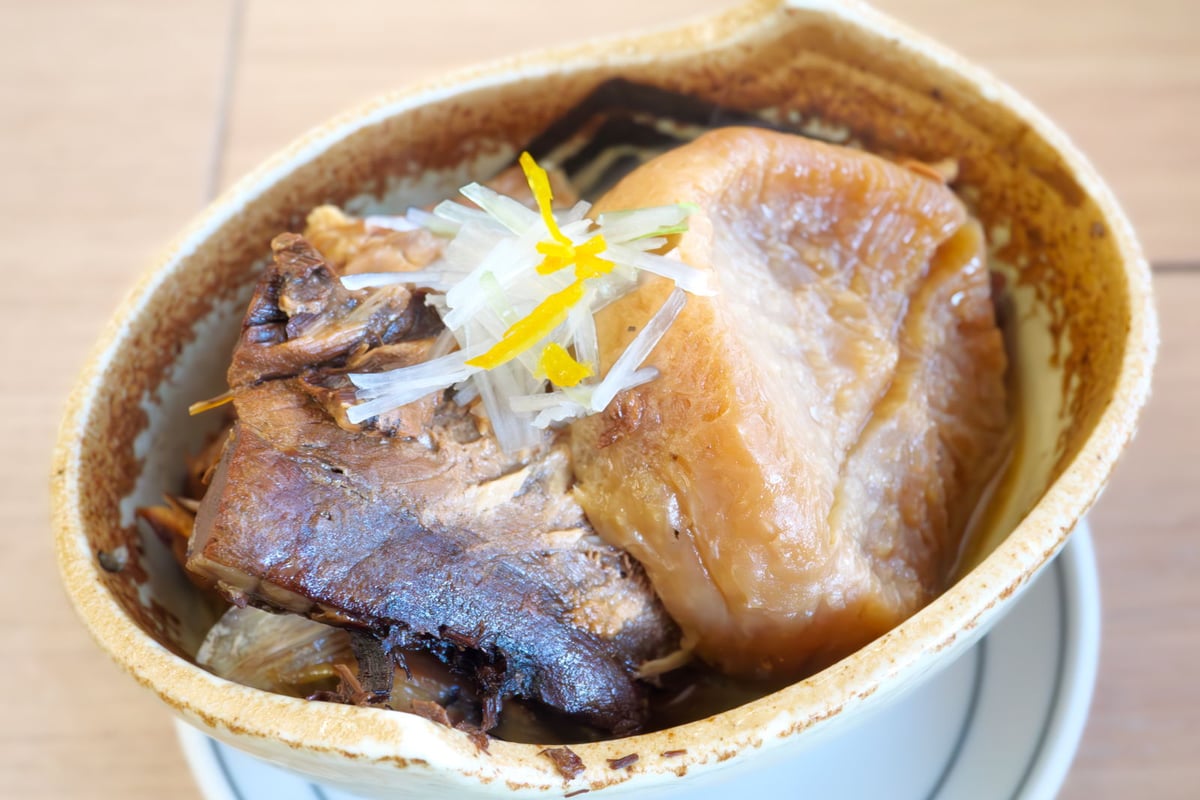
Buri Daikon (Simmered Yellowtail and Daikon)
Buri Daikon
Buri Daikon is a representative winter dish of Toyama Prefecture, made by slowly simmering the trimmings (ara) of fatty winter yellowtail (buri) landed in Toyama Bay together with daikon radish in a sweet-savory broth of soy sauce and sake. Yellowtail is said to be a fish with virtually no part wasted, and this dish grew out of the wisdom of simmering the ara — the head, collar, and other cuts left over after the flesh was used for sashimi or teriyaki — together with daikon to make full use of every bit of flavor. From late autumn into early winter, Toyama Bay is hit by stormy weather with thunder known as 'buri-okoshi,' and the winter yellowtail that reach peak season around this time are considered especially rich and delicious. Yellowtail landed in Himi City in particular is branded as 'Himi Kan-buri' and is highly regarded nationwide. Because yellowtail is a shusse-uo (a fish whose name changes as it grows, seen as auspicious), it is indispensable at celebrations and New Year meals, and buri daikon has long appeared on the table at such occasions. With the daikon soaking up the yellowtail's rich flavor, the dish lets diners enjoy both the well-seasoned, tender daikon and the flaky yellowtail meat, and it remains a beloved, warming winter home-cooked dish in Toyama households today.
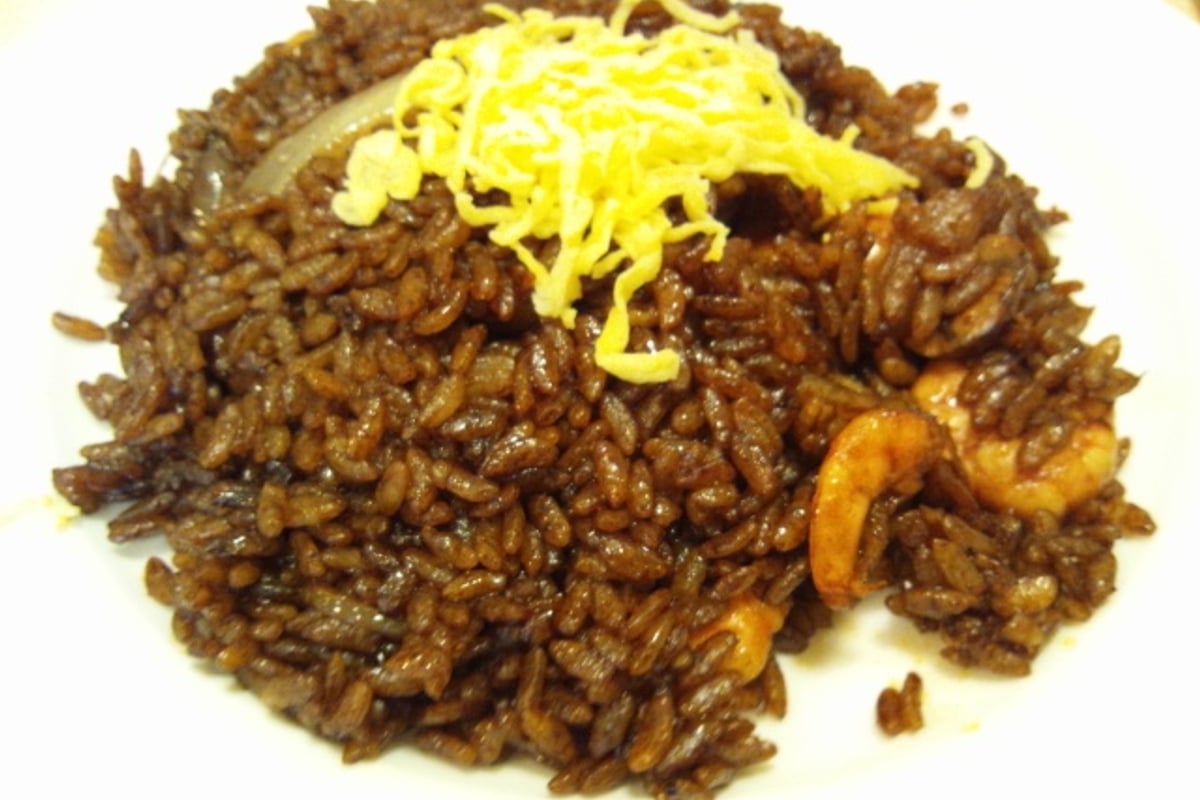
Ebi Meshi (Shrimp Pilaf)
Ebi Meshi
Ebi Meshi is a local specialty that originated in Okayama City: a shrimp pilaf stir-fried in a secret, dark brown sauce combining demi-glace sauce, ketchup, and caramel. The classic style tops it with shredded omelet and finely shredded cabbage, giving it a striking appearance and a distinctive sweet-and-savory flavor. Its roots trace back to a curry shop called 'Indeira' in Shibuya, Tokyo, where an employee from Okayama, Idei Tatsumi, learned the technique through a form of shop-branch permission and brought it home, serving it at the Western-style restaurant he opened in Hokanmachi, Okayama City—said to be the origin of Ebi Meshi. Its reputation subsequently spread mainly through central Okayama City, and today it is served at many Western-style restaurants and cafes both in and outside the city, making it one of Okayama's representative local B-grade specialties.
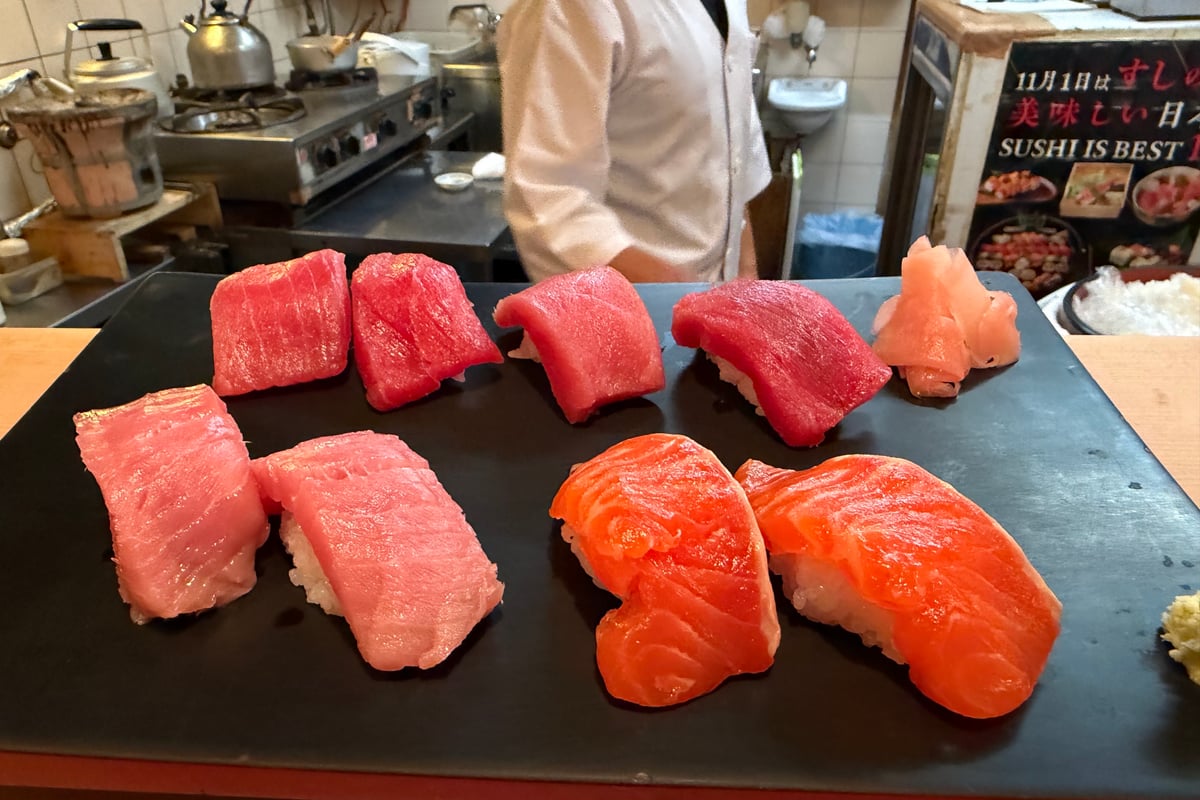
Edomae Zushi (Edo-Style Sushi)
Edomae Zushi
Edomae Zushi is a style of nigiri sushi that originated in Edo (present-day Tokyo) during the Bunsei era (1818-1830) of the late Edo period. In an age without refrigeration, it developed as a food-stall dish in which seafood caught in the Edomae sea (present-day Tokyo Bay) was given careful preparation known as 'shigoto'—vinegar-curing, soy-sauce marinating, and simmering in a sweetened soy glaze—then hand-pressed to order together with vinegared rice. Hanaya Yohei, who opened the shop Yoheizushi in Ryogoku, is said to have helped perfect nigiri sushi, and unlike fermented narezushi or the pressed sushi of the Kansai region, it won popularity among ordinary people as a sushi that could be eaten quickly and matched the brisk spirit of Edo townspeople. The 'shigoto' preparation gives the toppings more umami and better keeping quality than raw sashimi, while the vinegared rice is firmly seasoned with vinegar and salt. Today it is served in forms ranging from high-end restaurants to conveyor-belt sushi shops, and is known worldwide as a food culture representative of Tokyo.
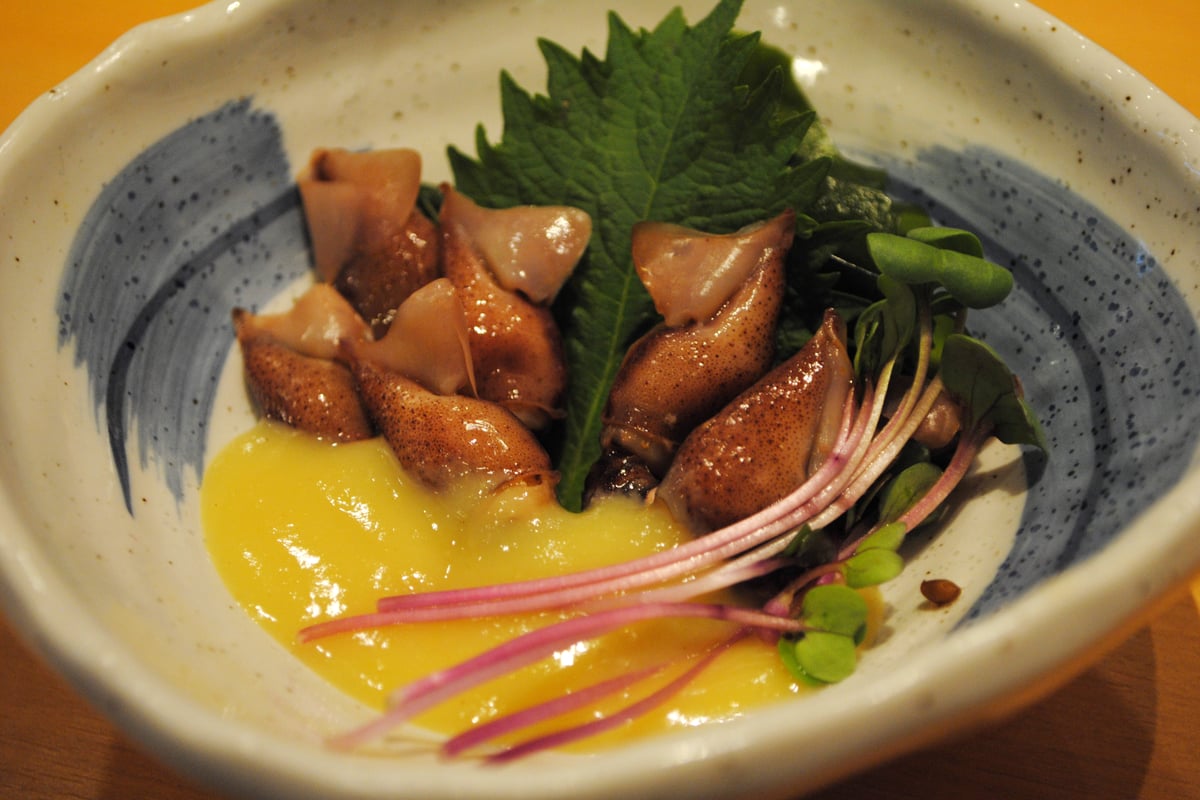
Firefly Squid with Vinegared Miso
Hotaruika no Sumiso-ae
Hotaruika no sumiso-ae is a simple dish made by boiling firefly squid, a signature ingredient of Toyama Bay in spring, and dressing it in vinegared miso or spicy vinegared miso. Firefly squid normally live at depths of over 200 meters, but from around March to May they gather in huge numbers along the shore of Toyama Bay to spawn, creating a mysterious sight as their entire bodies glow pale blue while drifting in schools. The area of Toyama Bay where this phenomenon occurs has been designated a Special Natural Monument of Japan as the ‘Hotaruika Group Migratory Waters,’ and firefly squid have become a symbol of spring in Toyama. Because they are caught with fixed-net fishing, the squid suffer little damage, and the short distance between the fishing grounds and the ports allows them to be shipped while still very fresh — a particular strength of Toyama Bay's firefly squid. The sticky texture and faint bitterness of the boiled squid combine with the mellow tang of the vinegared miso to create a flavor beloved as a springtime staple both at home and in restaurants.
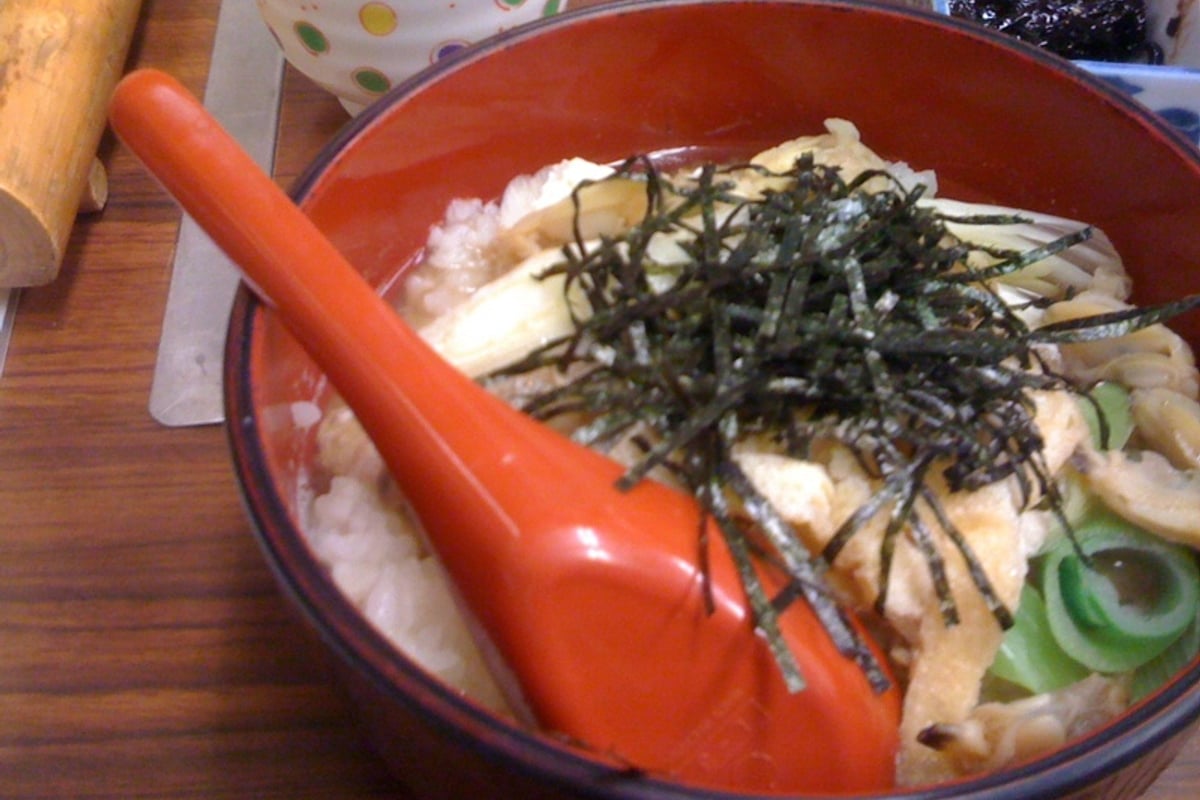
Fukagawa Meshi
Fukagawa Meshi
Fukagawa meshi is a local dish that originated in the fishing town of Fukagawa (present-day Koto Ward) during the Edo period, and it comes in two main styles built around clams: 'bukkake' and 'takikomi.' The area now known as Koto Ward once had broad, shallow tidal flats and thrived as a fishing town rich in clams, hard clams (hamaguri), and Japanese trough shells (aoyagi). The dish is said to have originated as 'bukkake meshi' — clams simmered in miso or soy sauce ladled over hot rice so fishermen could eat quickly between jobs — and later a version in which rice is cooked together with clams and vegetables, known as 'Fukagawa-don' or 'Fukagawa-meshi,' also spread. During the Edo period it was common to use bakagai (aoyagi), which were caught in great quantities at the time, but from the Meiji and Taisho eras onward, clams became the mainstream ingredient. Counted among Japan's five great rice dishes, it is a fisherman's dish representative of Tokyo that can still be enjoyed today at specialty restaurants throughout Koto Ward.
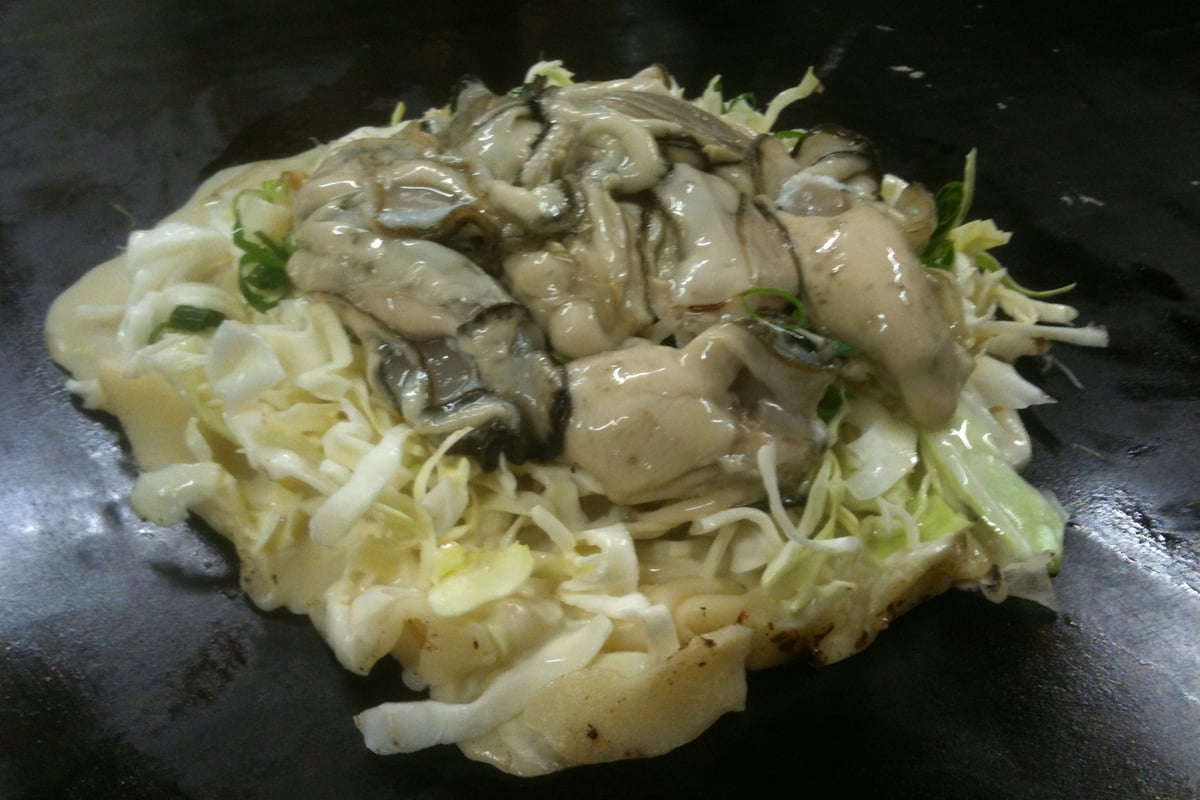
Hinase Kaki Okonomiyaki (Oyster Okonomiyaki)
Hinase Kaki Okonomiyaki
Hinase Kaki Okonomiyaki is a local specialty born in Hinase, Bizen City, Okayama Prefecture: an okonomiyaki savory pancake made generously with raw oysters. Hinase is a fishing town facing the Seto Inland Sea, known as a major production area accounting for more than half of Okayama Prefecture's oyster harvest. Its defining feature is a runny batter combined with a mountain of finely shredded cabbage and fresh raw oysters, grilled together on a griddle; because freshly landed oysters are used, they release little excess moisture and retain a plump, springy texture even after cooking without shrinking. It is said to have originated with fishermen bringing in small or damaged oysters unfit for sale to eat at local okonomiyaki shops, and it became known nationwide after the local 'Hinase Kaki Okonomiyaki Study Group' coined the name 'Kaki-oko' in 2002 and began promotional activities.
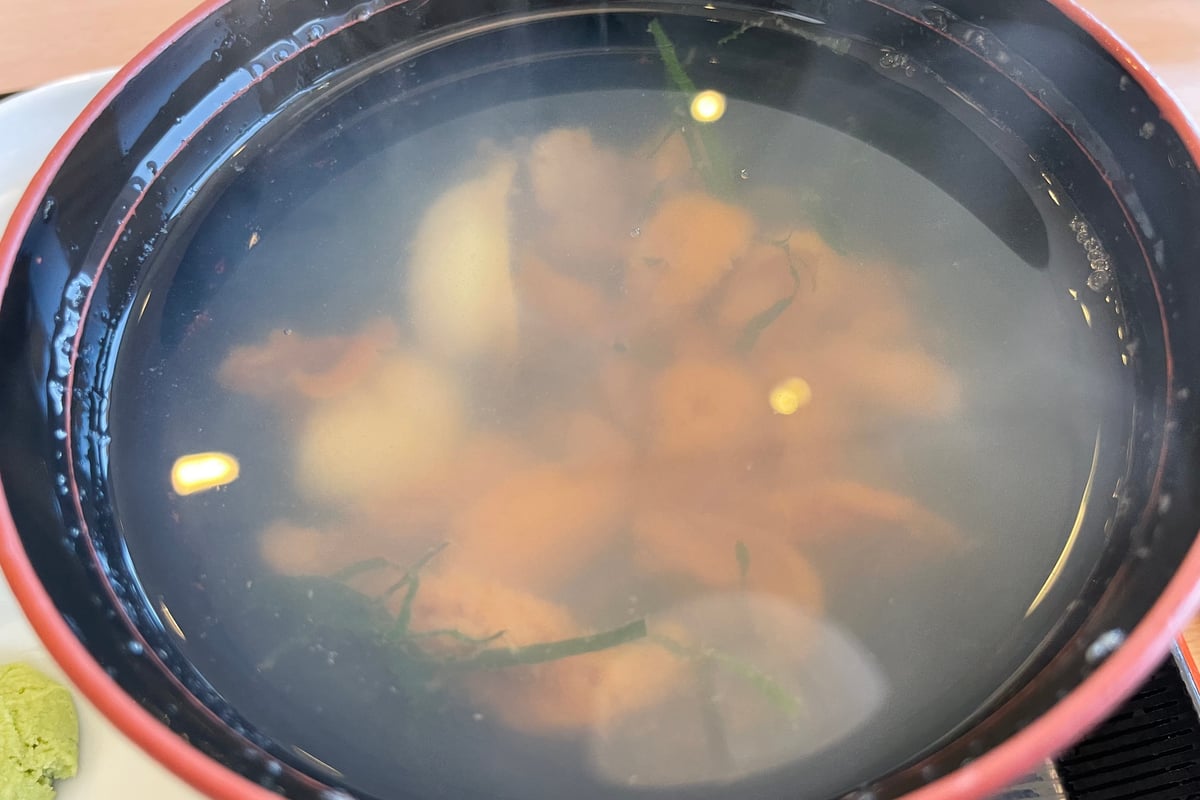
Ichigo-ni (Sea Urchin and Abalone Soup)
Ichigo-ni
Ichigo-ni is a local dish handed down along the Pacific coast of Aomori Prefecture, including Hachinohe City and Hashikami Town in Sannohe District, made by briefly simmering sea urchin and abalone in a lightly salted broth. It is said to have its roots in a "fishermen's meal," in which fishermen boldly simmered freshly caught sea urchin and abalone on the beach. The dish is said to be named "ichigo-ni" ("wild strawberry simmer") because the sight of golden sea urchin sinking into the milky, cloudy abalone broth resembled wild strawberries hazy in the morning mist. In the Taisho era, the proprietor of a long-established local ryokan and restaurant began arranging it beautifully in bowls to serve to guests, and it spread as a feast dish served to entertain visitors. In 1980, the local food company Ajino Kakunoya became the first in Japan to successfully can ichigo-ni, and it has since become established as an Aomori souvenir known nationwide.
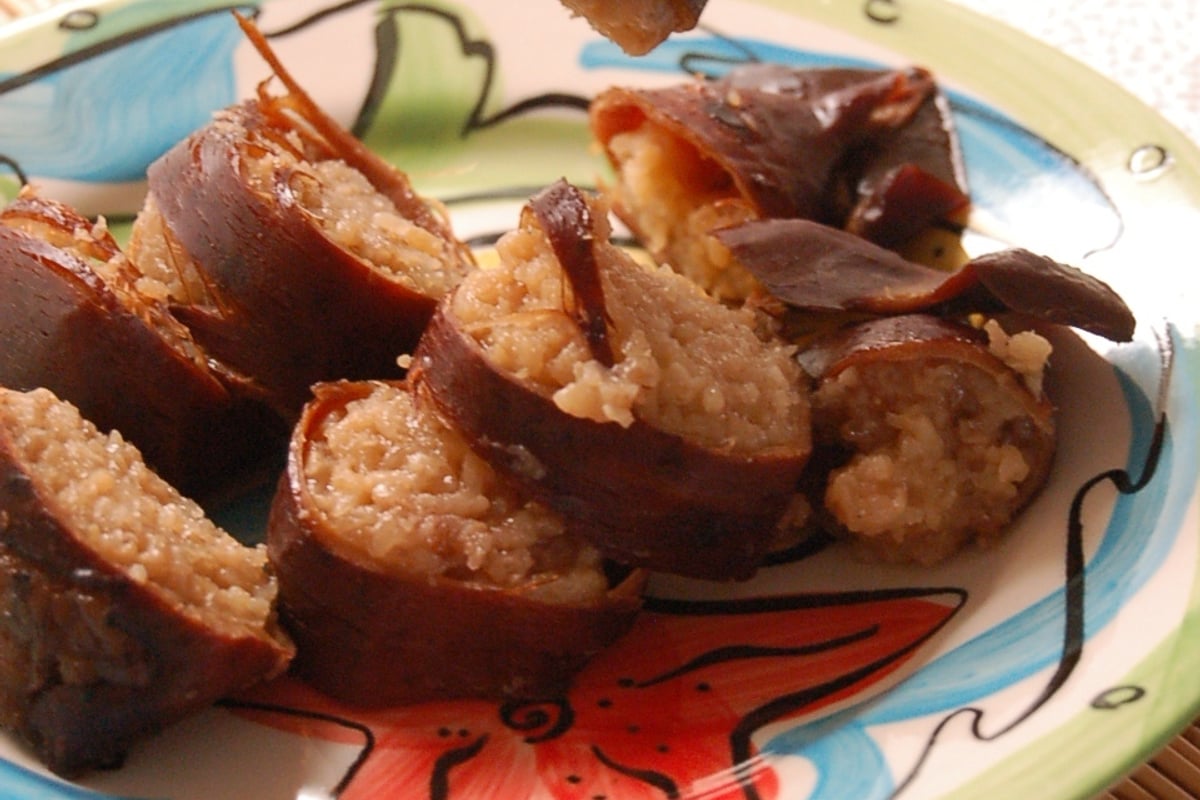
Ikameshi (rice-stuffed squid)
Ikameshi
Ikameshi is a local dish of Mori, Hokkaido, in which small squid bodies are stuffed with glutinous and non-glutinous rice and simmered slowly in a soy-based sauce. It is said to have been created in 1941 by Abe Shoten, a shop running an ekiben (train station box lunch) business in front of Mori Station, as a substitute food to make up for the rice shortage during the Pacific War. Originally the squid was used as a clever way to “bulk out” precious rice and stretch it further, but the combination of chewy rice and the squid's umami became popular, and it took hold as the signature ekiben of JR Mori Station. From around 1955 it also began to be sold through live demonstrations at department stores in Tokyo, and it built a nationwide reputation, ranking among the top sellers for many years at Keio Department Store's “Original Famous Ekiben and National Delicacies Fair.” The combination of squid and rice soaked in a sweet-savory soy sauce is a testament to the finished quality unique to an ekiben — delicious even when cold.
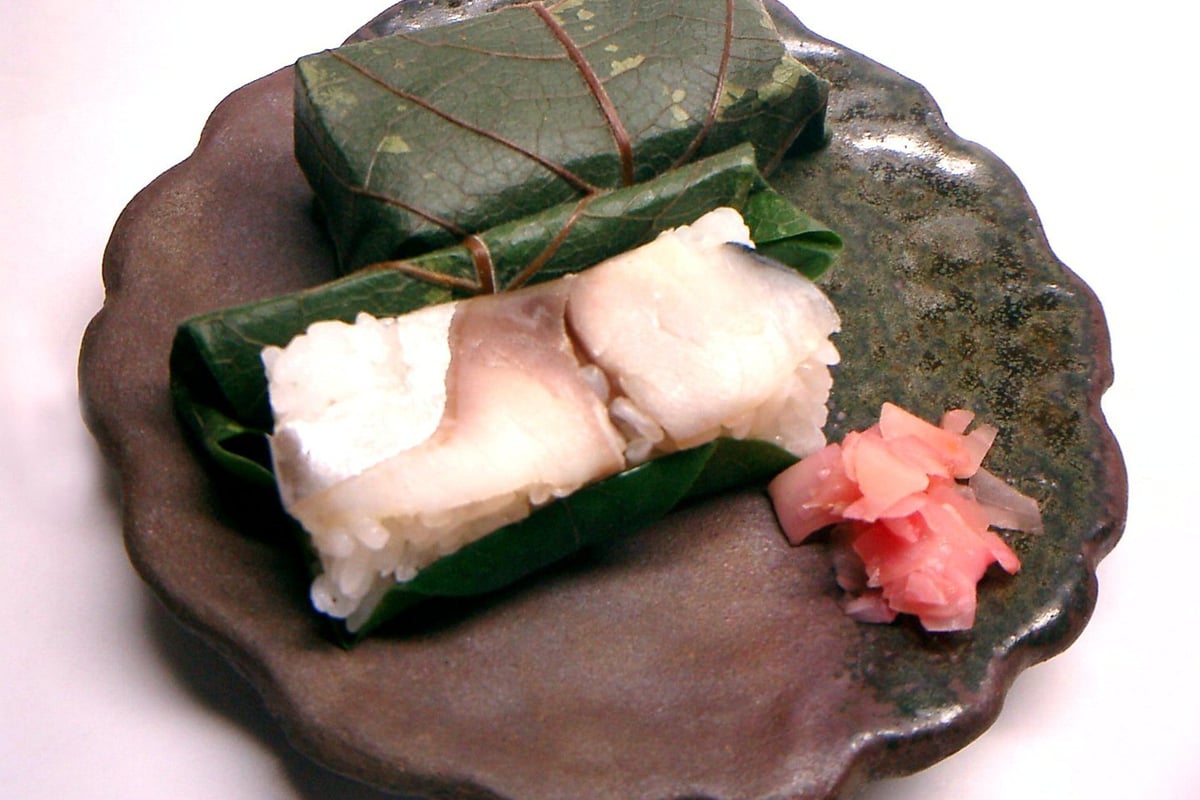
Kakinoha-zushi (Persimmon Leaf Sushi)
Kakinoha-zushi
Kakinoha-zushi is a signature local dish of Nara Prefecture in which bite-sized portions of vinegared rice topped with salt-cured slices of mackerel or salmon are individually wrapped in the leaves of the astringent persimmon (shibugaki). It is said to trace back to the mid-Edo period, when summer mackerel from the Kumano-nada sea was salt-cured in Kishu and carried over the mountains to villages along the Yoshino River, where it came to be made in each household as a festive dish for summer festivals. Because fresh seafood was precious in the sea-less Nara Basin, salt-curing was combined with the antibacterial properties of persimmon leaves as a way to improve preservation. Letting the wrapped sushi rest for about a night allows the aroma of the persimmon leaves and the flavor of the fish to blend into the vinegared rice, producing its distinctive taste. Today, makers are found throughout Nara Prefecture, especially in the Yoshino and Gojo areas, and it is known nationwide as one of Nara's representative souvenirs.
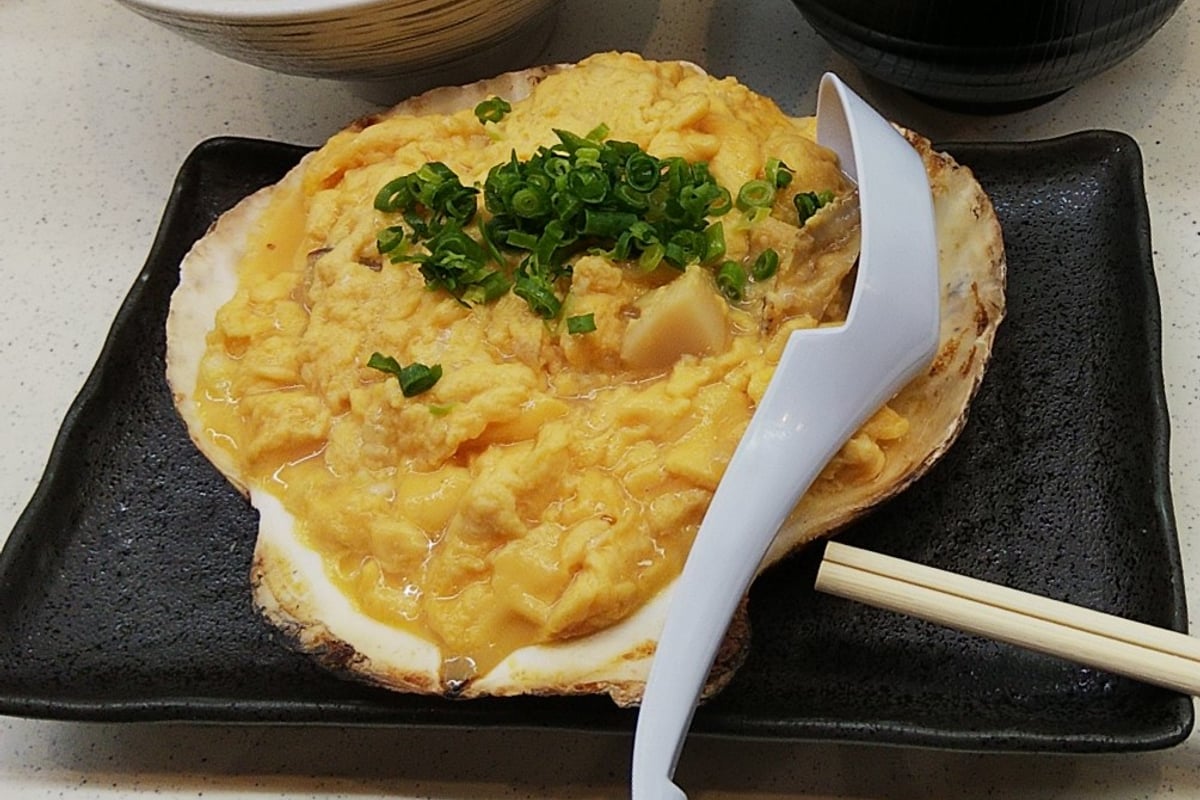
Kayaki-miso (Scallop Shell Miso Hot Pot)
Kayaki-miso
Kayaki-miso is a local dish handed down in the Tsugaru and Shimokita regions of Aomori Prefecture, in which a large scallop shell is used in place of a pot to simmer scallops, fish fillets, and vegetables in dashi and miso, finished by pouring in beaten egg. Around Tsugaru Bay, long known as a scallop-producing area, it is said that as early as the Edo period people were already using shells as pots to grill sardines or mackerel with homemade miso, in a simple fisherman's dish. Later, once eggs became available, it evolved closer to its present form, finished with beaten egg; however, because eggs were a precious commodity at the time, kayaki-miso was also a special nourishing food that only the ill or pregnant women were allowed to eat. Osamu Dazai, a novelist born in Tsugaru, wrote in his novel "Tsugaru" of his longing for the egg-topped kayaki-miso he ate as a child when he caught a cold, and the dish is also known for being deeply tied to the memories of the people of Tsugaru.
Konbujime (Kelp-Cured Sashimi)
Konbujime
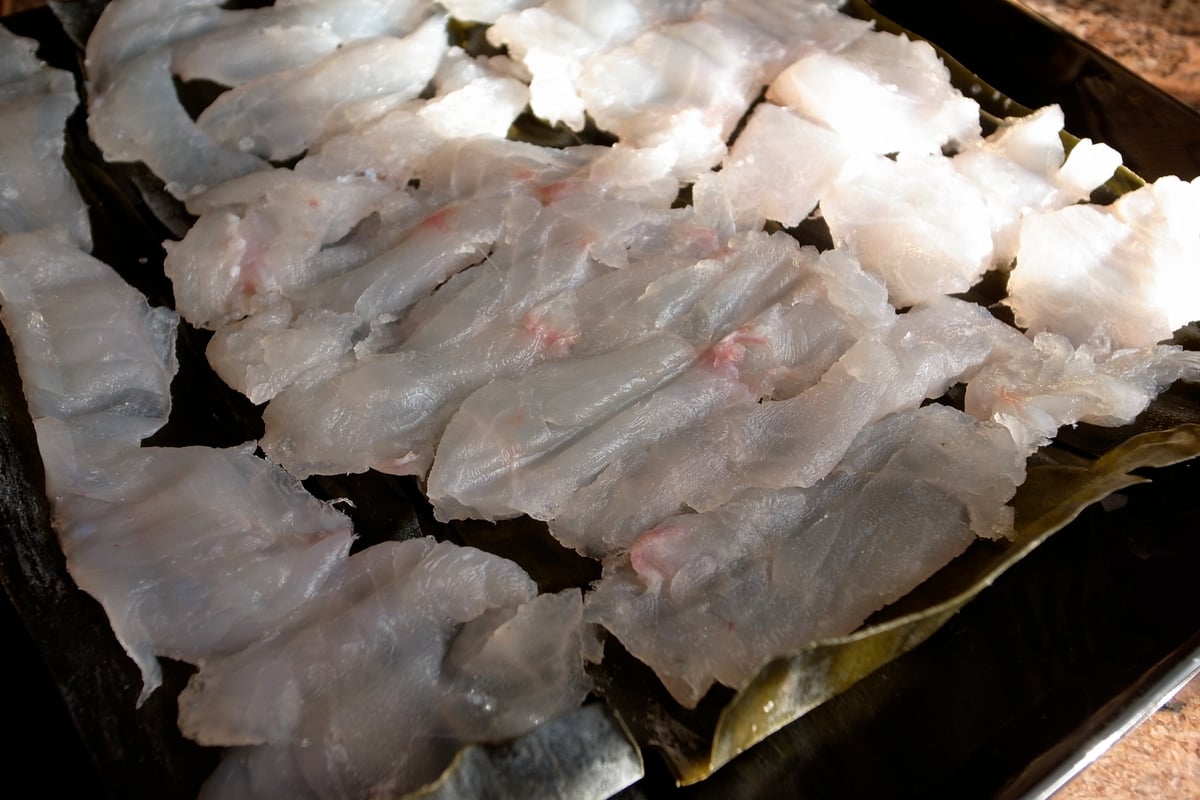
Konbujime is a representative fish preparation and preservation technique from Toyama Prefecture in which sashimi-grade white fish is sandwiched between sheets of kelp (konbu) and left to rest for a set period, allowing the fish to absorb the kelp's umami and undergo a moisture-drawing maturation. It is said to have originated in the Edo period from the combination of kelp brought from Hokkaido via the Kitamae-bune trading ships and fresh fish caught in Toyama Bay, and it spread as a wisdom for preserving raw fish deliciously in an age before refrigeration. As the fish rests between the kelp, excess moisture is drawn out and the flesh firms up, while the glutamic acid in the kelp adds umami, producing a deep flavor quite different from ordinary sashimi. Toyama Prefecture, centered on Takaoka and Fushiki, former Kitamae-bune port towns, is said to rank among the highest in Japan for kelp consumption, and its kelp culture runs so deep that it is sometimes called the 'Kingdom of Kelp.' Konbujime stands as a symbolic dish of this culture, enjoyed widely from home cooking to dishes served at specialty restaurants.
Lake Kasumigaura Wakasagi Cuisine (Hobikibune Fishing)
Kasumigaura Wakasagi Cuisine (Hobikibune Fishing)
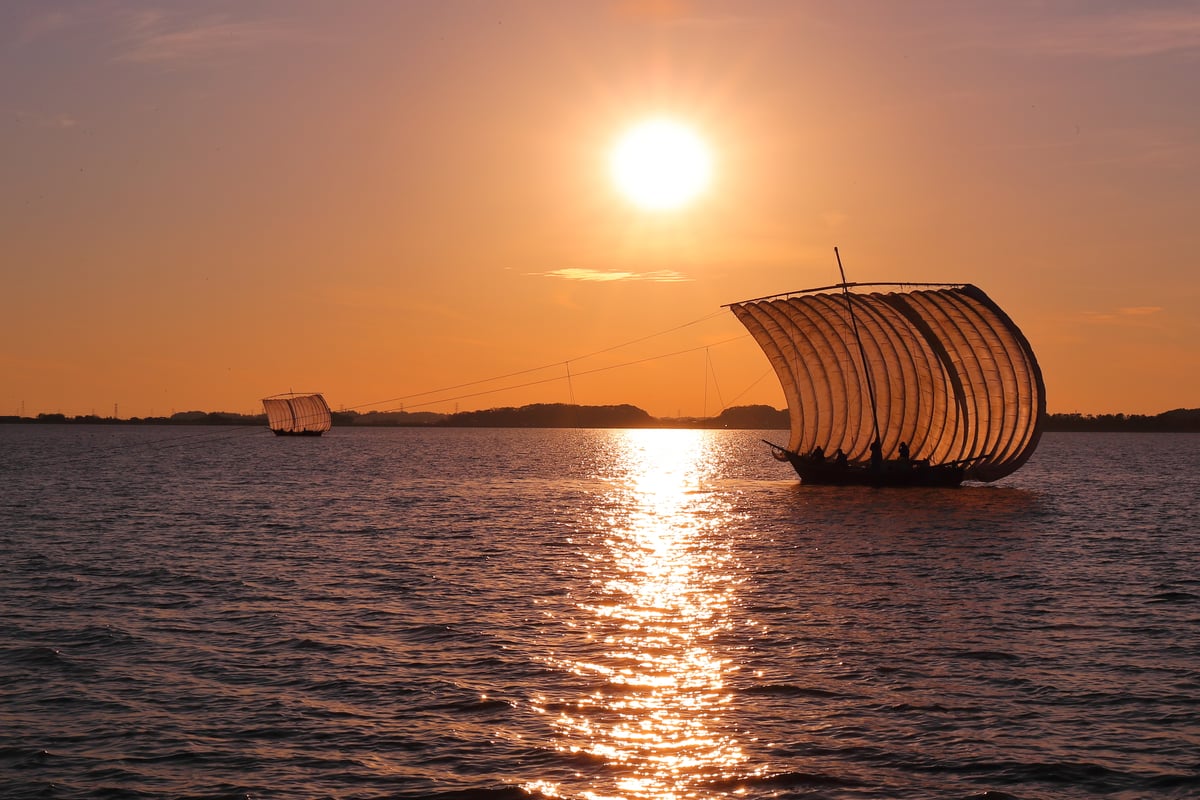
Lake Kasumigaura wakasagi (pond smelt) cuisine is a fish-eating culture around Kasumigaura City and Tsuchiura City that developed alongside hobikibune (sail-net fishing boat) fishing, said to have been devised around 1880 by local fisherman Orimoto Ryohei. The hobikibune is a distinctive fishing boat that catches fish in a bag-shaped net towed behind it while the whole boat is pushed sideways by wind caught in its large sail; originally devised for icefish fishing, it later became the main method for catching wakasagi, and remained the mainstay of Lake Kasumigaura fishing for about a century until it was replaced by motorized boats around 1967. The wakasagi that are caught are prepared into dishes that make the most of freshwater fish's mild flavor and bones soft enough to eat whole, such as sweet-and-savory simmered tsukudani and kanroni, as well as deep-fried and tempura preparations, and are enjoyed at local eateries and souvenir shops. Today, sightseeing hobikibune boats operate seasonally to recreate the scenes of the past, letting visitors enjoy both the lake's food culture and its fishing history together.
Maguro no Kabuto-yaki (Grilled Tuna Head)
Maguro no Kabuto-yaki
Maguro no Kabuto-yaki (grilled tuna head) is a hearty local dish born in the port town of Misaki in Miura City, one of Japan's leading tuna fishing harbors. The tuna's head (kabuto) holds rare, richly flavored parts distinct from the body meat—such as the hachi-mi (crown meat), cheek meat, the flesh behind the eye, and throat meat—which are slow-grilled, often simply salted, to bring out their deep umami. The fishermen of Misaki have long practiced 'oki-ryori' (offshore cooking), a tradition of ingeniously preparing the tuna's innards and other underused parts, and kabuto-yaki is said to have emerged from this culinary lineage. Because only a small amount of this rare cut can be taken from a single fish, it is mostly served at specialty tuna restaurants around Misaki Port, and it has become a beloved dish among visitors as a symbol of Misaki's distinctive tuna food culture.
Mamakari-zushi (Sappa Herring Sushi)
Mamakari-zushi
Mamakari-zushi is a signature local sushi of Okayama Prefecture, made from mamakari — a small fish caught along the Seto Inland Sea coast — filleted into three pieces, marinated in sweet vinegar, and placed atop vinegared rice. The standard Japanese name for mamakari is sappa, a small fish of the herring family that is at its fattiest and most flavorful from autumn into early winter. The name is said to come from a saying that the fish is so delicious people would go 'borrow rice (mama) from the house next door' for more of it, making it a food deeply familiar to the people of Okayama. It was selected as one of the Ministry of Agriculture, Forestry and Fisheries' '100 Local Dishes of Farming and Fishing Villages,' and is sold not only at home but also in boxed sets at sushi restaurants and souvenir shops. The distinctive tartness and umami of the vinegar-cured small fish pairs beautifully with the vinegared rice, making it a beloved dish that symbolizes Okayama's food culture.
Masu-no-sushi
Masu-no-sushi
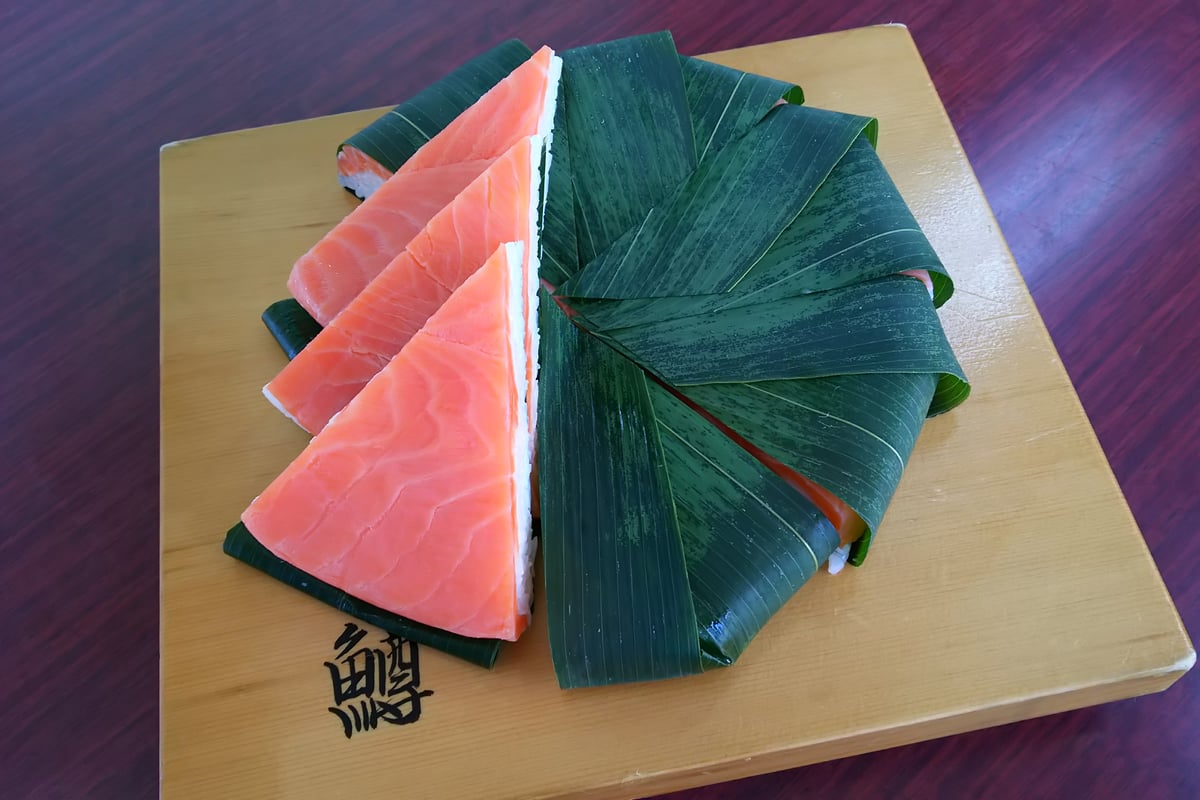
Masu-no-sushi is Toyama Prefecture's signature pressed sushi, made by layering vinegared rice and thin slices of sakura masu (cherry salmon) with bamboo-grass leaves, packed into a round bentwood container and pressed firm. It is said to have originated when a retainer of the Toyama domain presented ayu (sweetfish) sushi from the Jinzu River to the lord, and the dish later evolved into its present form using sakura masu caught in the same river. After it began being sold as an ekiben (station bento) at Toyama Station in 1912, its fame spread nationwide with the opening of the Hokuriku Main Line, and today it stands as the quintessential Toyama souvenir. Its flavor balances the refreshing aroma of bamboo grass, the mild richness of the sakura masu, and the tang of vinegared rice, and its long shelf life at room temperature has made it a favorite for station bento, gifts, and outing lunches alike. Many shops, mainly in Toyama City, still compete with their own recipes today, and comparing the differences in vinegar seasoning and fish thickness between shops is a popular pastime.
Nakagawa River Ayu Cuisine
Nakagawa River Ayu Cuisine
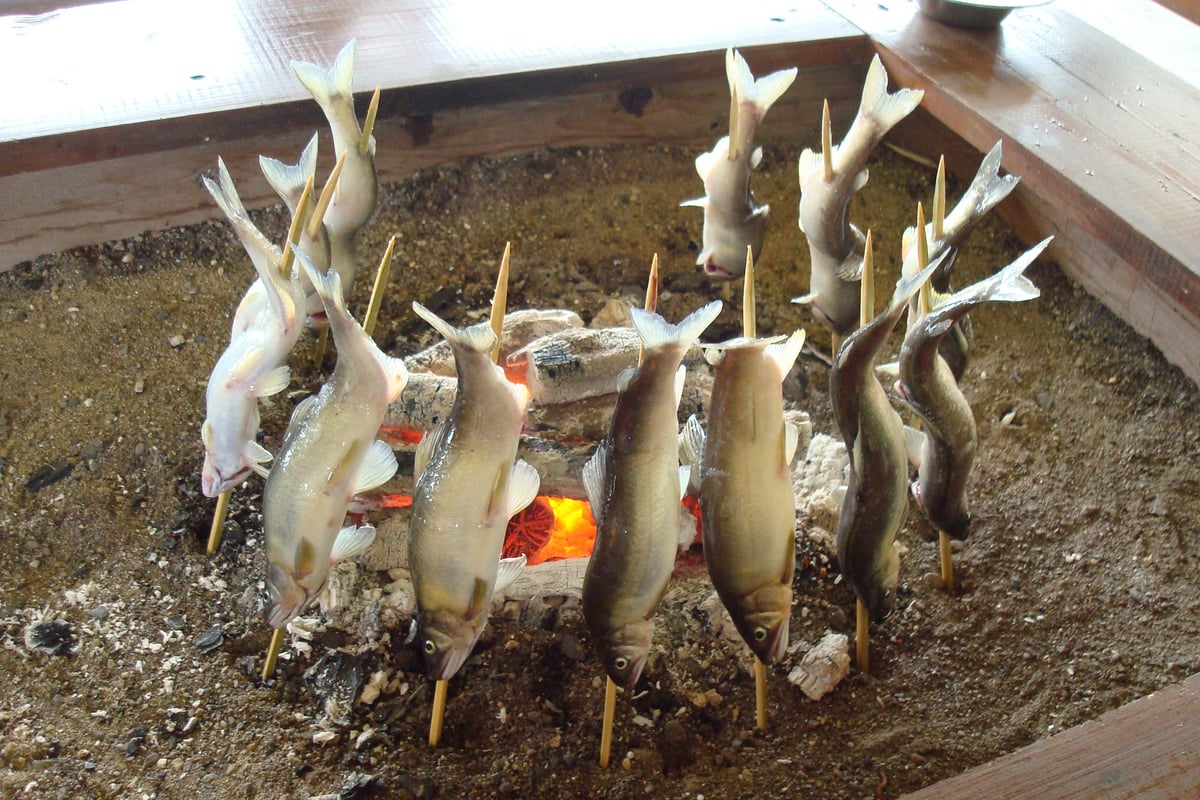
The Naka River, a Class A river flowing through eastern Tochigi Prefecture from its source in the Nasu Highlands, is a clear stream known as one of Japan's finest for ayu (sweetfish) catches. Along this river, a traditional fishing method called 'yana' has long been practiced, damming the current into a V-shape and letting ayu leap up onto bamboo lattices set in the flow. Every year from mid-July to around the end of October, tourist yana facilities are set up along the river for a limited season, offering visitors the chance to catch leaping ayu by hand as well as enjoy a variety of ayu dishes, including salt-grilled ayu slowly cooked over charcoal, kamameshi rice, and sashimi. Facilities such as Kurobane Kanko Yana in Otawara City and Ose Kanko Yana in Motegi Town dot the banks of the Naka River, and the area bustles with families and visitors from summer into autumn, offering a seasonal specialty that captures the blessings of Tochigi's clear waters.
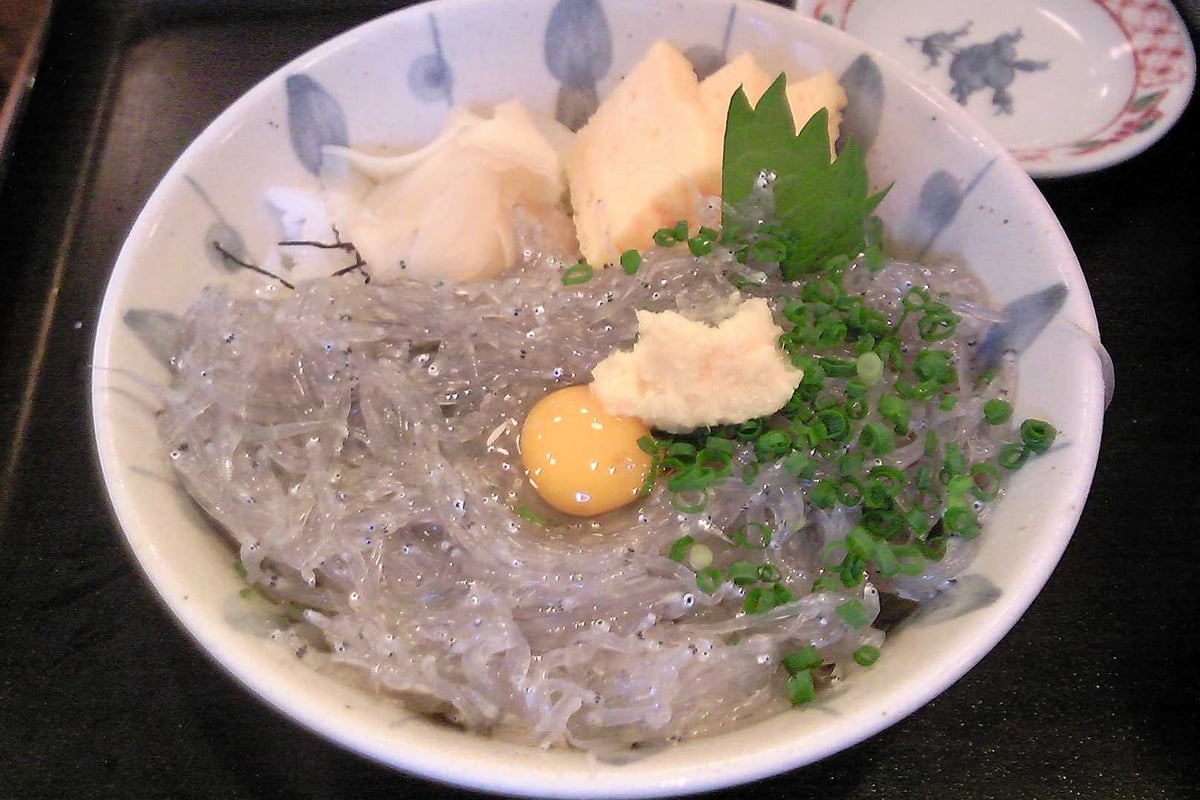
Nama-Shirasu-Don (Raw Whitebait Rice Bowl)
Nama-shirasu-don
Nama-shirasu-don is a seafood rice bowl representative of the Shonan area, piled high with freshly caught raw shirasu (young sardines) from Sagami Bay. Shirasu caught near the fishing ports around Enoshima, Koshigoe, and Kamakura spoil very quickly, so it can only be enjoyed raw on the day it is landed and near where it was caught—a rarity that is part of its appeal. It is known for its plump texture and a melt-in-the-mouth quality, typically eaten with soy sauce or ponzu and condiments such as ginger and chopped scallion. Shirasu fishing is closed from January through mid-March each year, so raw shirasu can only be enjoyed during the limited season after the ban is lifted. At eateries in Enoshima and Koshigoe, many restaurants offer their own take on the dish, such as bowls combining boiled (kama-age) and raw shirasu.
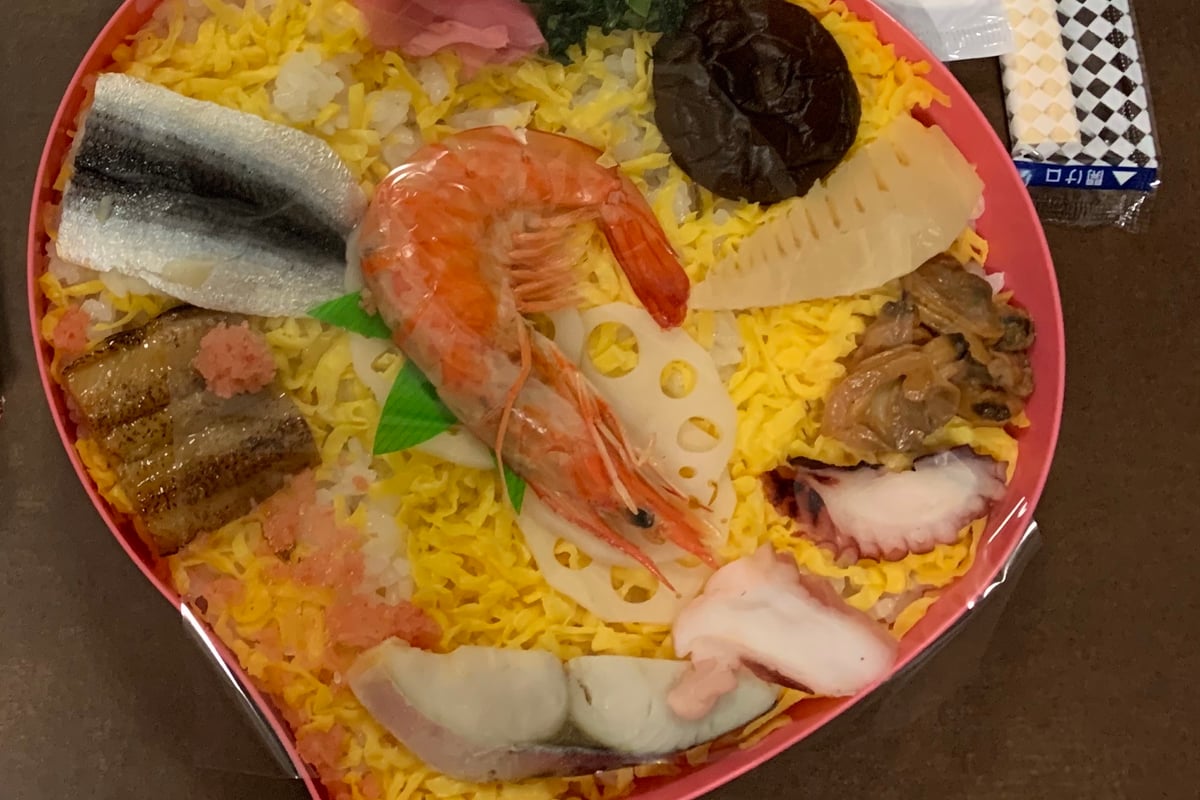
Okayama Barazushi (Festival Sushi)
Okayama Barazushi
Okayama barazushi (also called matsuri-zushi, or 'festival sushi') is a local scattered sushi from Okayama Prefecture, topped with colorful seafood from the Seto Inland Sea and seasonal vegetables arranged over vinegared rice. It is said to have originated in the Edo period, when Ikeda Mitsumasa, the first lord of the Bizen Okayama domain, issued a sumptuary edict decreeing that meals should consist of only one soup and one side dish. In response, the common people devised the idea that 'piling toppings on top of rice is still just one dish,' and the tradition is said to have grown from there. It developed into an essential dish for festive occasions such as festivals, New Year, and entertaining guests, with each household adding its own character through the ingredients and arrangement used. Today it is served year-round at sushi restaurants throughout Okayama City and is affectionately known locally as 'barazushi.' Its colorful, festive appearance also makes it a popular dish among visitors to Okayama.
Salmon chanchan-yaki (grilled salmon with miso)
Salmon Chanchan-yaki
Salmon chanchan-yaki is a local dish of Hokkaido in which chunks of salmon and vegetables such as cabbage and onion are placed on an iron griddle or hot plate, coated with a miso-based sauce, and steam-grilled together. It is said to have originated in the fishing towns of the Ishikari region, and in the late 1930s fishermen reportedly grilled salmon they had just cleaned aboard their boats, cooking it boldly right there on improvised griddles made from cut-open oil drums. There are several theories about the origin of the name — that it can be made quickly (“chacha-tto”), that it is a dish made by one's father (“chan”), or that it comes from the sound of the spatula striking the griddle — though none has been confirmed by definitive sources. In 2007 it was selected for MAFF's “100 Best Local Dishes of Japan,” and it is counted among the three great local dishes of Hokkaido alongside Ishikari nabe and Jingisukan. The savory aroma of miso and the richness of the salmon's fat soak into the vegetables, making it a dish that brightens the table from autumn through winter.
Sanriku Sea Urchin (Uni) Cuisine
Sanriku Sea Urchin
Sanriku sea urchin (uni) cuisine is a local seafood tradition using uni harvested along the Sanriku Coast in coastal Iwate Prefecture, in towns such as Miyako, Kuji, and Hirono. The waters off Sanriku are a rich fishing ground where the cold Oyashio Current meets the warm Kuroshio Current, and the abundance of kelp and other feed produces large, richly sweet uni, making the area one of Japan's leading uni-producing regions. Distinctive ways of enjoying the freshness and flavor have developed here, including raw uni served straight over rice ('nama-uni-don'), 'shiomizu uni' — uni preserved in saltwater without alum — and 'gyunyu-bin uni,' uni packed into bottles while still in the shell. From early to midsummer, when the season opens, 'uni-don' bowls and 'uni festivals' are held throughout the region, drawing many visitors from within and outside the prefecture in search of Sanriku's summer flavors.
Shiroebi no Kakiage
Shiroebi no Kakiage
Shiroebi no kakiage is a signature seafood dish of Toyama Prefecture made by coating shiroebi (Toyama's white shrimp), known as ‘the jewel of Toyama Bay,’ in batter and frying it until crisp. Shiroebi are small, translucent, pale pink shrimp about 5–6 centimeters long that normally live in the deep sea at depths of around 200 to 400 meters, but the unusual topography of the seabed in Toyama Bay allows them to gather in schools even in relatively shallow layers, making Toyama the only place in Japan where they are landed in quantities sufficient to support a fishery. The main landing ports are Shinminato and Iwase, and while shiroebi were once mostly dried whole in their shells for making dashi stock, advances in freezing and shelling technology have brought renewed attention to the delicate sweetness and silky texture of the flesh, making it popular for sashimi and sushi as well. Kakiage is a classic preparation that is also easy to make at home, and its crisp batter paired with a subtle sweetness has made it beloved by many.