Image: Wikimedia Commons
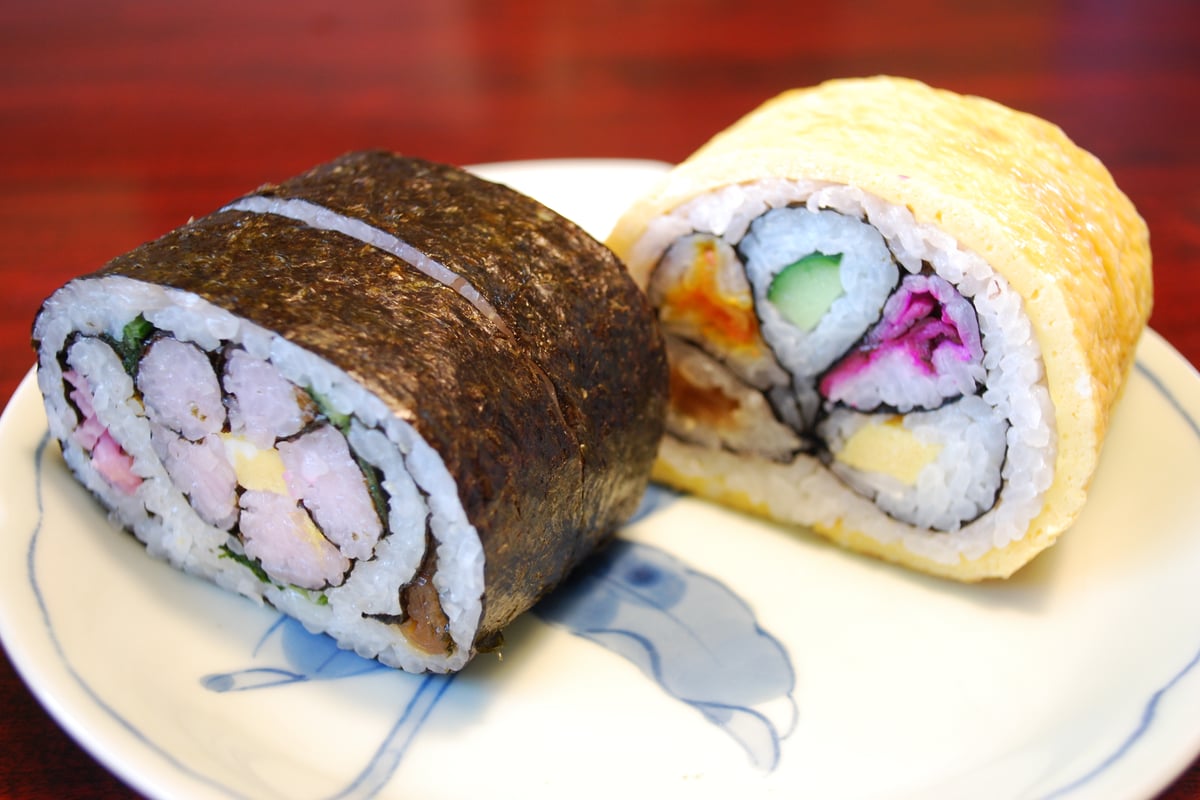
Futomaki Matsurizushi is a signature local dish of Chiba Prefecture, handed down in the Boso Peninsula (the Awa and Kazusa regions). Its defining feature is that when the rolled sushi is sliced, the cross-section reveals pictures of flowers, animals, characters, and more. It is said there are over 100 different designs, each passed down uniquely by region and household. Its history is said to trace back to the Kansei era (1789-1801) in the late Edo period, with one theory holding that its roots lie in 'mehari-zushi,' brought to Boso by fishermen who had relocated from Kishu. It was once made as a hospitality dish for celebratory gatherings such as village festivals, weddings, and children's birth celebrations that brought together large groups of people, and in 2007 it was selected as Chiba Prefecture's representative in the Ministry of Agriculture, Forestry and Fisheries' '100 Local Dishes of Rural and Fishing Villages' and '100 Furusato Onigiri.' Today it remains a beloved celebratory sushi, enjoyable to look at as well as to eat, indispensable for ceremonial occasions and annual events.
Origin
The origins of Futomaki Matsurizushi are said to trace back to the Kansei era (1789-1801) in the late Edo period. One theory holds that its roots lie in 'mehari-zushi,' brought to Boso by fishermen who relocated there from Kishu (present-day Wakayama Prefecture); it is said to have developed into its own unique rolled-sushi culture as it combined with Boso's local ingredients.
History
It was once made as a hospitality dish for celebratory gatherings—village festivals, weddings, children's birth celebrations—that brought together large numbers of people, with local women competing to show off their skill in making it. In 2007, it was selected as Chiba Prefecture's representative in the Ministry of Agriculture, Forestry and Fisheries' '100 Local Dishes of Rural and Fishing Villages' and '100 Furusato Onigiri,' and it has since become known as a dish representative of the Boso region.
Features
Using vinegared rice and nori seaweed, ingredients such as rolled omelet, kanpyo (dried gourd shavings), pickled greens, and sakura denbu (sweetened fish flakes) are combined and rolled so that, when sliced, the cross-section reveals pictures such as flowers, butterflies, or characters. It is said there are over 100 different designs, making it a visually striking sushi that showcases both dazzling appearance and the roller's skill.
Main Ingredients
Food Culture
It developed as an indispensable hospitality dish for celebratory gatherings that brought together large numbers of people, such as village festivals, weddings, and children's birth celebrations. The designs carry the wishes of each region and household, and the dish also reflects the skill and individuality of the person who makes it.
Famous Shops
食と農の体験工房 花味結
千葉県鴨川市細野392
A workshop offering hands-on experience making Futomaki Matsurizushi. Experience fee starts at around 1,700 yen (reservation required).
View details →道の駅 たけゆらの里おおたき
千葉県夷隅郡大多喜町石神855
A roadside station with an attached direct-sales shop that sells boxed Matsurizushi meals.
View details →FAQ
Q. Why is it called 'Matsurizushi' (festival sushi)?
A. It is said to be called 'Matsurizushi' (festival sushi) because it was made to serve at celebratory gatherings that brought together large numbers of people, such as village festivals and weddings.