Image: Wikimedia Commons
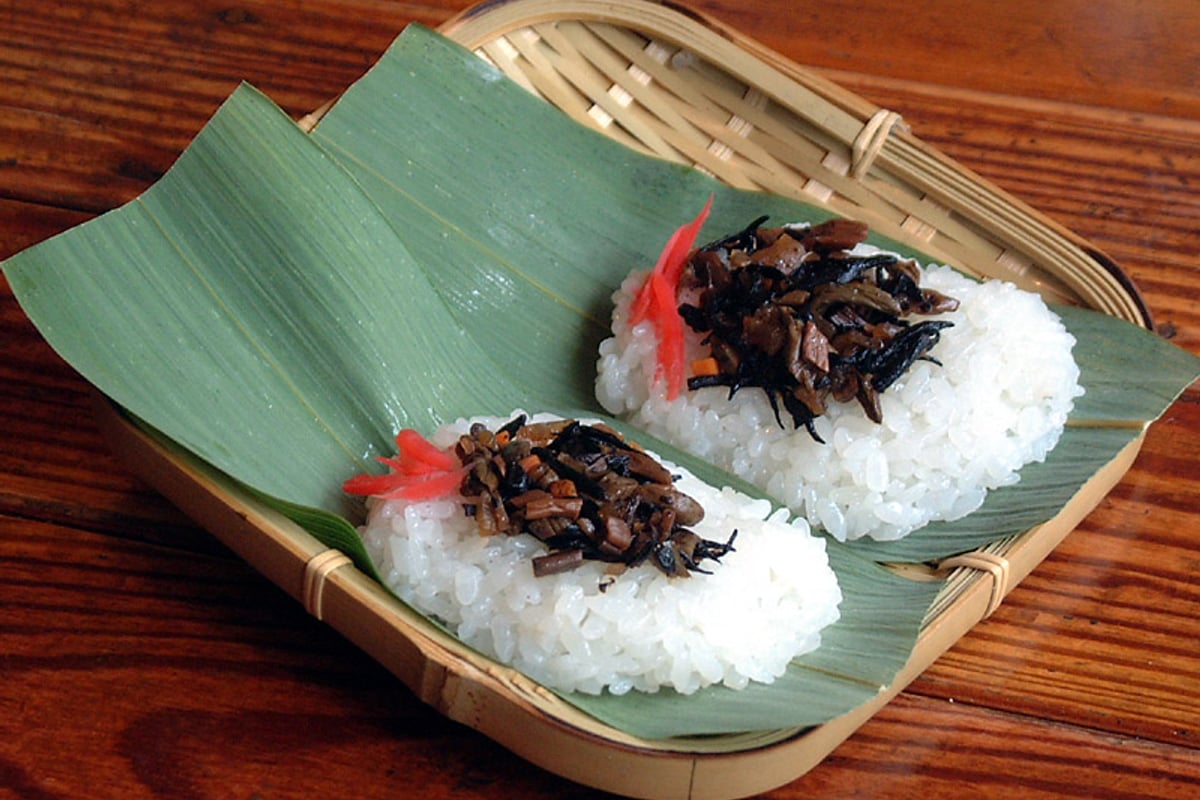
Sasa-zushi is a local dish of the Joetsu region of Niigata Prefecture in which bite-sized portions of vinegared rice are placed on kumazasa (Sasa veitchii) bamboo-grass leaves and colorfully topped with ingredients such as mountain vegetables, shredded thin omelet (kinshi tamago), and flaked salmon (soboro). It is made mainly in Myoko City, Joetsu City, and Itoigawa City, and Sasa-zushi of the same lineage is also handed down in the Hokushin area of northern Nagano Prefecture. Because the leaves are folded into the shape of a mi (winnowing basket), a farming tool, to hold the rice, some areas of the Joetsu region call it 'mizushi.' As for its birth, there is a story that Uesugi Kenshin's troops in the Sengoku (Warring States) period used sasa leaves in place of dishes to serve rice in the mountains, and another that it was presented to Kenshin on his way to the Battles of Kawanakajima. However, both are handed down as legends. Sasa leaves are said to have antiseptic properties, and because it can be easily picked up and eaten by hand, it has been passed down as a feast for special occasions such as Obon and festivals. Today it is also sold at sushi restaurants, farm produce stands, and tourist facilities.
Origin
There are several legends about its origin. One tells that during the Sengoku period, Uesugi Kenshin's troops, on their way to fight Takeda Shingen, served rice on sasa leaves in place of dishes while in the mountains. Another tells that when Kenshin crossed Tomikura Pass (in present-day Iiyama City, Nagano Prefecture) on his way to the Battles of Kawanakajima, local people presented him with sushi on sasa leaves, which is why it is also called 'Kenshin sasa-zushi.' Neither is supported by historical records; both are handed down as oral tradition.
History
Sasa leaves are considered to have strong antibacterial and antiseptic effects, and sushi served on them has long been valued as a dish that keeps well and is easy to carry. In the Joetsu region, it has been made in each household for special occasions when people gather, such as Obon and festivals. In 2014 (Heisei 26), the Itoigawa Junior Chamber registered July 7 as a commemorative day, 'Itoigawa: Tanabata is Sasa-zushi Day.' The name comes from the fact that Tanabata is also called the 'Sasa Festival' (Sasa no Sekku), and efforts to pass this local flavor on to the next generation continue.
Features
Bite-sized portions of vinegared rice are spread on kumazasa leaves, and toppings are arranged on top. The toppings vary by area and household, and include mountain vegetables such as dried zenmai (royal fern), warabi (bracken), and bamboo shoots, as well as himetake shoots, flaked salmon, shredded thin omelet, walnuts, and Nozawana pickles. Sweet-vinegar pickled ginger is sometimes served alongside. The leaves may be used flat, folded into boat, triangle, or mi (winnowing basket) shapes, or wrapped like chimaki, so the forms vary. Another feature is that it can be eaten by hand without chopsticks.
Main Ingredients
Food Culture
A dish for special occasions, made by families and neighbors for events such as Obon and festivals and served to those who gather. Because it uses seasonal ingredients such as mountain vegetables and local produce, it offers colors unique to each time of year. In Myoko City and elsewhere, there are also hands-on experiences in which local people teach how to fold the leaves and arrange the toppings.
Famous Shops
郷土料理と地酒の店 雁木亭
新潟県上越市仲町3-4-9
A restaurant serving Joetsu local dishes and local sake, about a 7-minute walk from Takada Station on the Echigo TOKImeki Railway. It offers Sasa-zushi made with warabi and walnuts from Joetsu, reportedly by reservation only, for orders of 10 pieces or more placed by the previous day.
妙高山麓直売センター とまと
新潟県妙高市坂口新田430-1
A farm stand selling vegetables and specialty products from the foot of Mt. Myoko. Handmade Sasa-zushi is sold for around 600 yen and is so popular that only a few may be left before noon. At the adjoining eatery, you can also enjoy dishes such as soba.
FAQ
Q. What is 'mizushi'?
A. In Myoko City, Joetsu City, and other parts of the Joetsu region, sasa leaves are folded into the shape of a mi (a flat basket used in farm work to sift and sort grain) to hold the vinegared rice, so some areas call Sasa-zushi 'mizushi.'
Q. Is it the same as the Sasa-zushi of Nagano Prefecture?
A. Sasa-zushi of the same lineage is also handed down in Iiyama City and other parts of northern Nagano Prefecture, where it is also called 'Kenshin-zushi.' One theory holds that it began when it was served to Kenshin's troops at Tomikura Pass, which became a military route during the Battles of Kawanakajima. Toppings such as miso-pickled daikon radish and walnuts are used.