Image: Wikimedia Commons
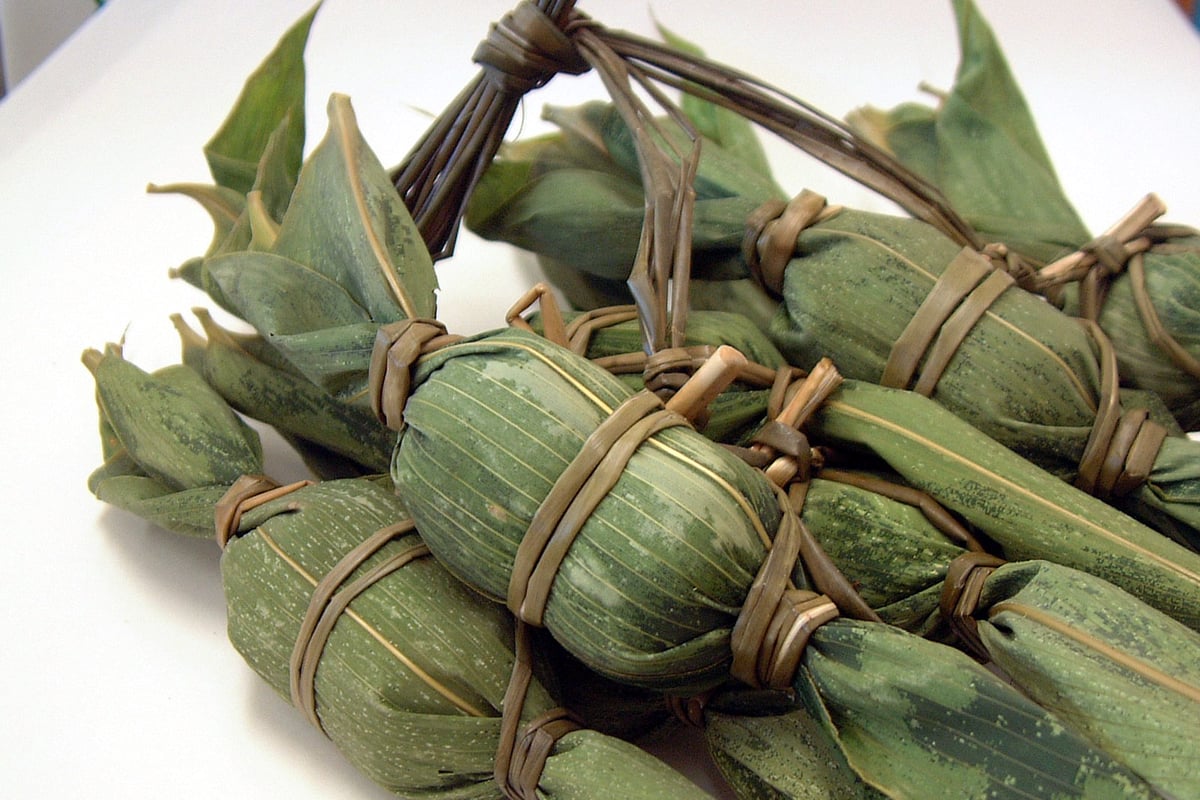
Sasa Dango is a local confection representative of Niigata Prefecture, made by wrapping sweet red bean paste in dumpling dough kneaded with mugwort (yomogi), enclosing it in several sasa (bamboo-grass) leaves, tying it with cords of sedge or rush, and steaming it. It is distinguished by its bale-like shape, with cords tied at both ends. It is said to have been eaten for about 500 years in the Chuetsu and Kaetsu regions of Niigata and in parts of the Aizu region of Fukushima Prefecture. One theory holds that it was a portable preserved food of the Sengoku (Warring States) period that made use of the antibacterial properties of sasa leaves, and that Uesugi Kenshin carried it as field rations; another holds that it arose from the wisdom of making tasty use of broken rice that could not be paid as annual tax. It was once a confection for seasonal events, offered to Yakushi (the Buddha of healing) on the eighth day of the fourth month of the old lunar calendar and made in large quantities for the Boys' Festival (Tango no Sekku) on May 5. It became known nationwide after being chosen as a recommended souvenir by the prefecture and city for the Niigata National Sports Festival (1964, Showa 39), and it is now a classic Niigata souvenir.
Origin
There are various theories about its origin. Because sasa leaves have antibacterial properties, one theory holds that it was born as a portable preserved food during the Sengoku period, and some sources cite a description in the 'Hokuetsu Fudoki' as evidence. There are also stories that Uesugi Kenshin carried it as field rations or even devised it, but these are regarded as folk belief. Another theory holds that it arose from the wisdom of farmers, who ground chipped, broken rice unfit for annual tax payment into flour so that it could be eaten deliciously.
History
In the past, the filling was not limited to red bean paste; some were stuffed with whatever side dishes were at home, such as simmered hijiki or arame seaweed and kinpira (sautéed and simmered burdock root), and it was eaten as everyday food. Sweet bean paste is said to have come into use around the middle of the Meiji era. The turning point was the Niigata National Sports Festival in 1964 (Showa 39). At the request of the prefecture and city, Sasagawa Yukichi (笹川勇吉), the fourth-generation owner of Sasagawa Mochiya, a shop founded in the Meiji era, improved the production method so that the dumplings would keep longer. After being certified as a recommended specialty product, Sasa Dango spread nationwide as a 'Niigata souvenir.'
Features
The basic method is to knead rice-flour dough with mugwort that has been reconstituted in water, wrap it around red bean paste, and roll it into a ball. This is wrapped in about three sasa leaves, tied with sedge or rush cords, and steamed for about 20 minutes. Bundles of about 10 individually tied dumplings are also a familiar sight. The tying method varies by area: around Niigata City they are tied crosswise at the center, called 'yoko-shibari' (horizontal tying), while in former castle towns such as Shibata City and Murakami City they are said to be tied lengthwise, called 'tate-shibari' (vertical tying), so as not to evoke a samurai's seppuku (ritual suicide).
Main Ingredients
Food Culture
It has been made in households in early summer, when the sasa leaves are at their most beautiful, and in the mugwort seasons of spring and autumn. It is a confection for special occasions tied to seasonal events, offered to Yakushi on the eighth day of the fourth month of the old lunar calendar and made in large quantities for the Boys' Festival (Tango no Sekku) on May 5. It is still made at home for festivals and events today.
Famous Shops
笹川餅屋
新潟県新潟市中央区西堀前通4番町739
The long-established shop that sparked Sasa Dango's rise to a Niigata specialty by developing a longer-lasting version as a souvenir for the Niigata National Sports Festival. Its dough is made from Niigata-grown Koganemochi and Koshihikari rice ground with a millstone, and no preservatives are used. Dumplings filled with coarse red bean paste (tsubuan) are said to start from around 160 yen each.
View details →田中屋本店 みなと工房
新潟県新潟市中央区柳島町1-2-3
The workshop store of a Sasa Dango shop founded in 1931 (Showa 6), about a 7-minute drive from JR Niigata Station. Visitors can tour the production process and try making dumplings by hand. Packs of five with coarse (tsubuan) or smooth (koshian) bean paste cost around 1,350 yen, and varieties filled with chamame (a fragrant type of edamame) or kinpira are also available.
View details →江口だんご 本店
新潟県長岡市宮本東方町52-1
A mochi confectionery shop in Nagaoka founded in 1902 (Meiji 35). It is particular about its methods, such as millstone-ground rice, pounding with a wooden pestle (kine), and 'ato-mushi' (post-steaming). The main store has a hands-on workshop called 'Mochi Doma' and a café, and the Sasa Dango-making experience costs around 950 yen (excluding tax) for a set of two.
View details →| Sasa Dango from Tanakaya Honten, CoCoLo Niigata Station Building Shop | A shop with live production demonstrations that opened in March 2024 on the second floor of 'CoCoLo Niigata,' the JR Niigata Station building, where you can buy Sasa Dango before boarding your train. Along with the classic tsubuan and koshian varieties, it also offers items such as chamame Sasa Dango made with Kurosaki chamame.Where to buy →PR |
|---|
FAQ
Q. Has Sasa Dango always been filled with red bean paste?
A. In the past, some were filled with whatever side dishes were on hand, such as simmered hijiki or arame seaweed and kinpira, and they were eaten as everyday meals. Sweet red bean paste is said to have come into use around the middle of the Meiji era.