Image: Wikimedia Commons
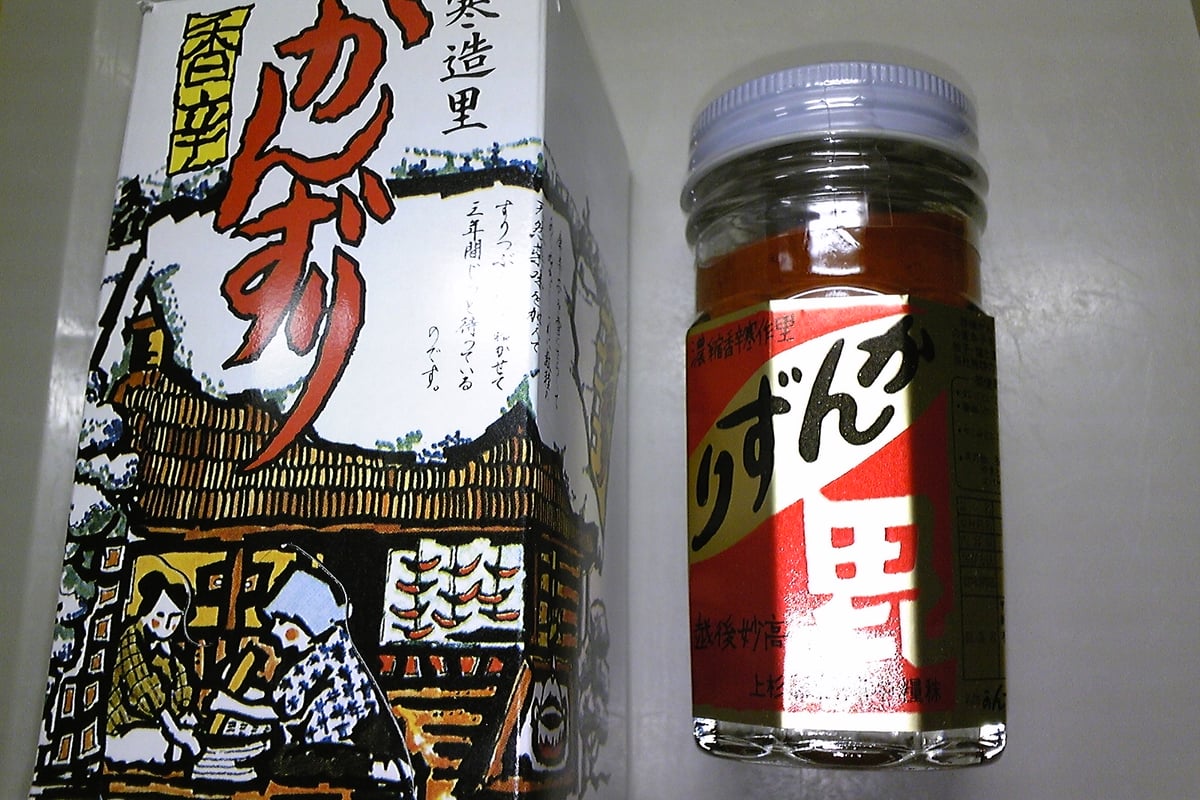
Kanzuri is a fermented spicy seasoning handed down in Myoko City (formerly Arai City), Niigata Prefecture. Salt-pickled chili peppers are laid out on the snow around Daikan (around January 20, the coldest time of year), then combined with rice koji, yuzu, and salt and aged and fermented for about three years. Exposing the chilies to the snow is said to draw out their strong harshness, giving a mellower heat, and it is characterized by a deep flavor in which the aroma of yuzu overlaps with the umami of koji. It is a local flavor that has long been eaten to warm chilled bodies in Myoko, so snowy that it is designated a Special Heavy Snowfall Area, and it is also written with the characters '寒造里.' This regional traditional food was commercialized in 1966 (Showa 41) by Kanzuri Co., Ltd., and the name 'Kanzuri' is the company's registered trademark. 'Snow bleaching' (yuki-zarashi), in which bright red chilies are scattered over white snowfields at Daikan, is known as a signature winter scene of Myoko. Its uses are wide-ranging, from a condiment for hot pots and ramen to an accompaniment for sashimi, and it has become established as a Niigata souvenir.
Origin
The name is also written with the characters '寒造里,' and is said to come from the fact that it is prepared during the coldest time of the year. As for its origin, a legend holds that it began when the Sengoku warlord Uesugi Kenshin brought back from Kyoto chili peppers that had been introduced from Europe and shared them with farmers. It is said to have started as a simple mixture of ground chilies and miso, eaten to warm bodies chilled to the bone in snowy Myoko.
History
The traditional food handed down in the Myoko area was commercialized in 1966 (Showa 41) by Kanzuri Co., Ltd. The company has its head office and factory in Saijo, Myoko City, and grows its 'chili peppers for Kanzuri', whose seeds it has saved itself for many years, on its own fields and through local contract farmers. Kanzuri has spread nationwide as a Niigata souvenir and is gradually becoming known in the United States and elsewhere as a traditional Japanese spice. Snow bleaching at Daikan continues today: on January 20, 2026, employees scattered about 640 kg of chilies over the snowfield at Ikenotaira Onsen Alpen Blick Ski Area.
Features
Chili seeds are sown in mid-March to raise seedlings, and the peppers are harvested from August to November and pickled in salt. When they are laid out on the snow for about three to four days from Daikan (usually around January 20), the snow is said to absorb their harshness. The collected chilies are crushed and combined with koji, yuzu, and salt, then aged and fermented for a full three years, with the contents of the barrels stirred once a year in a process called 'tegaeshi.' The finished product is a red paste, with the fragrance of yuzu coming through its heat.
Main Ingredients
Food Culture
It has taken root in the lives of people in snow country as a seasoning for getting through the severe cold of winter. Its uses are wide-ranging: it is added as a secret ingredient to hot pots, ramen, and pasta, served with sashimi, or used with yakitori and in dipping sauces, and it has also been suggested as a topping for chilled tofu (hiyayakko) in place of soy sauce.
Famous Shops
有限会社かんずり(かんずり工房・売店)
新潟県妙高市西条437-1
A shop attached to the head office factory where you can buy Kanzuri and related products. The standard Kanzuri costs around 864 yen for the large 70 g size and around 561 yen for the mini 40 g size, and there is also a ginjo type aged for six years. Closed on Sundays and public holidays.
View details →道の駅あらい
新潟県妙高市大字猪野山58-1
A roadside station (michi-no-eki) accessible from both the Joshin-etsu Expressway and National Route 18. It has a vegetable stand, restaurants, and lodging, and stocks Kanzuri as a Myoko specialty alongside rice, sake, and seafood from the Sea of Japan.
| Ginjo Kanzuri Six-Year Aged (吟醸かんずり六年仕込) | As the name indicates, this ginjo-type Kanzuri is aged for six years and costs around 1,296 yen for 70 g. As a premium product prepared longer than the standard three-year-aged version, it is sold through Kanzuri Co., Ltd.'s official online shop and elsewhere. |
|---|---|
| Kanzuri Shuto (かんずり 酒盗) | A snack to go with sake that has gained popularity as a collaboration product made with Kanzuri, costing around 594 yen for 80 g. The company also makes 'Kanzuri-zuke,' pickles of mountain vegetables, enoki mushrooms, perilla seeds, and more. |
FAQ
Q. Where does the name 'Kanzuri' come from?
A. It is also written with the characters '寒造里,' and the name is said to come from the fact that it is prepared during the coldest time of the year. There are also examples using the characters '寒作里.' Note that 'Kanzuri' is a registered trademark of Kanzuri Co., Ltd.