Image: Wikimedia Commons
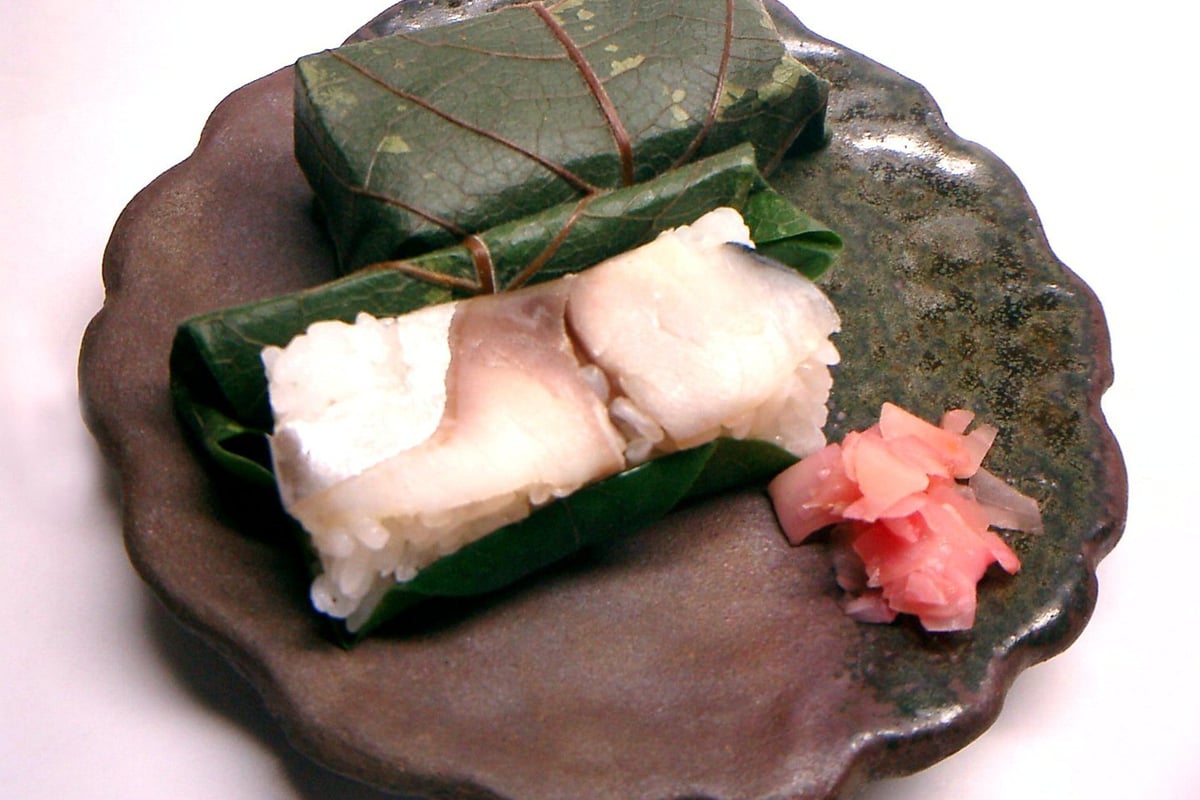
Kakinoha-zushi is a signature local dish of Nara Prefecture in which bite-sized portions of vinegared rice topped with salt-cured slices of mackerel or salmon are individually wrapped in the leaves of the astringent persimmon (shibugaki). It is said to trace back to the mid-Edo period, when summer mackerel from the Kumano-nada sea was salt-cured in Kishu and carried over the mountains to villages along the Yoshino River, where it came to be made in each household as a festive dish for summer festivals. Because fresh seafood was precious in the sea-less Nara Basin, salt-curing was combined with the antibacterial properties of persimmon leaves as a way to improve preservation. Letting the wrapped sushi rest for about a night allows the aroma of the persimmon leaves and the flavor of the fish to blend into the vinegared rice, producing its distinctive taste. Today, makers are found throughout Nara Prefecture, especially in the Yoshino and Gojo areas, and it is known nationwide as one of Nara's representative souvenirs.
Origin
It is said to have originated in the mid-Edo period, when fishermen from Kishu, burdened by heavy taxes, salt-cured summer mackerel caught in the Kumano-nada sea and carried it over mountain passes to sell in villages along the Yoshino River. The leading theory holds that this coincided with the season when villages held their summer festivals, and that wrapping the salted mackerel together with vinegared rice in persimmon leaves became established as a festive food. Another theory holds that it developed as a preserved, portable food.
History
In sea-less Nara, seafood was precious, and eating fish had long been a wish of the people even from the era when Nara was the capital. As a way to eat salted mackerel deliciously while keeping it preservable, kakinoha-zushi spread to households throughout the region and has been passed down as a dish for summer festivals and for entertaining guests. Today, numerous specialist makers have emerged mainly in the Yoshino and Gojo areas, and it has developed into one of Nara's representative souvenirs.
Features
Bite-sized balls of vinegared rice are topped with thin slices of mackerel or salmon and carefully wrapped, one at a time, in leaves of the astringent persimmon, which contain antibacterial tannins. Letting the wrapped sushi rest for about a night allows the aroma of the persimmon leaves and the flavor of the fish to transfer into the vinegared rice, giving it a mellow taste. Although it is a type of pressed sushi, it can be eaten easily once the leaf is removed, which is another reason it has been valued as a dish for festivals and hospitality.
Main Ingredients
Food Culture
In the sea-less Nara Basin, seafood was a precious commodity, and the technique of wrapping salt-cured fish in persimmon leaves to extend its shelf life took root as a piece of everyday wisdom. It has been made in households for summer festivals, the Bon holiday, and to entertain guests, and today it remains a dish symbolic of Nara's food culture.
Famous Shops
柿の葉すし本舗たなか なら本店
奈良県奈良市東向中町5番地2
Around 1,059 yen and up for a pack of 7 mackerel pieces. A long-established brand with its main shop in Nara City.
View details →柿の葉ずし総本家 平宗 奈良店
奈良県奈良市今御門町30-1
A long-established shop with a history of over 160 years. Individual sushi pieces from around 1,500 yen; the hanare kaiseki course runs up to around 8,800 yen.
View details →| Kakinoha-zushi Honpo Tanaka: Mackerel and Salmon Assortment | A classic set combining mackerel and salmon, priced at around 1,156 yen for a pack of 7. Available at the main shop in Nara City and via the online shop.Where to buy →PR |
|---|