Image: Wikimedia Commons
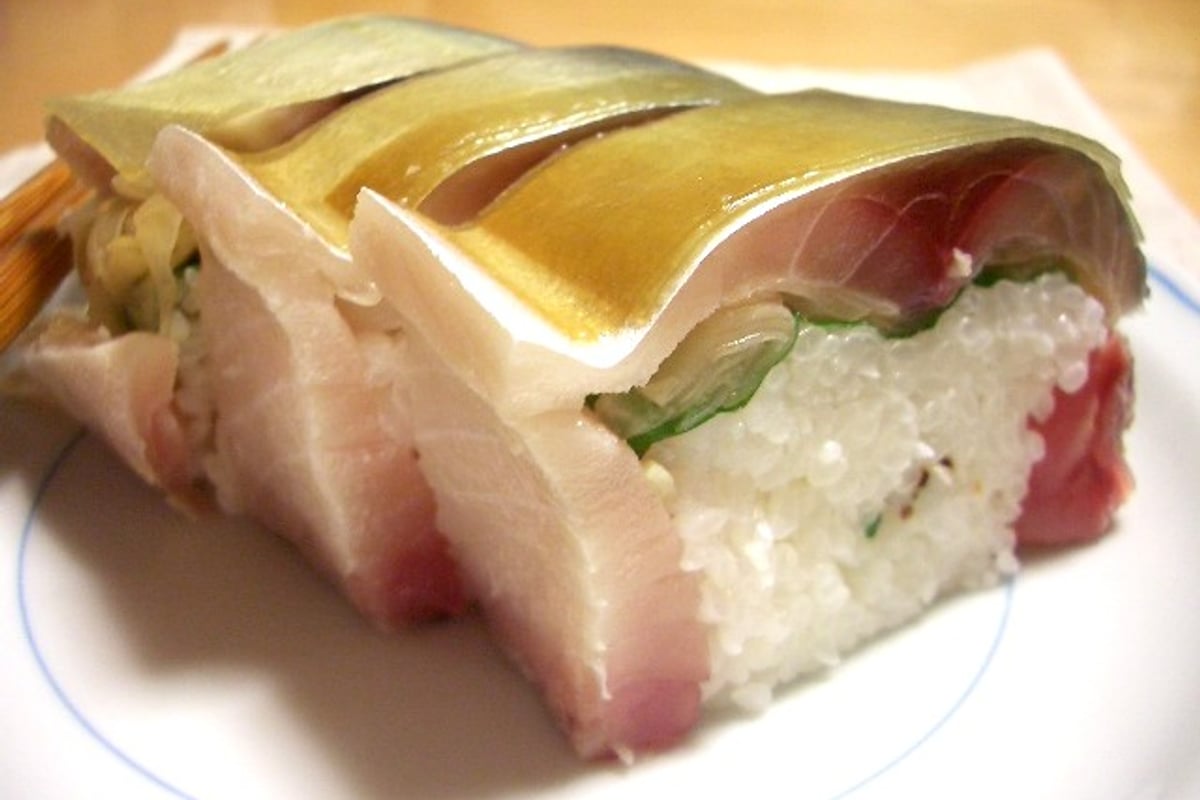
Osaka-zushi is a general term for the sushi that has been made in Osaka, including pressed sushi, rolled sushi (makizushi), and steamed sushi (mushi-zushi). In contrast to the nigiri sushi of Edo, the mainstream in Osaka was oshizushi (pressed sushi), in which sushi rice and toppings are packed into a wooden frame or box and pressed firm. The leading example is hako-zushi (box-pressed sushi), which is pressed in a wooden box and cut into bite-size pieces. Yoshino Sushi (吉野寿司) in Senba, founded in 1841 (Tenpo 12), is said to have devised a colorful hako-zushi using sea bream, shrimp, conger eel (anago), and other toppings in the Meiji era. Also called '2-sun-6-bu kaiseki,' this hako-zushi was favored by the masters of Senba's merchant houses (danna-shu). Another specialty is battera, made by layering vinegar-cured mackerel and shiraita kombu (thin white kelp sheets) and pressing them together. It is said to have been devised in 1891 (Meiji 24) by 寿司常 in Minami-Senba, and its name derives from a Portuguese word meaning small boat. Because it is pressed firm to remove the air, it keeps well, and it has long been valued as a boxed lunch for theatergoers and as a gift to bring when visiting.
Origin
In Kansai, oshizushi, in which fish and rice are pressed firm in a box or wooden frame, has long been popular. Among ordinary people, oshizushi made with inexpensive, common fish such as mackerel and horse mackerel was typical. At Yoshino Sushi in Senba, founded in 1841 (Tenpo 12), the third-generation owner is said to have devised hako-zushi using luxurious toppings such as sea bream, shrimp, and conger eel in the Meiji era. Hako-zushi, with bite-size pieces of sushi arranged colorfully in a box, won strong support from the masters of Senba's merchant houses.
History
Hako-zushi does not easily lose its flavor even as time passes, making it ideal as a boxed lunch during intermissions (makuai) at the theater or as a gift. For this reason, it spread throughout Osaka as a standard dish for entertaining guests. In 1891 (Meiji 24), 寿司常 in Minami-Senba devised battera. At first it used konoshiro (gizzard shad), which was caught in abundance in Osaka Bay, but this was gradually replaced by the more readily available mackerel, and the pressing mold also changed to a square box. 寿司常 closed at one point, but the fourth-generation owner reopened the shop in 2016.
Features
Hako-zushi is made by packing sushi rice into a wooden frame, layering on sweet and savory simmered shiitake, tamagoyaki (rolled omelet), and prepared seafood, then putting on the lid and pressing firmly. The toppings take time and effort to prepare: they are cured in vinegar or seasoned in advance with dashi or simmering liquid. Pressed sushi is said to taste better after sitting for a while, as the flavors of the rice and toppings blend. Battera is made by pressing thinly sliced vinegar-cured mackerel and sushi rice in a wooden frame and wrapping it in shiraita kombu moistened with vinegar. Another feature is that it can be eaten without soy sauce.
Main Ingredients
Food Culture
Hako-zushi is still enjoyed as an accompaniment when watching kabuki or rakugo, and as a feast for special occasions (hare no hi). Battera is a familiar sushi that can be bought at reasonable prices even at supermarkets and convenience stores. In Osaka, the shiraita kombu used for battera is sometimes called 'battera kombu.'
How It Differs from Home Cooking
At home, people sometimes make battera and similar sushi easily using store-bought vinegar-cured mackerel and a pressing mold. Hako-zushi at specialty shops takes days of preparation, such as curing sea bream with salt and letting it rest for a day, or simmering shiitake for a long time and then letting them rest further. Because of the effort required, the number of shops serving hako-zushi is said to be declining.
Famous Shops
吉野寿司
大阪府大阪市中央区淡路町3-4-14
Founded in 1841 (Tenpo 12), this long-established shop is known as the birthplace of hako-zushi. Its hako-zushi, made by pressing grilled conger eel, small sea bream, thick rolled omelet, shrimp, and more in a wooden frame, costs about 3,197 yen (tax included) for a 10-piece single serving. It focuses mainly on takeout and also has outlets in Takashimaya Osaka and at Shin-Osaka Station.
View details →寿司常
大阪府大阪市北区天神橋2-4-3
A shop said to have devised battera in 1891 (Meiji 24). It closed at one point, but the fourth-generation owner reopened it in 2016 and carries on the battera devised by the founder. It has also been selected for the Michelin Guide's Bib Gourmand.
| すし萬 Kodai Suzume-zushi (Small Sea Bream Pressed Sushi) | A specialty of すし萬, which began as a fish shop in 1653 (Joo 2) and became a shop specializing in suzume-zushi in 1781 (Tenmei 1). It is a pressed sushi made with a whole wild small sea bream from the Seto Inland Sea, and costs about 4,320 yen (tax included) per bar. The main store is located at 大阪市西区靱本町2-3-7. |
|---|
FAQ
Q. Where does the name 'battera' come from?
A. It is said to come from 'bateira' (バッテイラ), a Portuguese word meaning small boat. When it was first devised, it used konoshiro opened flat, and it is said to have been named because the shape of the sushi topped with a half fillet resembled a small boat. Later, mackerel came to be used, and the shape also changed to a square box shape.
Q. What does '2-sun-6-bu kaiseki' mean?
A. It is a phrase known as another name for hako-zushi. It is said to liken the sight of sea bream, shrimp, conger eel, tamagoyaki, and other toppings arranged colorfully in a small wooden box to kaiseki cuisine. 2 sun 6 bu is about 8 cm and is said to refer to the size of the box, although some sources give the inner dimension of Yoshino Sushi's box as 2 sun 2 bu.