Image: Wikimedia Commons
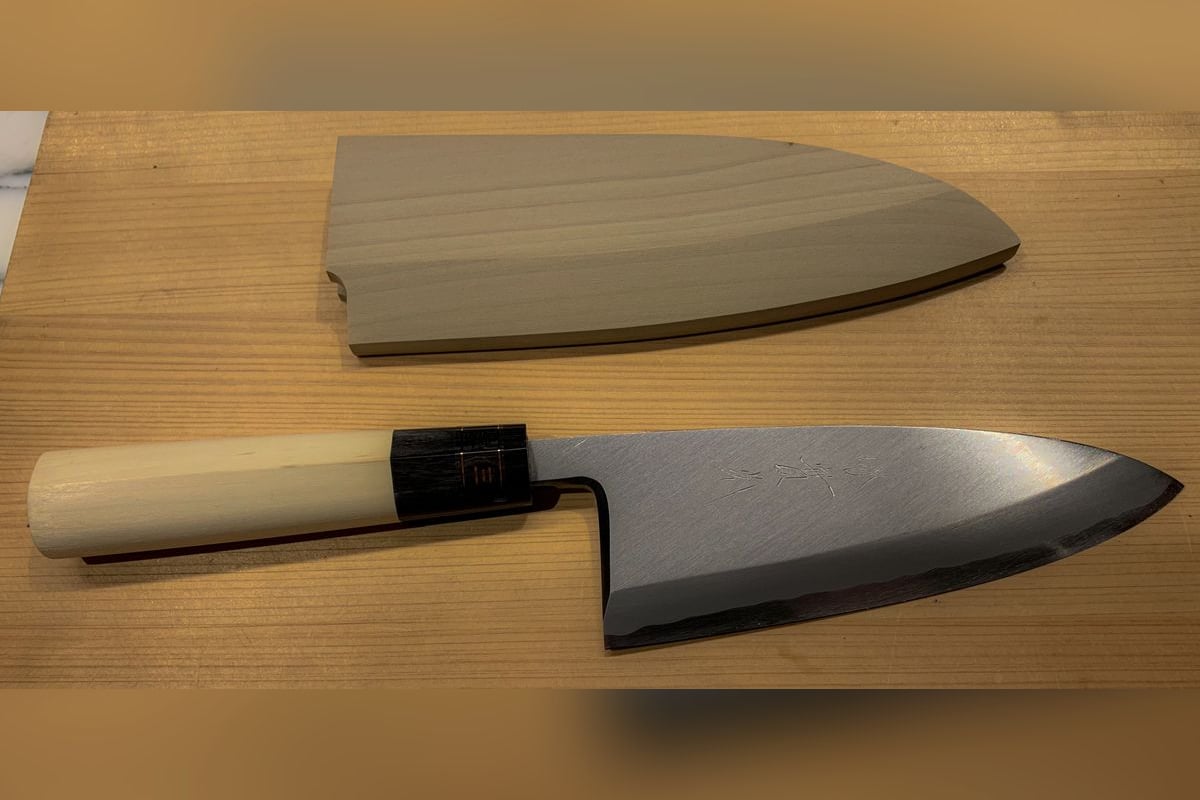
Sakai Uchihamono (堺打刃物) are kitchen knives, scissors and other bladed tools made mainly in Sakai City, Osaka Prefecture. After firearms and tobacco arrived from Portugal in the 16th century, Sakai began making 'tobacco knives' for shredding tobacco leaves. The Edo shogunate is said to have recognized their quality and allowed them to be sold stamped with the 'Sakai Kiwame' hallmark. This spread Sakai's name throughout the country, and production eventually developed into cooking knives such as the deba knife. Making a knife is divided among specialists: 'forging,' which shapes the blade; 'sharpening (hatsuke),' which grinds and hones the edge; and 'handle fitting (etsuke),' which attaches the handle. Knives made by forge-welding hard blade steel onto a soft iron base are said to neither break nor bend and to cut well. Sakai is also said to account for about 90 percent of the domestic market for Japanese kitchen knives (wa-bocho) used by professional chefs. In 1982 (Showa 57), Sakai Uchihamono was designated a Traditional Craft Designated by the Minister of Economy, Trade and Industry.
Origin
Sakai's blacksmithing skills are sometimes traced back to the making of tools used to build the huge burial mounds of the Kofun period. When firearms arrived in the mid-16th century, Sakai became a major center of gun production. Tobacco later arrived from Portugal as well, and in the late 16th century, Sakai began making 'tobacco knives' for shredding tobacco leaves. Osaka Prefecture describes the production of tobacco knives as having started in the Azuchi-Momoyama period.
History
The Edo shogunate gave Sakai's tobacco knives the 'Sakai Kiwame' hallmark and granted them exclusive sales rights, and their sharpness became known nationwide. Deba knives and other cooking knives came to be made afterward. Sources differ on when the deba knife appeared, some placing it in the early Edo period and others in the mid-Edo period. In the late Edo period, flower-arranging shears and garden shears were also made, and specialist makers formed trade guilds (kabunakama) that shaped the production area. Sakai Uchihamono was designated a national traditional craft in 1982 and registered as a regional collective trademark in 2007.
Features
Sakai Uchihamono are basically made by forge-welding a soft iron base (jigane) to high-carbon blade steel (hagane). Because the soft base supports the edge hardened by quenching, the knives are said to neither break nor bend and to cut well. Single-bevel Japanese kitchen knives are the core of production, with many types available for different uses, such as the yanagiba (sashimi knife) and the deba knife. The division of labor, in which forging, sharpening and handle fitting are each carried out by different craftspeople, continues today, and many craftspeople's hands go into a single knife.
Techniques
Forging (hizukuri)
The work begins with 先付け, in which blade steel is laid on the base iron, heated to about 900 degrees and hammered together. The piece is drawn out and shaped, then goes through annealing and rough hammering. Quenching in water from 750 to 800 degrees, followed by tempering at 180 to 200 degrees, gives the blade both hardness and toughness.
Sharpening (hatsuke)
Blades delivered from the blacksmith are sharpened in stages: rough grinding, main grinding, back grinding and setting the small secondary edge. Dento Kogei Aoyama Square explains that there are 27 steps, including straightening and the kasumi bokashi (misty blurred finish). Under the standards for national traditional crafts, sharpening, honing and finishing must be done by hand.
Honyaki
A knife made entirely of blade steel, without a base iron. Because the blade is coated with clay (土置き) before being quenched, it is prone to cracking and warping, and advanced skill is required. For knives that combine base iron and blade steel, the blade is instead coated with mud (泥塗り) before quenching.
Materials Used
Production Process
- 1
Forging
Steel stock is cut and heated, and the base iron and blade steel are forge-welded together. The piece is drawn out into the shape of a knife with a belt hammer or similar tool, and its structure is tightened by annealing and rough hammering.
- 2
Quenching and tempering
The blade, coated with mud and dried, is heated in a furnace and rapidly cooled in water to harden it. It is then heated again at a lower temperature and left to cool naturally, giving the blade toughness.
- 3
Sharpening (hatsuke)
Rough grinding and main grinding are done on large rotating whetstones, and any distortion is corrected with a chisel (tagane). The hollow on the back is shaped by back grinding, and the final edge is put on with a small whetstone.
- 4
Handle fitting (etsuke)
The tang (nakago) at the base of the knife is heated and inserted into a wooden handle, and the end of the handle is struck with a wooden mallet to fix it in place. Finally, the maker's name is engraved to finish the knife.
| Main Production Areas |
|
|---|
Artisans & Workshops
水野鍛錬所
A blacksmith in 桜之町西, Sakai Ward, Sakai City, founded in Meiji 5 (1872). In a traditional workshop equipped with a bellows, it forges kitchen knives and swords. It was chosen as a smith (kokaji) for the dismantling and restoration of Horyu-ji Temple, and displays in the shop a sickle identical to the talismanic sickles on the temple's five-story pagoda.
Official site →芦刃物製作所
A cutlery maker in 並松町, Sakai Ward, Sakai City. Combining machine technology with the handwork of craftspeople, it focuses on cooking knives and also makes custom knives and seal-engraving knives. It handles everything from quenching to sharpening, handle fitting and inspection in-house. Tours of the production process are available by reservation.
Official site →How to Buy
- 堺伝匠館 (Sakai Traditional Industry Hall)
- A facility at 材木町西1丁1-30, Sakai Ward, Sakai City, that brings together Sakai's traditional industries. The shop on the first floor sells kitchen knives and whetstones, and the Sakai Knife Museum on the second floor introduces their history and production process. Admission is free. Closed on the third Tuesday of each month (the following day if it falls on a national holiday) and over the New Year holidays.Where to buy →PR
- Buying from blacksmiths and knife shops
- Knives can be bought directly from knife shops that double as workshops, such as 水野鍛錬所 and 芦刃物製作所. 藤井刃物製作所 (北旅籠町西, Sakai Ward) sells household bunka knives and deba knives for about 5,000 to 20,000 yen. Most workshop tours require a reservation.
Hands-on Experiences
和田商店 包丁づくり体験(研ぎ・柄付け)
大阪府堺市堺区神明町東1-1-1
At this knife shop, founded about 150 years ago, visitors can try sharpening and handle fitting under the guidance of a craftsperson and take home the knife they finish. You can choose from a petty knife, deba knife, sashimi knife or all-purpose knife, and it takes about 90 to 120 minutes. The fee ranges from about 12,000 to 18,000 yen depending on the publication. Reservations are required.
View details →FAQ
Q. Why do professional chefs choose Sakai knives?
A. Because Sakai offers a wide range of single-bevel knives suited to Japanese cooking, such as the yanagiba and the deba knife. Another reason given is that forging, sharpening and handle fitting are divided among specialists who have each refined their own process. There are also sharpeners who respond to chefs' detailed requests, and Sakai is said to hold about 90 percent of the market for professional Japanese kitchen knives.
Q. What is 'Sakai Kiwame'?
A. It is a hallmark certifying quality that the Edo shogunate gave to Sakai's tobacco knives. Knives stamped with this mark were granted exclusive sales rights, and this became the starting point for the reputation of Sakai's blades spreading across the country.