Image: Wikimedia Commons
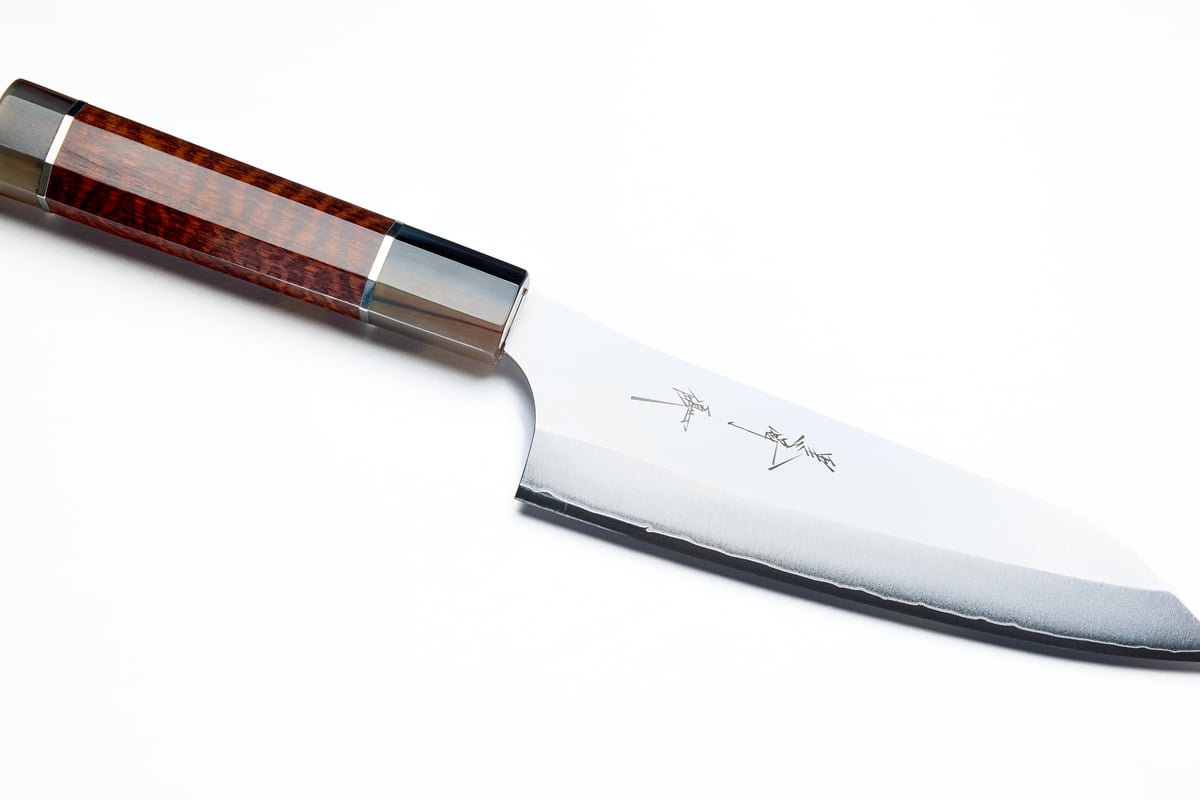
Echizen Uchihamono are forged blades made in Echizen City, Fukui Prefecture. They are said to have begun about 700 years ago in the Nanboku-cho period, when Chiyozuru Kuniyasu, a swordsmith from Kyoto, moved to Fuchu (present-day Echizen City) in search of good water for swordmaking and made sickles for the local farmers. In the Edo period the craft developed under the protection of the Fukui Domain. As Echizen lacquer-tapping craftsmen traveling around the country carried sickles with them and sold them, the name of Echizen blades spread far and wide. Techniques of hizukuri (hot forging) and hand finishing have been handed down, including 'nimai-hiroge,' in which two blades are stacked and hammered out together. The blades are known for being thin, light and exceptionally sharp, and today the main products are kitchen knives and other knives. In 1979, it became the first forged-blade craft to be designated a Traditional Craft Designated by the Minister of Economy, Trade and Industry. At Takefu Knife Village in the city, visitors can watch craftsmen at work up close.
Origin
The origins of Echizen Uchihamono are traced to around 1337, in the Nanboku-cho period. Chiyozuru Kuniyasu, a swordsmith from Kyoto, came to Fuchu (present-day Echizen City) in search of good water for making swords. It is said that alongside making swords, Kuniyasu made sickles for the local farmers. This is regarded as the beginning of Echizen Uchihamono, and the city also has a promotional facility, 'Echizen Chiyozuru no Yakata,' named after the founder.
History
In the Edo period, under the protection of the Fukui Domain, a blacksmiths' quarter and wholesale district were established, and kabunakama (trade guilds) were organized. As Echizen lacquer-tapping craftsmen traveled around the country carrying sickles and selling them, the market spread to many regions. From the mid-Edo period through the Meiji period, Echizen sickles boasted one of the largest production volumes in Japan. In January 1979, it became the first forged-blade craft to be designated a national Traditional Craft.
Features
The distinctive quality of Echizen Uchihamono lies in Japan's traditional hizukuri forging techniques and hand finishing. The blades, forged by hammering heated steel, are characteristically thin and light. Sickles were once the main product, but today kitchen knives and other knives are central, and hatchets and pruning shears are also made. The kitchen knives are favored by chefs in Japan and abroad, and custom knives with outstanding design are also gaining popularity.
Techniques
Nimai-hiroge (Two-Blade Spreading)
A technique unique to Echizen in which two blades are stacked and hammered out from both sides with a belt hammer. The work is done quickly so that both blades are stretched equally thin. It has been handed down as the technique that produces Echizen's thin, light blades.
Mawashi-hagane-tsuke
A technique in which the steel that forms the cutting edge is flattened diagonally into a diamond shape and attached. It has been used to make sickles that are thin, easy to sharpen and yet durable. Together with nimai-hiroge, it has been passed down to the present day as a traditional Japanese forging technique.
Materials Used
Production Process
- 1
Preparing the Steel
The steel that will form the blade is prepared.
- 2
Warikomi and Wakashi-zuke (Forge Welding)
The steel is sandwiched in the base iron, heated and hammered to join them into one piece.
- 3
Nimai-hiroge
Two blades are stacked and hammered out to spread them thin.
- 4
Quenching and Tempering
The heated blade is rapidly cooled to harden it, then reheated to give it toughness.
- 5
Sharpening and Finish Sharpening
The blade is sharpened to perfect its cutting edge.
| Main Production Areas |
|
|---|
Artisans & Workshops
タケフナイフビレッジ
A joint workshop in Yokawa-cho, Echizen City, run by a dozen or so blade companies. It was founded by craftsmen in 1993, at a time when the production area was declining due to the spread of stainless steel products and inexpensive stamped blades. Craftsmen from each company hone their skills beyond company boundaries, and it offers tours, a shop and hands-on classes.
Official site →龍泉刃物
A blade maker headquartered in Ikenokami-cho, Echizen City. Founded in 1948 (Showa 23), it makes kitchen knives using Echizen's forging techniques, which have continued for 700 years. In recent years it has also produced cutlery and has received awards such as the Good Design Award.
Official site →How to Buy
- タケフナイフビレッジ Shop
- A shop attached to the joint workshop, selling kitchen knives from the participating companies and original products. Customers can also consult about resharpening and repairs. Open 9:00 to 17:00.Where to buy →PR
- 越前打刃物会館
- A facility at 49-1-3 Ikenokami-cho, Echizen City. It introduces the craft's 700-year history and manufacturing process through panels and videos, and also displays works by master craftsmen. Kitchen knives, sickles, hatchets, pruning shears and more are sold at factory-direct prices. Admission is free.Where to buy →PR
Hands-on Experiences
タケフナイフビレッジ
福井県越前市余川町22-91
Workshop tours are free, and visitors can see craftsmen at work up close. The double-edged kitchen knife class for individuals costs around 20,000 yen (about 6 hours, ages 18 and over), and participants can experience hizukuri forging and attaching the handle. Advance reservations are required for hands-on activities.
View details →FAQ
Q. Where can I see and buy Echizen Uchihamono?
A. At Takefu Knife Village, you can tour the joint workshop for free and buy kitchen knives at the attached shop. At the Echizen Uchihamono Kaikan, you can choose blades at factory-direct prices while viewing exhibits on the history and manufacturing process.
Q. What is the connection between Echizen Uchihamono and Echizen Shikki?
A. In the Edo period, Echizen lacquer-tapping craftsmen traveled around the country to collect lacquer. It is said that the Echizen sickles they carried and sold on these journeys helped expand the market for Echizen Uchihamono.