Image: Wikimedia Commons
Echizen Shikki is lacquerware made mainly in the Kawada district of Sabae City, Fukui Prefecture. It is said to have begun about 1,500 years ago, when the future Emperor Keitai, then still a prince, ordered a lacquerer in the village of Katayama to recoat his damaged crown. The lacquerer presented the crown together with a black-lacquered bowl, and the prince, impressed by the fine workmanship, encouraged the making of lacquerware. It is characterized by a glossy, durable finish created by carefully applying layer upon layer of lacquer over a sturdy base. At the end of the Edo period, the area adopted maki-e techniques from Kyoto and chinkin techniques from Wajima. From the Meiji period onward, it expanded sales of commercial lacquerware for inns and similar businesses, and today it produces most of the lacquerware used in the restaurant and food service industry. In 1975 it became a Traditional Craft Designated by the Minister of Economy, Trade and Industry.
Origin
The origins of Echizen Shikki are said to date back about 1,500 years, to the late Kofun period. When the 26th emperor, Emperor Keitai, was living in Echizen as Prince Odo (Odo no O), he ordered a lacquerer in the village of Katayama (present-day Katayama-cho, Sabae City) to recoat his damaged crown. The lacquerer repaired the crown and presented it along with a black-lacquered bowl. It is said that the prince, impressed by the splendid workmanship, encouraged the making of lacquerware, and that this was the beginning.
History
In the Muromachi period, bowls made in the Katayama area came to be called 'Katayama-wan' (Katayama bowls). At the end of the Edo period, the area broadened its range of decoration by adopting maki-e techniques from Kyoto and chinkin techniques from Wajima. From the mid-Meiji period, production of angular items such as trays, tiered boxes and serving trays increased, and a mass-production system was established that opened up sales of commercial lacquerware to inns and other businesses. Production spread throughout the Kawada district, and in 1975 it was designated a national Traditional Craft.
Features
It is characterized by a beautiful luster and elegant appearance that come from carefully applying layer upon layer of lacquer over a sturdy base. The production area has an established division of labor in which specialized craftsmen handle each stage: making the wooden base, groundwork, lacquering and decoration. In addition to traditional items such as bowls, dining trays and tiered boxes, vessels in new colors are also being developed. For commercial use, the area also makes synthetic resin lacquerware and produces 80 to 90 percent of the lacquerware used in the restaurant and food service industry.
Techniques
Uwanuri (Top Coating: Hana-nuri and Roiro-nuri)
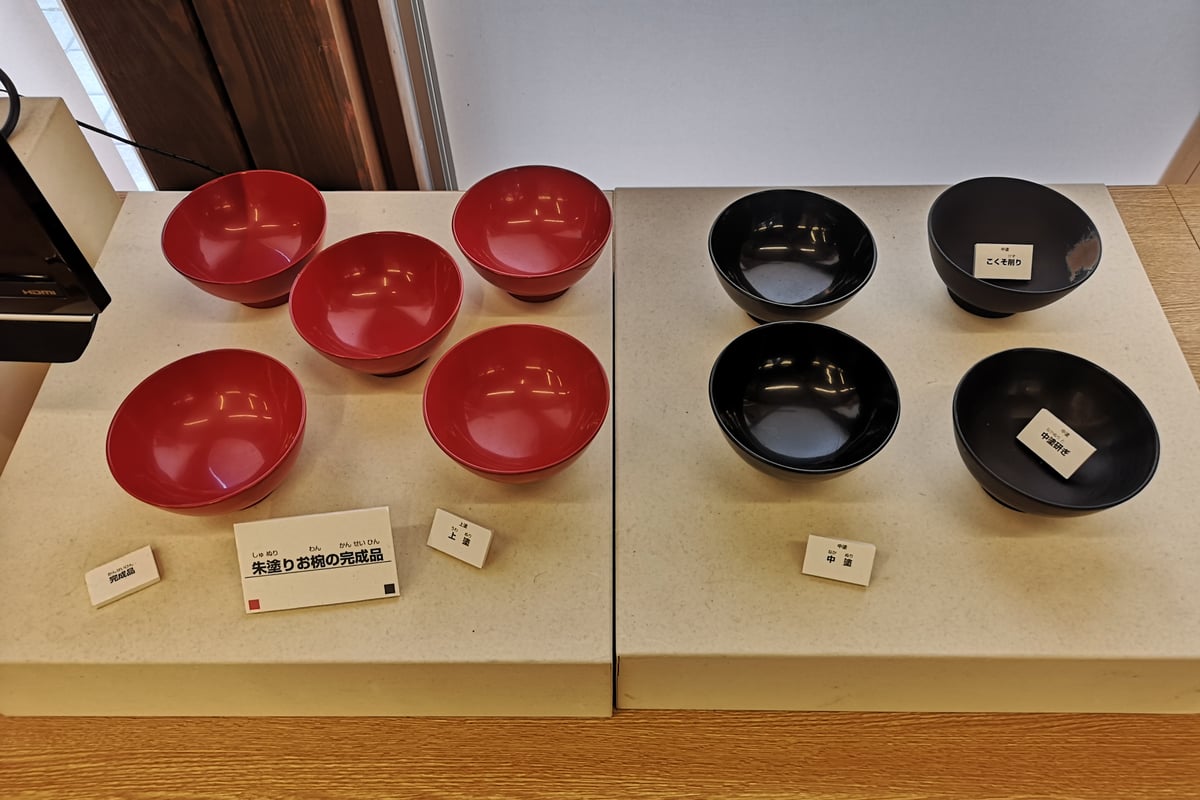
Hana-nuri is a technique in which the top coat of lacquer is left unpolished and finished as a beautiful lacquered surface. In roiro-nuri, the top coat is repeatedly ground and polished to bring out a deep luster. Both have been handed down as representative finishes of Echizen Shikki.
Maki-e and Chinkin
Maki-e is a decorative technique in which designs are drawn in lacquer and gold or silver powder is sprinkled on before it dries. In chinkin, designs are carved into the lacquered surface and gold leaf or gold powder is applied to the grooves. Both were introduced from Kyoto and Wajima at the end of the Edo period.
Materials Used
Production Process
- 1
Making the Wooden Base
The shape of the vessel is formed, for example by turning wood on a lathe.
- 2
Groundwork (Shitaji)
A sturdy base is prepared, for example with 'shibu-shitaji,' which uses persimmon tannin.
- 3
Nakanuri (Middle Coating)
Layers of lacquer are applied and ground to even out the surface.
- 4
Uwanuri (Top Coating)
The piece is finished with hana-nuri or roiro-nuri.
- 5
Decoration
Designs are applied using maki-e or chinkin.
| Main Production Areas |
|
|---|
Artisans & Workshops
漆琳堂
A lacquerware maker founded in 1793 (Kansei 5), headquartered in Nishibukuro-cho, Sabae City. Its eighth-generation head, Uchida Toru, became the youngest certified traditional craftsman in the production area in 2012. It works to create lacquerware suited to modern life, for example by developing 'Echizen Kataurushi,' which can be washed in a dishwasher.
Official site →越前漆器協同組合
The production-area cooperative, based at the Urushi no Sato Kaikan in Nishibukuro-cho, Sabae City. Through exhibitions, demonstrations in craftsmen's workshops and hands-on classes, it conveys the skills and appeal of Echizen Shikki, which is supported by a division of labor.
Official site →How to Buy
- うるしの里会館 Museum Shop
- It displays and sells more than 1,000 kinds of Echizen Shikki at prices only available in the production area. Open 9:00 to 17:00; closed on the fourth Tuesday of every month (or the following day if it falls on a public holiday) and during the year-end and New Year holidays.Where to buy →PR
- 漆琳堂 Flagship Store
- A directly run store at 701 Nishibukuro-cho, Sabae City. In addition to traditional lacquerware, it carries items from its original brands 'Shitsurindo,' 'RIN&CO.' and 'aisomo cosomo,' such as vessels in colorful hues. Open 10:00 to 17:00; closed irregularly.
Hands-on Experiences
うるしの里会館
福井県鯖江市西袋町40-1-2
Under the guidance of craftsmen, visitors can try lacquer painting (around 2,200 yen), chinkin (around 2,500 yen) and fuki-urushi (wiped lacquer, around 3,300 yen). Each can be completed within an hour. Available for groups of 2 or more, with a reservation required 2 to 3 days in advance.
View details →FAQ
Q. What was the 'Echizen-shu'?
A. They were groups of craftsmen from Echizen who traveled throughout Japan from the Edo period to the Meiji period tapping lacquer trees (collecting lacquer). They spread a tapping technique known as the 'Echizen-shiki Koroshigaki method' to various regions. The fact that they sold Echizen sickles on their lacquer-tapping journeys also helped expand the market for Echizen Uchihamono.
Q. What is commercial lacquerware?
A. It is lacquerware used at inns, hotels, restaurants and similar establishments. Echizen Shikki opened up commercial sales channels in the Meiji period, and today the area produces 80 to 90 percent of the lacquerware used in the restaurant and food service industry, including synthetic resin items.