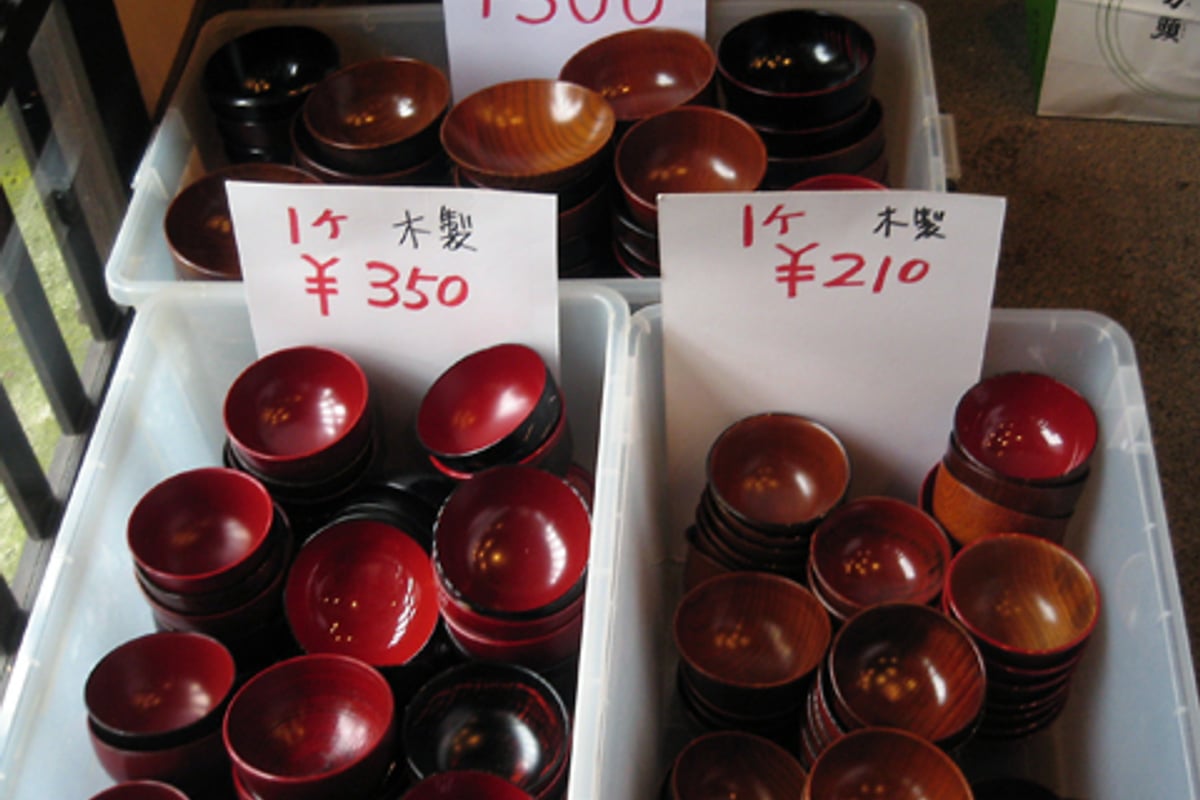
Image: Wikimedia Commons
Yamanaka Lacquerware is produced mainly in the Yamanaka Onsen district of Kaga City, Ishikawa Prefecture, and is known for its exceptional wood-turning skill, earning it the nickname 'Yamanaka of the woodwork.' It is said to have begun in the Azuchi-Momoyama period, when a group of wood-turning craftsmen who traveled from mountain to mountain making bowls and trays on lathes settled in the Masago area upstream of Yamanaka Onsen and began turning wood there. During the Edo period, lacquering and maki-e techniques were introduced from Aizu, Kyoto, and Kanazawa, adding decorative turning and vermilion-tinted lacquering techniques unique to the region. Its greatest characteristic is its lathe-turning craftsmanship: 'tategi-dori,' cutting wood along the grain to produce a beautiful, warp-resistant base, along with intricate decorative turning techniques unmatched elsewhere, such as 'sensuji,' carving a dozen or more fine lines into a width of just three millimeters, and 'usubiki,' turning wood so thin it becomes translucent. In the field of turned woodwork, its craftsmen are considered top-class nationwide in both skill and numbers, and it was designated a national Traditional Craft in 1975.
Origin
The origins of Yamanaka Lacquerware trace back roughly 400 years to the Azuchi-Momoyama period. A group of wood-turning craftsmen who traveled from mountain to mountain making bowls, trays, and other turned goods settled in the Masago area upstream of Yamanaka Onsen, and, making use of the area's abundant timber resources, began turning wood there — this is considered the craft's origin. The wood-turning technique of rotating timber on a lathe and applying a blade to carve it into vessel shapes was refined in an environment blessed with Yamanaka's terrain and timber.
History
During the Edo period, lacquering and maki-e techniques were introduced from Aizu, Kyoto, and Kanazawa, giving rise to techniques such as decorative turning and vermilion-tinted lacquering and further developing Yamanaka Lacquerware. The wood-turning technique has been passed down through generations, producing many master craftsmen, including Kawakita Ryozo, the first wood-turning craftsman to be recognized as a Living National Treasure. Today it is registered as an Ishikawa Prefecture Intangible Cultural Property under the name 'Yamanaka Turned Woodwork,' and in 1975 it was designated a national Traditional Craft as 'Yamanaka Lacquerware.'
Features
Yamanaka Lacquerware's greatest characteristic lies in its beautiful, warp-resistant wood base produced through 'tategi-dori,' cutting the wood along the grain, combined with intricate lathe-turning skill. Techniques of decorative turning unmatched elsewhere include 'sensuji,' carving a dozen or more fine lines into a width of just three millimeters, and 'usubiki,' turning wood so thin it becomes translucent. Known alongside 'lacquering in Wajima' and 'maki-e in Kanazawa' as 'woodwork in Yamanaka,' its craftsmen are considered top-class nationwide in both skill and numbers in the field of turned woodwork.
Techniques
Tategi-dori (Vertical Wood-Grain Cutting)
A technique unique to Yamanaka Lacquerware of cutting the wood base along the grain, in the vertical direction. Compared with the horizontal 'yokogi-dori' method, it warps less and makes better use of the beauty of the grain.
Decorative Turning (Sensuji and Usubiki)
Turning techniques using the lathe to produce intricate patterns and textures, such as 'sensuji,' carving a dozen or more fine lines into a width of just three millimeters, and 'usubiki,' turning wood so thin it becomes translucent.
Materials Used
Production Process
- 1
Wood Cutting
Material for the vessel is cut from timber using the tategi-dori method.
- 2
Rough Turning
The wood base is roughly shaped on the lathe.
- 3
Drying
The roughly turned wood base is dried thoroughly.
- 4
Finish Turning
The lathe is used to turn the piece to its final shape and thickness.
- 5
Lacquering and Decoration
Layers of lacquer are applied, and maki-e or other decoration is added as needed.
| Main Production Areas |
|
|---|
Artisans & Workshops
浅田漆器工芸
A lacquerware workshop in Yamanaka Onsen founded in 1912. It handles everything from wood-turning to lacquering in-house, proposing Yamanaka Lacquerware suited to everyday life.
Official site →How to Buy
- 山中塗うるし座(山中漆器伝統産業会館)
- A facility exhibiting and selling works by Living National Treasure Kawakita Ryozo alongside products from more than 40 companies in the production district. It carries a wide range, from traditional lacquerware to pieces suited to modern living.Where to buy →PR
Hands-on Experiences
石川県立山中漆器産業技術センター(山中うるし座 隣接)
石川県加賀市山中温泉塚谷町イ268-2
Reservation required. Visitors can tour the wood-turning workshop and try a lathe-turning experience. The lathe experience is from around 3,850 yen and takes 20 minutes or more.
View details →