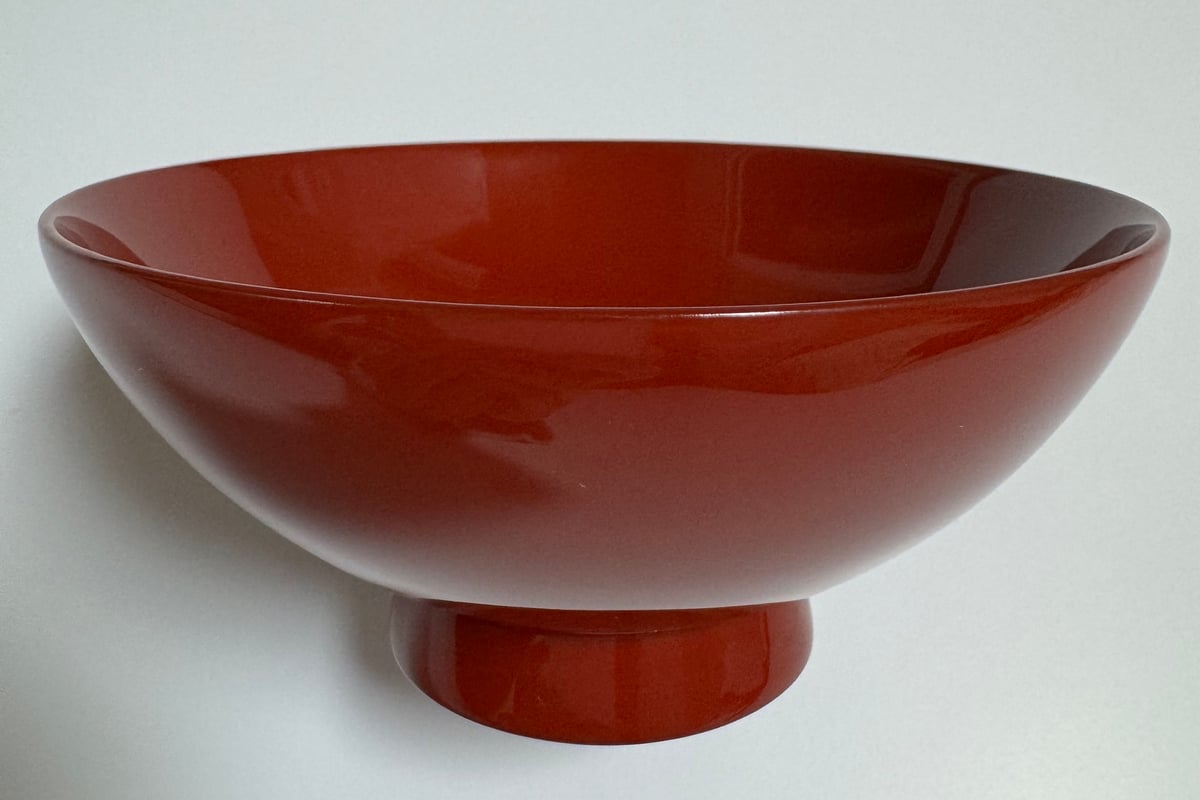
Image: Wikimedia Commons
Wajima-nuri is lacquerware produced in Wajima City, Ishikawa Prefecture, representing Japan's finest lacquer craftsmanship, characterized by its sturdy undercoating and a wide range of decorative techniques. Although its origins remain uncertain, historical records confirm that lacquerers were already working in Wajima by 1476, and it is said that by 1582, in the Momoyama period, the region's distinctive undercoating material, 'jinoko,' was already in use. Through the 'nunokise' technique of reinforcing weak points in the wood base with hemp cloth and the 'hon-kataji' technique of building up the undercoat with jinoko — made from fired diatomaceous earth — mixed into lacquer, Wajima-nuri overcame the fragility that plagues ordinary lacquerware and developed into a remarkably sturdy craft. In the late Edo period, a door-to-door sales system called 'wanko' was established, expanding its market nationwide. The decorative technique of 'chinkin,' perfected in the 18th century, and 'maki-e,' introduced from Aizu in the early 19th century, also became synonymous with Wajima-nuri; it was designated a national Traditional Craft in 1975 and an Important Intangible Cultural Property in 1977. Made through more than 20 stages and over 100 individual steps in total, it is lacquerware that combines durability with splendor.
Origin
There are several theories about the origins of Wajima-nuri, including that the technique came from the continent, or that it was spread by a wandering Negoro priest who visited Wajima in the early 15th century. It is also said that the 'Gouroku-wan' bowl, passed down in the nearby village of Yanagida, may have been its prototype, but historical records confirm that lacquerers were already working in Wajima by 1476. Records of Kaga domain lord Maeda Toshiie's tour of Noto in 1582 suggest that 'jinoko,' the undercoating material characteristic of Wajima-nuri, was already in use at that time, indicating the foundations of today's techniques had already taken shape.
History
During the Edo period, Wajima-nuri earned a reputation for its durability, and through a door-to-door sales system called 'wanko,' in which peddlers sold on an installment-payment basis, its products were carried and sold across the country by traveling merchants, expanding its market widely. Among the decorative techniques, 'chinkin,' in which gold powder is inlaid into carved grooves, was perfected in the 18th century, and in the early 19th century, maki-e was introduced from Aizu, further enhancing the splendor of Wajima-nuri. During the Bunka-Bunsei era (1804–1829), its high quality became widely known, and in 1975 it was designated a national Traditional Craft; in 1977 it became the first lacquer craft to receive Important Intangible Cultural Property (holding-group) designation.
Features
Wajima-nuri's greatest characteristic lies in the 'nunokise' technique of reinforcing weak points in the wood base with hemp cloth, and the 'hon-kataji' technique of building up the undercoat with layers of lacquer mixed with jinoko, made from fired local diatomaceous earth. This meticulous undercoating produces vessels far more durable and long-lasting than lacquerware from other regions. In decoration, two major techniques are used: chinkin, in which gold leaf or gold powder is inlaid into carved grooves in the pattern, and maki-e, in which patterns are drawn in lacquer and sprinkled with gold powder, together producing an expression that combines strength and splendor.
Techniques
Chinkin (Gold Inlay Engraving)
A decorative technique in which patterns are carved into the lacquer surface with a chisel or needle, and raw lacquer is rubbed into the grooves before gold leaf, gold powder, or colored powder is inlaid. Established around the Kyoho era (1716–1736), it allows for richly shaded expression depending on the depth of the carving and the color of the powder used.
Maki-e (Gold Lacquer Painting)
A decorative technique in which patterns are drawn in lacquer and, before it dries, gold or silver powder is sprinkled on and fixed in place. Introduced from Aizu via Kanazawa to Wajima in the early 19th century, it developed alongside chinkin as one of the two representative decorative techniques of Wajima-nuri.
Hon-Kataji (Cloth Reinforcement and Jinoko Undercoating)
A technique in which hemp cloth is applied with lacquer to reinforce parts of the wood base prone to chipping ('nunokise'), and jinoko, made from fired diatomaceous earth, is kneaded into lacquer and built up in repeated layers as an undercoat. This is the foundational process supporting Wajima-nuri's sturdiness.
Materials Used
Production Process
- 1
Wood Base Making
Wood such as zelkova or hiba cypress is shaped into bowls, trays, and other forms.
- 2
Nunokise (Cloth Reinforcement)
Parts prone to chipping are reinforced by applying hemp cloth with raw lacquer.
- 3
Undercoating (Jinoko)
Jinoko is kneaded into lacquer and applied in several layers.
- 4
Mid-Coating and Polishing
Lacquer is applied over the undercoat, and after drying, the surface is polished smooth.
- 5
Final Coating
The final finishing coat of lacquer is applied in an environment free of even a speck of dust.
- 6
Decoration (Chinkin and Maki-e)
Patterns are applied using chinkin or maki-e to complete the piece.
| Main Production Areas |
|
|---|
Artisans & Workshops
田谷漆器店
A long-established Wajima-nuri workshop and store that runs a tourist facility with a gallery and studio, allowing visitors to closely observe the craftsmen's handiwork.
Official site →輪島キリモト
The workshop of the Kirimoto family, which has handled everything from wood base to lacquerware for over 200 years. While drawing on traditional techniques, it also produces contemporary tableware and small goods suited to everyday life.
Official site →How to Buy
- 輪島塗会館
- A showroom gathering products from around 60 lacquerware shops in Wajima City under one roof. Visitors can compare a wide range of Wajima-nuri, from everyday tableware to decorative pieces.Where to buy →PR
Hands-on Experiences
輪島工房長屋
石川県輪島市河井町4-66-1
Reservation required. The My-Chopsticks-Making experience (chinkin) is from around 2,000 yen and takes about one hour. Tours of the craftsmen's workshops are also available.
View details →