Image: Wikimedia Commons
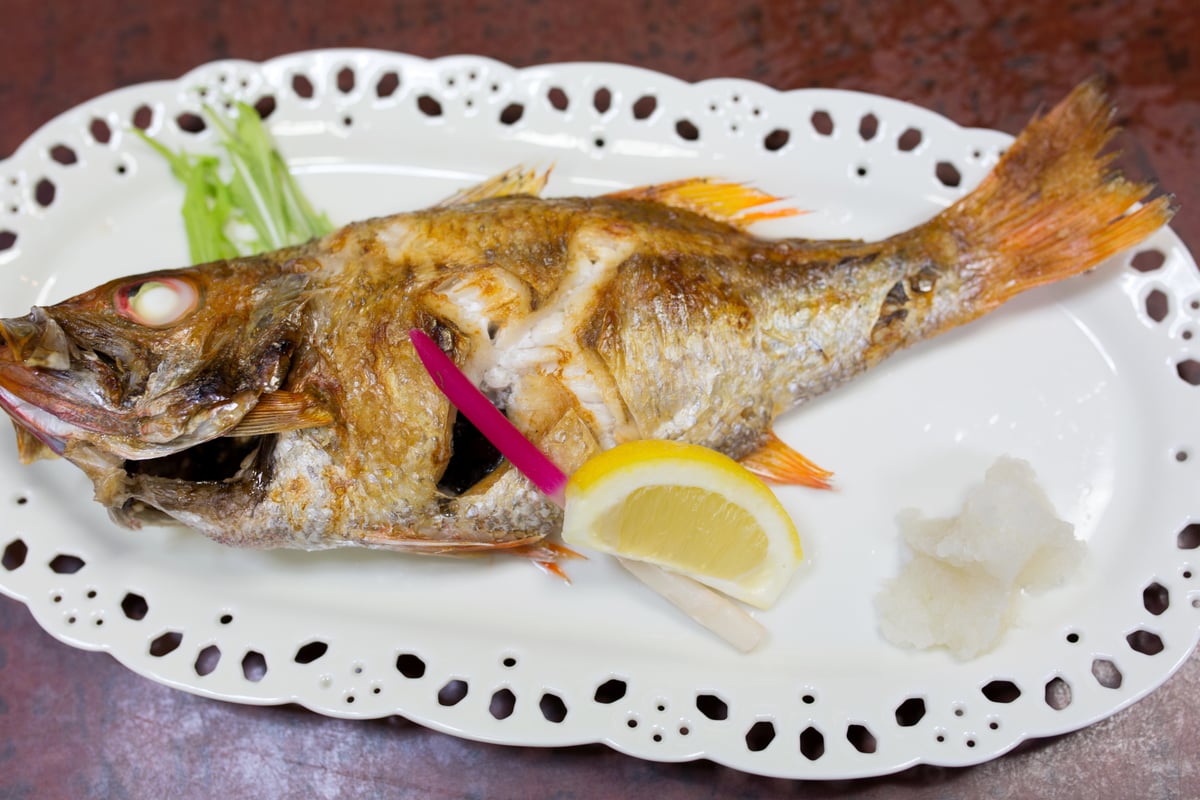
Nodoguro dishes showcase 'nodoguro,' a prized fish landed in the waters off Kanazawa, Ishikawa Prefecture, prepared in a variety of ways including salt-grilling, sashimi, shabu-shabu, and rice cooked in a small pot. Its official Japanese name is akamutsu, but it is popularly known as 'nodoguro' (literally 'black throat') because the back of its mouth appears black when opened. Despite being a white-fleshed fish, it carries rich fat, earning it the nickname 'the toro of white fish,' and in Kanazawa it has long been regarded as an auspicious fish served on occasions such as New Year's and memorial services. Once a familiar fish that appeared on ordinary dinner tables along the Sea of Japan coast, it gained nationwide popularity after being featured on television, and in recent years its price has risen, making it a premium fish today. Restaurants around Omicho Market offer a variety of specialty preparations, including rice cooked in a small pot with a whole nodoguro and elaborate kaiseki courses.
Origin
The name 'nodoguro' is a popular term derived from the fact that the back of the mouth appears black when opened; its official Japanese name is 'akamutsu.' It inhabits sandy mud bottoms at depths of roughly 100 to 200 meters, and the waters off Kanazawa City in Ishikawa Prefecture are known as one of its representative fishing grounds. In Kanazawa, it has long been treated as a fish served on special occasions such as New Year's and memorial services, and locally, some people refer to it respectfully by its official name, 'akamutsu.'
History
Until the Showa era, nodoguro circulated widely along the Sea of Japan coast and was a familiar fish that appeared on ordinary dinner tables. However, after being introduced on television and elsewhere as 'the toro of white fish,' its name recognition soared nationwide, and as demand increased, so did its price, until today it is treated as a premium fish. In Ishikawa Prefecture it had long been used as an auspicious fish for celebratory occasions even before the spread of tourist-oriented dishes, reflecting a food culture rooted deeply in the region.
Features
Its greatest characteristic is the elegant fat carried in its plump white flesh, which gives it a rich flavor said to rival that of 'toro,' the fatty cut of tuna. In Kanazawa's restaurants, it is offered in a variety of preparations, including salt-grilling, sashimi, rice slow-cooked in a small pot known as nodoguro kamameshi, shabu-shabu, and seared preparations, allowing diners to compare and enjoy the quality of its fat across different styles. The peak season varies somewhat by region and fishing method, but demand rises particularly when the fish is at its fattiest.
Main Ingredients
How It Differs from Home Cooking
At home it is often enjoyed simply, prepared as dried fish or salt-grilled, while restaurants offer a wider variety of preparations that make full use of the whole fish, such as kamameshi, shabu-shabu, and kaiseki courses.
Famous Shops
能加万菜 と成屋
石川県金沢市下堤町19-7
A specialty shop for nodoguro kamameshi. The first bowl is enjoyed plain, the second with garnish, and the third as ochazuke — three ways to savor a single dish. The nodoguro kamameshi is around 3,300 yen.
View details →加賀料理 大名茶家
石川県金沢市此花町7-5-1
A long-established restaurant founded in 1962, about a three-minute walk from Kanazawa Station. Its limited-time 'nodoguro kaiseki' offers sashimi, shabu-shabu in a small pot, salt-grilled preparation, and more.
FAQ
Q. Where does the name 'nodoguro' come from?
A. It is a popular name derived from the fact that the back of the mouth appears black when opened wide. Its official Japanese name is 'akamutsu,' and within Ishikawa Prefecture, including Kanazawa, it is sometimes called 'akamutsu' out of respect for its formal name.