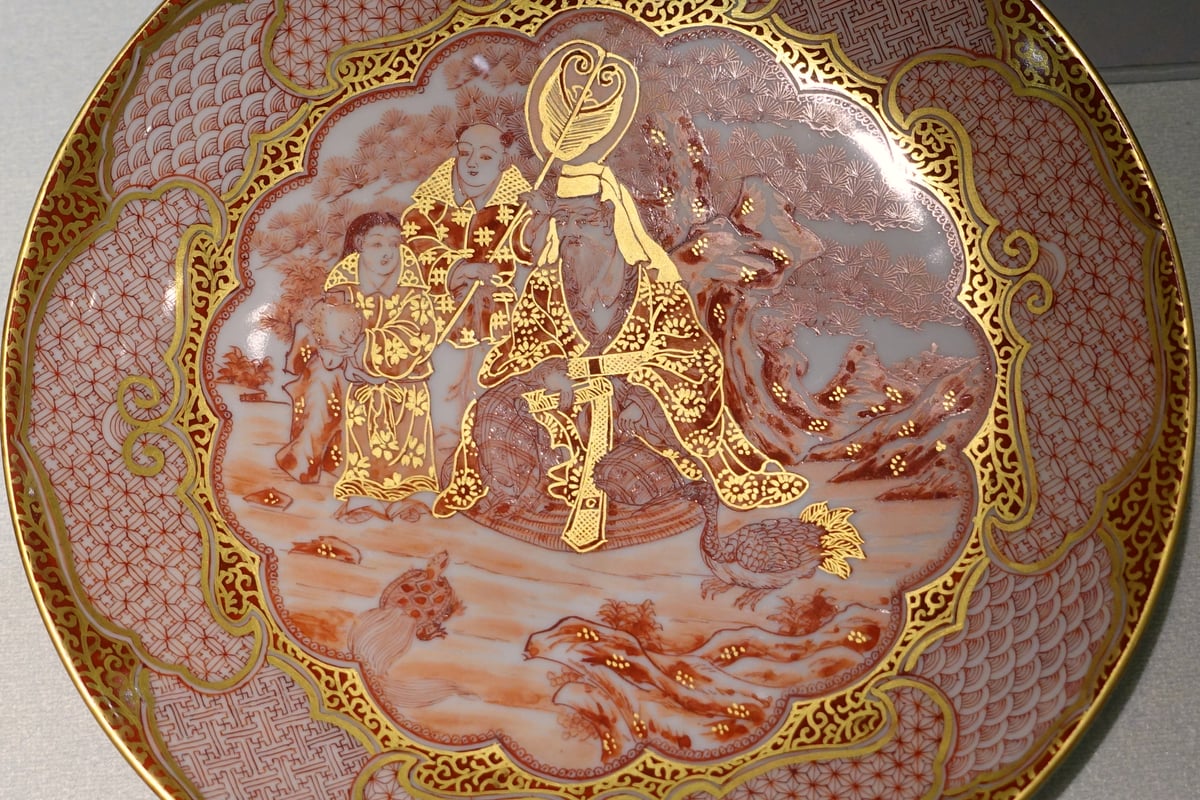
Image: Wikimedia Commons
Kutani ware is polychrome porcelain fired in the Kaga region of southern Ishikawa Prefecture, distinguished above all by its vivid overglaze painting in the 'Kutani Five Colors' — red, yellow, green, purple, and deep blue — known as Kutani gosai. Its origins trace back to the Meireki era (1655–1657), when Maeda Toshiharu, first lord of the Daishoji domain, a branch of the Kaga domain, learned that porcelain stone had been discovered in Kutani village within his territory and ordered the metalworker Goto Saijiro to fire polychrome porcelain there. Wares made during this period later became known as 'Ko-Kutani' (Old Kutani) and were highly acclaimed for their bold compositions and powerfully filled-in painting. However, the kiln at Kutani village closed after about 50 years, and production ceased for roughly a century. In the late Edo period, kilns aiming to revive Ko-Kutani sprang up one after another across the Kaga and Daishoji areas, a movement known as 'Saiko-Kutani' (Revived Kutani). Kilns such as Yoshidaya, Miyamotoya, and Eiraku each developed their own distinctive style while building on this foundation, establishing the basis for Kutani ware as it continues today. It is now produced mainly in Kanazawa, Komatsu, Kaga, and Nomi in southern Ishikawa Prefecture, and was designated a national Traditional Craft in 1975.
Origin
The origins of Kutani ware trace back to the Meireki era (1655–1657). Maeda Toshiharu, first lord of the Daishoji domain, a branch of the Kaga domain, learned that porcelain stone had been discovered in Kutani village (in present-day Yamanaka Onsen, Kaga City) within his territory, and ordered the metalworker Goto Saijiro to fire polychrome porcelain there — this is considered the beginning of Kutani ware. This kiln continued for about 50 years and produced numerous masterpieces, but it closed abruptly around the end of the Genroku era, and production ceased for roughly a century afterward. Works fired during this period later came to be called 'Ko-Kutani' (Old Kutani).
History
About a century after the kiln's closure, in the late Edo period, kilns aiming to revive Ko-Kutani sprang up one after another across the Kaga and Daishoji domains, a movement known as 'Saiko-Kutani' (Revived Kutani). Distinctive kilns developed throughout the Kaga region, each competing to refine its own techniques — the Yoshidaya kiln, which sought to recreate the painting style of Ko-Kutani; the Miyamotoya kiln, known for finely detailed red-painted designs; and the Eiraku kiln, which developed the kinrande gold-brocade style. In the Meiji era, Kutani ware also gained popularity as export porcelain, and in 1975 it was designated a national Traditional Craft under the name 'Kutani-yaki.'
Features
The greatest characteristic of Kutani ware is its overglaze painting technique known as 'Kutani gosai,' which uses five colors — red, yellow, green, purple, and deep blue. After outlining the design with cobalt underglaze pigment, the five colors are applied thickly to build up the coloring, and through the 'nurizume' technique, the background is filled in entirely with pigment rather than left blank, producing vessels of overwhelming presence. Green, yellow, purple, and deep blue take on a glassy, rich luster when fired, while red alone allows for thin, delicate line work — the painting makes use of the distinct properties of each color.
Techniques
Kutani Gosai (Five-Color Overglaze Painting)
An overglaze technique using five colors — red, yellow, green, purple, and deep blue. After the fired piece is outlined with cobalt underglaze pigment, the five colors are applied thickly to build up the coloring, and the piece is fired again.
Nurizume (Filled-In Background)
A technique unique to Kutani ware in which the background surrounding the pattern is completely filled in with pigment. In contrast to painting styles from other regions that make use of blank space, this produces a rich, powerful sense of color and presence.
Materials Used
Production Process
- 1
Forming
Porcelain stone is shaped into vessel forms using a potter's wheel or molds.
- 2
Bisque Firing
The shaped clay body is fired once at a low temperature to harden it.
- 3
Underglaze Painting and Main Firing
The design is outlined with cobalt underglaze pigment, glaze is applied, and the piece is fired at high temperature.
- 4
Overglaze Painting
The pattern is painted and colored using the five Kutani gosai pigments.
- 5
Overglaze Firing
The piece is fired again at a low temperature to fix the overglaze pigments.
| Main Production Areas |
|
|---|
Artisans & Workshops
上出長右衛門窯
A long-established kiln founded in 1879 in Terai, Nomi City. It emphasizes hand-painted overglaze work and deep underglaze blue, producing contemporary pieces while staying rooted in tradition.
Official site →How to Buy
- 石川県九谷焼美術館「茶房古九谷」
- A select shop attached to a Kutani ware specialty museum in Daishoji, Kaga City. It carries fine works by around 30 artists and craftspeople, allowing visitors to purchase pieces alongside viewing masterworks of Ko-Kutani and Saiko-Kutani. Admission is from around 560 yen.Where to buy →PR
Hands-on Experiences
KAM能美市九谷焼美術館(体験館)
石川県能美市泉台町南33
A hands-on painting facility located within the Kutani Ceramic Art Village. Admission is free; the overglaze painting experience costs from around 1,000 yen for the unglazed piece, plus paint fees (around 500 yen for Western-style paints, 700 yen for Japanese-style paints).
View details →