Image: Wikimedia Commons
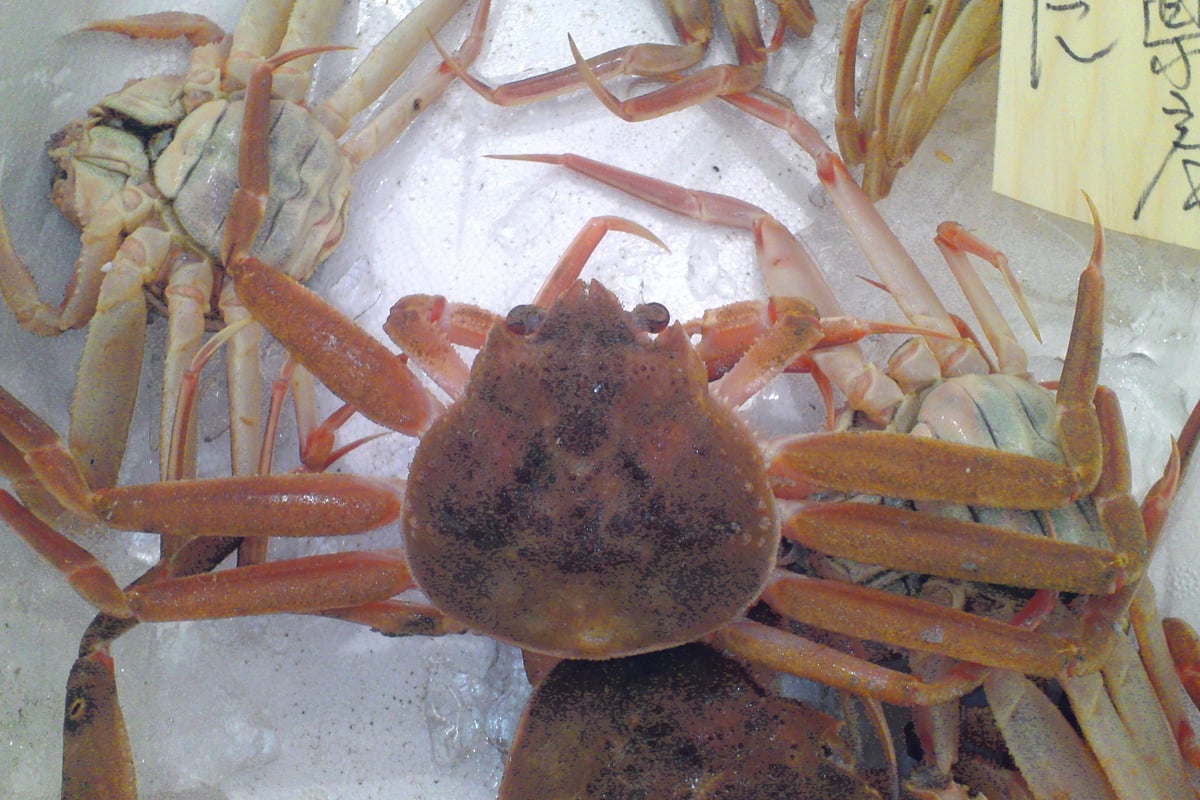
Kobako-gani is the local Ishikawa name for female snow crab, and while its shell is only about half the size of the male 'Kano-gani,' its appeal lies in the abundant immature roe called 'uchiko' along with crab miso packed inside the shell, and the mature roe called 'sotoko' carried under its belly. There are several theories about the origin of the name: that the rounded shape of its shell resembles a 'kobako,' a tea-ceremony incense box; that it comes from the local dialect word 'kobaku,' meaning 'cute'; and that the novelist Muro Saisei was involved in naming it. To protect the resource, the fishing season is short, running only from the opening on November 6 to around December 29, and during this period alone, crowds flock to Omicho Market and restaurants throughout the city to enjoy this winter tradition of Kanazawa. With its rich uchiko and sotoko and the delicate sweetness of its meat, it offers a charm distinct from that of Kano-gani.
Origin
In Ishikawa Prefecture, female snow crab is known locally as 'Kobako-gani.' There are several theories about the origin of the name — that the round shape of its shell resembles a tea-ceremony incense box called a 'kobako'; that it derives from the local dialect word 'kobaku,' meaning 'cute'; and that it comes from the fragrance of the uchiko roe — but none has been settled as definitive.
History
Because females are valuable individuals about to spawn, Ishikawa Prefecture strictly limits the fishing season to protect the resource. The season opens on November 6, a date that often falls on 'Risshun no Fuyu' (the first day of winter in the traditional calendar), linking the arrival of winter with the image of crab in people's minds; since the 2014 season, the closing date has been set at December 29.
Features
While its shell is only about half the size of the male Kano-gani, its greatest characteristic is the abundant, richly orange uchiko roe and crab miso packed inside the shell, along with the granular sotoko roe carried under its belly. It is enjoyed simply boiled, as well as prepared in various ways such as rice with uchiko and sotoko, sake warmed in the shell, and 'kani-men' (crab shell stuffed with miso and meat) in Kanazawa oden.
Food Culture
Because the fishing season is extremely short, running only from November 6 to around December 29, Omicho Market and restaurants throughout the city come alive the moment the season opens, making it a beloved harbinger of winter in Kanazawa. Locally, it is a classic custom to simply peel the boiled crab by hand and eat it as is.
How It Differs from Home Cooking
At home it is often enjoyed simply as boiled crab, while restaurants offer a wider variety of preparations that make the most of each part, such as rice with uchiko and sotoko, kani-men, and sake warmed in the shell.
Famous Shops
川木商店
石川県金沢市青草町88 近江町いちば館1F
A shop in Omicho Market specializing in crab and eel for over 40 years. Kobako-gani is priced from around 1,800 to 5,000 yen per crab, varying by season and weather.
FAQ
Q. Are Kobako-gani and Kano-gani different species of crab?
A. No, both are the same species — snow crab. In Ishikawa Prefecture, males are called 'Kano-gani' and females 'Kobako-gani,' but biologically they are the same species.