Image: Wikimedia Commons
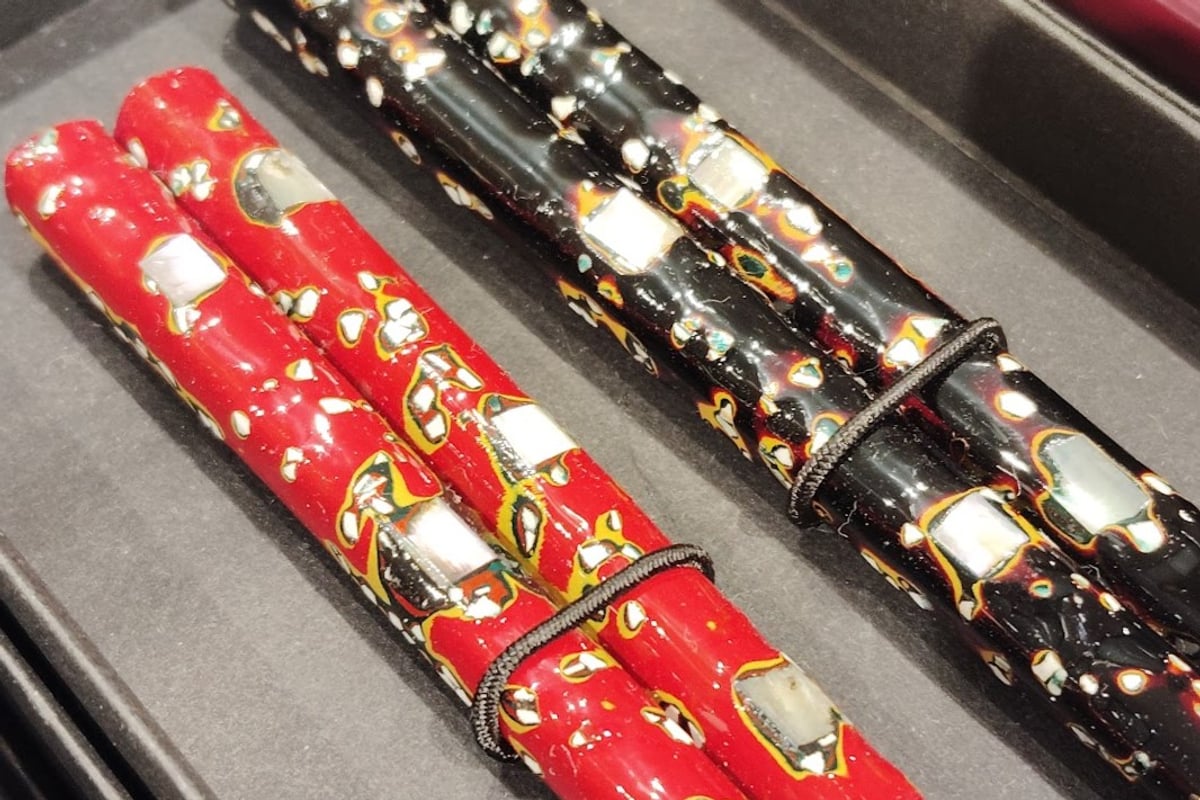
Wakasa-nuri is lacquerware made in Obama City, Fukui Prefecture. Its defining feature is togidashi ('polishing out'): patterns are created with eggshells, abalone and other seashells, pine needles and similar materials, colored lacquer is applied in many layers, and the surface is then ground with whetstones to bring the patterns to the surface. The patterns are said to evoke the seabed of Wakasa Bay, and it was once also called 'Hoseki-nuri' (jewel lacquer). It is said to have originated in the early Edo period, when Matsuura Sanjuro, the official lacquerer of the Obama Domain, took inspiration from Chinese lacquerware to devise a lacquer finish that stylized the appearance of the seabed. The ruling Sakai family generously protected Wakasa-nuri, and more than 200 lacquering methods are said to have been developed from the mid to late Edo period. In 1978 (Showa 53), it was designated a Traditional Craft Designated by the Minister of Economy, Trade and Industry. Today its representative product is lacquered chopsticks, and Obama City is said to account for more than 80% of the lacquered chopsticks produced in Japan. At Hashi no Furusato-kan WAKASA and Wakasa Kobo in the city, visitors can try togidashi polishing on chopsticks.
Origin
The origins of Wakasa-nuri date back to the early Edo period. It is said to have begun when Matsuura Sanjuro, the official lacquerer of the Obama Domain, took inspiration from zonsei, a type of Chinese lacquerware, and devised a lacquer finish that stylized the appearance of the seabed of Wakasa Bay. Sanjuro's finish was called 'Kikujin-nuri', and his disciples went on to create 'Isokusa-nuri'. It is said that a technique of applying gold leaf to eggshell was eventually perfected as well.
History
Sakai Tadakatsu, lord of the Obama Domain, who entered Wakasa in 1634 (Kan'ei 11), is said to have protected and promoted Wakasa-nuri as an undertaking of the whole domain and to have prohibited its techniques from leaking to other domains. In 1653 (Joo 2), Sanjuro and others were ordered to carry out craftwork in Edo for about seven months. The mid to late Edo period was the golden age of Wakasa-nuri, during which more than 200 lacquering methods are said to have been perfected. In 1862 (Bunkyu 2), the lacquerware in the trousseau prepared for the marriage of Princess Kazu-no-Miya was made entirely in Wakasa-nuri.
Features
The defining feature of Wakasa-nuri is togidashi, a technique of repeatedly applying layers of lacquer and polishing them down. Patterns are created with seashells, eggshells and gold leaf, lacquer is applied more than ten times, and the surface is then polished with stones and charcoal to reveal the patterns. A piece takes several months to complete and has a distinctive sense of weight and dignity. Its appeal lies in the brilliance of white, red, green, yellow, gold and other colors sparkling against a black or vermilion ground. Even slender lacquered chopsticks are decorated with the same technique, adding color to the dining table.
Techniques
Eggshell patterns
A technique in which eggshell is pasted onto lacquer to create patterns. Colored lacquer is layered on top and then polished out, so that the white shell patterns emerge from within the lacquer layers. It is one of the most representative patterns of Wakasa-nuri.
Seashell patterns
A technique that uses abalone and other seashells to create patterns. When the piece is polished out after colored lacquer has been layered, the shimmer of the shells appears within the deep tones, creating the seabed-like look characteristic of Wakasa-nuri.
Okoshi patterns (raised patterns)
A technique that uses pine needles, hiba (Japanese cypress) leaves, rapeseed, rice husks and similar materials to create raised and recessed patterns on the lacquer surface. When colored lacquer is layered over them and polished out, the shapes of the plants appear as delicate patterns.
Materials Used
Production Process
- 1
Making the base
Moso bamboo, cherry or other wood is split and shaved thick at the head and thin at the tip to make the chopstick base.
- 2
Patterning
Patterns are applied to the primed base using abalone shell, eggshell, pine needles and other materials.
- 3
Layering lacquer
Colored lacquer is applied and gold leaf is added, and then colored lacquer is applied another six to seven times.
- 4
Stone polishing
The surface is ground with whetstones to bring the embedded patterns to the surface.
- 5
Glossing and polishing
Lacquer is rubbed in to bring out the gloss, and the piece is polished with charcoal powder, tonoko (polishing powder) and similar materials.
| Main Production Areas |
|
|---|
Artisans & Workshops
若狭塗箸協同組合
A cooperative made up of Wakasa-nuri chopstick makers and others in Obama City. It operates Hashi no Furusato-kan WAKASA, where it introduces the history and manufacturing process of Wakasa-nuri chopsticks and accepts bookings for togidashi experiences.
Official site →若狭工房
A group of traditional craft artisans made up of craftspeople and workshop owners in Obama City, based on the second floor of the Miketsukuni Wakasa Obama Food Culture Museum. Its members include certified traditional craftsmen of Wakasa-nuri such as 羽田浩一 (14th generation of 羽田漆器店) and 加福宗徳 (4th generation of 加福漆器店), who also instruct the experiences.
Official site →How to Buy
- Hashi no Furusato-kan WAKASA
- A facility of the Wakasa-nuri chopsticks cooperative in Fukutani, Obama City. It displays and sells mainly Wakasa-nuri chopsticks, and viewing the exhibits is free. Open 9:00-17:00; closed on Thursdays (open if a national holiday) and during the year-end and New Year holidays.Where to buy →PR
- Zen Kashiwade (online)
- An online shop introduced on the official website of Hashi no Furusato-kan WAKASA. Even if you cannot travel to Obama, you can order Wakasa-nuri chopsticks from home.Where to buy →PR
Hands-on Experiences
箸のふるさと館WAKASA
福井県小浜市福谷8-1-3
An experience of polishing out and finishing Wakasa-nuri chopsticks made with natural shells, costing around 1,100 yen (about 10 minutes). Reservations are required: by phone until 15:00 on the day of your visit, or via the email form up to two days before your visit.
View details →若狭工房(御食国若狭おばま食文化館2階)
福井県小浜市川崎3丁目4番
The experience of polishing out Wakasa-nuri chopsticks inlaid with abalone shell and eggshell takes about 40 minutes and is said to cost around 1,500 yen. Experience fees were revised in April 2026, so check the latest prices in advance. Closed on Wednesdays (open on national holidays).
View details →FAQ
Q. How are Wakasa-nuri patterns made?
A. Patterns are created with eggshells, seashells, pine needles and similar materials, colored lacquer is layered over them many times, and the surface is ground with whetstones to reveal the patterns. Because the way the patterns appear changes depending on how the piece is polished, each item looks slightly different even with the same design.
Q. How many Wakasa-nuri chopsticks are made?
A. Obama City is said to produce more than 80% of the lacquered chopsticks made in Japan. At Hashi no Furusato-kan WAKASA, you can compare and choose from a wide variety of Wakasa-nuri chopsticks.