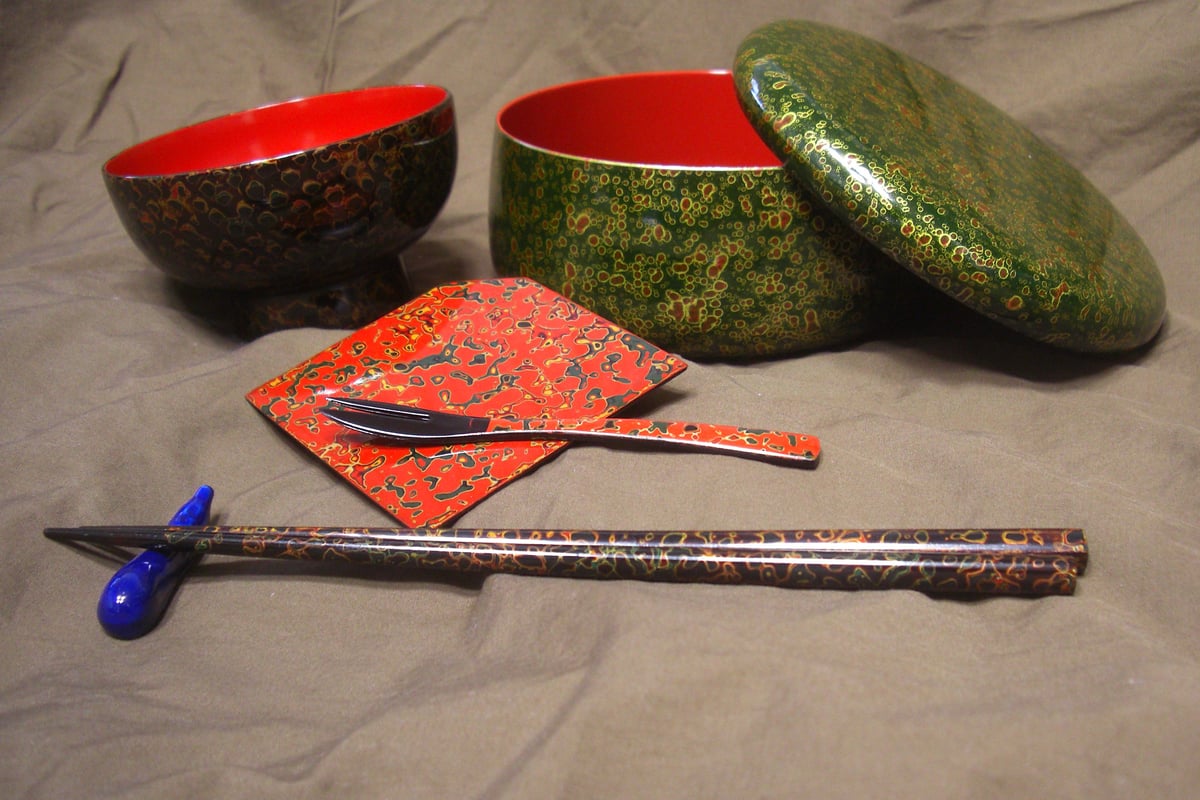
Image: Wikimedia Commons
Tsugaru-nuri is lacquerware produced mainly in Hirosaki City, Aomori Prefecture, and the only Traditional Craft designated by the Minister of Economy, Trade and Industry from Aomori Prefecture. Its origins trace to the mid-Edo period, when Tsugaru Nobumasa, the fourth lord of the Hirosaki domain, invited the lacquer craftsman Ikeda Genbei from Wakasa Province to help develop local industry. Genbei's son Gentaro later studied the seigaiha-nuri technique in Edo and went on to create original lacquerware in Tsugaru. Over the roughly 300 years since, four representative techniques - Karanuri (唐塗), Nanako-nuri (七々子塗), Monsha-nuri (紋紗塗), and Nishiki-nuri (錦塗) - were established, each involving repeated layers of lacquer built up and then polished down, a process that can take around 50 steps and many months to complete. Because of this painstaking process, Tsugaru-nuri is also known by the nickname "baka-nuri" ("foolish lacquering"). The name Tsugaru-nuri became widely known after the craft was exhibited at the 1873 Vienna World's Fair. In 1975 it was designated a Traditional Craft by the Minister of Economy, Trade and Industry, and today many craftspeople in and around Hirosaki continue to carry on the tradition.
Origin
The origins of Tsugaru-nuri go back to the mid-Edo period, when Tsugaru Nobumasa, the fourth lord of the Hirosaki domain, invited craftspeople from across Japan to help promote local industry. The lacquer craftsman Ikeda Genbei, recruited from Wakasa Province, traveled to Edo and became a pupil of the lacquer master Seikai Tarozaemon, but died there before completing his training. His son Gentaro carried on his father's aspirations, studying maki-e and seigaiha-nuri techniques. In 1727, taking the name "Seikai Genbei," he began producing lacquerware with original designs in Tsugaru - considered the true starting point of Tsugaru-nuri.
History
A document from 1758 already refers to "Karanuri" as a leading lacquerware style of Hirosaki, suggesting the technique was well established by the late Edo period. After being exhibited at the 1873 Vienna World's Fair, the name "Tsugaru-nuri" became widely known, and craftspeople centered on Hirosaki continued to refine their skills. In 1975 it was designated a Traditional Craft by the Minister of Economy, Trade and Industry, and it remains the only craft in Aomori Prefecture to hold this designation.
Features
The greatest distinguishing feature of Tsugaru-nuri is its four representative techniques - Karanuri, Nanako-nuri, Monsha-nuri, and Nishiki-nuri. Each involves repeatedly layering lacquer and then polishing it down, a process requiring around 50 steps and several months to complete, which is why the craft is also known by the nickname "baka-nuri." No two patterns produced by this layering and polishing are ever quite alike, and the finished pieces combine durability with a lustre that deepens with use.
Techniques
Karanuri (唐塗)
A technique in which lacquer is dabbed on in dots using a perforated spatula to create a speckled pattern, then covered with layers of colored lacquer and polished down. It is the most representative Tsugaru-nuri technique, and the more intricate the pattern, the more labor it requires - the very reason behind the nickname "baka-nuri."
Nanako-nuri (七々子塗)
A technique in which rapeseed grains are scattered onto the lacquer surface to leave small ring-shaped marks, which are then covered with layers of colored lacquer and polished down. Because the pattern of rings resembles fish roe, it was named "nanako" ("fish eggs"), producing an elegant ground pattern reminiscent of Edo komon dyeing.
Monsha-nuri (紋紗塗)
A technique in which a pattern is drawn in black lacquer, then charred rice-husk powder is scattered over it and polished down. The result is a subdued, matte black ground with patterns emerging from it - a technique unique to Tsugaru-nuri, not found in lacquerware from other regions.
Nishiki-nuri (錦塗)
A further development of Nanako-nuri, in which arabesque and other patterns are drawn in black lacquer over a nanako ground, then finished with scattered tin powder. Because it demands both time and advanced skill, only a very small number of craftspeople are said to still practice this technique today.
Materials Used
| Main Production Areas |
|
|---|
Artisans & Workshops
小林漆器
A long-established workshop founded in the Meiji era that has practiced lacquer craftsmanship in Tsugaru for six generations. Its founder was a direct disciple of the seventh-generation Seikai Genbei, and it now offers more than 500 kinds of products, from bowls and cups to smartphone cases.
Official site →津軽塗たなか(たなか銘産)
Founded in 1947. While upholding traditional techniques, the workshop also explores new expressions such as light-permeable "see-through Tsugaru-nuri," and manufactures and sells a wide range of products from chopsticks and tableware to sundries.
Official site →How to Buy
- イシオカ工芸
- A specialty store handling everything from wholesale, exhibition sales, and mail order to repairs of Tsugaru-nuri. It carries a wide range of items, from traditional tableware to everyday goods.Where to buy →PR
- 青森県津軽塗漆器協同組合連合会 販売店案内
- The cooperative's official website introduces Tsugaru-nuri retailers both within and outside Aomori Prefecture, serving as a reliable starting point for finding certified, genuine products from the production area.Where to buy →PR
Hands-on Experiences
小林漆器
青森県弘前市東城北3-3-12
A togidashi (polishing) experience. Choose from chopsticks, hand mirrors, or spoons from around 2,200 yen each, seal cases or hand mirrors from around 3,850 yen, or sake cups from around 4,400 yen (reservation required).
View details →津軽藩ねぷた村
青森県弘前市亀甲町61
A tourist facility offering a Tsugaru-nuri togidashi experience. For ages 6 and up; takes about 1 hour 30 minutes or more.
View details →