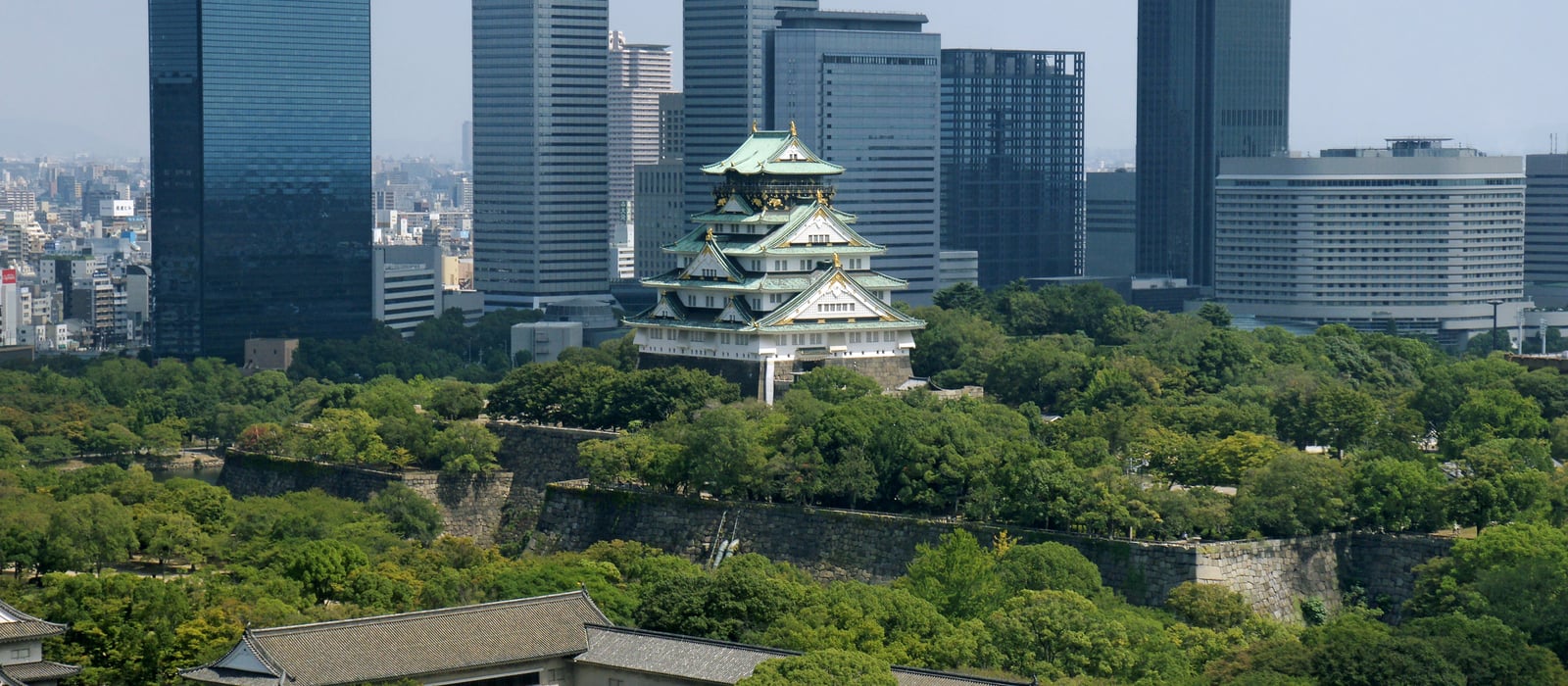
 Image: Wikimedia Commons
Osaka Prefecture
In the Edo period, Osaka was called 'the nation's kitchen' (Tenka no Daidokoro) and flourished as a merchant city where goods and people from all over the country gathered. Cultures of handcraft and food have grown up within that tradition. Osaka has eight Traditional Crafts Designated by the Minister of Economy, Trade and Industry: Sakai Uchihamono, Osaka Naniwa Suzuki, Osaka Ranma, Osaka Karaki Sashimono, Osaka Senshu Kiri Tansu, Osaka Kongo Sudare, Osaka Butsudan, and Naniwa Honzome. Knives from Sakai are widely used by professional chefs, and chusen-dyed tenugui and hand-woven dantsu carpets are also carried on in Sakai. There are production areas throughout the prefecture as well, such as tonbodama glass beads in Izumi City, paulownia chests in Senshu, and bamboo blinds in Tondabayashi and Kawachinagano. In food, konamon (flour-based dishes) such as takoyaki and okonomiyaki, the kushikatsu of Shinsekai, and kitsune udon, said to have been born in Senba, are well known. Osaka-zushi such as hako-zushi and battera, tecchiri (fugu hot pot), and harihari nabe of whale and mizuna are also flavors unique to Osaka. You can also enjoy specialties rooted in the land, such as Senshu's pickled mizunasu, awa okoshi and iwa okoshi, and Sakai's kurumi mochi.
Osaka's Traditional Crafts
Sakai Uchihamono (Sakai Forged Knives)
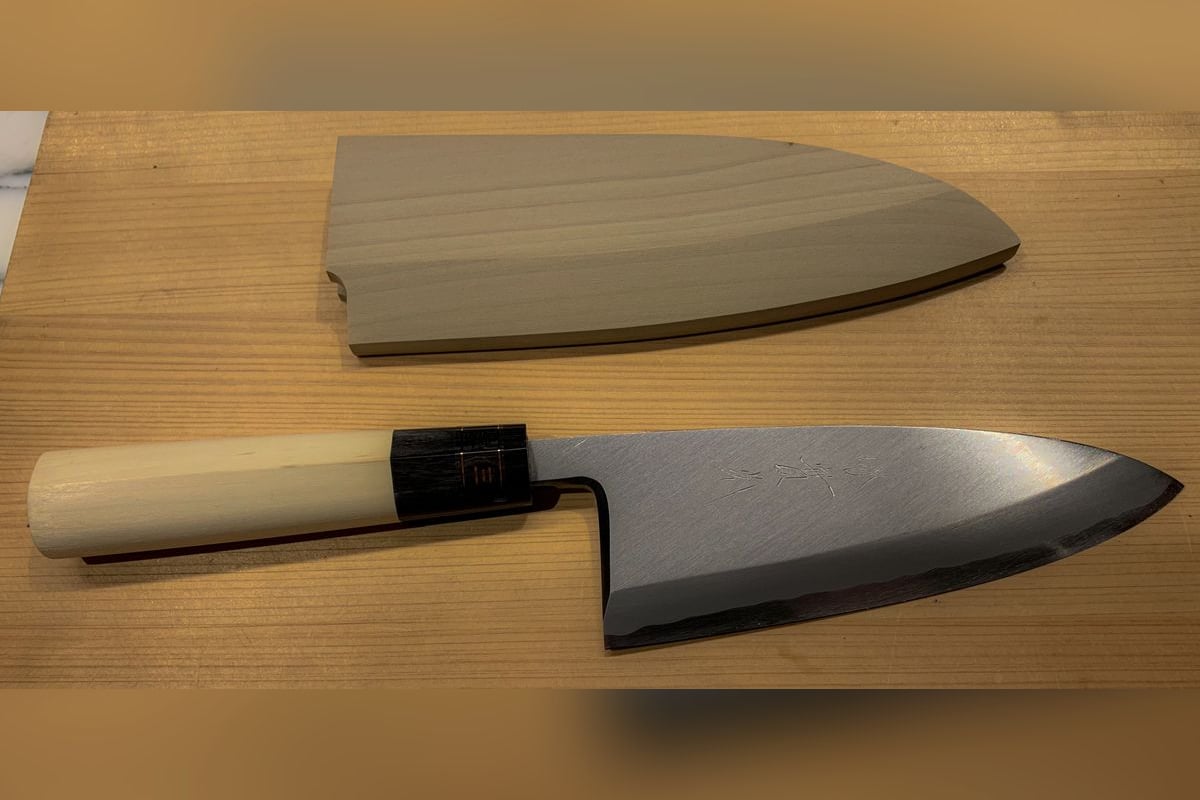
Sakai Uchihamono (Sakai Forged Knives)
Sakai Uchihamono (堺打刃物) are kitchen knives, scissors and other bladed tools made mainly in Sakai City, Osaka Prefecture. After firearms and tobacco arrived from Portugal in the 16th century, Sakai began making 'tobacco knives' for shredding tobacco leaves. The Edo shogunate is said to have recognized their quality and allowed them to be sold stamped with the 'Sakai Kiwame' hallmark. This spread Sakai's name throughout the country, and production eventually developed into cooking knives such as the deba knife. Making a knife is divided among specialists: 'forging,' which shapes the blade; 'sharpening (hatsuke),' which grinds and hones the edge; and 'handle fitting (etsuke),' which attaches the handle. Knives made by forge-welding hard blade steel onto a soft iron base are said to neither break nor bend and to cut well. Sakai is also said to account for about 90 percent of the domestic market for Japanese kitchen knives (wa-bocho) used by professional chefs. In 1982 (Showa 57), Sakai Uchihamono was designated a Traditional Craft Designated by the Minister of Economy, Trade and Industry.

Osaka Naniwa Suzuki (Osaka Naniwa Pewterware)
Osaka Naniwa Suzuki (Osaka Naniwa Pewterware)
Osaka Naniwa Suzuki (大阪浪華錫器) is tinware (suzu-ki) made in Osaka City and other areas. Tin is a precious metal ranking next to gold and silver, and since ancient times it has been used for tableware at the imperial court and for ritual implements at shrines and temples. Tinware making is said to have begun in Kyoto, and by the mid-Edo period Osaka had become a major production center. Tin shops gathered in Shinsaibashi, Tenjinbashi and Tennoji, making sake vessels and tea utensils. The main techniques are casting, in which molten tin is poured into molds, and lathe turning (rokuro-biki), in which the piece is shaved on a lathe to refine its shape. Tin does not oxidize easily and is said to make sake taste mellower, and because it is highly airtight it is also suited to tea caddies. In 1983 (Showa 58), it was designated a Traditional Craft Designated by the Minister of Economy, Trade and Industry. Today, 大阪錫器株式会社 carries on the techniques and accounts for about 70 percent of domestic tinware produced with traditional techniques.
Osaka Ranma (Osaka Transom Panels)
Osaka Ranma (Osaka Transom Panels)
Osaka Ranma (大阪欄間) are ranma (transom panels) made in Osaka Prefecture. A ranma is a fitting installed above the lintel (kamoi) of a Japanese-style room that decorates the room while letting light and air pass through. They are said to date back to the early 17th century, and the techniques from which they derive can be seen at Hijiri Shrine in Izumi City and Shitennoji Temple in Osaka City. In the mid-Edo period, ranma were also adopted in ordinary homes, especially merchant houses. A defining feature is their wide variety, including picture-like 'carved ranma' that make use of the grain of Yakusugi cedar, and 'openwork (sukashibori) ranma' in which patterns are cut out of paulownia boards. Other types made include 'osa ranma,' with rows of thin bars, and 'kumiko ranma,' with geometric lattice patterns. Because they divide two adjoining Japanese-style rooms, they are made to be viewed from both front and back. In 1975 (Showa 50), Osaka Ranma was designated a Traditional Craft Designated by the Minister of Economy, Trade and Industry.
Osaka Karaki Sashimono (Osaka Exotic Hardwood Cabinetry)
Osaka Karaki Sashimono (Osaka Exotic Hardwood Cabinetry)
Osaka Karaki Sashimono (大阪唐木指物) is furniture and furnishings made from imported woods such as rosewood (shitan) and ebony (kokutan). These woods have long been called 'karaki,' meaning rare woods that came from the land of Tang (China). Sashimono refers to the technique of making furniture and boxes by joining boards together. In the Edo period, karaki was shipped into Nagasaki, and Osaka's medicinal-herb wholesalers are said to have handled all of it. Osaka thus became a place where karaki gathered, and by the mid-Edo period a production center for karaki sashimono had formed. The main products include display shelves, tea shelves, low tables for tatami rooms and flower stands. They are assembled without nails or screws, using joints called kumite. A finish in which raw lacquer is rubbed in many times produces a deep color and a calm luster. In 1977 (Showa 52), it was designated a Traditional Craft Designated by the Minister of Economy, Trade and Industry.
Osaka Senshu Kiri Tansu (Osaka Senshu Paulownia Chests)
Osaka Senshu Kiri Tansu (Osaka Senshu Paulownia Chests)
Osaka Senshu Kiri Tansu (大阪泉州桐箪笥) are paulownia chests (kiri tansu) made mainly in the Senshu area of southern Osaka Prefecture. The main production areas are Kishiwada City, Sakai City, Izumi City and Tadaoka Town. Tansu chests are sometimes said to have first originated in Osaka, and by the mid-Edo period the techniques for making them had been established in Osaka. These techniques are said to have spread from the city of Osaka through Sakai to Izumi, forming a production area in Senshu. Because they use thick paulownia wood, have many kumite (joints that interlock boards) and are carefully built and finished, they are sometimes called 'the finest of paulownia chests.' Many are made in the 胴丸型 style with rounded corners, and another characteristic is the strong demand for custom pieces decorated with maki-e or lacquer coating. Because paulownia keeps out moisture and does not conduct heat easily, these chests have long been prized as furniture for storing precious clothing such as kimono. In 1989 (Heisei 1), they were designated a Traditional Craft Designated by the Minister of Economy, Trade and Industry.
Osaka Kongo Sudare (Bamboo Blinds)
Osaka Kongo Sudare (Bamboo Blinds)
Osaka Kongo Sudare are bamboo blinds (sudare) made from madake bamboo in Tondabayashi City, Kawachinagano City and Osaka City. The area was once blessed with fine bamboo growing at the foot of Mount Kongo and Mount Katsuragi, and blinds came to be woven alongside the making of bamboo baskets. The misu (court blind), used for partitions and decoration in the Heian-period imperial court, is said to be the prototype of today's zashiki sudare (indoor blind). The main products are misu used at shrines and temples and zashiki sudare used as room partitions and sunshades in homes. Highlights include a weaving method that uses the natural nodes of the bamboo strips (higo) to draw a 'ku'-shaped (く) pattern, and borders of Nishijin donsu (a glossy figured silk fabric). In 1985 (Showa 60), it was designated an Osaka Prefecture-designated Traditional Craft under the name 'Kongo Sudare.' In 1996 (Heisei 8), it became a Traditional Craft Designated by the Minister of Economy, Trade and Industry under the name 'Osaka Kongo Sudare.' According to a survey report by Osaka Prefecture, all the misu used in filming the NHK Taiga dramas 'Atsuhime' (篤姫) and 'Go' (江) were Osaka Kongo Sudare.
Osaka Butsudan (Buddhist Altars)
Osaka Butsudan (Buddhist Altars)
Osaka Butsudan are Buddhist altars (butsudan) that have been made in various parts of the prefecture, including Osaka City, Sakai City and Yao City. Their origins go back to the Asuka period and are said to lie with artisans invited from Baekje (Kudara) when Prince Shotoku founded Shitennoji Temple. The full-scale formation of the production area is said to have followed the founding of Kita-Mido and Minami-Mido in the Edo period. The national traditional craft 'Osaka Butsudan' is a lacquered butsudan (gold-lacquered butsudan, or kin-butsudan): natural lacquer is applied to the wooden base, which is decorated with gold leaf, coloring and decorative metal fittings (kazari kanagu). Its greatest feature is takamaki-e (raised maki-e), a technique of building up lacquer to draw designs, which makes them look as if metal fittings had been nailed on. Because no metal fittings are used, damage to the wooden base from rust is said to be prevented. Processes such as woodworking, carving, lacquering, maki-e and gold-leaf application are each carried out by specialized craftspeople in a division of labor. In 1982 (Showa 57), it was designated a Traditional Craft Designated by the Minister of Economy, Trade and Industry. 'Osaka Karaki Meiboku Butsudan,' which use rosewood (shitan), ebony (kokutan) and other woods, and 'Osaka Nuri Butsudan' are designated as Osaka Prefecture-designated Traditional Crafts.
Naniwa Honzome (Chusen Dyeing)
Naniwa Honzome (Chusen Dyeing)
Naniwa Honzome are tenugui (cotton hand towels) and yukata dyed using chusen (pour-dyeing), a technique born in Osaka around Meiji 20 (1887). Chusen is a dyeing method unique to Japan in which cloth coated with resist paste is folded and stacked in many layers, and dye is poured in from above. Because the dye penetrates to the core of the threads, the fabric is dyed in the same pattern and the same color with no distinction between front and back, and it resists fading. The soft texture of gradation (bokashi), possible only with hand dyeing, is another attraction. The fabric used is wazarashi (bleached cotton), cotton cloth bleached in Sakai, where the craft is said to have continued for 400 years. After chusen workshops in Osaka City suffered war damage in World War II, they moved to Sakai, and the 津久野 and 毛穴 areas along the 石津川 river became the main production areas. On November 20, 2019 (Reiwa 1), it was designated a Traditional Craft Designated by the Minister of Economy, Trade and Industry. 'Naniwa Honzome Yukata' and 'Naniwa Honzome Tenugui' had already been designated as Osaka Prefecture-designated Traditional Crafts before that.
Izumi Tonbodama (Glass Beads)
Izumi Tonbodama (Glass Beads)
Izumi Tonbodama are glass beads (tonbodama) made in Izumi City and Sakai City. Tonbodama are round glass beads whose surfaces are decorated with patterns in two or more colors of glass. The name is said to come from the resemblance of their dotted patterns to the compound eyes of a dragonfly (tonbo). In Izumi Province (present-day Sakai City and the area to its south), glass beads are said to have been made since before the Nara period. In the Edo period, they were widely known as '泉州玉' (Senshu beads) and 'saka-tonbo.' Production techniques were established in the early Meiji era, and in the Shinoda area of Izumi City, glass-bead making flourished as a side business for farmers. In the Taisho era, the production of artificial pearls, made by coating glass beads, also spread. The beads are formed by winding colored glass rods melted in a flame around a mandrel, and patterns are then added to the surface. The color techniques created by combining multiple kinds of glass are also put to use in restoring National Treasures and repairing cultural properties. In 2002 (Heisei 14), it was designated an Osaka Prefecture-designated Traditional Craft.
Sakai Teori Dantsu (Hand-Woven Carpets)
Sakai Teori Dantsu (Hand-Woven Carpets)
Sakai Teori Dantsu is a hand-woven floor covering that began in Sakai in the late Edo period. Dantsu (pile carpet) refers to thick woven floor coverings; the technique is said to have come from China and spread via the Nabeshima Domain of Hizen to Ako in Banshu and Sakai in Senshu. In Sakai, it began in Tenpo 2 (1831), when the thread merchant 藤本庄左衛門 had 泉利兵衛 weave dantsu and sold them as 'Sakai Dantsu.' It became widely known after being exhibited at the 1st National Industrial Exhibition (Naikoku Kangyo Hakurankai) in Meiji 10 (1877). 藤本荘太郎, 藤本庄左衛門's grandchild, who was called the 'Dantsu King,' improved the techniques and personally traveled to the United States to spread it overseas. In the mid-Meiji era, they were shipped in large numbers both in Japan and abroad, and production reached its peak. Woven by hand using techniques that require great skill, the carpets are durable and have a substantial, weighty finish. In 1986 (Showa 61), it was designated an Osaka Prefecture-designated Traditional Craft. In 2006 (Heisei 18), its techniques were also designated an Osaka Prefecture Intangible Folk Cultural Property.
Osaka's Local Food
Takoyaki
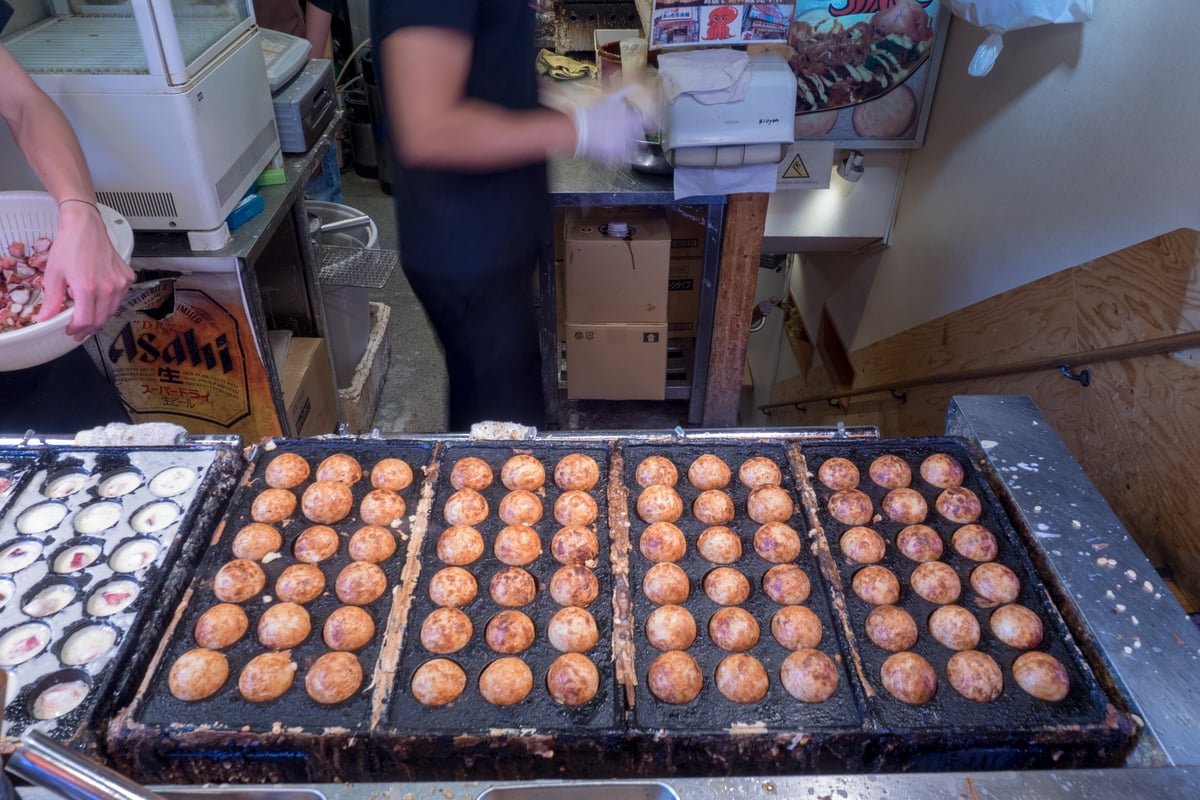
Takoyaki
Takoyaki is an Osaka konamon (flour-based dish) made by adding chopped octopus and tenkasu (tempura bits) to a batter of wheat flour mixed with dashi and egg, then grilling it into balls. It is cooked on a special iron plate lined with round hollows and finished so that it is fragrant on the outside and soft and runny inside. The classic way to eat it is topped with sauce, aonori (green laver flakes), and dried fish flakes (kezuribushi). Its roots are said to lie in chobo-yaki, which was popular with children at dagashiya (cheap candy shops) and festival fairs (ennichi) from the late Meiji era through the Taisho era, and in the later rajio-yaki. In the early Showa era, rajio-yaki made with octopus as the filling began to be sold in Osaka City. Aizuya (会津屋) in Nishinari Ward, Osaka City, is known as the originator that created octopus-filled takoyaki in 1935 (Showa 10). At first it was eaten with nothing on it, but thick sauce appeared after the war, and the current style is said to have taken hold then. Many households in the prefecture own a takoyaki maker, and it is loved as the soul food of the people of Osaka Prefecture.
Okonomiyaki (Osaka Style)
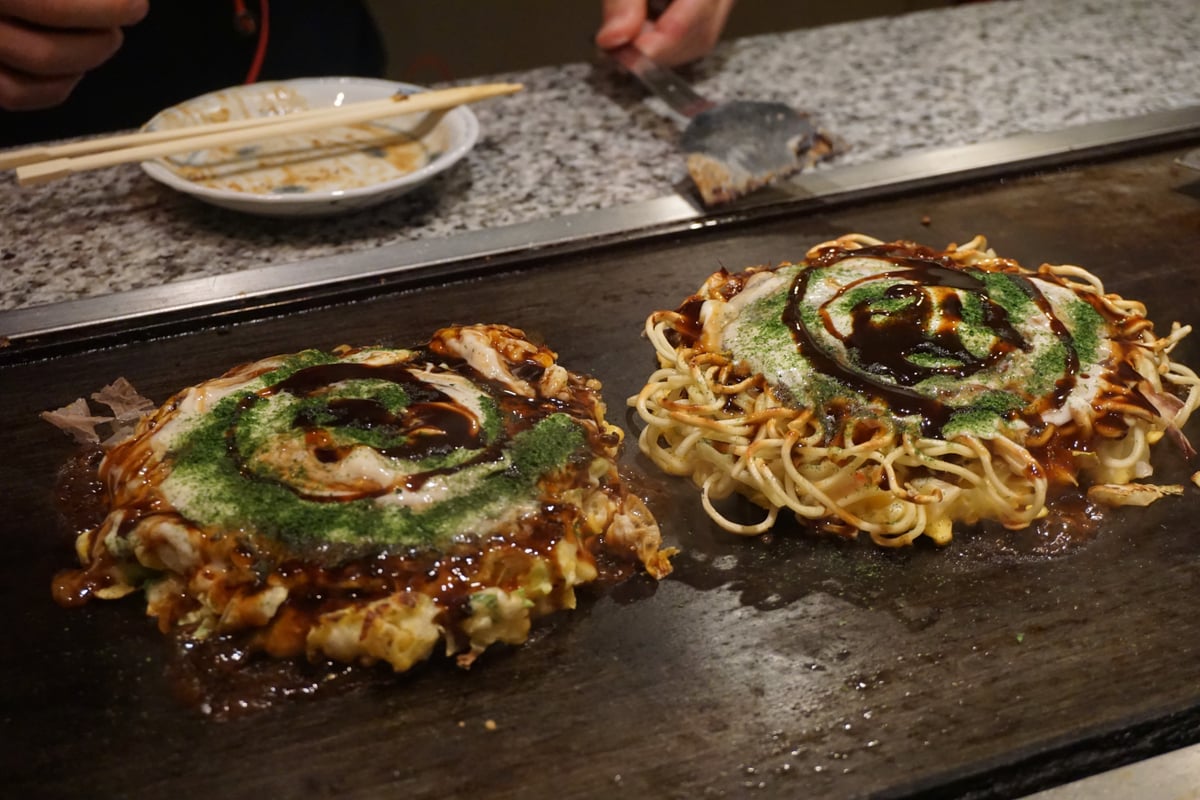
Osaka-style Okonomiyaki
Osaka-style okonomiyaki is a dish in which ingredients such as chopped cabbage, tenkasu (tempura bits), pork, and squid are mixed into a batter of wheat flour mixed with dashi, then cooked flat on both sides on an iron griddle. When it is done, it is brushed with sauce and eaten topped with dried fish flakes (kezuribushi), aonori (green laver flakes), and mayonnaise if desired. Along with takoyaki, it represents Osaka's konamon (flour-based dishes) culture. In the late Meiji era, 'yoshoku-yaki' made with wheat flour, cabbage, and sauce appeared. The snack sold at dagashiya (cheap candy shops) and elsewhere as 'issen yoshoku' is said to have developed after the war into a meal using plenty of pork and vegetables. At first it was made in the kasaneyaki (layered) style, with the ingredients placed on top of the batter, but in Osaka the mazeyaki (mixed) style, in which the ingredients are mixed into the batter before cooking, became widespread. From the end of the Showa 30s into the Showa 40s, chain restaurants promoted it as an Osaka specialty, and it became known nationwide. Modan-yaki, which adds noodles to the batter, is also a way of eating it that was born in Osaka.
Kushikatsu
Kushikatsu (Deep-fried Skewers)
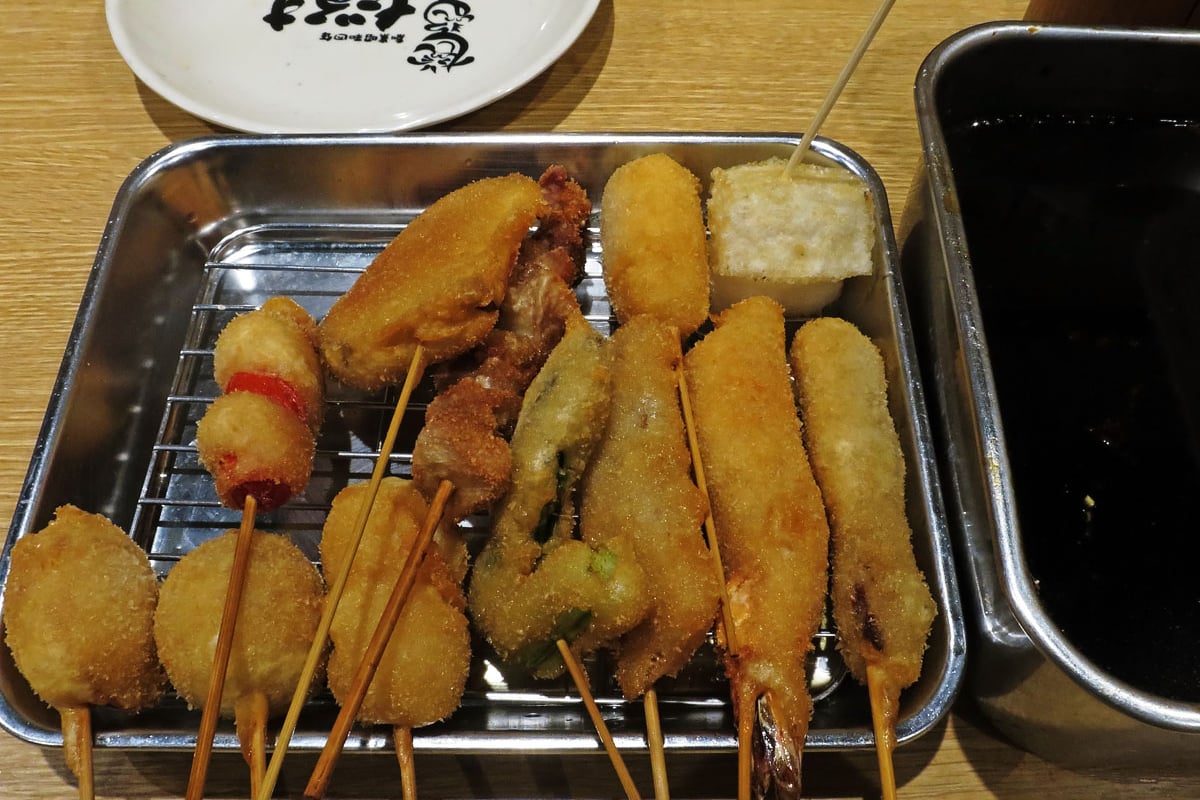
Kushikatsu is an Osaka specialty in which beef, vegetables, seafood, and other ingredients are cut into bite-size pieces, skewered, coated in batter and panko breadcrumbs, and deep-fried. The freshly fried skewers are eaten after dipping them in sauce from a container placed on the table. Because customers share the sauce, the iron rule of 'no double-dipping' in the sauce is widely known. There are various theories about its origin, but the leading one is that it was born in Shinsekai, home of Tsutenkaku Tower, between the late Taisho era and the early Showa era. Daruma (だるま), founded in 1929 (Showa 4), says it began when its first proprietress (okami) served it to laborers working nearby, and it is regarded as the originator of Osaka-style kushikatsu. The prototype was thin beef coated in a thick batter and fried, so that it would be cheap, filling, and quick to eat. In the 2000s, chain restaurants specializing in kushikatsu spread across Japan, and it became known as an Osaka specialty. Even today, many kushikatsu restaurants line the streets of Shinsekai and Jan Jan Yokocho.
Kitsune Udon
Kitsune Udon
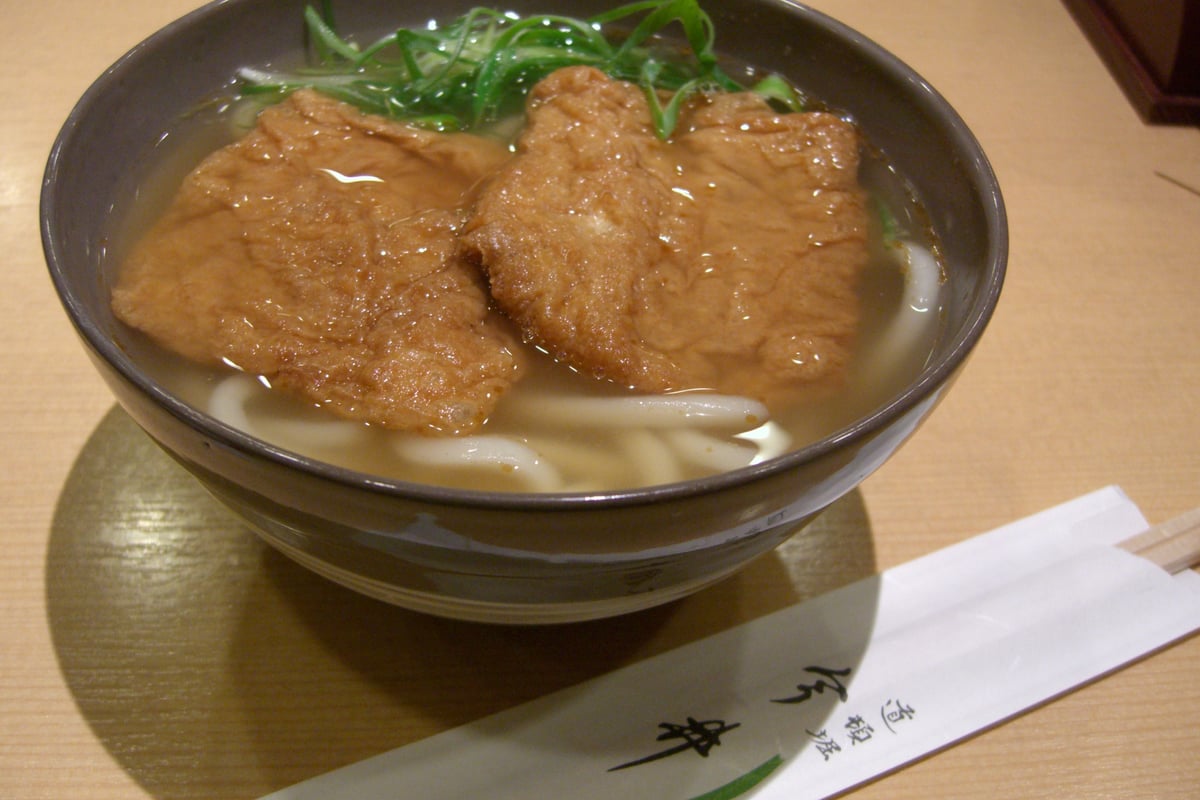
Kitsune udon is a dish of udon in a broth made from kombu and dried fish (fushi), topped with aburaage (deep-fried tofu) simmered in a sweet and savory seasoning. It is said to have been born in Osaka and is also said to be the udon most loved by the people of Osaka Prefecture. Osaka udon is said to be characterized by soft, chewy noodles that are not too thick and blend well with the dashi. In Osaka, once called 'the nation's kitchen' (Tenka no Daidokoro), kombu from Hokkaido was brought in by Kitamaebune trading ships, and a food culture that values dashi developed. Kitsune udon is said to have started at Matsubaya (松葉家, now Usami-tei Matsubaya), an udon shop that opened in Senba in 1893 (Meiji 26). It is said that when the founder, 宇佐美要太郎, served aburaage meant for inari sushi alongside plain udon (su-udon), customers put it on their udon and ate it, and this became the start. The name comes from the belief that aburaage is a favorite food of foxes (kitsune). In the Kansai region, there is also a distinctive naming culture, such as calling soba topped with aburaage 'tanuki.'
Osaka-zushi (Hako-zushi and Battera)
Osaka-zushi (Hako-zushi and Battera)
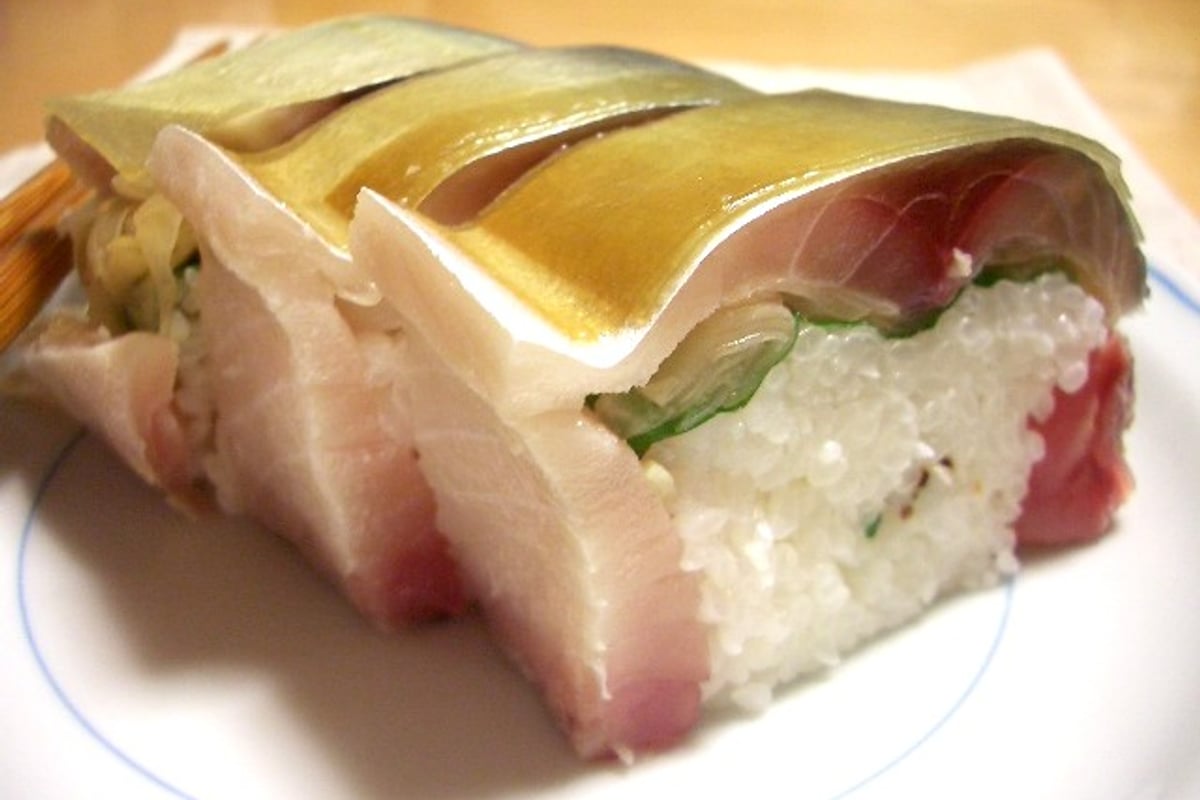
Osaka-zushi is a general term for the sushi that has been made in Osaka, including pressed sushi, rolled sushi (makizushi), and steamed sushi (mushi-zushi). In contrast to the nigiri sushi of Edo, the mainstream in Osaka was oshizushi (pressed sushi), in which sushi rice and toppings are packed into a wooden frame or box and pressed firm. The leading example is hako-zushi (box-pressed sushi), which is pressed in a wooden box and cut into bite-size pieces. Yoshino Sushi (吉野寿司) in Senba, founded in 1841 (Tenpo 12), is said to have devised a colorful hako-zushi using sea bream, shrimp, conger eel (anago), and other toppings in the Meiji era. Also called '2-sun-6-bu kaiseki,' this hako-zushi was favored by the masters of Senba's merchant houses (danna-shu). Another specialty is battera, made by layering vinegar-cured mackerel and shiraita kombu (thin white kelp sheets) and pressing them together. It is said to have been devised in 1891 (Meiji 24) by 寿司常 in Minami-Senba, and its name derives from a Portuguese word meaning small boat. Because it is pressed firm to remove the air, it keeps well, and it has long been valued as a boxed lunch for theatergoers and as a gift to bring when visiting.
Tecchiri (Fugu Hot Pot)
Tecchiri (Fugu Hot Pot)
Tecchiri is a hot pot dish in which the flesh and bony trimmings (ara) of fugu (pufferfish), mainly tiger puffer (torafugu), are simmered in kombu dashi with vegetables and tofu and then eaten with ponzu. It is known as the name for fugu hot pot in Kansai, and especially in Osaka. Poisonous fugu was likened to a gun, since 'if it hits you, you die,' and was called 'teppo' (gun); the name 'tecchiri' is said to be a shortened form of teppo no chirinabe (fugu chiri hot pot). In the same way, fugu sashimi is called tessa (teppo sashimi). Osaka is said to account for about 60 percent of Japan's fugu consumption and is known as the country's largest consumer of fugu. Fugu grew in popularity in Osaka in the early Showa era, and after the war the number of specialty restaurants increased, establishing it as a winter delicacy. The standard way to finish the meal is zosui (rice porridge) made with the dashi into which the umami of the fugu has dissolved. Preparing fugu requires specialized knowledge and skill. In Osaka Prefecture, under a prefectural ordinance, only people who have received registration as registered fugu processors may process fugu as a business.
Harihari Nabe (Whale and Mizuna Hot Pot)
Harihari Nabe (Whale and Mizuna Hot Pot)
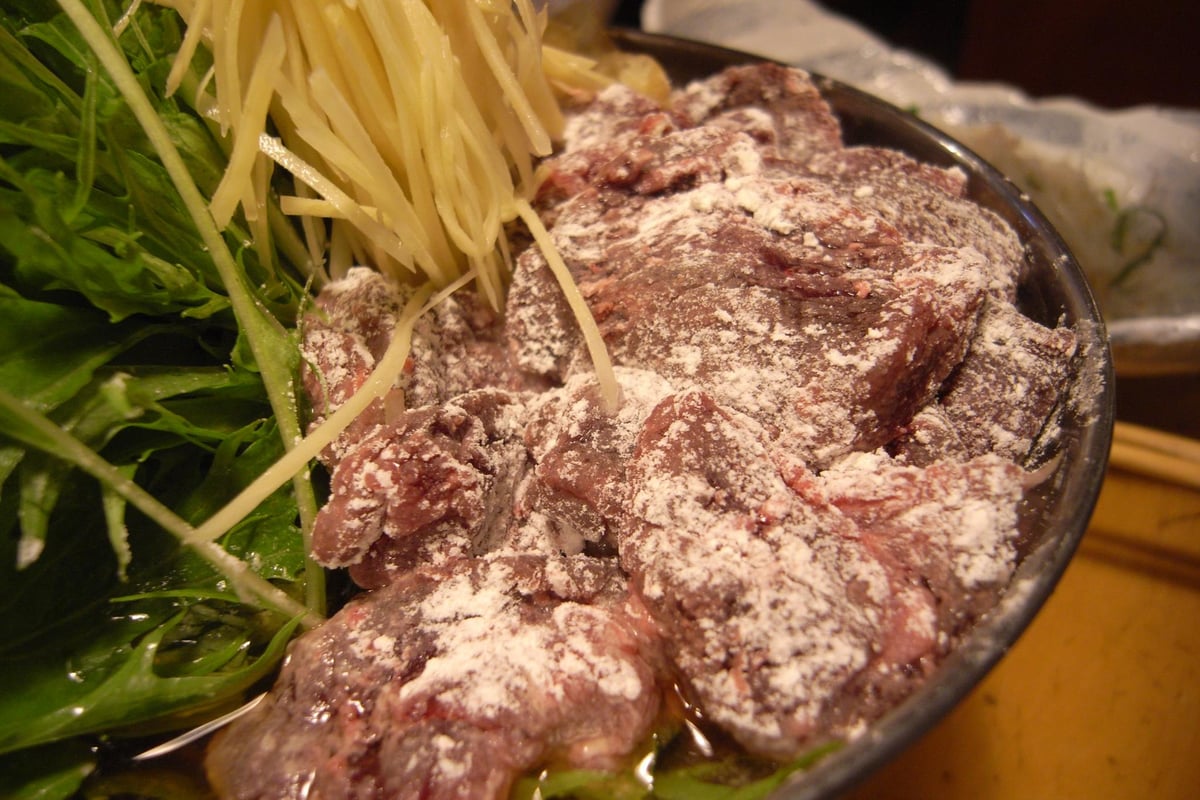
Harihari nabe is an Osaka hot pot dish in which whale meat and mizuna are briefly simmered in dashi made from kombu and dried fish flakes (fushi). 'Harihari' is said to be a word expressing the crisp texture and sound of eating mizuna. Osaka, called 'the nation's kitchen' (Tenka no Daidokoro), was a hub where foodstuffs were collected and distributed; whale was also brought in from various regions, and a culture of eating whale flourished. Hot pots of whale and mizuna are said to have been commonly eaten in Osaka homes and restaurants. The name is said to have been given by 徳家, a whale restaurant that opened in Sennichimae in Minami in 1967 (Showa 42). In recent years, opportunities to eat whale have decreased due to whaling restrictions and other factors, and pork or other meats are sometimes used instead. In fiscal 2024 (Reiwa 6), 'Osaka whale harihari nabe' was recognized under the Agency for Cultural Affairs' '100-Year Food' program (Future 100-Year Food category). It is also introduced as a regional dish of Osaka Prefecture in the Ministry of Agriculture, Forestry and Fisheries' 'Our Regional Cuisines' (Uchi no Kyodo Ryori).
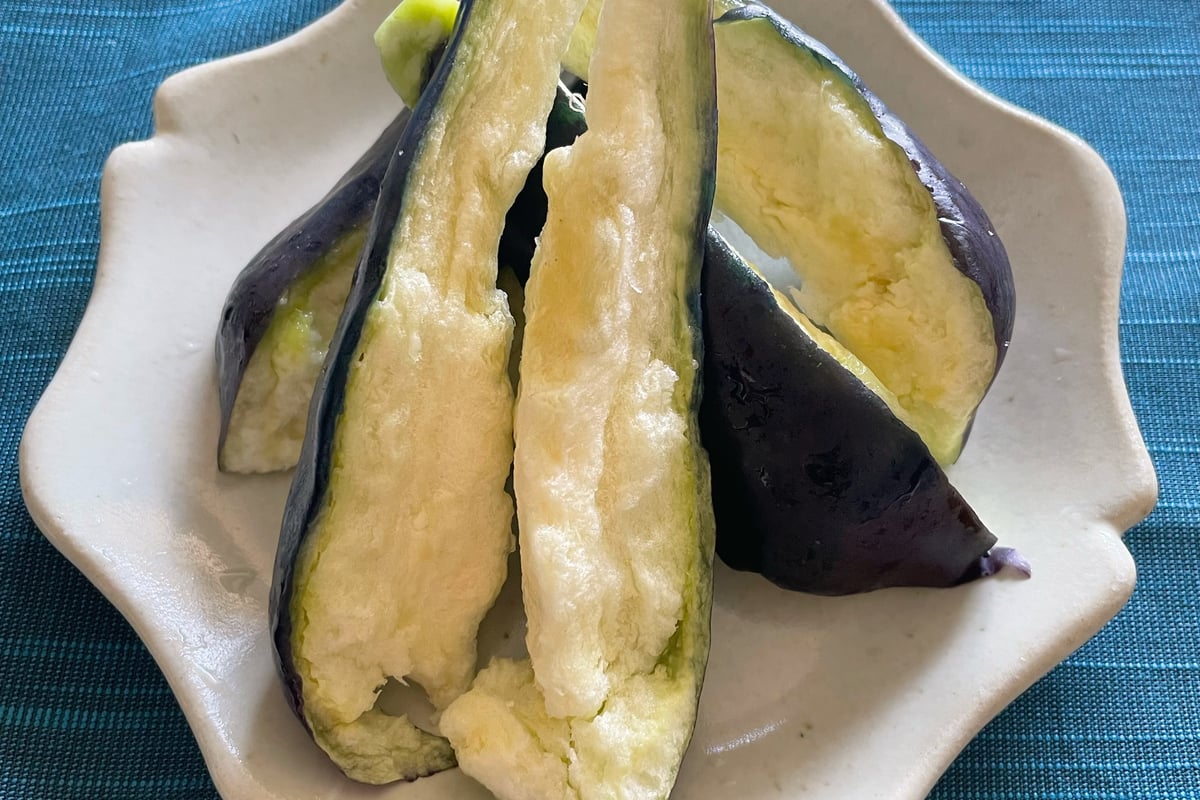
Senshu Mizunasu-zuke (Pickled Water Eggplant)
Senshu Mizunasu-zuke (Pickled Water Eggplant)
Senshu mizunasu-zuke are pickles made by steeping mizunasu (water eggplant), grown in the Senshu area of southern Osaka Prefecture, in a rice-bran bed or a seasoning liquid. Mizunasu is so juicy that water drips from it when squeezed tightly, and its skin and flesh are soft with a subtle sweetness. Because its skin is thin and it has little bitterness (aku), it can even be eaten raw, and asazuke (lightly pickled) that brings out these qualities has taken root as part of the local food culture. Cultivation is said to have continued since the early Edo period, and the area around 澤 in Kaizuka City and 上之郷 in Izumisano City is said to be its birthplace. In 2007, the local JA (agricultural cooperative) registered 'Senshu Mizunasu' as a regional collective trademark. In January 2025 (Reiwa 7), it was also registered as a national Geographical Indication (GI). 'Senshu mizunasu no asazuke' is listed in the Ministry of Agriculture, Forestry and Fisheries' 'Our Regional Cuisines' (Uchi no Kyodo Ryori). Besides being eaten daily at home, it is also popular as a souvenir and gift representing Osaka.
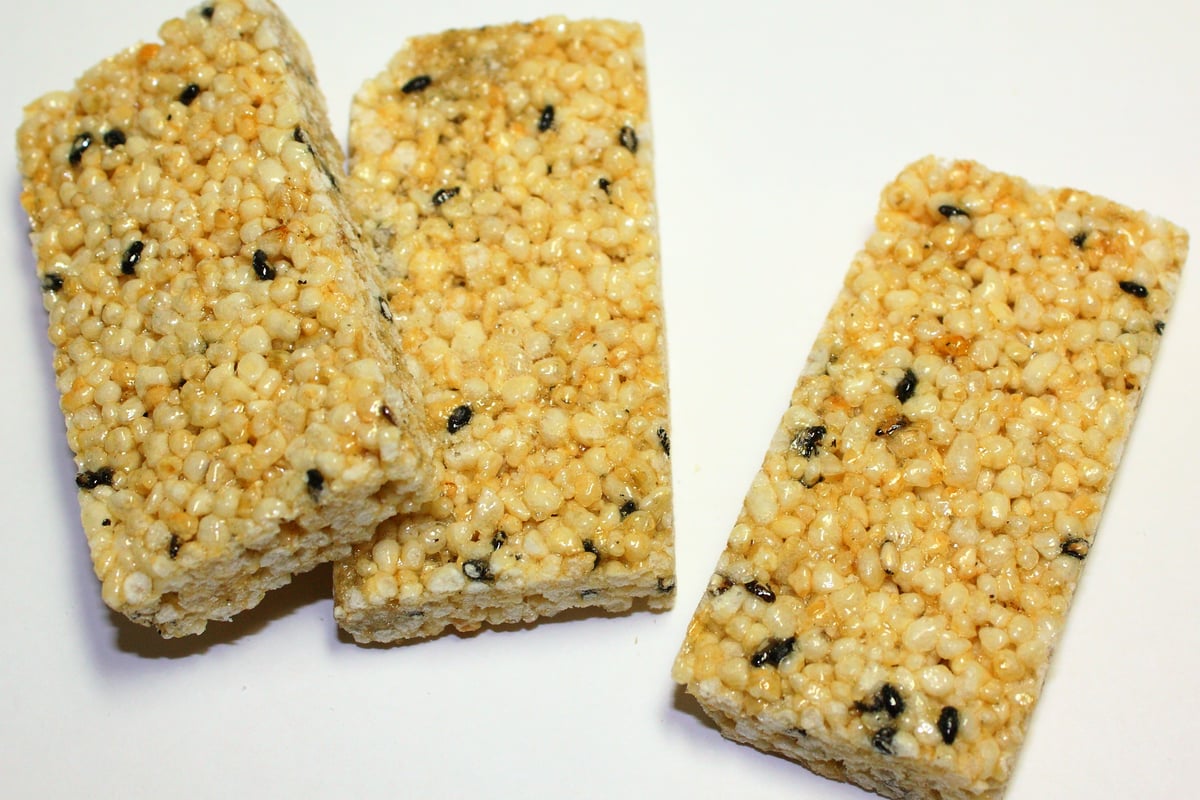
Awa Okoshi and Iwa Okoshi
Awa Okoshi and Iwa Okoshi (Osaka Puffed Rice Crackers)
Awa okoshi and iwa okoshi are regional sweets that represent Osaka. Okoshi is a dry confection made by binding steamed and dried rice, millet, or other grains with mizuame (starch syrup) and sugar. It was originally a sweet for ordinary people made from millet (awa), barnyard millet (hie), and other grains, but in Osaka in the mid-Edo period, 'awa okoshi,' made from rice crushed finely into millet-sized grains, was born. In the background was the fact that high-quality rice, mizuame, and sugar gathered from all over Japan in Osaka, which was called 'the nation's kitchen' (Tenka no Daidokoro). 'Iwa okoshi' is made by crushing the rice even more finely and pressing it firmly, flavored with ginger and kokuto (brown sugar). It took hold as an Osaka specialty as a lucky sweet said to 'raise oneself up, raise the household, raise the nation, and raise good fortune' (okosu meaning 'to raise'). Long-established makers such as Amidaike Daikoku (あみだ池大黒), founded in 1805 (Bunka 2), still continue to produce it today. In fiscal 2024 (Reiwa 6), awa okoshi was recognized under the Agency for Cultural Affairs' '100-Year Food' program (Traditional 100-Year Food category).
Kurumi Mochi
Kurumi Mochi (Sakai Wrapped Rice Cake)
Kurumi mochi is a specialty sweet of Sakai City, Osaka Prefecture, consisting of small pieces of mochi wrapped in a green bean paste (an). The 'kurumi' in the name does not refer to walnuts (kurumi) but comes from 'kurumu,' meaning to wrap the mochi in bean paste. The originator is said to be Kanbukuro (かん袋), a long-established shop in Sakai Ward, Sakai City. According to the shop's history, it began when 和泉屋徳兵衛 opened a mochi shop in 1329 (Gentoku 1). In the middle of the Muromachi period, in Sakai, which prospered through trade with Ming China, the fifth-generation owner is said to have created it as a salty tea sweet using agricultural produce brought in from Ming. Later, when sugar arrived from Luzon (today's Philippines), sweetness was added, giving it its present flavor. In the Meiji era, 'kori kurumi mochi,' topped with shaved ice, was also created, and in summer people line up at the shop. With its combination of lightly sweetened bean paste and soft mochi, it is also introduced as a dish of Osaka Prefecture in the Ministry of Agriculture, Forestry and Fisheries' 'Our Regional Cuisines' (Uchi no Kyodo Ryori).
Model Course
Knives, chusen dyeing and kurumi mochi in Sakai's old town
Start by heading to 堺伝匠館 in Zaimokucho-nishi, Sakai Ward. At the shop on the first floor you can buy knives and chusen-dyed tenugui, and at the Sakai Knife Museum on the second floor you can learn about the history and making of blades. Before noon, try kurumi mochi wrapped in green bean paste at かん袋 in Shinzaikecho-higashi. In summer, kori kurumi mochi topped with shaved ice is also popular. In the afternoon, at 和田商店 in Shinmeicho-higashi, you can try sharpening and handle fitting and finish your own knife (reservation required).
Eating your way through konamon and dashi flavors in Dotonbori and Sennichimae
Start in Sennichimae at わなか, eating takoyaki grilled on copper plates while standing. In Dotonbori, you can enjoy Osaka okonomiyaki at 美津の, founded in 1945, and at ぼてぢゅう總本店, which describes itself as the birthplace of modan-yaki. To finish, have kitsune udon at 道頓堀今井, known for its dashi of kombu with dried mackerel and round herring flakes. At 伊勢屋商店 in Kuromon Market, you can buy nukazuke of Senshu mizunasu pickled by hand.
Long-established shops for kitsune udon, hako-zushi and okoshi in Senba and Horie
うさみ亭マツバヤ in Minami-Senba was founded in 1893 (Meiji 26) and is said to be the birthplace of kitsune udon. Fill up with a bowl topped with aburaage simmered for three days to soak up the flavor. 吉野寿司 in Awajimachi was founded in 1841 (Tenpo 12), and you can take away its hako-zushi of grilled conger eel and small sea bream pressed in a wooden frame. If you go further west to あみだ池大黒本店 in Kita-Horie, you can choose awa okoshi and iwa okoshi at this long-established shop founded in 1805.
Kushikatsu in Shinsekai and the original takoyaki in Tamade
In Shinsekai, you can enjoy freshly fried kushikatsu at だるま新世界総本店, founded in 1929 (Showa 4) and said to be the originator of Osaka-style kushikatsu, or at 八重勝 in Jan Jan Yokocho. Because the sauce is shared, the rule is not to dip twice. Then head to 会津屋玉出本店 in Tamade, Nishinari Ward. It is said to be the shop that created takoyaki with octopus in 1935 (Showa 10), and you can enjoy the original flavor served without sauce.
Winter tecchiri and harihari nabe at long-established shops in Minami
Osaka is known as a major consumer of fugu, and in the cold season people start craving tecchiri. At 玄品法善寺総本店 near Hozenji Yokocho, you can enjoy fugu at a reasonable price in a course combining tessa, tecchiri and zosui (rice porridge). On another day, visit 西玉水 in Shimanouchi. It is a whale cuisine specialty restaurant said to have been founded in 1885, and its signature harihari nabe lets you enjoy whale tail meat together with mizuna.
Paulownia chest and tonbodama workshops and mizunasu in Senshu
At 初音の家具(田中家具製作所), about a 7-minute walk from Haruki Station on the Nankai Main Line, you can tour the making of paulownia chests and try planing and making a paulownia box (free, reservation required, closed Sundays and holidays). At 佐竹ガラス in Saiwai, Izumi City, you can join a class to make tonbodama by melting colored glass rods (reservation required). At 愛彩ランド, a JA farmers' market in Kishiwada City, you can look for Senshu mizunasu, mainly around July, when the open-field crop reaches its peak.
Hands-on course: carving ranma in Settsu and hammering patterns into tinware in Higashisumiyoshi
At 木下らんま店 in Torikai-nono, Settsu City, you can carve boards of cedar or cypress under the guidance of a certified traditional craftsperson (Dento Kogeishi) to make coasters or mini ranma (fourth grade and up, reservation by phone). In the afternoon, move to 大阪錫器 in Tanabe, Higashisumiyoshi Ward, Osaka City. There you can hammer patterns into the surface of tin to make your own guinomi sake cup or tumbler. For both, check fees and schedules by inquiring in advance.
Learning the history of Osaka Kongo Sudare at the Sudare Museum in Kawachinagano
すだれ資料館 in Amanocho, Kawachinagano City, displays bamboo blinds made by traditional methods, as well as materials on historical blinds handed down in China and Korea. Admission is free but by reservation only, and it is open on weekdays from 10:00 to 16:00. At the 'Sudare Fair,' held several times a year, you can also see production demonstrations. 大阪簾工業協同組合 in Tondabayashi City serves as a contact point for learning about Osaka Kongo Sudare products and makers.
Events
Sakai Knife Festival (堺刃物まつり)
Spring (in 2026: April 11 and 12) / Kita Ward, Sakai City (堺市産業振興センター イベントホール)
View details →Naniwa Honzome (Chusen) Exhibition (浪華本染め(注染)展)
Early summer (in 2026: June 29 to July 3) / Sakai Ward, Sakai City (1st floor of the Sakai City Hall main building)
View details →