Senshu Mizunasu-zuke (Pickled Water Eggplant)
Senshu Mizunasu-zuke (Pickled Water Eggplant)
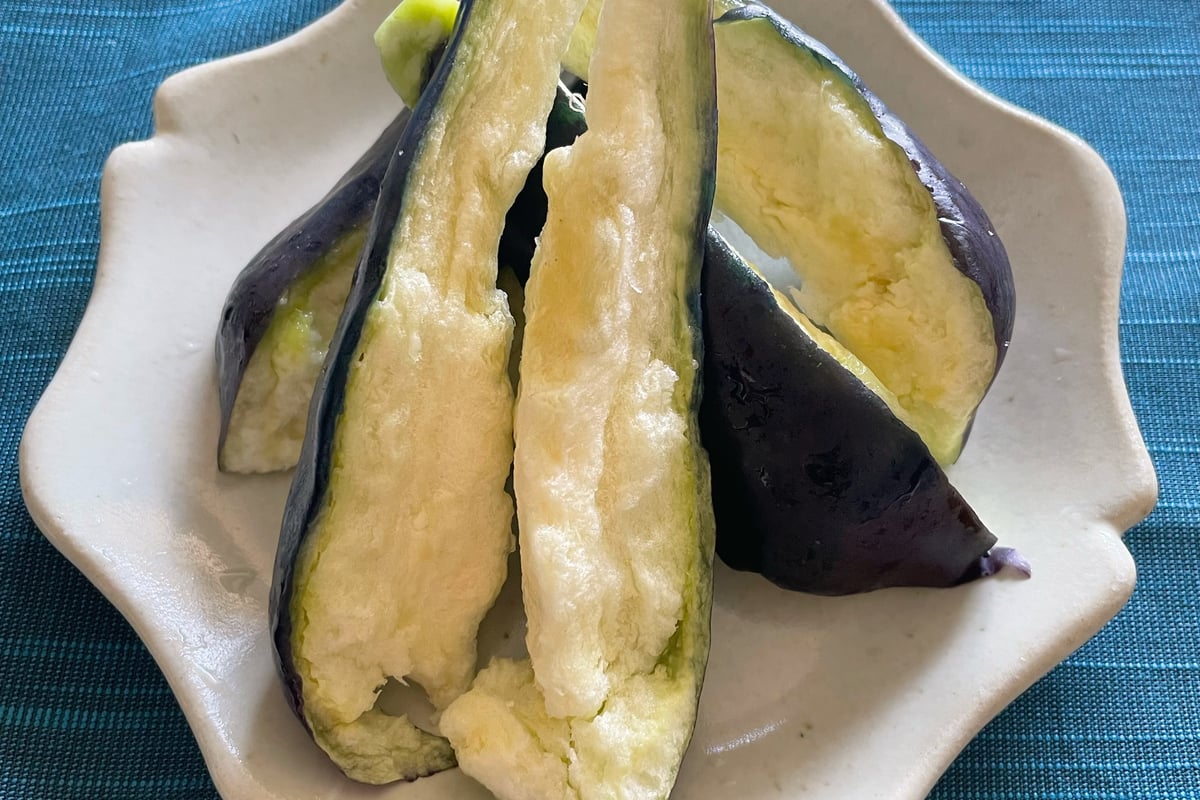
Image: Wikimedia Commons
Senshu mizunasu-zuke are pickles made by steeping mizunasu (water eggplant), grown in the Senshu area of southern Osaka Prefecture, in a rice-bran bed or a seasoning liquid. Mizunasu is so juicy that water drips from it when squeezed tightly, and its skin and flesh are soft with a subtle sweetness. Because its skin is thin and it has little bitterness (aku), it can even be eaten raw, and asazuke (lightly pickled) that brings out these qualities has taken root as part of the local food culture. Cultivation is said to have continued since the early Edo period, and the area around 澤 in Kaizuka City and 上之郷 in Izumisano City is said to be its birthplace. In 2007, the local JA (agricultural cooperative) registered 'Senshu Mizunasu' as a regional collective trademark. In January 2025 (Reiwa 7), it was also registered as a national Geographical Indication (GI). 'Senshu mizunasu no asazuke' is listed in the Ministry of Agriculture, Forestry and Fisheries' 'Our Regional Cuisines' (Uchi no Kyodo Ryori). Besides being eaten daily at home, it is also popular as a souvenir and gift representing Osaka.
Origin
In the Teikin Orai (庭訓往来), dating from the latter half of the Muromachi period, the name 'mizunasubi' (澤茄子), thought to be the origin of mizunasu, appears in the section on sweets. It is thought to have been treated as a special eggplant that could be eaten raw like fruit. In Izumisano City, the saying 'Hineno azuki, 上之郷 eggplant' (日根野あずきに上之郷なす) remains. The area around present-day 澤 in Kaizuka City and 上之郷 in Izumisano City is said to be the birthplace of mizunasu cultivation. Agricultural surveys of the Izumi region in the Edo period suggest that it was grown in riverside villages in Sakai, Kishiwada, Kaizuka, and Izumisano.
History
Mizunasu is said to change in shape, color, and flesh quality when grown elsewhere, and it has been regarded as a specialty that never left its home area. There is also an anecdote that Yamauchi Kazutoyo, the first lord of the Tosa domain, could not forget the mizunasu pickles served with chagayu (rice porridge cooked in tea) when stopping at Kishiwada Castle, and tried to grow it in Tosa. Until the early Showa era, mizunasu had the drawback of losing its color when pickled, and from 1942 onward, the prefectural agricultural experiment station worked on improving the variety. Because its thin skin bruises easily, it was consumed within Senshu until the 1960s. From the 1980s onward, as road networks and refrigerated home delivery services developed, asazuke began to be sent throughout Japan as gifts.
Features
There are mainly two kinds of pickles: nukazuke (rice-bran pickles), steeped in a rice-bran bed, and asazuke (salt pickles), steeped in a seasoning liquid. In both cases, the characteristic is to make the most of the juiciness of mizunasu and to eat them before they become over-pickled. In nukazuke, the skin takes on a rich rice-bran flavor while the flesh stays juicy. It is also said that it is best to tear them lengthwise by hand rather than cutting them with a knife, so that soy sauce and other seasonings cling well to the uneven surface. 'Jako-goko,' in which long-fermented pickles (furuzuke) are desalted and simmered with small shrimp in a sweet and savory sauce, is also known as a regional dish of Senshu.
Main Ingredients
Food Culture
In the past, mizunasu is said to have been planted in a corner of fields and eaten to quench thirst during farm work under the blazing sun. Osaka Prefecture and JA Group Osaka have designated mizunasu as a 'Naniwa specialty product' (なにわ特産品). Almost all of the eggplants grown in Senshu are mizunasu, a brand vegetable that represents the area. At the G20 Osaka Summit in 2019, it was also chosen as an ingredient for the dinner banquet.
How It Differs from Home Cooking
According to a project report by the Agency for Cultural Affairs, mizunasu used to be pickled in households throughout Senshu, and each family had its own pickling method and flavor. In recent years, there are fewer opportunities to pickle at home, and more people use store-bought products. Some pickle shops do not mechanize and instead pickle by hand in their own rice-bran beds.
Famous Shops
伊勢屋商店(黒門市場)
大阪府大阪市中央区日本橋2-3-4
A pickle shop said to have been founded in Kuromon Market in 1897 (Meiji 30). It is committed to pickling by traditional methods without mechanization. Its 'mizunasu nukazuke,' made by hand-pickling Senshu-grown mizunasu in its own rice-bran bed, is certified as an Osaka Prefecture 'Osaka-mon Meihin' (大阪産(もん)名品) product.
JA大阪泉州 農産物直売所「こーたり~な」
大阪府泉佐野市松風台3-1-1
A farm produce direct sales outlet operated by JA大阪泉州. It is one of the facilities that Osaka Prefecture introduces as places to buy Senshu mizunasu, and you can look for mizunasu and mizunasu pickles typical of the production area.
JAいずみの 農産物直売所「愛彩ランド」
大阪府岸和田市岸の丘町3-6-18
A farm produce direct sales outlet operated by JAいずみの in Kishiwada City. It is one of the facilities that Osaka Prefecture introduces as places to buy Senshu mizunasu, and it sells mizunasu along with other local produce.
| 堺共同漬物 Osaka Senshu Mizunasu-zuke Assortment | An assortment by 堺共同漬物 of Sakai City that lets you compare three kinds: nukazuke, asazuke, and a cut type. The company's mizunasu pickles are certified as Osaka-mon Meihin. In department store gift selections, it is sold for about 4,968 yen (tax included). |
|---|---|
| 久吾商店 Mizunasu-zuke Assortment | An assortment of mizunasu nukazuke and salt pickles made by 久吾商店 in 土生町, Kishiwada City. The company's mizunasu pickles are certified as Osaka-mon Meihin and are introduced as an Osaka souvenir and gift. |
FAQ
Q. How is mizunasu different from ordinary eggplant?
A. It is extremely juicy, so much so that water drips from it when squeezed tightly. Its skin and flesh are soft with a subtle sweetness, and because it has little bitterness, it can even be eaten raw. It is said to change in shape and flesh quality when grown elsewhere, and Senshu's sandy soil and seaside climate are said to be well suited to growing it.
Q. When is Senshu mizunasu in season?
A. Greenhouse-grown mizunasu is available from about March to August, and open-field mizunasu from about May to November, with open-field production peaking in July. Asazuke is also popular as a summer gift, such as for ochugen (midsummer gifts).