Image: Wikimedia Commons
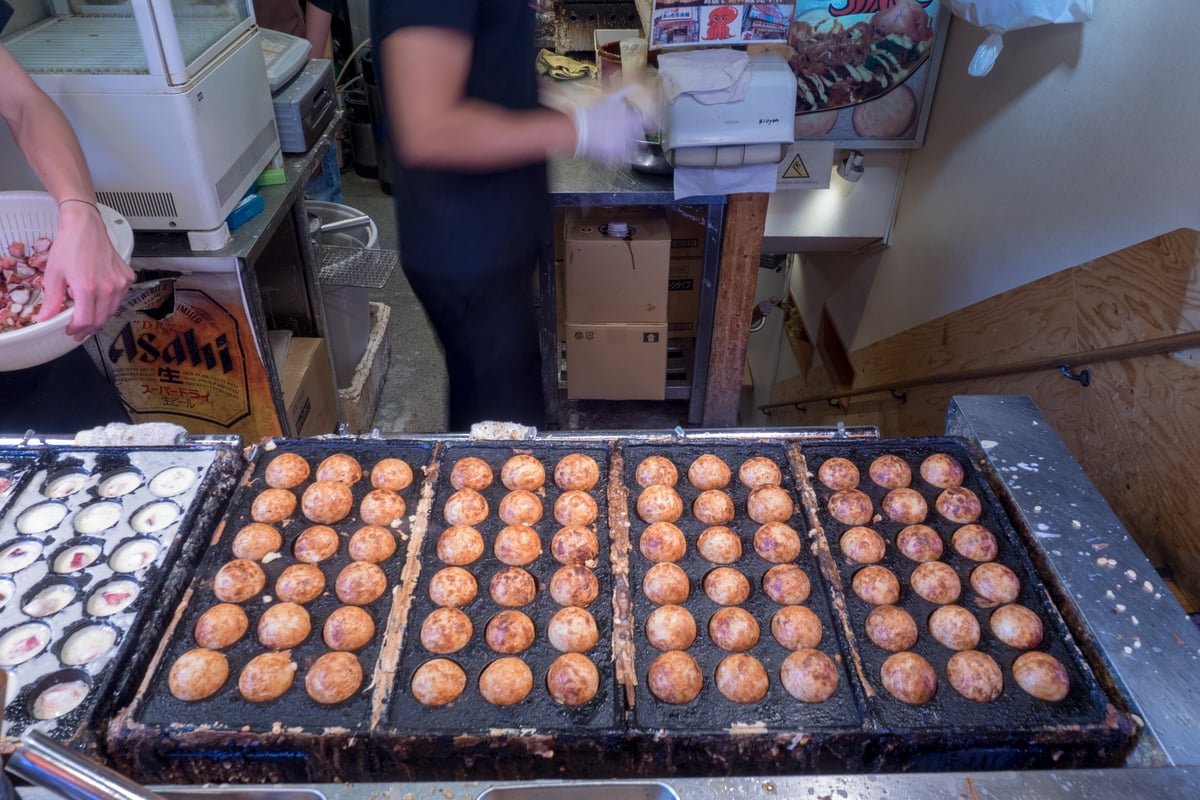
Takoyaki is an Osaka konamon (flour-based dish) made by adding chopped octopus and tenkasu (tempura bits) to a batter of wheat flour mixed with dashi and egg, then grilling it into balls. It is cooked on a special iron plate lined with round hollows and finished so that it is fragrant on the outside and soft and runny inside. The classic way to eat it is topped with sauce, aonori (green laver flakes), and dried fish flakes (kezuribushi). Its roots are said to lie in chobo-yaki, which was popular with children at dagashiya (cheap candy shops) and festival fairs (ennichi) from the late Meiji era through the Taisho era, and in the later rajio-yaki. In the early Showa era, rajio-yaki made with octopus as the filling began to be sold in Osaka City. Aizuya (会津屋) in Nishinari Ward, Osaka City, is known as the originator that created octopus-filled takoyaki in 1935 (Showa 10). At first it was eaten with nothing on it, but thick sauce appeared after the war, and the current style is said to have taken hold then. Many households in the prefecture own a takoyaki maker, and it is loved as the soul food of the people of Osaka Prefecture.
Origin
The source of takoyaki is said to be chobo-yaki. It was made by pouring wheat flour mixed with water onto a copper or iron plate with semicircular hollows, adding konnyaku, red pickled ginger (beni shoga), green onions, and other ingredients, and grilling it. Soy sauce was added to the batter for flavor, and it was sold to children at dagashiya and at stalls at festival fairs. When radio broadcasting began in the late Taisho era, a stall food called rajio-yaki appeared, named after the radio, which was then at the cutting edge of civilization. Replacing the filling of this rajio-yaki with octopus is said to be the beginning of takoyaki.
History
The first-generation owner of Aizuya, 遠藤留吉, began selling 'rajio-yaki' (written ラヂオ焼) filled with beef tendon and konnyaku in 1933 (Showa 8). In 1935 (Showa 10), taking a hint from a customer's remark that 'in Akashi they put octopus in it,' the owner is said to have devised takoyaki grilled with octopus and a seasoned batter. After the war, when thick sauce was created, the style of topping it with sauce, aonori, and dried fish flakes, serving it on a boat-shaped tray, and adding toothpicks spread. The Osaka Convention & Tourism Bureau explains that takoyaki shops began to increase in the city from the Showa 30s.
Features
The batter is soft wheat flour mixed with dashi and egg, and it is characteristically loose, with a high water content. Plenty of batter is poured into the hollows of a heated iron plate, and octopus cut into pieces of about 15 mm and tenkasu are added. When the edges start to cook, the balls are turned round and round with a pointed tool, tucking in the batter that has spilled over to shape them into spheres. The basic finish is to brush on sauce and sprinkle aonori and dried fish flakes. Each shop has its own character, such as adding mayonnaise, or serving takoyaki without sauce so that it is eaten with only the flavor of the dashi.
Main Ingredients
Food Culture
In Osaka it is eaten every day as an easy snack, and many households in the prefecture are said to own a takoyaki maker. Takoyaki shops line the streets around Dotonbori in Minami, and eating it while strolling is a staple for tourists. Organizations such as the Japan Konamon Association (日本コナモン協会) also promote the culture of konamon cooked on iron griddles, including takoyaki, in Japan and abroad.
How It Differs from Home Cooking
At home, it is often grilled easily in an electric or gas takoyaki maker using store-bought takoyaki flour. Specialty shops each have their own ingenuity: some use copper plates with good heat conduction to grill takoyaki quickly over high heat, while others blend several kinds of dashi or yam (yamaimo) into the batter. Some shops, like Aizuya, season the batter and serve takoyaki to be eaten without sauce.
Famous Shops
たこ焼発祥のお店 会津屋 玉出本店
大阪府大阪市西成区玉出西2-3-1
Founded in 1933 (Showa 8), this shop is known as the originator of takoyaki. It began with 'rajio-yaki' (ラヂオ焼) devised by the first-generation owner, 遠藤留吉, and octopus-filled takoyaki was born here in Showa 10. Its hallmark is takoyaki grilled from a batter seasoned with dashi and soy sauce and eaten as is, without sauce.
たこ焼道楽 わなか 千日前本店
大阪府大阪市中央区難波千日前11-19
A standing-only takoyaki shop near Namba Grand Kagetsu. By using copper plates with high thermal conductivity and grilling quickly over high heat, it achieves a texture that is crisp outside and soft and runny inside. Besides its special sauce, it also offers takoyaki enjoyed with kettle-boiled salt.
View details →大阪アメリカ村 甲賀流 本店
大阪府大阪市中央区西心斎橋2-18-4
Founded in 1974, this shop stands in front of Sankaku Park (Triangle Park) in Amerikamura. It is also said to be the birthplace of the style of drizzling mayonnaise in a crisscross pattern. Its batter combines seven kinds of dashi with yam, and the classic 'sauce-mayo' costs about 600 yen for 10 pieces.
| 瓢月堂 Takopatie (たこパティエ) | An Osaka souvenir made by 株式会社瓢月堂 that turns the flavor of takoyaki into a confection. It combines the flavors of sauce, aonori, and katsuobushi with the sweetness of walnuts and caramelization. It is sold at places such as Shin-Osaka Station, Osaka Station, and Kansai International Airport, starting at about 778 yen for a box of 12. |
|---|
FAQ
Q. What is the difference between takoyaki and Akashiyaki?
A. Akashiyaki is a specialty of Akashi City in Hyogo Prefecture, in which octopus is wrapped in a soft batter made with plenty of egg and eaten dipped in dashi. Osaka takoyaki is generally eaten after grilling, topped with sauce, aonori, and the like. Aizuya's takoyaki is said to have been born from a hint in a customer's story that people in Akashi put octopus in it.
Q. Did takoyaki in the old days have no sauce on it?
A. That's right. When it was first created, the batter is said to have been seasoned and the takoyaki eaten with nothing on it. The style of topping it with sauce, aonori, and dried fish flakes spread after the war and is also said to have been influenced by okonomiyaki. Aizuya, regarded as the originator, still serves takoyaki without sauce.