Image: Wikimedia Commons
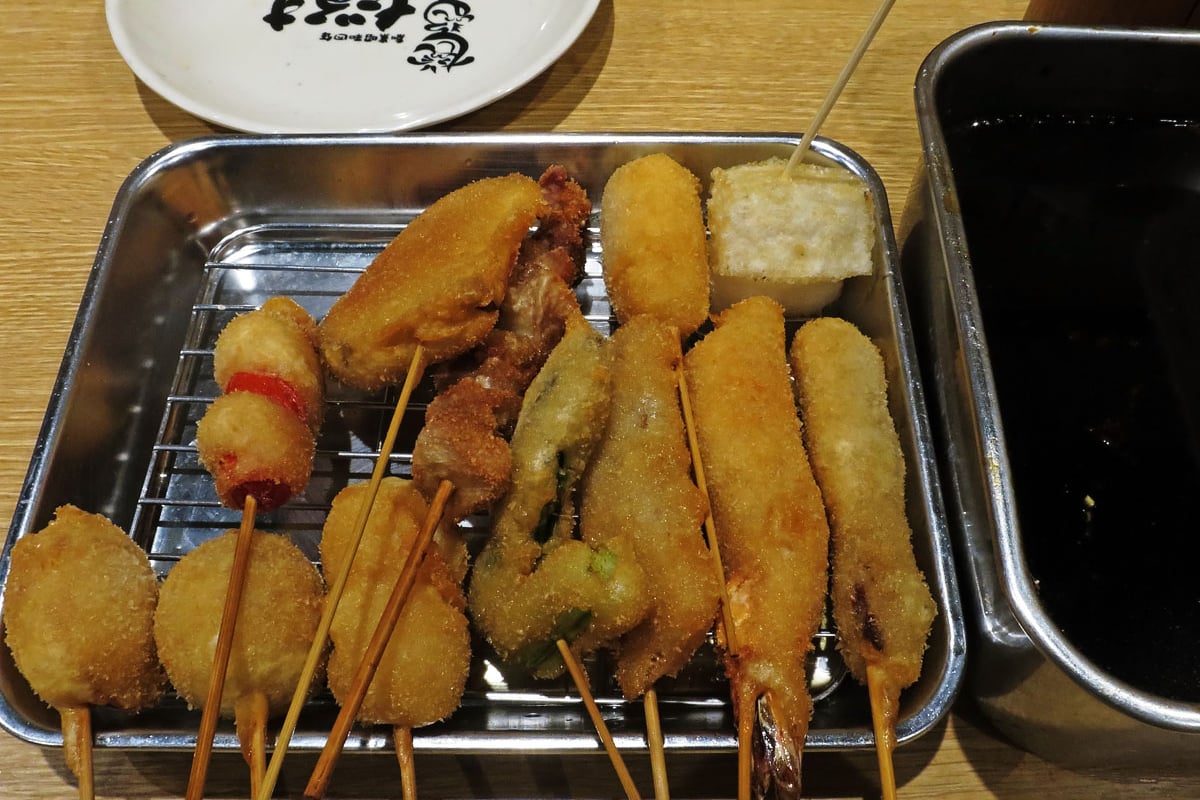
Kushikatsu is an Osaka specialty in which beef, vegetables, seafood, and other ingredients are cut into bite-size pieces, skewered, coated in batter and panko breadcrumbs, and deep-fried. The freshly fried skewers are eaten after dipping them in sauce from a container placed on the table. Because customers share the sauce, the iron rule of 'no double-dipping' in the sauce is widely known. There are various theories about its origin, but the leading one is that it was born in Shinsekai, home of Tsutenkaku Tower, between the late Taisho era and the early Showa era. Daruma (だるま), founded in 1929 (Showa 4), says it began when its first proprietress (okami) served it to laborers working nearby, and it is regarded as the originator of Osaka-style kushikatsu. The prototype was thin beef coated in a thick batter and fried, so that it would be cheap, filling, and quick to eat. In the 2000s, chain restaurants specializing in kushikatsu spread across Japan, and it became known as an Osaka specialty. Even today, many kushikatsu restaurants line the streets of Shinsekai and Jan Jan Yokocho.
Origin
There are various theories about the origin of kushikatsu, but one says it was born in Osaka's Shinsekai between the late Taisho era and the early Showa era. At the time, many people engaged in manual labor lived around Shinsekai. It is said to have begun as a dish devised to fill these people's stomachs: cheap, plentiful, and quick to eat between jobs. By frying thin beef in a thick batter, it was designed to be filling even with only a little meat.
History
Daruma in Shinsekai claims to have been founded in 1929 (Showa 4) and is regarded as the originator of Osaka-style kushikatsu. After the war, when the food supply was unstable, kushikatsu restaurants are said to have increased, since food served freshly fried posed less worry about food poisoning. In Shinsekai's Jan Jan Yokocho, long-established restaurants founded shortly after the war are still in business. In the 2000s, national chains specializing in kushikatsu advertised it as an Osaka specialty, and its name spread throughout the country.
Features
It is characterized by a wide variety of ingredients, such as beef, pork, shrimp, quail eggs, and onions. The ingredients are skewered, coated in a batter of wheat flour and egg, then covered in panko and deep-fried. Some restaurants add yam (yamaimo) to the batter for a light texture. The etiquette is to dip each freshly fried skewer only once into the shared sauce. Restaurants often provide raw cabbage, which customers can generally eat freely.
Main Ingredients
Food Culture
It is a popular, everyday taste enjoyed all year round regardless of season. Shinsekai is still packed with kushikatsu restaurants, many of which are standing-only. It is a dish that is 'cheap, fast, and tasty,' but in recent years, restaurants using luxury ingredients and those with a stylish atmosphere have also increased.
How It Differs from Home Cooking
It can be made at home, but in Osaka it is considered a dish mainly eaten at restaurants. At restaurants, you can enjoy the distinctive style of freshly fried skewers served one after another and dipped in shared sauce. Each restaurant is particular about the variety of ingredients, the batter recipe, and the sauce blend, and each one's character shows in the texture of the batter and how the skewers are fried.
Famous Shops
大阪新世界元祖串かつ だるま 新世界総本店
大阪府大阪市浪速区恵美須東2-3-9
Founded in 1929 (Showa 4), this restaurant is regarded as the originator of Osaka-style kushikatsu. Though it is a small place with about 12 counter seats, it is the head restaurant of the branches operating in Osaka City and elsewhere. It offers more than 35 kinds of skewers, starting at about 143 yen per skewer.
八重勝
大阪府大阪市浪速区恵美須東3-4-13
Founded in 1947 (Showa 22), this is a popular restaurant in Shinsekai's Jan Jan Yokocho. Its hallmark is adding yam to the batter and frying the skewers until fluffy. They are fried in an iron pot, whose temperature is difficult to control, to give them a crisp texture. It has counter seats only, and lines sometimes form.
FAQ
Q. Why is 'double-dipping' in the sauce forbidden?
A. Because at kushikatsu restaurants, customers generally share the container of sauce. Putting a skewer back into the sauce after biting into it is not hygienic, so no double-dipping is an iron rule. If you want to add more sauce, one way is to scoop it up with the cabbage provided and pour it on.
Q. What is the cabbage served with kushikatsu for?
A. At kushikatsu restaurants, raw cabbage is often set out as a side dish. The Osaka Convention & Tourism Bureau explains that although double-dipping is forbidden, the cabbage on the side is all-you-can-eat. By scooping up sauce with the hollow of a cabbage leaf, you can add sauce to your kushikatsu without contaminating the shared sauce.