Image: Wikimedia Commons
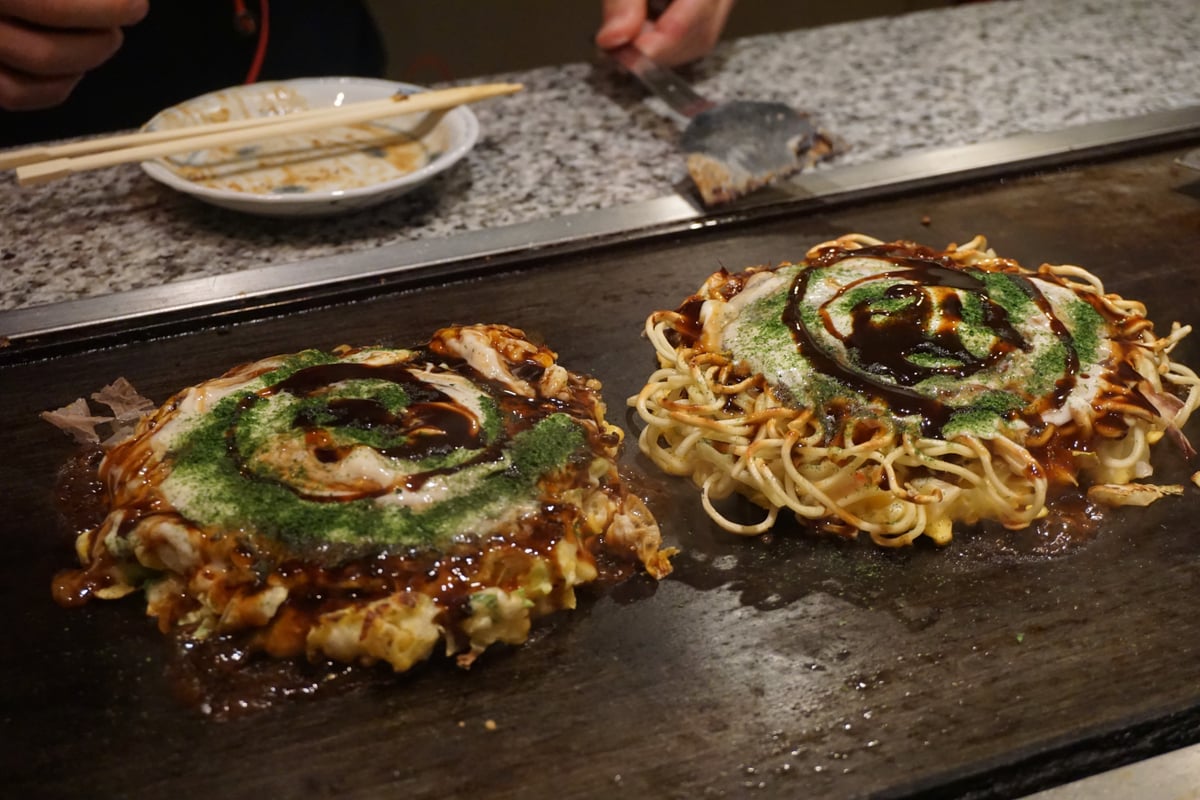
Osaka-style okonomiyaki is a dish in which ingredients such as chopped cabbage, tenkasu (tempura bits), pork, and squid are mixed into a batter of wheat flour mixed with dashi, then cooked flat on both sides on an iron griddle. When it is done, it is brushed with sauce and eaten topped with dried fish flakes (kezuribushi), aonori (green laver flakes), and mayonnaise if desired. Along with takoyaki, it represents Osaka's konamon (flour-based dishes) culture. In the late Meiji era, 'yoshoku-yaki' made with wheat flour, cabbage, and sauce appeared. The snack sold at dagashiya (cheap candy shops) and elsewhere as 'issen yoshoku' is said to have developed after the war into a meal using plenty of pork and vegetables. At first it was made in the kasaneyaki (layered) style, with the ingredients placed on top of the batter, but in Osaka the mazeyaki (mixed) style, in which the ingredients are mixed into the batter before cooking, became widespread. From the end of the Showa 30s into the Showa 40s, chain restaurants promoted it as an Osaka specialty, and it became known nationwide. Modan-yaki, which adds noodles to the batter, is also a way of eating it that was born in Osaka.
Origin
One theory traces the roots of okonomiyaki to 'funoyaki,' which Sen no Rikyu served at tea gatherings in the Azuchi-Momoyama period. It was a confection made by thinly cooking wheat flour mixed with water, spreading it with miso, and rolling it up. By the end of the Edo period, the custom of cooking and eating flour batter on an iron griddle had spread among ordinary people. In the late Meiji era, 'yoshoku-yaki' made with merikenko (imported wheat flour), cabbage, and sauce appeared. Because it could be bought at dagashiya for about one sen, it was also called 'issen yoshoku' (one-sen Western food).
History
Before the war, issen yoshoku was a snack for children containing green onions, dried shrimp, red pickled ginger (beni shoga), and the like. After the war, it came to be eaten as a meal using rationed wheat flour, and the ingredients, such as pork and vegetables, increased. Botejyu (ぼてぢゅう), founded in 1946 (Showa 21), states that it came up with using mayonnaise, which was precious at the time, as a topping. From the end of the Showa 30s into the Showa 40s, chain restaurants promoted it as an 'Osaka specialty,' and it spread nationwide.
Features
The biggest feature of the Osaka style is mazeyaki, in which the batter, cabbage, and other ingredients are mixed well in a bowl before cooking. The Ministry of Agriculture, Forestry and Fisheries' 'Our Regional Cuisines' (Uchi no Kyodo Ryori) introduces a method of spreading the batter on an iron griddle at about 200 to 220°C, cooking it for about 3 minutes, then laying pork belly on top before turning it over. It is then covered and cooked over low heat for 4 minutes, turned once more, and cooked for 1 minute to finish. Mixing the batter with dashi gives it a fluffy texture and flavor. Some shops add yam (yamaimo) to the batter. The ingredients vary, including pork, squid, and shrimp, and there are also derivative dishes such as negiyaki (green onion okonomiyaki).
Main Ingredients
Food Culture
In Osaka it is eaten regardless of season, and okonomiyaki restaurants line the streets throughout the prefecture. It is also a familiar dish cooked routinely at home on hot plates and the like. In the Showa 30s, many families are said to have converted part of their homes to run okonomiyaki shops. Organizations such as 上方お好み焼たこ焼協同組合 (a cooperative of Kamigata okonomiyaki and takoyaki businesses) are also working to promote it.
How It Differs from Home Cooking
At home, it is often made easily on a hot plate or in a frying pan using store-bought okonomiyaki flour. Specialty shops finish it on a large iron griddle while carefully judging how it is cooking. Each shop has its own refinements, such as blending yam or its own dashi into the batter, or using seafood bought from the market.
Famous Shops
美津の
大阪府大阪市中央区道頓堀1-4-15
Founded in 1945 (Showa 20), this long-established restaurant has been run for three generations in Dotonbori. It has also been selected for the Michelin Guide's Bib Gourmand. Its signature 'yamaimo-yaki' is cooked using only yam, without wheat flour, and costs about 1,800 yen.
ぼてぢゅう 總本店
大阪府大阪市中央区道頓堀1-6-15 Comradeドウトンビル2F
A restaurant that started in Tamade, Osaka, in 1946 (Showa 21). It describes itself as the birthplace of the style of topping okonomiyaki with mayonnaise and of modan-yaki. It uses a batter of wheat flour with yam and natural dashi added, and offers dishes such as the 'Ganso Butatama' (original pork okonomiyaki).
千房 道頓堀ビル店
大阪府大阪市中央区道頓堀1-5-5
An okonomiyaki specialty restaurant founded in Sennichimae, Osaka, in 1973. Besides 千房, it also operates other brands such as ぷれじでんと千房. The Dotonbori Building branch is in the heart of Dotonbori, which bustles with tourists.
| 千房 Okonomiyaki Set (Frozen) | An assortment of frozen 千房 okonomiyaki. It includes butatama (pork), mochi cheese, negiyaki, ikatama (squid), sauce, and more, and can be eaten just by heating it in a microwave. A set containing seven pieces, including butatama, costs about 5,400 yen (tax included). |
|---|
FAQ
Q. How do Osaka-style and Hiroshima-style okonomiyaki differ?
A. The Osaka style is mazeyaki, in which the batter, cabbage, and other ingredients are mixed together beforehand and then cooked. The Hiroshima style is kasaneyaki, in which cabbage, noodles, meat, and so on are layered on top of thinly cooked batter. In Osaka, too, it was originally made in the layered style, but the mixed style eventually became mainstream.
Q. What is modan-yaki?
A. It is okonomiyaki batter cooked with yakisoba noodles added. Botejyu states that it was born at its restaurant during the period of rapid economic growth after the war. It is filling and has become one of the standard menu items at Osaka okonomiyaki restaurants.