Image: Wikimedia Commons
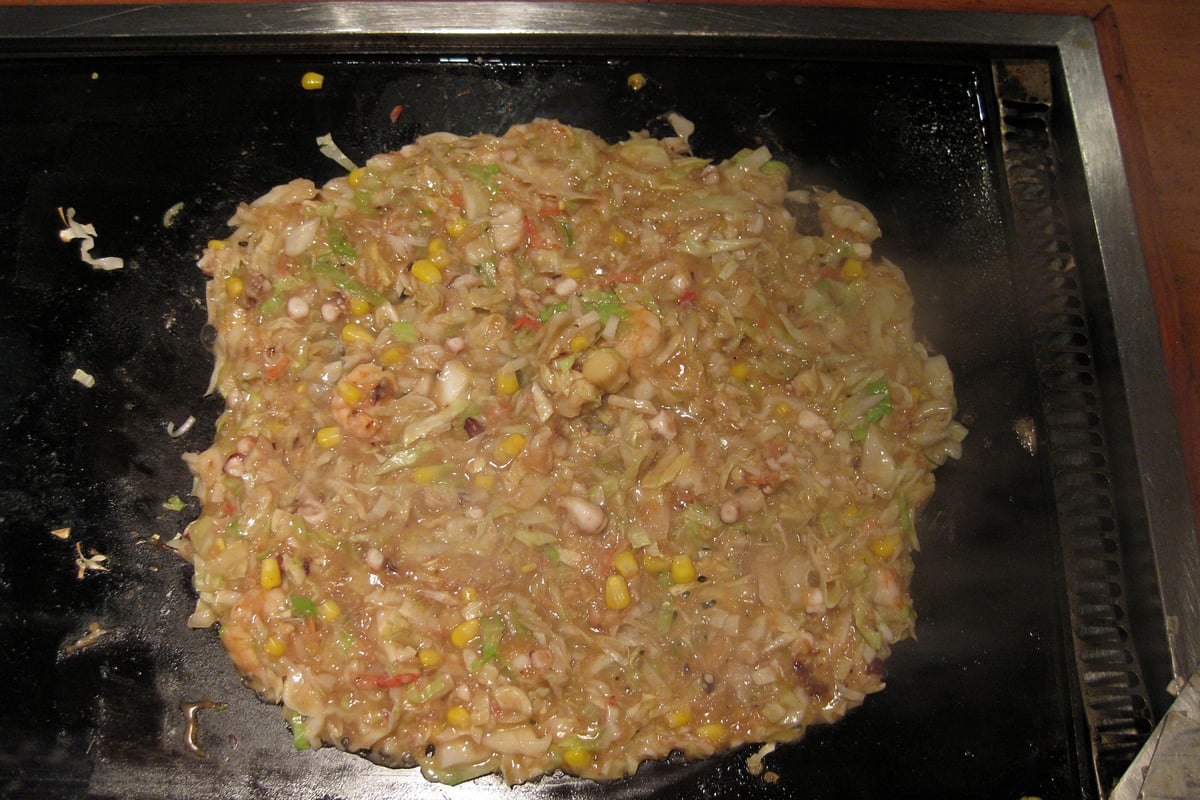
Monjayaki is a flour-based dish born in Tokyo's shitamachi (downtown) districts, made by mixing chopped cabbage and other ingredients into flour batter thinned with water and cooking it on a griddle as you eat. It is said to have originated as a children's snack sold at candy shops from the late Edo period through the Meiji era, in which flour batter thinned with water was cooked thin on a griddle and seasoned with soy sauce or starch syrup. Because children would draw letters and pictures in the still-loose batter with a spatula as it cooked, it came to be called 'moji-yaki' (letter-grilling), a name that is said to have shifted over time into 'monja.' From the late Showa era onward, Tsukishima in Chuo Ward saw a rapid increase in monjayaki specialty restaurants, and today it is known as the dish's signature neighborhood, with many shops lining what is now called 'Monja Street.' The defining feature of monjayaki is its batter, which is much runnier than okonomiyaki, and part of its charm lies in the distinctive way it is eaten — scooped directly off the griddle with a small spatula called a 'hagashi.'
Origin
The prototype of monjayaki is said to have been a children's snack served at candy shops in Tokyo's shitamachi districts from the late Edo period through the Meiji era, made by cooking flour batter thinned with water thin on a griddle. Because children would draw letters and pictures in the still-loose batter with a spatula as it cooked, it was called 'moji-yaki' (letter-grilling), a name that is said to have become 'monjayaki' over time.
History
After the war, shops offering monjayaki on griddles tucked into the corner of candy stores could be found throughout shitamachi neighborhoods, but their numbers gradually declined. In Tsukishima, Chuo Ward, there were only a handful of specialty restaurants in the 1950s and 60s, but their numbers grew rapidly from around the start of the Heisei era, forming the shopping street now known as 'Monja Street.' Today it is known nationwide as a signature feature of Tokyo tourism, and Tsukishima has come to be called the 'holy land of monja.'
Features
Monjayaki batter contains far more water than okonomiyaki batter, so when poured onto the griddle it spreads thin into a runny, viscous state. The basic method is to arrange chopped cabbage and other ingredients in a ring on the griddle like a levee, pour the batter into the center, and cook while mixing — and part of the enjoyment comes from pressing the crispy, browned bits with a spatula to make 'okoge' (crispy scorched bits). It is distinctively eaten by scooping with a small spatula called a 'hagashi,' and sharing one griddle among several people is also a culture typical of Edo's shitamachi districts.
Main Ingredients
Food Culture
Having developed from a children's snack sold at candy shops, monjayaki carries strongly the character of a dish meant for enjoying communication — gathering around a single griddle with friends or family and cooking it little by little as you eat.
How It Differs from Home Cooking
Okonomiyaki mixes the ingredients and batter together beforehand and cooks both sides, whereas monjayaki forms a levee of ingredients, pours the batter into the middle, and cooks only one side, then is eaten with a special spatula while still runny and loose — a major difference between the two.
Famous Shops
月島もんじゃ もへじ 本店
東京都中央区月島3-16-9
A popular restaurant on Tsukishima's Monja Street. Classic monja is available from around 748 yen, and original creations such as mentai mochi cheese monja are also popular.
View details →| 月島もんじゃ焼ソース | A home-use seasoning produced by Bulldog Sauce under the supervision of the Tsukishima Monja Promotion Cooperative. With just cabbage and water on hand, you can recreate monjayaki close to the authentic taste at home.Where to buy →PR |
|---|
FAQ
Q. What does 'monja' mean?
A. It is said to derive from 'moji-yaki' (letter-grilling), a name given because people would spread the runny batter on the griddle and draw letters in it with a spatula as they cooked, a name that later shifted to 'monjayaki.' There are several theories about the origin of the name.