Image: Wikimedia Commons
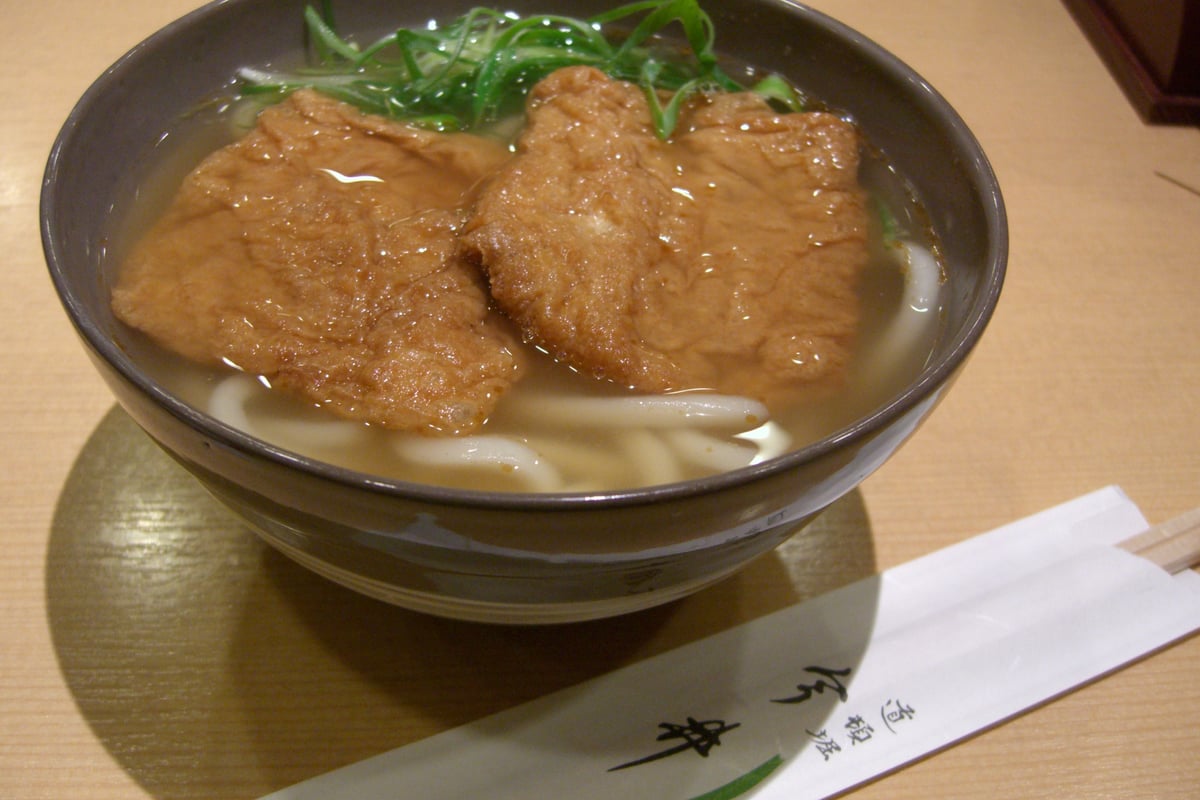
Kitsune udon is a dish of udon in a broth made from kombu and dried fish (fushi), topped with aburaage (deep-fried tofu) simmered in a sweet and savory seasoning. It is said to have been born in Osaka and is also said to be the udon most loved by the people of Osaka Prefecture. Osaka udon is said to be characterized by soft, chewy noodles that are not too thick and blend well with the dashi. In Osaka, once called 'the nation's kitchen' (Tenka no Daidokoro), kombu from Hokkaido was brought in by Kitamaebune trading ships, and a food culture that values dashi developed. Kitsune udon is said to have started at Matsubaya (松葉家, now Usami-tei Matsubaya), an udon shop that opened in Senba in 1893 (Meiji 26). It is said that when the founder, 宇佐美要太郎, served aburaage meant for inari sushi alongside plain udon (su-udon), customers put it on their udon and ate it, and this became the start. The name comes from the belief that aburaage is a favorite food of foxes (kitsune). In the Kansai region, there is also a distinctive naming culture, such as calling soba topped with aburaage 'tanuki.'
Origin
Osaka has a long history of eating udon: it is said that when Toyotomi Hideyoshi built Osaka Castle, udon and soba shops lined the 'Sunaba' (sand yard) where building materials were stored. The shop regarded as the originator of kitsune udon is Matsubaya, an udon shop in Senba. 宇佐美要太郎, who had trained at a sushi restaurant, became independent and opened an udon shop in 1893 (Meiji 26). It is said to have begun when the sweet and savory aburaage used for inari sushi was served on a separate plate from plain udon, and customers put it on their udon and ate it.
History
Udon is said to have spread widely in Osaka around the middle of the Edo period. When the Kitamaebune shipping routes were established, ingredients such as kombu from Hokkaido, wheat flour, and salt gathered in Osaka. In the early Meiji era, many noodle factories appeared, and while shops bought their noodles from them, they are said to have competed over the flavor of their dashi and broth. Kitsune udon spread as this dashi culture and flour-food culture came together. Matsubaya continues to operate today in Minami-Senba as Usami-tei Matsubaya.
Features
The broth is made by adding soy sauce, mirin, sugar, and other seasonings to dashi taken mainly from makombu kelp and zatsubushi (dried fish flakes other than katsuobushi) such as sababushi (dried mackerel). Noodles that blend well with the dashi and are soft and chewy without being too thick are preferred. The aburaage has its excess oil removed and is then simmered in dashi, sugar, soy sauce, and so on until it soaks up a sweet and savory flavor. The aburaage is placed on boiled udon, the broth is poured over it, and finely sliced green onions are scattered on top.
Main Ingredients
Food Culture
It is an everyday taste eaten casually both at home and at restaurants, loved all year round regardless of season. In Osaka, aburaage simmered in sweet and savory seasoning is sometimes affectionately called 'oage-san.' Kizami udon, topped with unseasoned, chopped thin aburaage, is also loved as an udon unique to Kansai.
How It Differs from Home Cooking
At home, it is often made easily using store-bought udon broth and pre-seasoned aburaage. Some specialty shops use natural kombu and several kinds of fushi, making dashi several times a day instead of preparing it in advance. They put effort into both the dashi and the aburaage, for example by taking several days to let the aburaage absorb its flavor.
Famous Shops
うさみ亭マツバヤ
大阪府大阪市中央区南船場3-8-1
Founded in 1893 (Meiji 26), this shop is regarded as the birthplace of kitsune udon. A sign reading 'Ganso Kitsune Udon' (the original kitsune udon) still stands at the storefront. Its aburaage is purchased from a tofu shop in Osaka City and takes three days to absorb its flavor. Kitsune udon costs about 650 yen.
道頓堀 今井 本店
大阪府大阪市中央区道頓堀1-7-22
Founded in 1946 (Showa 21), this long-established shop is also known as 'Imai of dashi' (だしの今井). It makes its dashi from natural kombu from 黒口浜 in Hokkaido and sababushi and urumebushi (dried round herring) from Kyushu. The dashi is not made in advance; it is said to be made fresh several times a day.
| 道頓堀 今井 Kitsune Udon Set, 3 Servings | A set that lets you enjoy the kitsune udon of 道頓堀 今井 at home. It contains dashi made from natural kombu, sababushi, and urumebushi, thick aburaage (oage) slowly simmered, and chewy Osaka udon. It is sold through outlets such as the Takashimaya online store, at about 2,754 yen (tax included). |
|---|
FAQ
Q. Are 'kitsune' and 'tanuki' in Kansai different from those in Kanto?
A. Yes. In Osaka, udon topped with aburaage is called 'kitsune,' and soba with the same topping is called 'tanuki.' For this reason, people do not usually order 'tanuki udon.' What Kanto calls udon or soba with tenkasu (tempura bits) is called 'haikara' in Kansai. There are also regional differences; in Kyoto, for example, udon in a thickened sauce (ankake) with chopped aburaage is called 'tanuki.'
Q. Why is it called 'kitsune'?
A. The name comes from the belief that aburaage is a favorite food of foxes (kitsune). It is also said to have spread as an auspicious udon topped with the favorite food of the fox, the messenger of Inari shrines. At Matsubaya, too, kitsune udon is said to have begun with serving aburaage meant for inari sushi.