Image: Wikimedia Commons
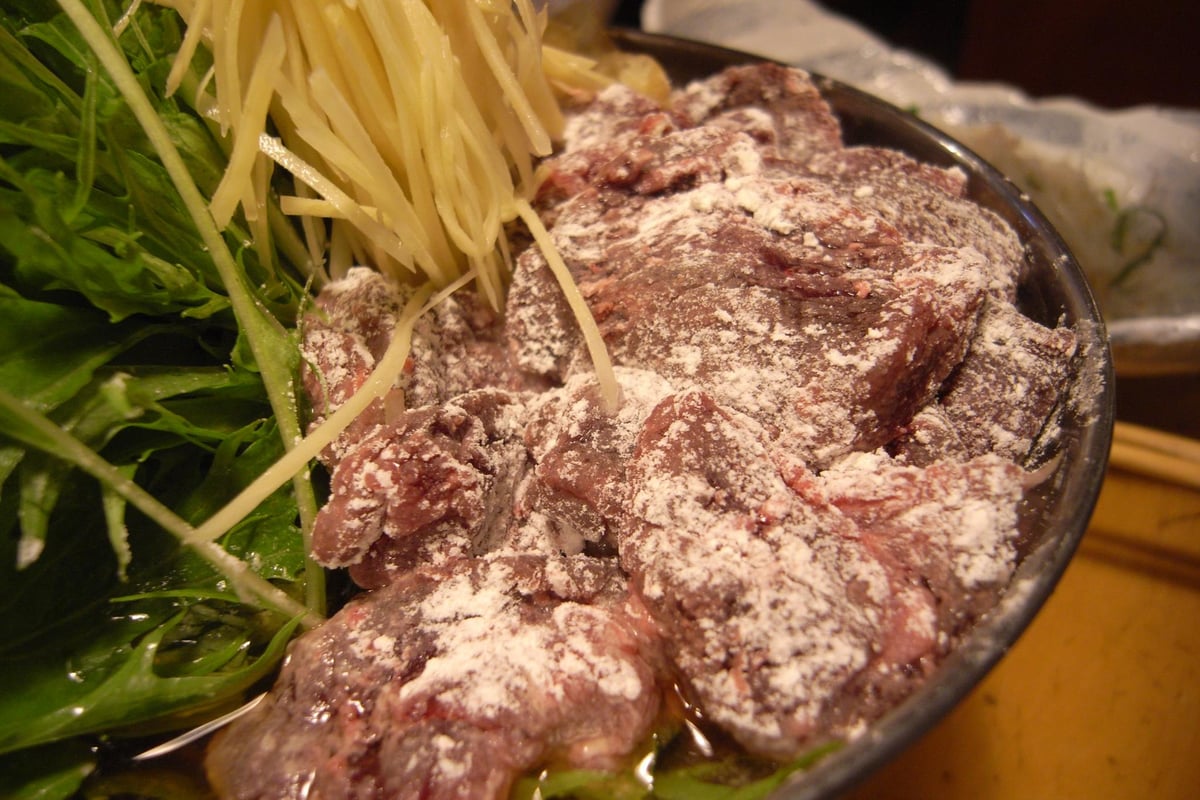
Harihari nabe is an Osaka hot pot dish in which whale meat and mizuna are briefly simmered in dashi made from kombu and dried fish flakes (fushi). 'Harihari' is said to be a word expressing the crisp texture and sound of eating mizuna. Osaka, called 'the nation's kitchen' (Tenka no Daidokoro), was a hub where foodstuffs were collected and distributed; whale was also brought in from various regions, and a culture of eating whale flourished. Hot pots of whale and mizuna are said to have been commonly eaten in Osaka homes and restaurants. The name is said to have been given by 徳家, a whale restaurant that opened in Sennichimae in Minami in 1967 (Showa 42). In recent years, opportunities to eat whale have decreased due to whaling restrictions and other factors, and pork or other meats are sometimes used instead. In fiscal 2024 (Reiwa 6), 'Osaka whale harihari nabe' was recognized under the Agency for Cultural Affairs' '100-Year Food' program (Future 100-Year Food category). It is also introduced as a regional dish of Osaka Prefecture in the Ministry of Agriculture, Forestry and Fisheries' 'Our Regional Cuisines' (Uchi no Kyodo Ryori).
Origin
Whale has long been regarded as a precious food, and the Japanese have made use of every part of it while showing respect for whales, for example by building memorial towers for them. The long-thriving whaling industry in Wakayama, near Osaka, is said to be part of the background of Osaka's whale-eating culture. Whale arrived from various regions in Osaka, known as the nation's kitchen, and a hot pot combining it with mizuna grown in the surrounding area was born. However, there are also theories that the dish originated in Taiji in Wakayama Prefecture, where whaling was thriving, or in Kochi.
History
Hot pots of whale and mizuna have been popular in Osaka homes and restaurants. The name 'harihari nabe' is said to have been given by 徳家, a whale restaurant that opened in Sennichimae in Minami in 1967 (Showa 42). Whale meat is said to have once been a relatively inexpensive ingredient. However, due to whaling restrictions and cultural differences, opportunities to eat whale gradually decreased. Today, an association for passing on the tradition of eating whale (鯨食の伝統を継承する会) is working to promote it from Minami, centered on 'Whale Day' (Kujira no Hi) on September 4.
Features
Dashi made from kombu and dried fish flakes is poured into the pot, and whale meat and mizuna are added and briefly simmered. The appeal of this hot pot is eating the mizuna before it is overcooked, while it still has its crisp texture. Simmering the whale meat spreads its umami into the dashi, which the mizuna then absorbs, creating a light yet deep flavor. Mizuna in the frosty season is tender and is said to be well suited to simmering with whale. Some restaurants also offer a style in which high-quality whale meat that can even be eaten raw is briefly swished through the dashi.
Main Ingredients
Food Culture
What supported Osaka's whale-eating culture was the strength of its distribution network, which gathered ingredients from various regions to the nation's kitchen. In Minami, there remains a whale cuisine specialty restaurant said to have been founded in the Meiji era, where you can still enjoy whale dishes. The Agency for Cultural Affairs' 100-Year Food program sets out the aim of passing down harihari nabe for the next 100 years as part of Osaka's traditional food culture and as a soul food.
How It Differs from Home Cooking
At home, it is sometimes made with pork belly, which is easier to obtain, instead of whale meat. The combination of fatty meat and refreshing mizuna remains the same, and it is enjoyed as an easy winter hot pot. Whale cuisine specialty restaurants, on the other hand, use high-quality whale meat from carefully chosen cuts and finish it by passing it briefly through the dashi.
Famous Shops
西玉水
大阪府大阪市中央区島之内2-17-24
A whale cuisine specialty restaurant said to have been founded in 1885 (Meiji 18), and also introduced as Japan's first whale cuisine specialty restaurant. It serves whale dishes regardless of the season, and its signature harihari nabe lets you enjoy the fatty tail meat of large whales together with mizuna. The first floor has counter seats, and the second floor has private rooms.
新どおぞの
大阪府大阪市北区曽根崎新地1-5-9 REXビル3階
A whale restaurant in Kitashinchi. Its specialty is 'kujira harishabu nabe' (鯨はりしゃぶ鍋), in which tender whale meat is swished through a secret-recipe dashi. There is also an eight-dish whale full course (for two or more people), and the dinner budget is said to be about 8,000 to 10,000 yen per person.
FAQ
Q. What does 'harihari' mean?
A. It is said to be a word expressing the crisp texture and sound of eating mizuna. The Agency for Cultural Affairs' 100-Year Food program explains that the name came from the 'hari-hari' sound mizuna makes when you eat it. The key to enjoying it is to avoid overcooking the mizuna and eat it while it still has its texture.