Awa Okoshi and Iwa Okoshi
Awa Okoshi and Iwa Okoshi (Osaka Puffed Rice Crackers)
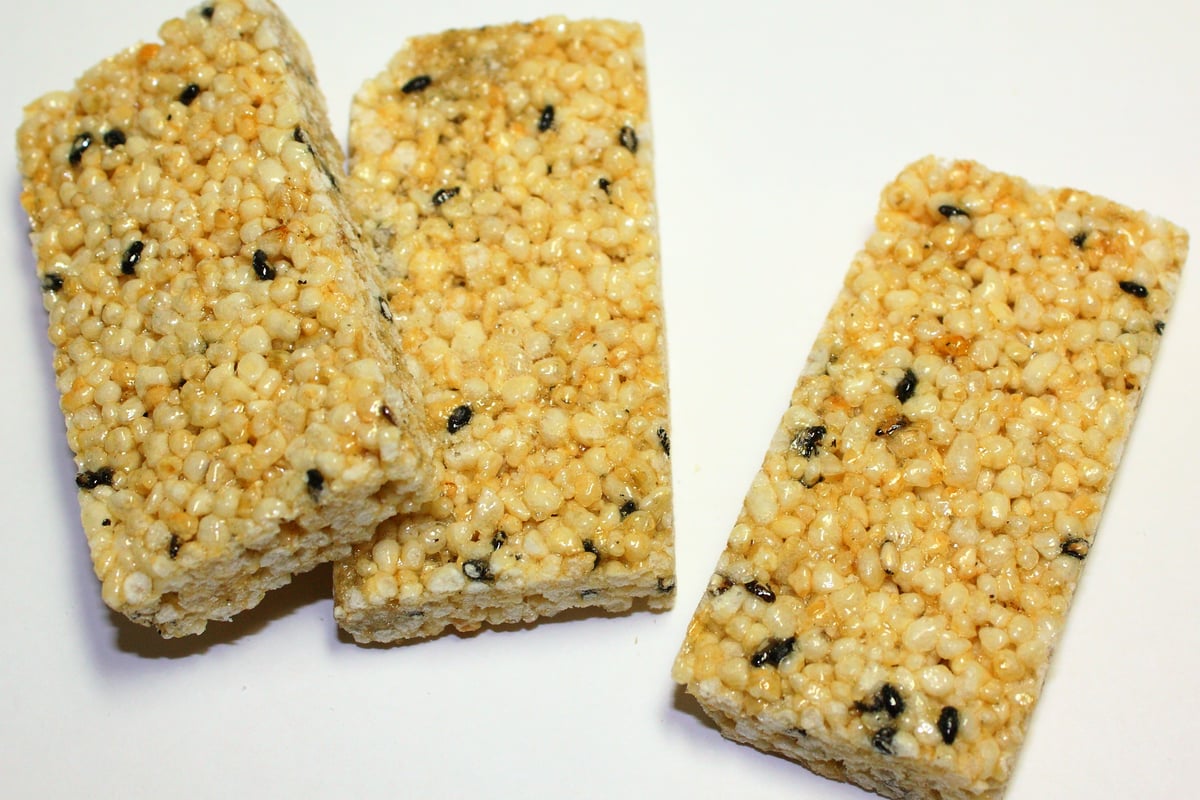
Image: Wikimedia Commons
Awa okoshi and iwa okoshi are regional sweets that represent Osaka. Okoshi is a dry confection made by binding steamed and dried rice, millet, or other grains with mizuame (starch syrup) and sugar. It was originally a sweet for ordinary people made from millet (awa), barnyard millet (hie), and other grains, but in Osaka in the mid-Edo period, 'awa okoshi,' made from rice crushed finely into millet-sized grains, was born. In the background was the fact that high-quality rice, mizuame, and sugar gathered from all over Japan in Osaka, which was called 'the nation's kitchen' (Tenka no Daidokoro). 'Iwa okoshi' is made by crushing the rice even more finely and pressing it firmly, flavored with ginger and kokuto (brown sugar). It took hold as an Osaka specialty as a lucky sweet said to 'raise oneself up, raise the household, raise the nation, and raise good fortune' (okosu meaning 'to raise'). Long-established makers such as Amidaike Daikoku (あみだ池大黒), founded in 1805 (Bunka 2), still continue to produce it today. In fiscal 2024 (Reiwa 6), awa okoshi was recognized under the Agency for Cultural Affairs' '100-Year Food' program (Traditional 100-Year Food category).
Origin
Okoshi is said to be one of the confections with the longest history in Japan. The Osaka Prefecture Awaokoshi Industry Cooperative (大阪府粟起工業協同組合) explains that the Nihon Shoki records hoshii (rice that was steamed and dried) bound with syrup (mitsu). The Ryori Monogatari, a cookbook from the early Edo period, describes a method using inexpensive millet, Job's tears, and other grains, and okoshi was enjoyed as a sweet for ordinary people. In mid-Edo-period Osaka, rice paid as annual tax was brought in by ship from various regions, and the Dojima rice market flourished to the point where futures trading took place. As the ingredients became easier to obtain, awa okoshi and iwa okoshi made from rice, sugar, and syrup gained popularity.
History
In 1805 (Bunka 2), Amidaike Daikoku began making and selling okoshi in Osaka. The shop name is said to come from the fact that the shop was located near Amida Pond (阿弥陀池), and, because rice is the main ingredient, from Daikoku, the god of abundant harvests of the five grains. In Osaka, where waterway construction was active, rocks turned up one after another whenever the ground was dug, which gave rise to the pun 'Osaka no hori-okoshi, iwa-okoshi' (a play on okosu, 'to dig up': in Osaka, digging up the ground means digging up rocks), and it is said the sweets' reputation spread. The association reports that during the Russo-Japanese War, Emperor Meiji ordered 350,000 boxes of okoshi bearing the chrysanthemum crest as comfort gifts for soldiers at the front. Before the war, the voluntary association had 253 members, while the Osaka Prefecture Awaokoshi Industry Cooperative, established after the war, now has 7 member companies.
Features
Awa okoshi is a confection that combines roasted rice with mizuame, sugar, and sesame, and it is characterized by a light, crisp texture and a toasty aroma. Iwa okoshi is made by crushing the rice grains even more finely before pressing them together, so there are almost no gaps, and it is hard enough to offer a firm bite. It is commonly flavored with the sharp taste of ginger and the richness of kokuto. Osaka okoshi bears the 'umebachi crest' (plum-blossom crest) as its symbol. This is said to come from a legend that villagers presented awa okoshi to Sugawara no Michizane as Michizane headed to Dazaifu in Kyushu, and in return were given a kosode (short-sleeved robe) bearing the umebachi crest.
Main Ingredients
Food Culture
Taking its name from the word 'okosu' (to raise), it has been enjoyed as a lucky sweet that raises oneself, the household, the nation, and good fortune. Because it is a dry confection that keeps well, it has become a classic Osaka souvenir and is sold at places such as the souvenir shops at Shin-Osaka Station. Members of the Osaka Prefecture Awaokoshi Industry Cooperative (大阪府粟起工業協同組合) have continued to exhibit okoshi at the National Confectionery Exposition since the Meiji era.
Famous Shops
あみだ池大黒 本店
大阪府大阪市西区北堀江3-11-26
A long-established okoshi maker founded in 1805 (Bunka 2). In addition to traditional awa okoshi and iwa okoshi, it offers many products, such as the bite-sized 'Fuku no Hana.' 'Fuku Okoshi,' which added peanuts in 1906 (Meiji 39), was also exhibited at the San Francisco World's Fair in 1915.
梅仙堂
大阪府大阪市北区芝田2-1-3
A long-established okoshi maker in 芝田, Umeda. Under the name 'Tengu Okoshi,' it continues to make traditional hard iwa okoshi and awa okoshi. It also creates new flavors, such as 'Takonosuke,' which combines takoyaki and awa okoshi, and the small-grained '浪速姿.'
| あみだ池大黒 Iwa Okoshi, Bundle of 10 | A bundle of 10 pieces of traditional iwa okoshi flavored with ginger and kokuto. It is also certified as an Osaka-mon Meihin (大阪産(もん)名品) product. The price is about 756 yen. |
|---|---|
| 梅仙堂 Awa Okoshi, Bundle of 10 | A bundle of 10 pieces of traditional awa okoshi, made by pressing rice crushed into millet-sized grains. It has a light, crisp texture, and the price is about 648 yen. |
FAQ
Q. Is awa okoshi made from millet?
A. Osaka awa okoshi is made mainly from rice. It was originally made from millet (awa) and barnyard millet (hie), but because high-quality rice was available in Osaka, people began making it by crushing rice finely into millet-sized grains. That is why the word 'awa' (millet) remains in the name.
Q. What is the difference between awa okoshi and iwa okoshi?
A. Awa okoshi is made by binding rice crushed to the size of millet grains, along with sesame and other ingredients, with mizuame and sugar, and it has a light, crisp texture. Iwa okoshi is made by crushing the rice even more finely before pressing it, so there are few gaps, and it is characterized by being as hard as rock (iwa). It is commonly flavored with ginger and kokuto.