Image: Wikimedia Commons
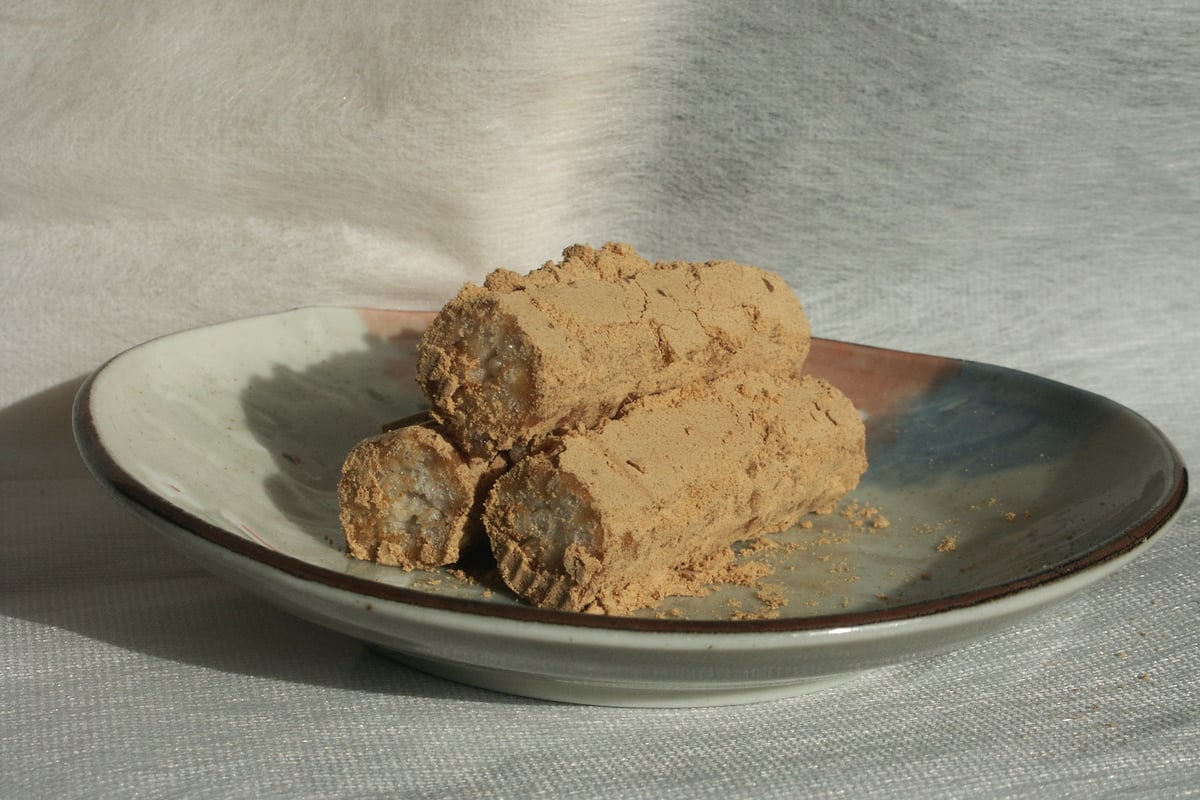
Gokabo is a local confection that originated in Kumagaya City, Saitama Prefecture, made by parching steamed glutinous rice into a malted 'okoshidane,' binding it into a stick shape with starch syrup, and coating the outside with roasted soybean flour (kinako). Kumagaya, which flourished as a post town on the Nakasendo highway, had an abundance of high-quality 'Ishihara rice,' soybeans, and the barley used to make starch syrup, and it is said the confection was first sold under the name 'Gokabo' during the Bunsei era (1818-1829). Later, the characters were changed to mean 'the five grains are the treasure of the household.' There are several theories about its origin, including one tracing it to a confectioner in Gunma and another to Gokamura Village in Shimosa Province, and amid these mixed accounts it spread across the northern Kanto region. Known for the fragrant aroma of kinako, the gentle sweetness of starch syrup, and a chewy texture, it continues to be made mainly by long-established confectioners in Kumagaya City today.
Origin
Kumagaya flourished as a post town on the Nakasendo highway and was well suited to confectionery-making thanks to an abundance of high-quality 'Ishihara rice,' soybeans, and the barley used for starch syrup. It is said to have originated when it was first sold under the name 'Gokabo' during the Bunsei era (1818-1829). There are several theories about its origin: one holds that a confectioner from Gunma sold it modeled on the Mito confection 'Yoshiwara Denchu'; another says that people from Tamai Village, Osato District, Musashi Province (now Kumagaya City), heard of its popularity and imitated it, bringing it home.
History
There is a theory that in 1843 a person from Tamai Village set up a shop at Kumagaya-shuku and improved the recipe, and another that it was developed around 1850 in Gokamura Village, Shimosa Province. Still another account holds that during the Tenmei famine (1782-1788), a village headman in Nara Village, Musashi Province, distributed roasted rice to disaster victims, and later commissioned a confectioner in Edo to turn it into a confection. The name evolved through several different character combinations before settling on the form meaning 'the five grains are the treasure of the household.' In fiscal 2021, it was certified in the traditional category of the Agency for Cultural Affairs' '100-Year Foods,' and also received a special jury award.
Features
This dry confection is made by binding okoshidane, produced from steamed glutinous rice, into a stick shape with starch syrup, and coating the outside with roasted soybean flour, giving it a chewy texture along with the fragrant aroma of kinako and the gentle sweetness of starch syrup. Its ingredients are said to be limited to soybeans, glutinous rice, starch syrup, and sugar, with no preservatives or artificial seasonings used, so its shelf life is relatively short, at about 10 days to two weeks. Each shop has its own character, with some offering versions dyed red and white or made with uguisu (green soybean) kinako, and it is counted, alongside Soka senbei and Kawagoe's sweet potato confections, as one of Saitama's three great confections.
Main Ingredients
Famous Shops
A long-established shop said to have been founded over 250 years ago. A box of 15 red-and-white Gokabo sticks starts at around 810 yen.
Founded in 1887. A box of 20 Gokabo sticks starts at around 648 yen, and assortments of uguisu-flavored and kinako varieties are also available.