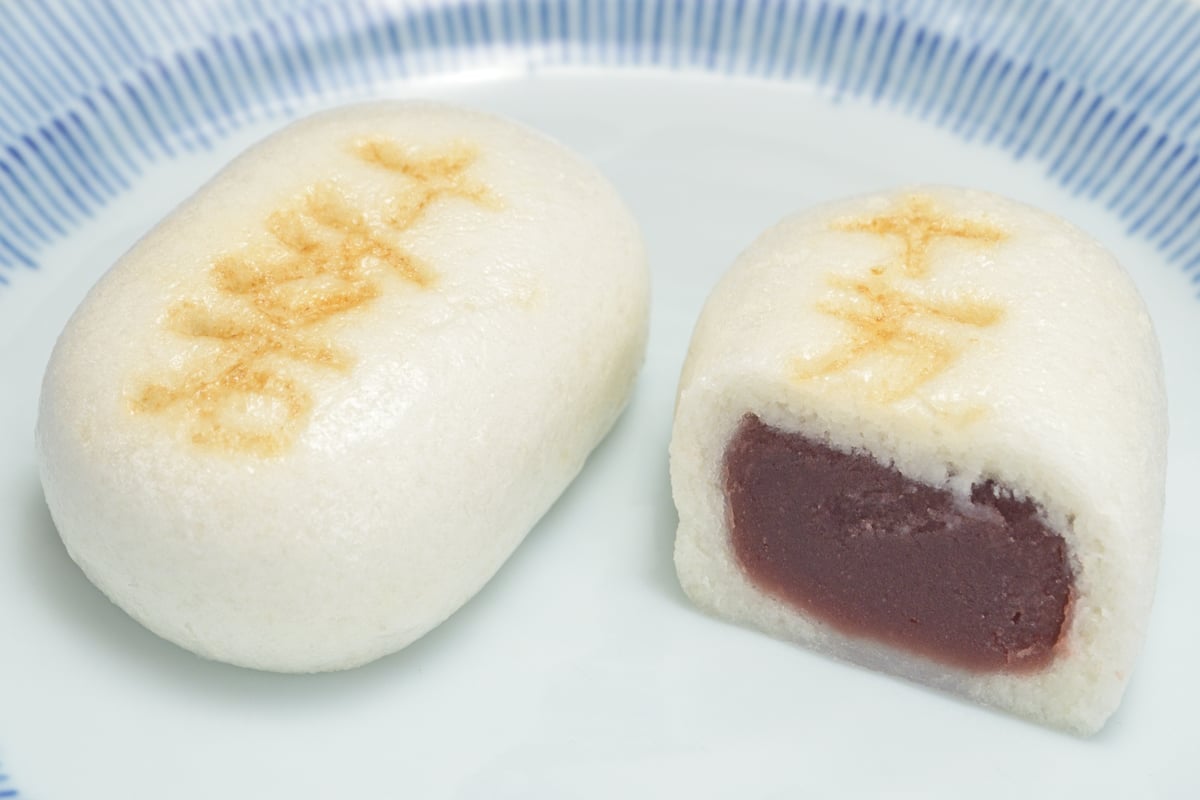
Image: Wikimedia Commons
Jumangoku Manju is a jo-yo manju made by the confectionery shop 'Jumangoku Fukusaya' in Gyoda City, Saitama Prefecture — a refined, delicately sweet treat in which white bean paste is wrapped in a moist dough containing gyuhi (pounded mochi). The name comes from Gyoda's history as the castle town of the 100,000-koku Oshi Domain. In 1952, when sugar rationing was lifted, the Japanese confectionery shop 'Fukuchaya' was founded and began selling the treat, and in 1960 the company was renamed 'Jumangoku Fukusaya' to build the brand. It became widely known through TV Saitama's local commercials featuring the catchphrase 'Umai, umasugiru!' ('Delicious, too delicious!'), said to have been created by the woodblock print artist Shiko Munakata, and it is now a familiar Saitama souvenir found in gift shops both inside and outside the prefecture.
Origin
In 1952, when sugar rationing was lifted after the Pacific War, the Japanese confectionery shop 'Fukuchaya' was founded in Honmachi, Gyoda City, and began selling 'Jumangoku Manju.' Wishing to make it a confection representative of Gyoda, the founders named it after the 100,000-koku ('jumangoku') assessed value of the Oshi Domain, which was based in Gyoda during the Edo period.
History
In 1960, Jumangoku Fukusaya Co., Ltd. was established, changing the shop's name to 'Jumangoku' to establish its brand. In 1953, the founder Shinzo Yokota met the woodblock print artist Shiko Munakata through an introduction from the calligrapher Daido Atsumi. After tasting the manju, Munakata reportedly said, 'Delicious, too delicious — if the princess of Oshi Castle were alive, she would surely say the same.' He then drew a 'Manju Princess' biting into a manju, which became the origin of the catchphrase. A TV Saitama commercial depicting this episode became popular, and the manju became widely known as a confection representative of Saitama.
Features
This jo-yo manju wraps white bean paste in a dough containing gyuhi, giving it a refined sweetness and a moist texture. The method has remained unchanged since its founding: yam (tsukuneimo) from Katsuragi in Nara Prefecture is grated fresh every morning and combined with flour milled from Koshihikari rice grown in Uonuma, Niigata Prefecture, to make the skin, which wraps a smooth bean paste made in-house from red beans grown in Tokachi, Hokkaido. As it is a fresh confection, its shelf life is a short 5 to 6 days. The building housing the Gyoda main store is a warehouse-style structure in the Edo style, over 100 years old, and registered as a national Tangible Cultural Property. The company operates about 38 stores across Saitama and Gunma, and also sells manju individually.
Famous Shops
The store building, over 100 years old, is a registered Tangible Cultural Property. Manju are priced from around 151 yen each, and individual pieces can also be purchased.
FAQ
Q. Why is it called 'Jumangoku'?
A. The name comes from Gyoda's history as the castle town of the 100,000-koku ('jumangoku') Oshi Domain during the Edo period, chosen out of a wish to make it a confection representative of Gyoda.