Image: Wikimedia Commons
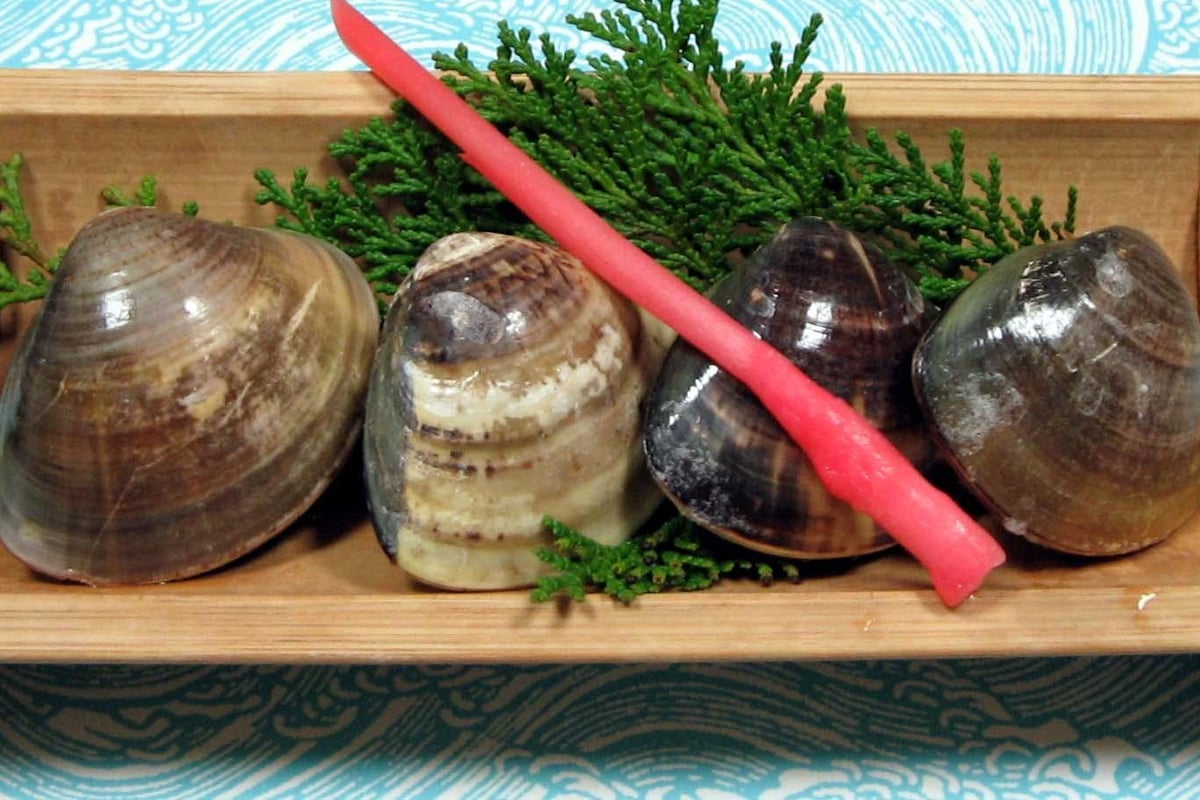
Kuwana hamaguri refers to the clams harvested off Kuwana City, Mie Prefecture, and the dishes made with them. Kuwana lies at the river mouths where the three Kiso rivers, the Kiso, Nagara, and Ibi Rivers, flow into Ise Bay. Because the clams grow in nutrient-rich fishing grounds where fresh river water and seawater meet, they are large and plump, with a rich flavor. They are a species native to Japan, the Japanese hard clam (Meretrix lusoria), and are also called 'ji-hamaguri' (local clams) in the area. In the Edo period, Kuwana prospered as a post town on the Tokaido, and grilled clams (yaki-hamaguri) were a specialty popular with travelers. They were so widely known that the wordplay 'sono te wa Kuwana no yaki-hamaguri' was born. Shigure hamaguri (clams simmered in soy sauce), simmered down in tamari soy sauce and other seasonings, is also a representative specialty of Kuwana. The catch once fell drastically, but fishers have continued their efforts to restore the resource. In fiscal 2024 (Reiwa 6), 'Kuwana Yaki-hamaguri' was recognized as one of the Agency for Cultural Affairs' '100-Year Foods.'
Origin
Kuwana's clams grow in brackish waters where fresh water from the three Kiso rivers mixes with seawater from Ise Bay. Kuwana clams have had a high reputation since long ago, and in the Edo period they were prized as offerings presented to the shogun's family. In the time of Toyotomi Hideyoshi, simmered clams are said to have already been eaten as a preserved food among Kuwana's shellfish dealers. This is thought to have been the basis of shigure hamaguri, which later became a local specialty.
History
When the Tokaido was established in 1601 (Keicho 6), Kuwana-juku and Miya-juku (present-day Atsuta Ward, Nagoya City) were connected by a sea route called Shichiri-no-watashi. At Kuwana-juku, which became the gateway to Ise Province, grilled clams were enjoyed by travelers as a specialty, and they appear in ukiyo-e prints and in Tokaido-chu Hizakurige. Meanwhile, the catch, which had been 2,000 to 3,000 tons a year in the Showa 40s, declined due to land reclamation and ground subsidence, falling to 0.8 tons in 1995 (Heisei 7).
Features
Yaki-hamaguri is a dish of clams grilled in their shells over a fire. The method of grilling them while smoking them with pine cones is depicted in ukiyo-e prints of the Tokaido, and local restaurants revived it after much research. Shigure hamaguri is shucked clam meat simmered down with chopped ginger in tamari soy sauce and other seasonings. The name is said to come from the fact that it tastes best when made around the time of 'shigure,' the showers that fall from autumn into winter, and one theory holds that it was named by Kagami Shiko (各務支考), a disciple of Matsuo Basho.
Main Ingredients
Food Culture
In Kuwana, besides grilled clams, hamaguri are enjoyed in a wide range of dishes, such as sashimi, sake-steamed clams, shabu-shabu, and zosui (rice porridge). Shigure hamaguri goes well with rice and is eaten on top of rice, as a filling for rice balls, or in ochazuke (rice with tea poured over it).
Famous Shops
桑名 丁子屋
三重県桑名市寿町3-56-1
A clam restaurant said to have been in business since the Edo period, about a 5-minute walk from Kintetsu/JR Kuwana Station. Its specialty is grilled clams, cooked while being smoked with the aroma of pine cones. The 'Hamaguri-zukushi' course, which features dishes such as sashimi, jibuni (a simmered dish), and zosui, requires a reservation and starts from about 11,000 yen.
食堂はまかぜ(はまぐりプラザ)
三重県桑名市赤須賀86-21
A restaurant inside Hamaguri Plaza at Akasuka fishing port, where you can grill and eat Kuwana's wild clams yourself. The grilled clam set meal costs about 2,700 yen and is said to require a reservation. Hamaguri-don (clam rice bowl) and hamaguri udon are also available, and on the first floor you can see exhibits about Kuwana's clams.
View details →| 総本家新之助貝新 Shigure Hamaguri | 総本家新之助貝新 in Kuwana City is a long-established maker of shigure-ni (soy-simmered foods) said to have been founded in the Keicho era (1596–1615). It sells shigure hamaguri, large clams caught at Akasuka fishing port simmered to a sweet-savory finish in a secret sauce handed down since its founding. The main store in 末広町, Kuwana City, has an eat-in space where you can have shigure chazuke (志ぐれ茶漬). |
|---|
FAQ
Q. What does 'sono te wa Kuwana no yaki-hamaguri' mean?
A. It is a play on words meaning 'sono te wa kuwanai' (I won't fall for that trick), in other words, 'I won't be fooled by such a too-good-to-be-true story.' It links the place name 'Kuwana' with 'kuwana(i)' (won't eat), followed by Kuwana's famous grilled clams. It is said to have been a favorite expression among the townspeople of Edo, which shows just how famous grilled clams were.
Q. Why are Kuwana clams rare?
A. Because postwar land reclamation, levee construction, ground subsidence, and other factors reduced the tidal flats where clams grow, causing the catch to drop sharply. Today, the fisheries cooperative protects the resource by restricting the size of clams that may be caught, the amount caught, and fishing days, and by releasing juvenile clams. As a result, the quantity available on the market is limited.