Image: Wikimedia Commons
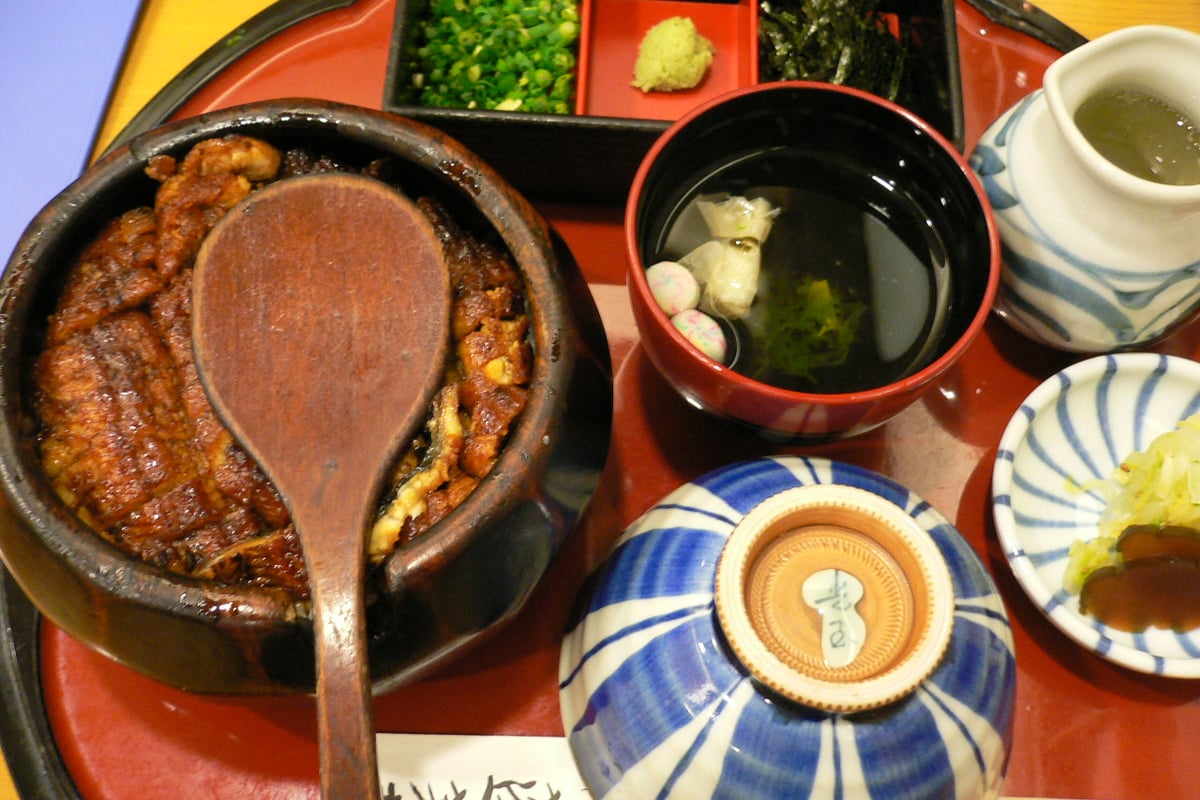
Hitsumabushi is a local dish that originated in Nagoya City, Aichi Prefecture, in which finely chopped grilled eel (unagi kabayaki) is mixed into white rice and served in an ohitsu (a wooden rice tub). Its greatest appeal is that a single serving can be enjoyed in several different ways: the first bowl is savored plain to taste the eel itself, the second is topped with condiments, the third is turned into a chazuke-style dish with dashi or tea poured over it, and the fourth is eaten however one likes. It is said to have been devised in the Meiji era by Atsuta Horaiken in Atsuta Ward, Nagoya City, which began using wooden ohitsu instead of ceramic bowls to prevent breakage during deliveries. Ibasho, in Nishiki 3-chome, also claims to be its birthplace, and the two shops differ on when the dish was actually established. The hiragana name 'hitsumabushi' itself is a registered trademark of Atsuta Horaiken, and today it is widely loved by tourists as one of Nagoya's signature local dishes.
Origin
It is said to have begun when Jinzaburo, the second-generation owner of Atsuta Horaiken, grew tired of ceramic eel bowls breaking during deliveries and started delivering eel rice for several people in unbreakable wooden ohitsu instead. Because diners tended to eat all the eel first when it was served this way, he finely chopped the eel and mixed it evenly through the rice, which proved popular and is said to have become the prototype of hitsumabushi.
History
Opinions differ on its origin: Atsuta Horaiken says the dish was established in the Meiji era, while Ibasho in Nishiki 3-chome says it dates to the Taisho era. The hiragana spelling 'hitsumabushi' was registered as a trademark of Atsuta Horaiken in 1987. In 2007, it was also introduced by the Ministry of Agriculture, Forestry and Fisheries as a representative local dish of Aichi Prefecture.
Features
The basic style is finely chopped grilled eel mixed into rice and served in an ohitsu. The first bowl is eaten plain, the second with condiments such as green onion, wasabi, and nori, the third as a chazuke-style dish with dashi or tea poured over it, and the fourth however one prefers, allowing a single dish to be enjoyed with several different flavor variations.
Main Ingredients
Food Culture
It emerged from delivery culture as a way to savor every part of an eel without waste. Unlike unadon or unaju rice bowls, its format, letting diners share it among several people or enjoy different ways of eating it alone, took root as a good fit for Nagoya's dining-out culture.
How It Differs from Home Cooking
At home, eel is typically eaten all at once as unadon or unaju, whereas specialty restaurants serve hitsumabushi with an ohitsu, condiments, and dashi as a set, letting diners enjoy the changing flavors gradually across four servings.
Famous Shops
あつた蓬莱軒 本店
愛知県名古屋市熱田区神戸町503
A long-established restaurant founded in 1873 that claims to be the birthplace of hitsumabushi. Hitsumabushi costs around 4,600 yen and up.
View details →いば昇
愛知県名古屋市中区錦3-13-22
Founded in the Taisho era, another long-established restaurant that also claims to be the birthplace of hitsumabushi. Hitsumabushi costs around 3,870 yen, and a rice bowl around 2,930 yen.
FAQ
Q. What is the origin of the name 'hitsumabushi'?
A. The name is said to come from combining ohitsu (the wooden rice tub) with mabusu (to coat or mix), referring to how the chopped eel is mixed into the rice in the tub. The hiragana spelling 'hitsumabushi' is a registered trademark of Atsuta Horaiken.