Image: Wikimedia Commons
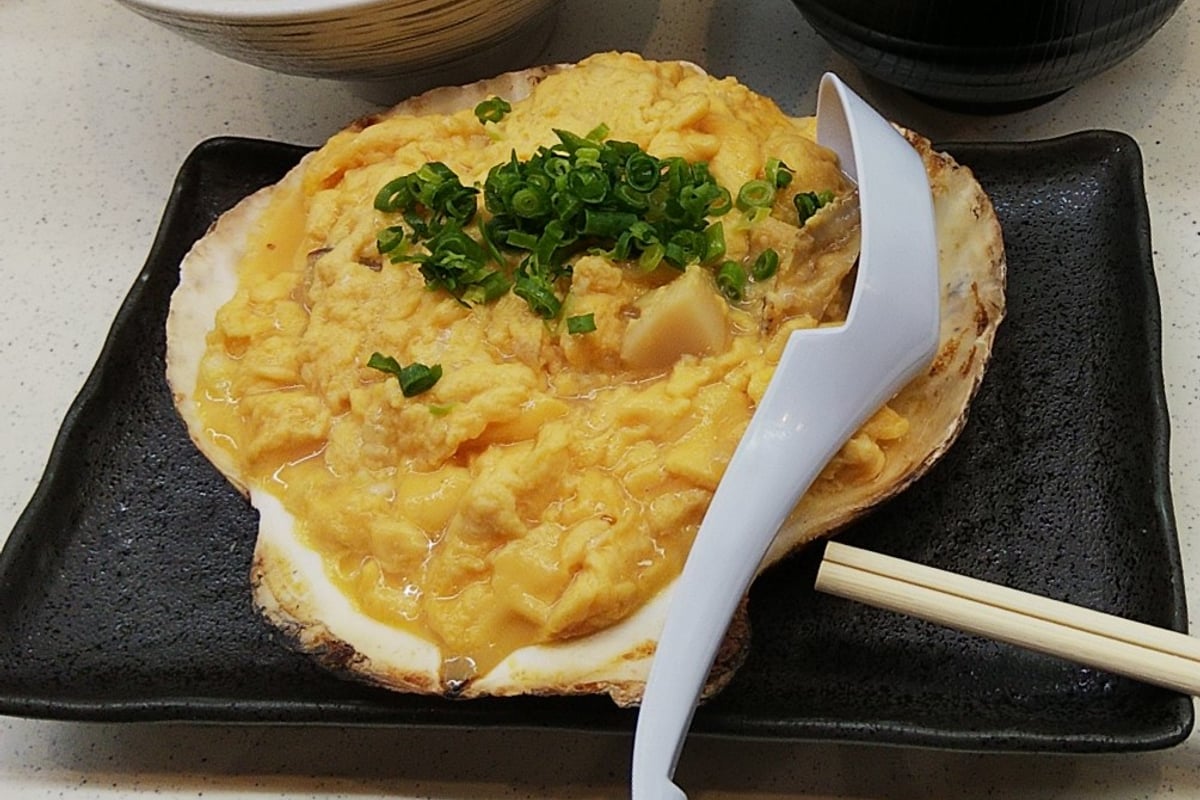
Kayaki-miso is a local dish handed down in the Tsugaru and Shimokita regions of Aomori Prefecture, in which a large scallop shell is used in place of a pot to simmer scallops, fish fillets, and vegetables in dashi and miso, finished by pouring in beaten egg. Around Tsugaru Bay, long known as a scallop-producing area, it is said that as early as the Edo period people were already using shells as pots to grill sardines or mackerel with homemade miso, in a simple fisherman's dish. Later, once eggs became available, it evolved closer to its present form, finished with beaten egg; however, because eggs were a precious commodity at the time, kayaki-miso was also a special nourishing food that only the ill or pregnant women were allowed to eat. Osamu Dazai, a novelist born in Tsugaru, wrote in his novel "Tsugaru" of his longing for the egg-topped kayaki-miso he ate as a child when he caught a cold, and the dish is also known for being deeply tied to the memories of the people of Tsugaru.
Origin
Around Tsugaru Bay, long known as a scallop-producing area, it is said that as early as the Edo period people were already eating a simple fisherman's dish made by using a large scallop shell in place of a pot, topping it with sardine or mackerel fillets and homemade miso, and grilling it. It is a dish born of the wisdom of coastal life, where fishermen made use of whatever shells were close at hand as makeshift pots between fishing trips.
History
Later, once ordinary people were able to obtain eggs, the dish evolved closer to its present form, poured with beaten egg to bind it together with the other ingredients. However, because eggs were expensive and precious at the time, kayaki-miso was also a special nourishing food that only those in poor health or pregnant women were allowed to eat. Dazai Osamu, born in Tsugaru, wrote in his novel "Tsugaru" about his feelings for the egg-topped kayaki-miso he ate in his childhood.
Features
The basic method is to use a scallop shell about 20 cm in diameter as a pot, bring miso dissolved in a small amount of water to a boil, add scallop adductor muscle, fish fillets, tofu, mushrooms and the like, and finish by pouring in green onion and beaten egg. Despite its rustic appearance — served at the table in the shell itself — it offers a rich flavor in which the depth of the miso, the umami of the seafood, and the soft, half-set egg all come together as one.
Main Ingredients
Food Culture
Osamu Dazai, a novelist born in Tsugaru, wrote in his novel "Tsugaru" of his longing for the egg-topped kayaki-miso he ate as a child when he had a cold, and the dish continues to be passed down as a flavor that evokes nostalgia for the people of Tsugaru.
Famous Shops
お食事処おさない
青森県青森市新町1-1-17
A diner in the arcade street in front of Aomori Station known for its scallop dishes. The scallop kayaki-miso set meal can be ordered starting at around 1,100 yen, with the option to switch to kenojiru soup — a shop long loved by locals.
さかなや道場 弘前駅前店
青森県弘前市大字駅前1-1-10 宝塚ビル1F
An izakaya in front of Hirosaki Station specializing in tuna and seafood dishes. Alongside fresh sashimi from the sea, it has added Aomori's local dish kayaki-miso to its menu.
FAQ
Q. Why is a scallop shell used as a pot?
A. It is said to have begun when fishermen of old used scallop shells that happened to be close at hand on the beach as makeshift pots during breaks in fishing. This practice became established as a cooking method in its own right and evolved into the form of a local dish passed down in households as well.