Image: Wikimedia Commons
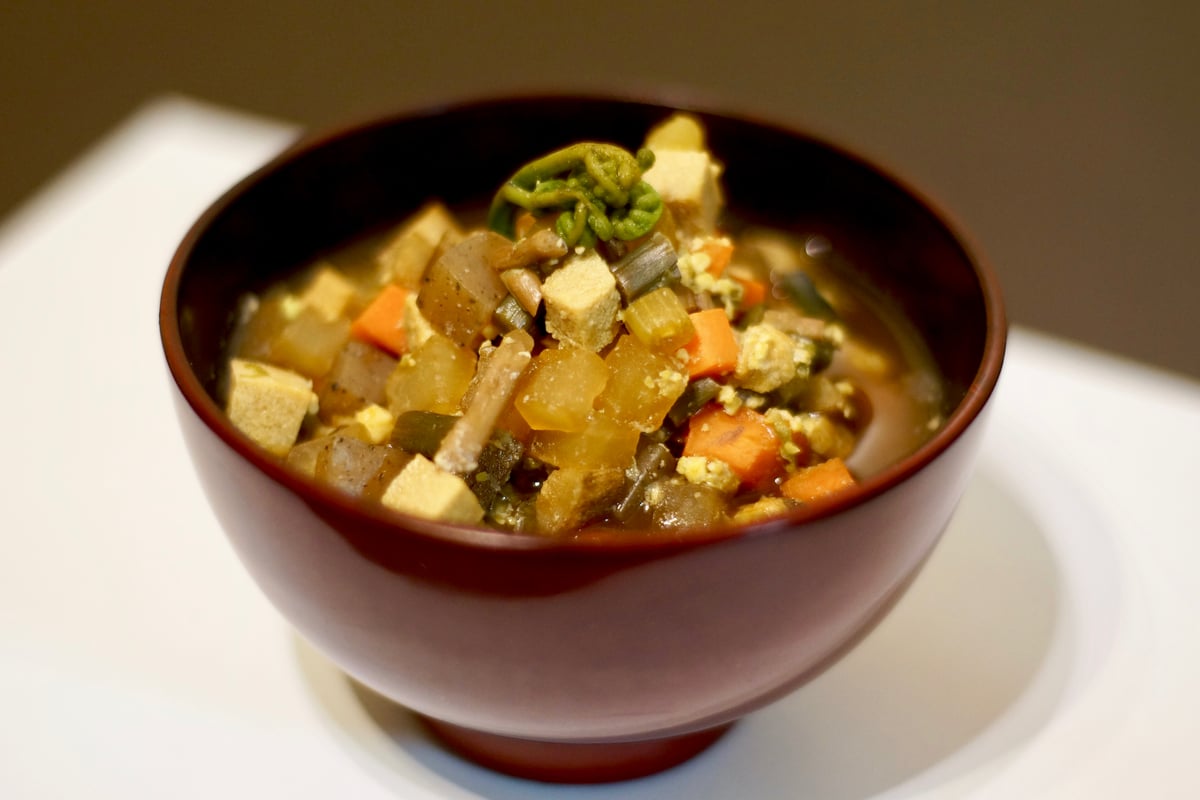
Keno-jiru is a hearty vegetable soup eaten mainly in the Tsugaru region, known as a traditional dish for Koshogatsu (the 'Little New Year,' January 15). Root vegetables such as daikon radish, carrot, and burdock, wild mountain vegetables like bracken and flowering fern, and dried ingredients such as fried tofu and frozen tofu are all chopped even finer than a small dice and simmered slowly in kelp dashi, then seasoned with miso or soy sauce. One theory holds that the name comes from 'ke,' a Tsugaru dialect word for rice porridge, though several other origin theories have also been passed down. It is also said to have originated as a dish women prepared in bulk before returning to their parents' homes at Koshogatsu, leaving behind a large potful for the men who remained—cooked in a big pot to last several days, with the flavor deepening day by day, a food culture that continues to be enjoyed today.
Origin
There are several traditions surrounding the origin of keno-jiru. One holds that it originated as food eaten by soldiers holed up in Wattoku Castle in Hirosaki City when it was attacked by Tsugaru Tamenobu (Oura Tamenobu) in 1571; another traces it to women who, before returning to their parents' homes at Koshogatsu after the busy New Year season, prepared a large potful in advance for the men left behind. Both traditions point to its character as a preserved food tied to the harsh Tsugaru winter.
History
Koshogatsu (January 15) is also known as 'Onna Shogatsu' ('Women's New Year'), and there was a custom of women who had been busy hosting guests and doing housework during the New Year returning to their parents' homes at this time. Keno-jiru is said to have been prepared in a large potful during their absence so the men left at home would have something to eat, and it took root as a seasonal dish from Tsugaru to Akita, equivalent to nanakusa-gayu (seven-herb rice porridge) eaten in other regions. It continues to be made today as a Koshogatsu dish in households and local specialty restaurants alike.
Features
Root vegetables such as daikon radish, carrot, and burdock, wild mountain vegetables like bracken and flowering fern, and ingredients such as fried tofu, frozen tofu, and konjac are all finely chopped with a knife, simmered in kelp dashi, and seasoned with miso or soy sauce. It is a shojin-style dish that uses no animal-derived ingredients, typically made in a large pot to last several days; reheating it each day is said to let the flavor sink in and improve, and its keeping quality as a preserved food is another defining characteristic.
Main Ingredients
Food Culture
Because it was prepared as a preserved food for the men left behind while women returned to their parents' homes at Koshogatsu, it has taken root in the Tsugaru region as a seasonal dish that expresses appreciation for the family's hard work. Given its composition, which is close to shojin cuisine, it has also been passed down in connection with the annual observances of temples and shrines.
Famous Shops
郷土ダイニング 鮪山(しびやま)
青森県弘前市駅前(JR弘前駅から徒歩1分)
An izakaya proud of its fresh fish delivered directly by fishermen every day. Keno-jiru is included in the local specialty set alongside dishes such as hotate-gai miso (scallop miso) and igamenchi.
津軽路 弥三郎
青森県弘前市大字鍛冶町23-2
A local specialty restaurant about a five-minute walk from Chuo-Hirosaki Station. It serves keno-jiru both as part of set meals made with local ingredients and as an individual dish.
FAQ
Q. What does 'ke' mean?
A. The most widely known theory is that it comes from 'ke,' the Tsugaru dialect word for 'kayu' (rice porridge), but there are several other origin theories as well, including one that traces it to a word for 'grass' found in the Man'yoshu, and another that connects it to 'ke,' meaning everyday food as opposed to 'hare' (special, ceremonial occasions).