Image: Wikimedia Commons
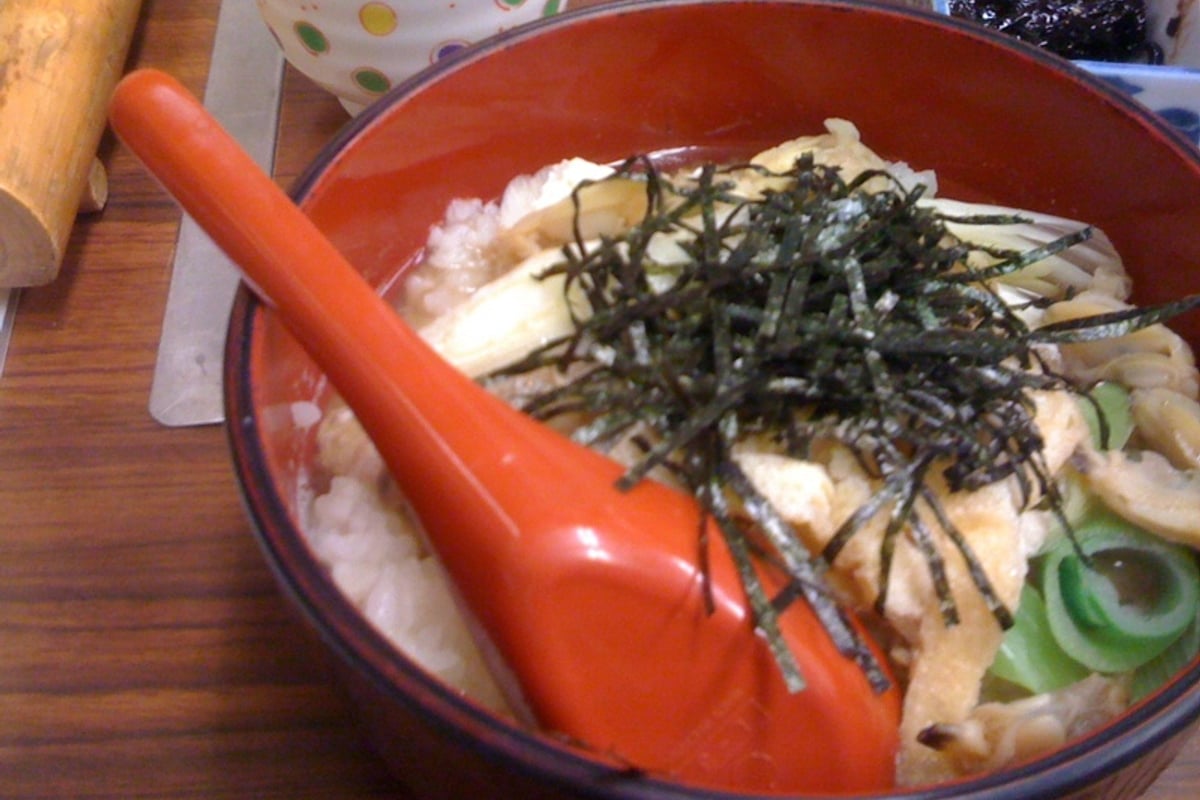
Fukagawa meshi is a local dish that originated in the fishing town of Fukagawa (present-day Koto Ward) during the Edo period, and it comes in two main styles built around clams: 'bukkake' and 'takikomi.' The area now known as Koto Ward once had broad, shallow tidal flats and thrived as a fishing town rich in clams, hard clams (hamaguri), and Japanese trough shells (aoyagi). The dish is said to have originated as 'bukkake meshi' — clams simmered in miso or soy sauce ladled over hot rice so fishermen could eat quickly between jobs — and later a version in which rice is cooked together with clams and vegetables, known as 'Fukagawa-don' or 'Fukagawa-meshi,' also spread. During the Edo period it was common to use bakagai (aoyagi), which were caught in great quantities at the time, but from the Meiji and Taisho eras onward, clams became the mainstream ingredient. Counted among Japan's five great rice dishes, it is a fisherman's dish representative of Tokyo that can still be enjoyed today at specialty restaurants throughout Koto Ward.
Origin
The roots of Fukagawa meshi lie in the tidal flats once known as Fukagawa-ura, in what is now the Eitai and Saga area of Koto Ward. It was a fishing town where clams, hard clams, and bakagai (aoyagi) could be gathered in abundance at low tide, and the dish is said to have begun when fishermen, wanting something they could eat quickly between hauls, ladled clams simmered in miso or soy sauce over hot rice. It was a simple fisherman's meal enjoyed by ordinary people throughout the Edo period.
History
During the Edo period, bakagai (aoyagi) was the main ingredient used, but by the Meiji and Taisho eras, clams had become the standard choice. Until the early Showa era, food stalls selling Fukagawa meshi could still be found in places like Asakusa, and it was widely enjoyed by ordinary people. After the war, Fukagawa lost its character as a fishing town, but the dish has been passed down as a local specialty through specialty restaurants and Koto Ward's tourism promotion efforts, eventually coming to be counted among Japan's five great rice dishes.
Features
Fukagawa meshi comes in two main styles. One is the 'bukkake' type, in which shelled clams simmered in miso or soy sauce are ladled over hot rice — a style closer to the original fisherman's meal. The other is the 'Fukagawa-don' or 'Fukagawa-meshi' type, in which clams, fried tofu, and burdock root are cooked together with the rice, a style that spread as a home-cooked dish. Both feature rice infused with the flavor of clam broth, offering an easy way to enjoy the bounty of Tokyo Bay.
Main Ingredients
Food Culture
The dish originated as 'bukkake meshi,' devised so fishermen could eat quickly aboard their boats or between jobs, and it carries on today the food culture unique to Edo's fishing towns, where people took in nutrition quickly amid busy labor.
How It Differs from Home Cooking
At home, the takikomi (cooked-together) style of 'Fukagawa-meshi' is more commonly made, but specialty restaurants also serve the original 'bukkake' style, in which clam miso soup is ladled over rice — and some shops let diners compare both.
Famous Shops
深川宿 本店
東京都江東区三好1-6-7
A Fukagawa meshi specialty restaurant located across from the Fukagawa Edo Museum. The 'Fukagawa meshi,' which lets diners enjoy both the bukkake and takikomi styles, costs around 2,145 yen, while the more indulgent 'Tatsumi Konomi' is around 2,365 yen.
View details →深川釜匠
東京都江東区白河2-1-13
A popular restaurant near Kiyosumi-shirakawa Station. Its signature dish is Fukagawa meshi cooked in a clay pot, with the lunch set available from around 1,050 yen.
| 深川めしの素 | A Tokyo souvenir made by Ninben, a long-established bonito flake shop in Nihonbashi. This seasoning mix lets you recreate authentic Fukagawa meshi at home just by preparing rice and clams and cooking them together — sold as a set of two packs (each for two servings) for around 1,080 yen.Where to buy →PR |
|---|