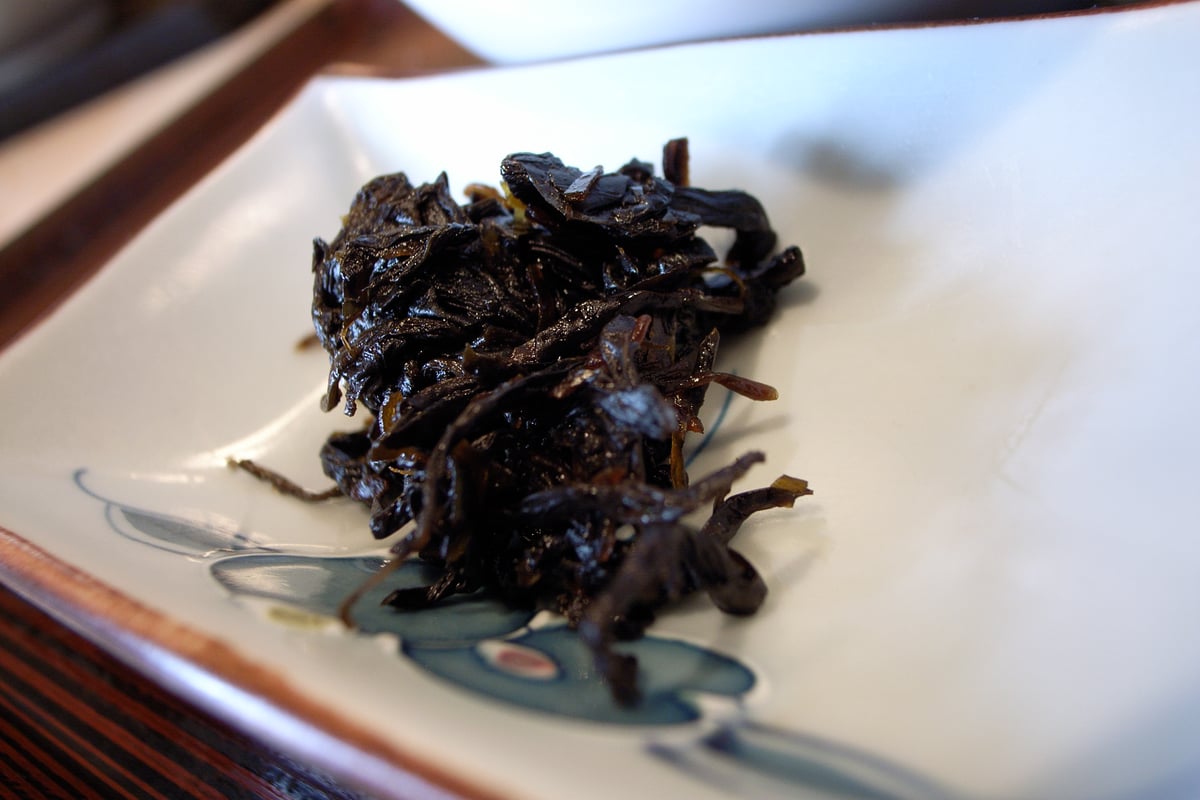
Image: Wikimedia Commons
Tsukudani is a preserved food made by slowly simmering small fish, shellfish, or seaweed in soy sauce and sugar, and it represents the food culture of Edo, having originated on Tsukudajima (present-day Tsukuda, Chuo Ward, Tokyo). Tsukudajima is said to have begun when Tokugawa Ieyasu, founder of the Edo shogunate, invited fishermen from Tsukuda Village in Settsu Province (present-day Osaka) and settled them on a tidal flat at the mouth of the Sumida River. To avoid wasting food on days they could not fish, or small fish and shellfish too minor to sell, the fishermen devised a way of simmering them down thickly in salt and soy sauce so they would keep - this is said to be the origin of the name 'tsukudani.' As dark soy sauce became more widely produced through the Edo period, the flavor grew richer and more refined, and samurai and travelers on the sankin-kotai (alternate attendance) journeys carried it home as a souvenir, helping it spread across the country. Long-established shops dating from the Edo period still line the streets around Tsukudajima today, making and selling tsukudani from a variety of ingredients such as small fish, shellfish, kombu, and ginger. Loved as an accompaniment to rice or sake and firmly established as a household staple, it is one of Japan's representative preserved-food traditions.
Origin
Tsukudajima began when Tokugawa Ieyasu, founder of the Edo shogunate, invited fishermen from Tsukuda Village in Settsu Province (present-day Nishiyodogawa Ward, Osaka) and settled them on reclaimed land at the mouth of the Sumida River. To avoid wasting the small fish and shellfish too minor to sell, or to have preserved food for days they could not fish, the fishermen developed a method of simmering them down thickly in salt and soy sauce so they would keep. This is said to be the origin of tsukudani.
History
As the production of dark soy sauce flourished through the Edo period, the flavor of tsukudani evolved to become richer and more refined. Samurai and travelers who visited Edo under the sankin-kotai system carried it home as a souvenir, and its recipe and flavor spread throughout the country, giving rise to regional variations made with local fish and wild vegetables. Long-established shops founded in the Edo period still remain on Tsukudajima today, carrying on the methods of that time.
Features
The basic method is to slowly simmer small fish (such as sand lance or dried baby sardines), shellfish (such as clams or freshwater corbicula), seaweed (kombu), and ginger in soy sauce, sugar, and mirin, reducing the liquid to extend shelf life. Shops and regions each bring their own balance of sweetness, saltiness, and soy sauce intensity, resulting in a wide range of flavors - from delicate seasoning that lets the ingredient's own flavor shine through to bold, rich seasoning perfect with rice.
Main Ingredients
Food Culture
Having originated as a preserved food, tsukudani has become a fixture of everyday meals as an accompaniment to rice, a snack with sake, or a treat with tea, and it is also popular as a gift assortment.
How It Differs from Home Cooking
At home, store-bought tsukudani is most often used, whereas long-established shops adjust the heat and simmering time for each ingredient and finish the dish using a sauce (tare) passed down through generations.
Famous Shops
天安本店
東京都中央区佃1-3-14
Founded in 1837 (Tenpo 8), it is the oldest surviving tsukudani shop on Tsukudajima. Items such as clam and kyarabuki (simmered butterbur) tsukudani are sold by weight, from around 500 to 800 yen per 100g.
鮒佐
東京都台東区浅草橋2-1-9
Founded in 1862 (Bunkyu 2), this long-established shop is said to have created the prototype of today's soy-sauce-based tsukudani. The fifth-generation owner still prepares it using a method unchanged since the Edo period.
View details →FAQ
Q. What is the origin of the name 'tsukudani'?
A. It is named after Tsukudajima in Tokyo (present-day Tsukuda, Chuo Ward), the place where it originated. It came to be called 'tsukudani' because fishermen on Tsukudajima simmered small fish and shellfish in soy sauce as a preserved food.