Image: Wikimedia Commons
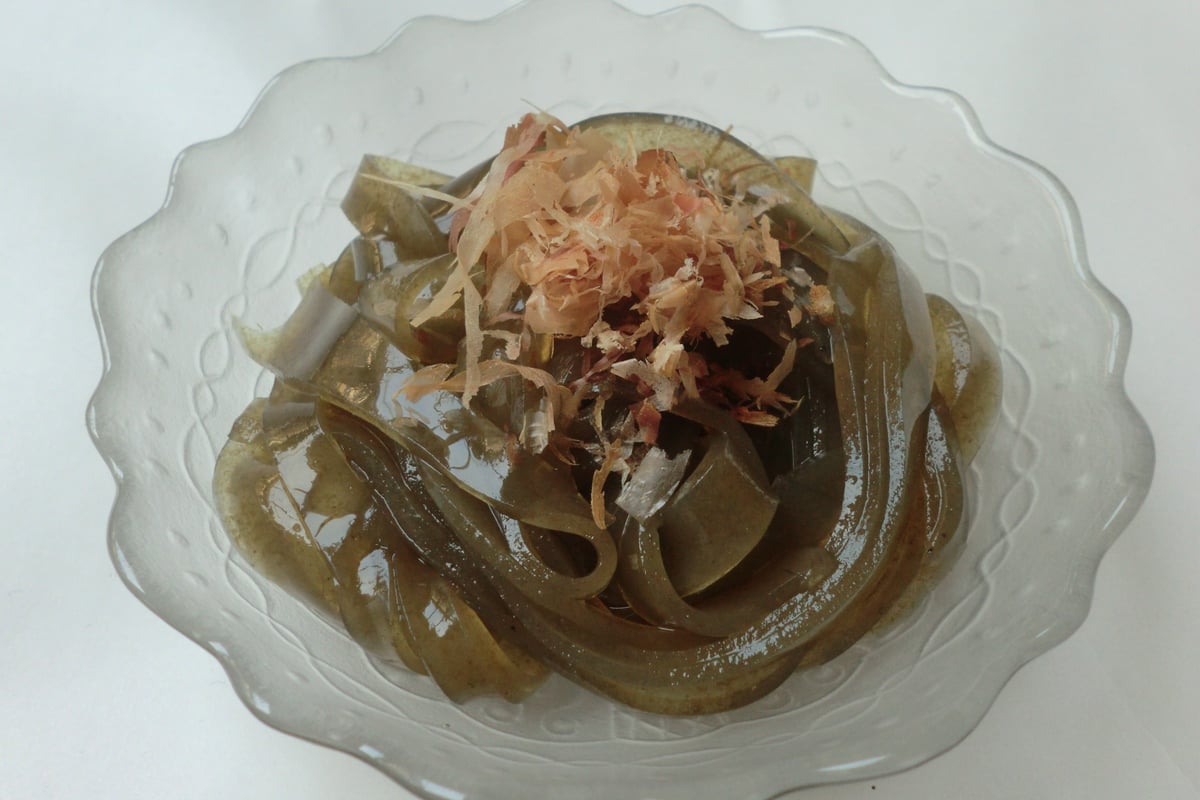
Okyuto is a local dish, made mainly in Fukuoka City, in which egonori seaweed is boiled down and set into a jelly-like block. Cherished since the Edo period as an essential part of Hakata's breakfast table, it was once sold every morning before the war by peddlers carrying baskets on shoulder poles, known as 'okyuto sellers.' It has a distinctive springy texture and a subtle seaweed aroma, and is typically topped with ginger, bonito flakes, or chopped scallions, then eaten with soy sauce or vinegared soy sauce. Because it is low in calories and rich in dietary fiber, it has recently drawn attention as a diet food, and can be found easily at convenience stores and supermarkets. It is also served in school lunches, making it a dish that symbolizes Fukuoka's food culture as it is passed down to younger generations.
Origin
Okyuto's origins lie in the technique of boiling down egonori seaweed until it sets. The Edo-period document 'Chikuzen Kuni Sanbutsucho' records it under the name 'uketo.' The area around Hakozaki in Fukuoka City's Higashi Ward is considered its birthplace; it was originally eaten only in part of Hakata but gradually spread across all of Fukuoka City and then throughout Kyushu. There are several theories about the origin of its name, and no single account is settled as definitive.
History
Several theories explain the origin of the name: one holds that it came to be called 'okyuto' (meaning 'relief person') because it saved many people from starvation during a famine; another suggests it was called 'okito' ('offshore people') because the recipe was learned from fishermen. Before the Asia-Pacific War, the 'okyuto seller,' who carried the dish through town on a shoulder pole, was a familiar seasonal sight in Hakata, and the dish was a staple of breakfast in nearly every household.
Features
Its main ingredient is egonori seaweed, sometimes combined with igisu seaweed, which is boiled down and left to set naturally in molds. Because it sets using nothing but the seaweed's natural stickiness, with no additives, it offers a briny aroma alongside a smooth, slippery texture and a slight crunch all at once. The classic way to eat it is cut into strips and topped with ginger, bonito flakes, and chopped scallions, then served with soy sauce or vinegared soy sauce.
Main Ingredients
Food Culture
Until the war, it was a daily routine for households in Hakata to buy okyuto each morning from a peddler carrying it on a shoulder pole, making it an indispensable part of the breakfast table. It is still produced in Fukuoka City today, and remains a familiar homestyle taste found in the prepared-food sections of local supermarkets.
How It Differs from Home Cooking
At home, the typical way to eat it is simply to slice a store-bought packaged okyuto and add toppings, but specialty shops boil down egonori from scratch to make their own, taking care to achieve a smooth texture and a stronger seaweed aroma.
Famous Shops
林隆三商店
福岡県福岡市東区箱崎2-13-5
Founded in the Taisho era, a specialty okyuto shop with a history of more than 90 years. Known locally as 'Hakozaki Okyuto.'
| Hakata Okyuto (Fukuya) | Packaged okyuto made by Fukuya, the long-established mentaiko specialist. Available at souvenir shops and supermarkets, it lets you enjoy the dish easily at home.Where to buy →PR |
|---|
FAQ
Q. Is okyuto the same as kanten (agar) or tokoroten?
A. The ingredients differ. Kanten and tokoroten are made from tengusa seaweed, while okyuto is made by boiling down a different seaweed called egonori until it sets, giving it a different stickiness, flavor, and texture.