Image: Wikimedia Commons
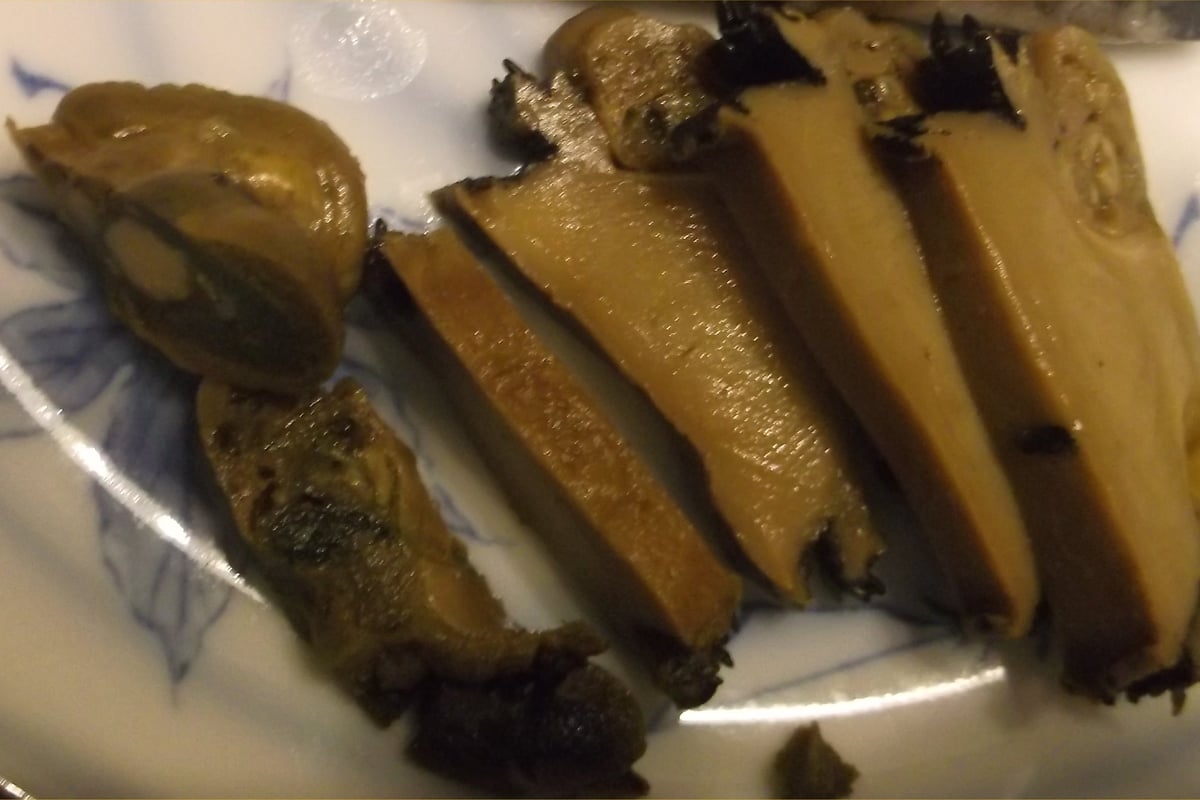
Awabi no Nigai is a specialty of Yamanashi Prefecture in which abalone is simmered in soy sauce and then steeped in the simmering liquid to absorb its flavor. It is known as a processed seafood product born in landlocked Koshu (Kai Province). According to tradition, it began in the Edo period when abalone landed at Numazu on Suruga Bay was packed into barrels with soy sauce, loaded onto horseback, and carried over mountain passes. During the long journey the soy sauce soaked in just right, and by the time it reached Kai it had reached the perfect flavor. It was praised by the samurai serving at Kofu Castle and eventually became known in Edo as well. There is also a story that Takeda Shingen used it as field rations, but this is only one of several theories. Today, some long-established makers use domestic black abalone and finish it with the liver still attached. The classic way to enjoy it is sliced thin like sashimi, and it is prized for celebrations such as New Year and weddings and as a gift.
Origin
Nigai is said to have originated in the transport of seafood between Numazu on Suruga Bay and Kai Province in the Edo period. According to an introduction by the Ministry of Agriculture, Forestry and Fisheries (MAFF), it began in the late Edo period when a fish wholesaler at Numazu Port sent abalone caught around the Seven Islands of Izu to Kai. Raw abalone was processed with soy sauce, packed into barrels, and carried slowly along the highway on horseback. It is said that by the end of the long journey the flavor had soaked in well, giving the finest result. Yamanashi Prefecture's tourism information introduces a route from Gotemba through Subashiri and over the Kagosaka Pass.
History
As an old written record, the name 'nigai' (written 尓加以) is said to appear in a diary from 1829 (Bunsei 12). Materials from the 1840s also contain spellings such as 仁賀伊 and 煮鮑. Nigai was praised by the shogunate's samurai serving at Kofu Castle, and its reputation spread to Edo. Minayo in Chuo, Kofu City, claims to have been founded in 1584 (Tensho 12) and calls itself the birthplace of nigai. There is also a tradition that Takeda Shingen used it for nourishment in the field and for entertaining guests, but reliable historical sources are scarce, and it is regarded as one of several theories.
Features
The abalone is removed from its shell, simmered in a liquid based on soy sauce, and then steeped in that liquid to absorb its flavor. The blend of the simmering liquid is a closely guarded secret of each maker, and some shops add bonito dashi. The flesh is tender, and the more you chew, the more the savory flavors of soy sauce and abalone spread. Some shops finish it with the liver (wata) still attached, so you can also enjoy a pleasantly bitter flavor. When eating, the classic way is to drain off the liquid, slice it thinly at an angle, and enjoy it like sashimi. It can also be eaten as a steak by grilling the slices on an iron griddle.
Main Ingredients
Food Culture
Nigai is a feast for festive occasions in Yamanashi Prefecture, served at celebrations such as New Year and weddings. Because it is expensive, it has also been prized as a gift. It is a dish that conveys to this day how highly the bounty of the sea brought from Suruga Bay was valued in Koshu, far from the sea.
How It Differs from Home Cooking
Rather than a dish made at home, nigai is a processed product made by specialist makers. Some long-established shops do not make it in advance; instead, after receiving an order, they vacuum-pack the required number and hand it over. The origin and size of the abalone and the blend of the simmering liquid differ from maker to maker, so comparing flavors and textures is part of the fun.
Famous Shops
みな与
山梨県甲府市中央3-11-20
A nigai specialty shop said to have been founded in 1584 (Tensho 12), about a 15-minute walk from JR Kofu Station. It uses only domestic black abalone from nearby waters and finishes it by hand, steeping it with the liver attached in a secret sauce. Awabi no Nigai is from about 5,900 yen for 65 g.
View details →| Domestic Black Abalone Nigai (Kaiya) | Nigai from Kaiya, a shellfish processing company in Kofu City founded in 1977 (Showa 52). It uses domestic wild black abalone and is finished with the company's own bonito-based dashi and kiage (raw) soy sauce from a local company. It is committed to a production method that uses no additives such as preservatives, and it can also be purchased from the online store.Where to buy →PR |
|---|
FAQ
Q. Why is it a specialty of landlocked Yamanashi Prefecture?
A. It is said to have begun when abalone landed at Numazu on Suruga Bay was steeped in soy sauce and carried on horseback to Kai Province. It is said that during transport the soy sauce soaked in just right, making it delicious. It was prized in Koshu, where seafood was precious, and became established as a specialty.
Q. Is it true that Takeda Shingen ate it?
A. There is a tradition that Shingen used it for nourishment in the field and for entertaining guests, but no reliable historical sources have been found. Abalone shells have been excavated from sites such as the Takeda Clan Residence Ruins, but it is surmised that they were used not for nigai but for a different abalone dish in which the flesh was served in the shell.
Q. How is it best eaten?
A. The classic way is to drain off the liquid, slice it thinly at an angle, and enjoy it like sashimi. It goes well as a snack with sake or as part of a celebratory meal. You can also grill the slices on an iron griddle and enjoy them as a steak.
Q. Does it keep well?
A. It varies by maker and product. For example, Minayo states that its nigai contains no preservatives or colorings and keeps for about a month unopened when refrigerated at 5°C or below. After purchasing, check the storage instructions shown for each product.