Image: Wikimedia Commons
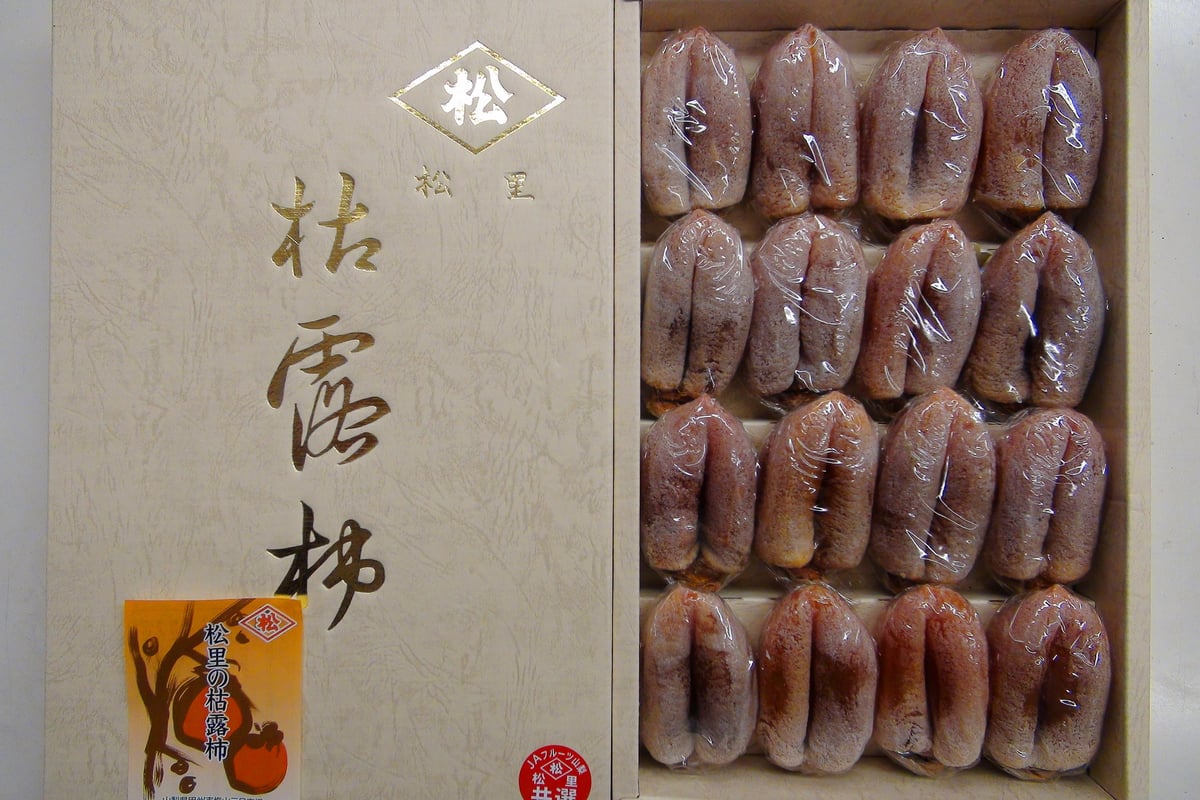
Korogaki are dried persimmons handed down in Koshu City and other parts of Yamanashi Prefecture, made by peeling large astringent persimmons and drying them in the sun. They mainly use 'Koshu Hyakume-gaki' persimmons grown in Koshu City, which are dried slowly until a white powder blooms on the surface. The name is said to come from rolling (korokoro) the fruit to change its orientation so that it receives sunlight evenly while drying. It is also said to have begun when Takeda Shingen encouraged their production as field rations, and in the Edo period they were used as a Koshu specialty presented to the shogunate. The Matsusato district of Enzan in Koshu City is known as a renowned production area, and from early November to early December, the eaves of houses are decorated with orange kaki-sudare (curtains of hanging persimmons). With their deep sweetness and thick, meaty texture, they are a winter delicacy of Yamanashi.
Origin
Korogaki are said to have begun when Takeda Shingen, the Sengoku-period feudal lord of Kai, encouraged the production of dried persimmons as field rations. However, this is told as a legend. According to an introduction by the Ministry of Agriculture, Forestry and Fisheries (MAFF), their production spread as a preserved food. The name is said to come from rolling (korokoro) the drying persimmons to change their position so that sunlight would fall on them evenly. It is said that from this they came to be called 'korogaki,' written as 転柿 (rolled persimmons) or 枯露柿.
History
In the Edo period, they became one of the specialties of Koshu and were also used as gifts presented to the shogunate. The most renowned production area is the Matsusato district of Enzan in Koshu City, where korogaki-making flourished because large Koshu Hyakume-gaki persimmons were harvested there. Minami-Alps City is also listed as one of the areas where the tradition has been handed down. Even today, from early November to early December, you can see persimmons hanging from the eaves and in the gardens of houses. At the Former Takano Family Residence (Kanzo Yashiki) in front of JR Enzan Station, korogaki are also hung to dry every year.
Features
The raw material, Koshu Hyakume-gaki, was originally called 'Koshu Hyakume-gaki' written with a different character (百匁柿), and is a large astringent persimmon that can weigh as much as 350 to 400 g each. They are harvested in early November and peeled, fumigated to prevent mold, and then hung from the eaves. They are dried in the sun for about 14 to 20 days, and once they reach a state like anpogaki (semi-dried persimmon), kneading begins. After that, they are dried for about 7 to 10 days while the kneading and rolling are repeated every day. They are finished when a white powder blooms on the surface, and they are characterized by a beautiful amber color and concentrated sweetness.
Main Ingredients
Food Culture
Korogaki are generally enjoyed as they are, savoring their deep sweetness as a snack with tea. Other traditional ways of eating them include adding them to the namasu (vinegared vegetables) of osechi New Year dishes to make 'kaki-namasu,' and making tempura from ones that have become hard. Because they are a luxury product made with great effort, they are also popular as gifts.
Famous Shops
旧高野家住宅(甘草屋敷)
山梨県甲州市塩山上於曽1651
A private house built in the mid-Edo period and designated a national Important Cultural Property, located right in front of JR Enzan Station. In autumn, korogaki are hung from the eaves, and visitors can see the scenery of kaki-sudare up close. Admission is about 310 yen, and it is closed on Tuesdays.
View details →JAフルーツ山梨フルーツ直売所
山梨県山梨市北239
A farm produce direct sales shop of JA Fruits Yamanashi, which also ships korogaki from Koshu City. In addition to vegetables and fruit picked that morning, rice, and flower seedlings, it also carries processed products such as korogaki. Opening hours are 9:00 to 17:00.
View details →| Carefully Selected Koshu Specialty Korogaki (Ikeda Seika) | Korogaki from Ikeda Seika, a greengrocer based in Koshu City that handles local fruit. Koshu Hyakume-gaki persimmons are dried one by one by hand, and they are characterized by a beautiful amber color and a thick, soft texture. They are also offered as a return gift for hometown tax donations (furusato nozei) to Koshu City.Where to buy →PR |
|---|
FAQ
Q. What is the difference between korogaki and anpogaki?
A. Both are made by drying astringent persimmons, but the degree of drying differs. Korogaki are dried further for about 7 to 10 days, being kneaded and rolled, after they reach a semi-moist state like anpogaki. Because they are dried until a white powder blooms on the surface, the flesh is firm and the sweetness is concentrated.
Q. When can I see the kaki-sudare scenery?
A. From early November to early December, you can see persimmons hanging from the eaves in areas such as the Matsusato district of Enzan in Koshu City. The orange kaki-sudare are a seasonal feature of winter in Yamanashi. Korogaki are also hung to dry every year at the Former Takano Family Residence (Kanzo Yashiki) in front of Enzan Station.