Image: Wikimedia Commons
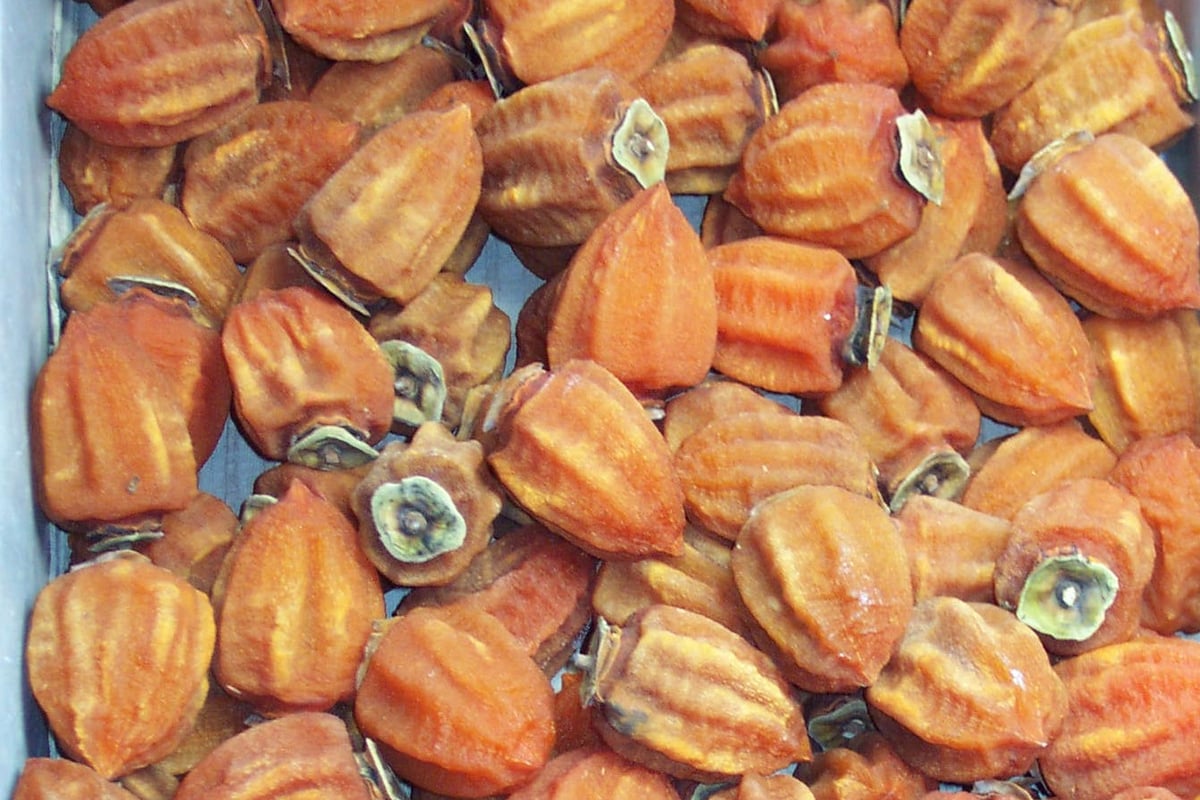
Anpogaki is a semi-dried persimmon that originated in the Isazawa district of Yanagawa-machi, Date City, Fukushima Prefecture. Astringent persimmons are fumigated with sulfur before being dried, producing vivid orange flesh with a soft, jelly-like texture. While ordinary dried persimmons are dried until firm, anpogaki is characterized by retaining more moisture, offering a refined sweetness that can be enjoyed either eaten as is or scooped out with a spoon. In the Isazawa district, regarded as the birthplace of anpogaki nationwide, techniques passed down through persimmon-growing families for more than a hundred years since the early Taisho era continue to be used, and the fruit is shipped nationwide as a taste representative of winter in Fukushima. In an area once known for sericulture, producers historically poured their efforts into persimmon cultivation as a new specialty product unaffected by fluctuations in the raw silk market, and today the whole of Date City is known as one of Japan's leading anpogaki-producing areas.
Origin
In the Isazawa district, the cultivation of astringent persimmons and the making of dried persimmons have flourished since the Edo period, producing a dried persimmon known as 'amaboshi-gaki' (written with characters meaning 'sun-dried' or 'sweet-dried' persimmon). This name is said to have become corrupted over time into 'anpogaki,' and the area has a history of focusing on dried persimmon production as a new agricultural product unaffected by fluctuations in the raw silk market.
History
Around 1922, sulfur fumigation techniques were introduced to the Isazawa district, making it possible to produce dried persimmons with better color, texture, and shelf life than before, and a shipping cooperative was organized the following year. This led to 'anpogaki' being produced and shipped in earnest as a specialty of Isazawa, and Date City continues to be known today as one of Japan's leading anpogaki-producing areas.
Features
The defining feature is that astringent persimmons are fumigated with sulfur and then dried only until about 40 percent of their moisture remains. The surface stays moist while the inside has a melting, jelly-like texture, allowing the rich sweetness characteristic of dried persimmons to be enjoyed in a softer form. The 'Hachiya' variety is mainly used, and its vivid orange appearance is one reason the persimmons are favored as gifts.
Main Ingredients
Food Culture
Anpogaki developed as a preserved food for winter and has long been enjoyed as a treat for welcoming guests at New Year's and during the winter season. From November through January, when production reaches its peak, rows of persimmons hung to dry beneath the eaves of houses in the Isazawa district have become a seasonal winter sight in the area.
How It Differs from Home Cooking
Dried persimmons made at home are often finished using only natural air-drying, which tends to remove more moisture, whereas producers in the growing region combine sulfur fumigation with careful temperature and humidity control, allowing them to consistently produce the soft, semi-dried texture and vivid color that anpogaki is known for.
Famous Shops
直売所 あぐりマート
福島県伊達市梁川町五十沢字聖天前26-1
A direct-sale shop run by persimmon farmers in Isazawa, the birthplace of anpogaki, mainly selling gift packs of around 500 grams.
View details →JAふくしま未来 公式オンラインショップ
Ships anpogaki grown in Date City nationwide, with sets including a 500-gram box (5 to 9 persimmons) starting at around 2,980 yen.
View details →FAQ
Q. How does anpogaki differ from ordinary dried persimmons?
A. Ordinary dried persimmons are dried thoroughly until the surface becomes firm, but anpogaki is fumigated with sulfur and dried while retaining more moisture, which gives it a soft, jelly-like texture.