Image: Wikimedia Commons
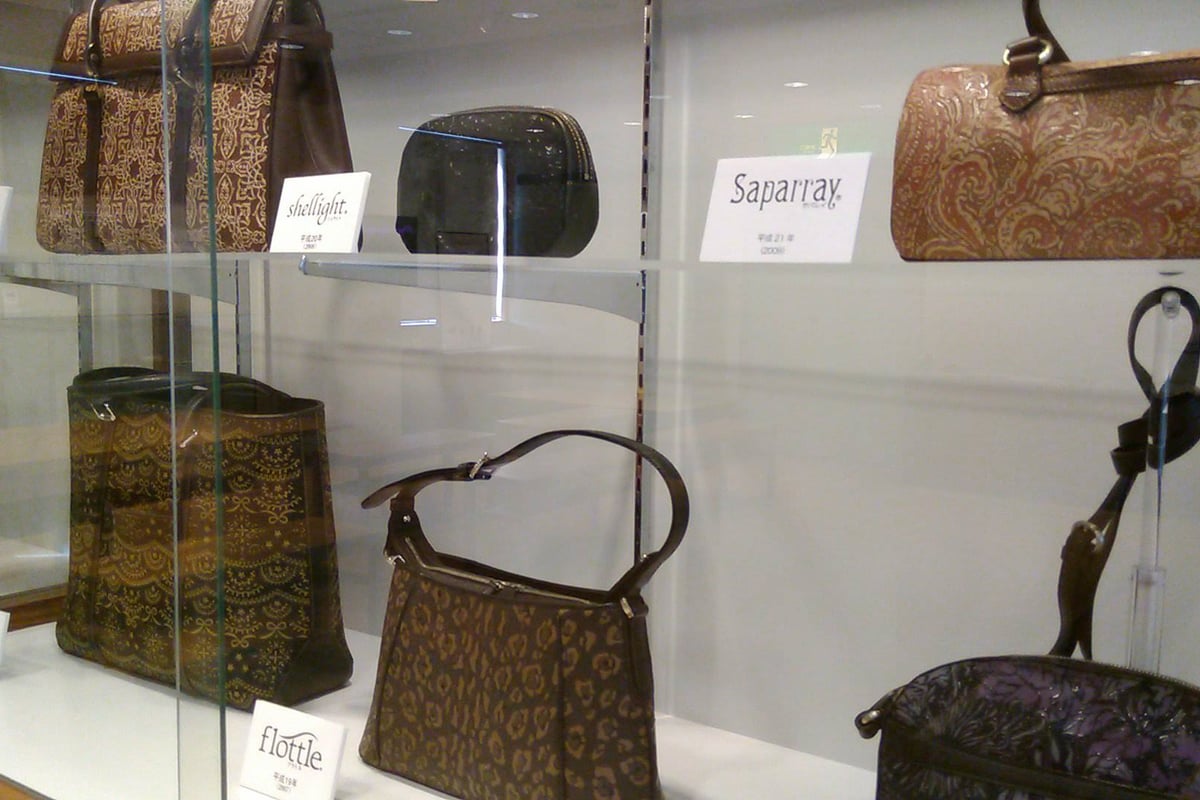
Koshu Inden is a deerskin craft made in Kofu City, Yamanashi Prefecture. Its defining feature is that a stencil is laid over tanned and dyed deerskin and urushi lacquer is rubbed in to apply patterns. The name 'inden' is said to come from decorative leather brought from India in the days of the Nanban trade (trade with the Portuguese and Spanish). Koshu Inden is said to have begun in the late Edo period, when Uehara Yushichi of Kofu devised a technique of applying lacquer to deerskin. In the Edo period inden was made in many places, but Koshu is the only place where its production methods survive today. Besides lacquer application, the techniques include 'fusube,' in which the leather is colored with the smoke of burning straw, and 'sarasa,' in which a different stencil is used for each color to create multicolored patterns. Deerskin is soft, strong and light, and the more it is used, the better it fits the hand. Over time the colors of the lacquer patterns grow clearer and take on a deep luster. In 1987 it became a Traditional Craft Designated by the Minister of Economy, Trade and Industry. On the second floor of Inden-ya's main store in Kofu City is the Inden Museum, which introduces the history and patterns of inden.
Origin
The name 'inden' is said to come from 'Indeya leather,' a decorative leather from India brought in through the Nanban trade of the 16th and 17th centuries. According to the family tradition of Inden-ya, the family business began in Tensho 10 (1582), when the Uehara family, retainers of the Takeda clan, started making armor and weapons. In the late Edo period, their ancestor Uehara Yushichi, who had moved to Kai Province, devised an original technique of applying lacquer to deerskin. This is considered the beginning of Koshu Inden.
History
In the Edo period inden was made in many places, and it was so popular among the townspeople of Edo that it even appears in Jippensha Ikku's 'Tokaidochu Hizakurige.' Lacquered inden was also called 'Jiwari Inden' and 'Matsukawa Inden.' The 1854 'Kofu Kaimono Hitori Annai' (a shopping guide to Kofu) lists inden workshops, and by the end of the Edo period Kofu had become an established production area. In the Meiji period, items such as Shingen-bukuro (drawstring bags) won awards at the National Industrial Exhibition, and inden became a famous product of Yamanashi.
Features
The deerskin used as the material is soft, strong and light, and the more it is used, the better it fits the hand and the more attached its owner becomes. Over time the colors of the lacquer patterns on the surface grow clearer, and they come to give off a deep, calm luster. The main products are pouches and bags such as wallets, kinchaku (drawstring pouches) and Shingen-bukuro. Inden was once made in many places in the Edo period, but today its production methods survive only in Koshu, and it has become a craft representative of Yamanashi.
Techniques
Urushi-zuke (Lacquer Application)
A technique in which a hand-carved stencil is placed on dyed deerskin and urushi lacquer is rubbed in over it to apply a pattern. When the stencil is removed, a glossy lacquer pattern remains on the leather. It is the technique that represents Koshu Inden, and at Inden-ya it has been handed down as a family technique.
Fusube (Smoking)
A technique in which deerskin is stretched over a cylinder called a 'taiko' and smoked with the smoke of burning straw to give it a natural color. It is said to have developed in the Nara period, and the missionary Luis Frois also wrote of the Japanese skill of coloring leather skillfully with nothing but straw smoke.
Sarasa (Multicolor Stenciling)
A technique derived from patterned dyeing brought from India and elsewhere through the Nanban trade. A different stencil is used for each color in the pattern, and the colors are rubbed in one at a time, layer upon layer, to create vivid multicolored designs.
Materials Used
Production Process
- 1
Dyeing (Smoking for Fusube)
The deerskin is dyed. For fusube, it is colored by smoking it with straw smoke.
- 2
Cutting
The leather is cut to match the shape of the product.
- 3
Patterning
A stencil is laid on the leather, and lacquer or other materials are rubbed in to apply the pattern.
- 4
Sewing
The patterned leather is sewn together and made into a product.
| Main Production Areas |
|
|---|
Artisans & Workshops
印傳屋 上原勇七
A long-established Koshu Inden maker said to have been founded in Tensho 10 (1582). It has inherited, generation after generation, the lacquer application technique devised by its ancestor Uehara Yushichi, and it also preserves the fusube and sarasa techniques. It sells its products at its main store in Chuo, Kofu City, which houses the Inden Museum on the second floor.
Official site →印傳の山本
A manufacturer and seller of Koshu Inden founded in Kofu City in 1955. Using more than 20 colors of leather and more than 200 pattern plates, it designs a wide variety of products. Its head, Mr. Yamamoto Yusuke, holds the title of Traditional Craftsman for Koshu Inden.
Official site →How to Buy
- 印傳屋 本店
- The main store of Inden-ya, at 3-11-15 Chuo, Kofu City. Open from 10:00 to 18:00 and every day except the New Year holidays. There is a parking lot next door. There are also directly managed stores in Aoyama (Tokyo), Shinsaibashi (Osaka) and Nagoya.Where to buy →PR
- INDEN-YA オンラインストア
- Inden-ya's official online store. Lacquered Koshu Inden products such as wallets, small cases and bags can be purchased by mail order.Where to buy →PR
Hands-on Experiences
印傳博物館
山梨県甲府市中央3-11-15 印傳屋本店2階
A museum that introduces the history and traditional patterns of inden, holding special exhibitions on changing themes. Open from 10:00 to 17:00. Admission is about 200 yen for adults and about 100 yen for elementary and junior high school students.
View details →FAQ
Q. Where does the name 'inden' come from?
A. It is said to come from 'Indeya leather,' a decorative leather brought from India in the days of the Nanban trade. It is also said to have been named after decorative Indian leather presented by foreigners in the Kan'ei era. It was later produced domestically and took its present form, in which patterns are applied to deerskin with lacquer.
Q. How does inden change with use?
A. Over time the colors of the lacquer patterns grow clearer, and they take on a deep, calm luster. The deerskin base is also soft, strong and light, and the more it is used, the better it fits the hand. Being able to use it for a long time and enjoy how it changes is part of the appeal of inden.
Q. Why did inden come to be made in Koshu?
A. Surrounded on all sides by mountains, Koshu has produced deerskin and lacquer since ancient times. For this reason, it is said to have been an ideal place for inden to be born and develop. By the end of the Edo period, inden making flourished, centered on the castle town of Kofu.