Image: Wikimedia Commons
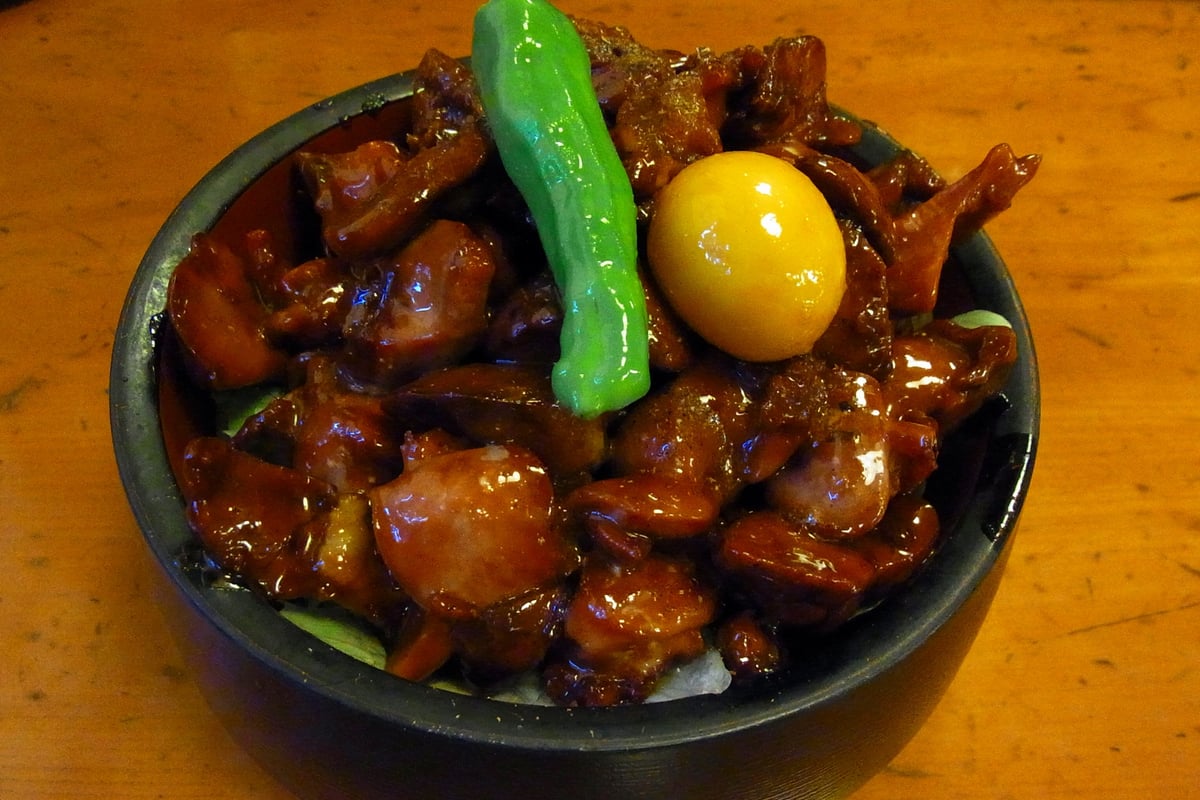
Kofu Torimotsu-ni is a dish of Kofu City in which chicken gizzards, hearts (hatsu), liver, and kinkan (unlaid eggs) are glazed and simmered in a sweet and savory sauce of sugar and soy sauce. Although it is called 'motsu-ni' (simmered giblets), it is not a soupy stew. A small amount of sauce is reduced over high heat for a short time, and the giblets are finished so that they are coated in the syrupy sauce. It is said to have been devised around 1950 (Showa 25), shortly after the war, at Okuto, a soba restaurant in Kofu City. It began as an attempt to make use of chicken giblets that were being thrown away. It then spread from the soba restaurant to other eateries and became part of Kofu's food culture alongside Hoto (Flat Noodles Simmered in Miso) and Awabi no Nigai (Soy-Simmered Abalone). In 2008, a volunteer group of Kofu City employees formed 'Minasama no En wo Torimotsu-tai' (literally, the squad that brings everyone together, a pun on torimotsu) and began promoting it nationwide. At the '5th B-1 Grand Prix in Atsugi' in 2010, it won the top prize, the Gold Grand Prix, in its first appearance.
Origin
Around 1950 (Showa 25), people were still living in a time of food shortages. According to tradition, the second-generation owner of Okuto, a soba restaurant founded in 1913 (Taisho 2), was asked by a butcher, 'Can't something be done with the chicken giblets that end up being thrown away?' Through repeated trial and error to create a cheap and tasty dish, he developed torimotsu-ni richly simmered in soy sauce and sugar, which were precious at the time.
History
Torimotsu-ni gained a good reputation, spread from the soba restaurant to other eateries, and became a familiar taste for ordinary people in Kofu. In June 2008, a volunteer group of Kofu City employees formed the community revitalization group 'Minasama no En wo Torimotsu-tai' under the slogan 'Energize Kofu with torimotsu-ni!' At the '5th B-1 Grand Prix in Atsugi' in September 2010, it won the Gold Grand Prix despite it being the group's first appearance, and the number of people coming from outside the prefecture to eat it increased.
Features
The giblets are trimmed of excess parts, cut into easy-to-eat pieces, and washed well in lightly salted water to remove odors. Soy sauce and sugar are brought to a boil over high heat in a frying pan, and when the sauce begins to bubble, the giblets are added. The pan is covered and stirred occasionally, and the dish is done when the sauce is reduced enough to stick to the edges of the pan. You can enjoy the contrasting textures: the crunch of the gizzards, the bite of the hearts, the softness of the liver, and the popping texture of the kinkan.
Main Ingredients
Food Culture
In Yamanashi Prefecture, it is loved as a standard menu item at soba restaurants, hoto restaurants, and set-meal eateries. Its sweet and salty flavor makes it both a snack to go with drinks and a side dish for rice, and it can easily be bought at supermarket deli counters. Together with the pun 'en wo torimotsu' (to bring people together), it is introduced as a local specialty representing Kofu.
How It Differs from Home Cooking
It can be made at home in a frying pan, but heat control and timing are important to bring out the glaze. The Torimotsu-tai describes the 'teri' (glaze) that soba chefs create with exquisite heat control as its essence. Some restaurants make it after the order is placed, and enjoying it together with handmade soba is the standard in Kofu.
Famous Shops
奥藤本店 国母店
山梨県甲府市国母7-5-12
A soba restaurant founded in 1913 (Taisho 2), known as the birthplace of Kofu Torimotsu-ni. You can enjoy the original torimotsu-ni, born in the Showa 20s, together with traditional handmade soba. It is about a 15-minute walk from Kokubo Station on the JR Minobu Line.
奥藤本店 甲府駅前店
山梨県甲府市丸の内1-7-4 たちばなビル1階
The second Okuto Honten restaurant, opened in 2011, about a two-minute walk from the south exit of JR Kofu Station. Because the torimotsu-ni is made after the order is placed, it takes about 15 minutes to be served. The Kofu Torimotsu-ni set combined with handmade soba is from about 1,300 yen.
ほうとう蔵 歩成 河口湖店
山梨県南都留郡富士河口湖町船津6931
A hoto restaurant near Lake Kawaguchi, in a building designed to evoke a traditional storehouse (kura). In addition to its signature 'Kogane Hoto,' it also offers basashi (horse sashimi), a Koshu specialty, and torimotsu-ni. The torimotsu-ni costs about 660 yen and can be enjoyed during a sightseeing trip around the Fuji Five Lakes.
View details →FAQ
Q. What kind of part is 'kinkan'?
A. It refers to the unlaid eggs inside a hen's belly. The Torimotsu-tai and Toririn, the butcher shop involved in the dish's creation, also describe it this way. In torimotsu-ni, it is an ingredient that offers a popping texture.
Q. What is 'Minasama no En wo Torimotsu-tai'?
A. It is a community revitalization group formed in June 2008 by a volunteer group of Kofu City employees. Its stated aim is to 'torimotsu' (bring together) connections between people through spreading Kofu Torimotsu-ni. The Gold Grand Prix at the B-1 Grand Prix was awarded to this group's community revitalization activities.