Image: Wikimedia Commons
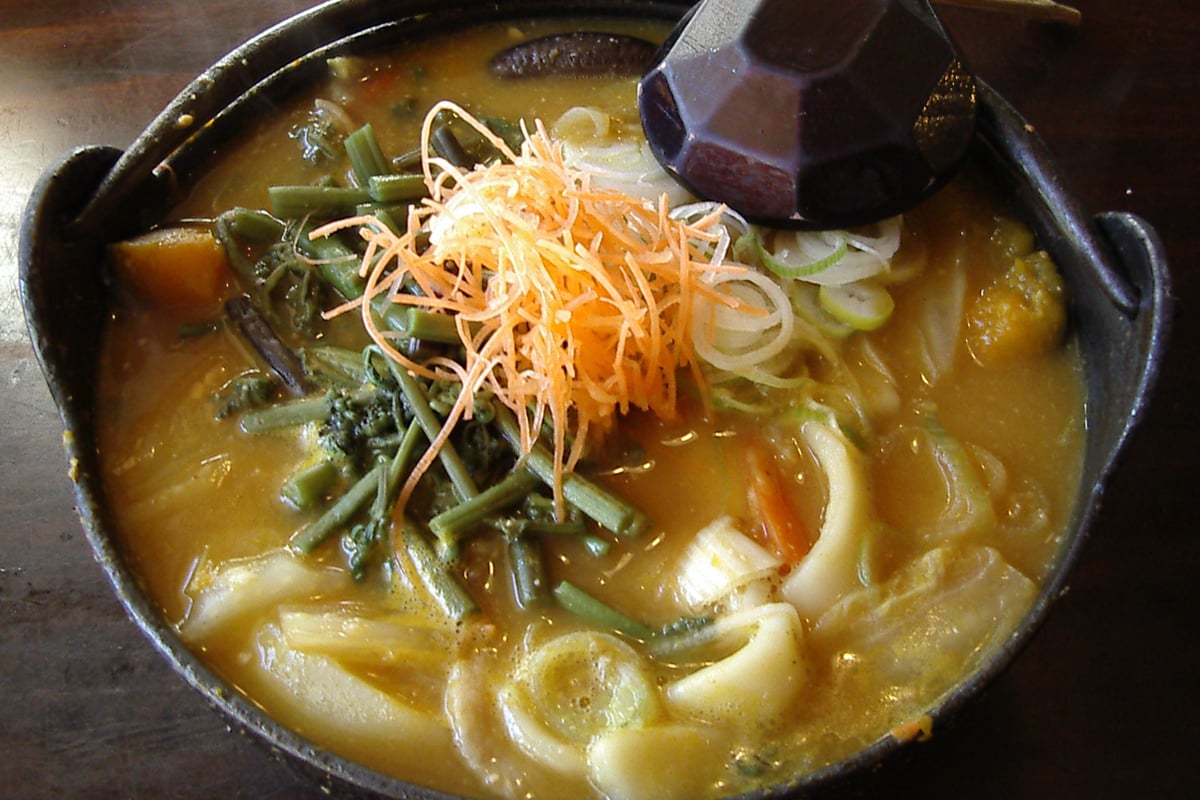
Hoto is a local dish of Yamanashi Prefecture in which fresh noodles, made by kneading wheat flour and cutting it into wide strips, are simmered in a miso-based broth together with kabocha squash and other vegetables. Because the noodles are made without salt, they can go straight into the pot without being boiled first. Since they are simmered with the dusting flour still on them, the broth thickens, stays hot for a long time, and warms the body. It is so well loved that there is even a saying, 'Umai mon da yo, kabocha no hoto' (Kabocha hoto is a tasty thing), and in 2007 it was selected for the Ministry of Agriculture, Forestry and Fisheries (MAFF)'s '100 Selected Local Dishes of Farming, Mountain and Fishing Villages.' About 80 percent of Yamanashi Prefecture is covered by mountain forests, and paddy fields for growing rice were limited. For this reason, a flour-based diet (funshoku), in which wheat and other grains are ground into flour and eaten, took root, and hoto became a staple food in place of rice. In the Kyonan region it is also called 'noshi-ire' or 'noshi-komi.' Today there are many specialty shops in the prefecture, and it is common for them to serve it in individual iron pots.
Origin
The name is said to come from 'hakutaku' (餺飥), a wheat-flour dish introduced from China. It is known that in the Heian period, aristocrats ate it at ceremonies and on other occasions. It is said that although it was once found in various places, it disappeared as rice cultivation spread and survived as a local dish of Yamanashi. In the Kamakura period, milling tools came into use among samurai and monks, and dishes using flour gradually increased.
History
In written records, hoto appears frequently as a specialty of Kai Province from the Edo period onward. In the early modern era, wheat was grown extensively as sericulture spread, and milling with water wheels installed in villages also became widespread, so the flour-based diet took hold on the tables of ordinary people. It continued to be eaten as an everyday meal in households, and after the war it spread to local-cuisine restaurants serving tourists. In the prefecture, the commercialization of the noodles progressed from the Showa 40s, and hoto also came to be sold as a souvenir.
Features
Lukewarm water is added little by little to wheat flour and kneaded, then the dough is rolled out thin and cut into strips about 1 cm wide. Because no salt is used, the noodles are not very firm, and they mingle well with the softened, crumbling kabocha and the broth. The dashi is made from niboshi (dried sardines), and the ingredients are simmered starting with the hard ones such as potatoes, daikon radish, and carrots. The miso is added in two stages, and finally green onions are put in and the pot is covered to let it steam. In the past, homemade Koshu miso prepared with both rice koji and barley koji was often used.
Main Ingredients
Food Culture
Because it was the staple food in place of rice in the mountains, making hoto has been regarded as the first step in a bride's training. In households it is made in plenty in a large pot, and some people prefer 'wakashi-kaeshi,' hoto reheated the next day. In summer, 'ozara,' in which the noodles are chilled in cold water and eaten with a dipping sauce, is also popular.
How It Differs from Home Cooking
At home, enough for the whole family is made in a large pot and served in bowls or soup bowls, and the ingredients are mainly vegetables and aburaage. Specialty shops simmer and serve each portion in an individual iron pot, and versions with pork, chicken, mushrooms, and other additions are also available. The noodles are often wide and rather thick, and at some shops it takes about 20 to 30 minutes from ordering until the dish is ready.
Famous Shops
ちよだ
山梨県甲府市丸の内2-4-8
A long-established restaurant founded in 1941, about a three-minute walk from the south exit of JR Kofu Station. Its hoto is made after the order is placed and costs about 1,280 yen. It is also known as the restaurant that started 'ozara' in Yamanashi, in which hoto noodles are chilled in cold water and eaten with a dipping sauce; ozara costs about 770 yen.
ほうとう不動 河口湖北本店
山梨県南都留郡富士河口湖町河口707
A hoto restaurant known as a specialty of Lake Kawaguchi. The menu consists of only one item, 'Fudo Hoto,' which costs about 1,320 yen. Firm homemade noodles are slowly simmered with kabocha, mountain vegetables, and more in a miso-based broth. The restaurant closes once the noodles run out.
View details →天下茶屋
山梨県南都留郡富士河口湖町河口2739
A teahouse standing on Misaka Pass, founded in 1934 (Showa 9). Dazai Osamu stayed here, and it became the setting of 'Fugaku Hyakkei' (One Hundred Views of Mt. Fuji). It serves hoto made without meat, with homemade noodles and vegetables simmered in local miso; the mushroom hoto hot pot costs about 1,350 yen.
FAQ
Q. Where does the name 'hoto' come from?
A. A widely known theory is that it is a transformation of 'hakutaku' (餺飥), a wheat-flour dish introduced from China. In folklore studies, there is also a theory that it derives from 'hataku,' the work of grinding grain into flour. There is also a story that Takeda Shingen cut the ingredients with his own treasured sword, but this is regarded as a popular legend that spread in later times.
Q. What is the difference between hoto and udon?
A. Udon is generally made by adding salt to the dough to give it firmness, and it is boiled before use. Hoto is made without salt and simmered in the broth while the noodles are still raw. The flour that dissolves from the noodles thickens the broth, creating a flavor in which the noodles, vegetables, and broth become one.
Q. Is it true that it was Takeda Shingen's field ration?
A. There is a tradition that it was a field ration devised by Shingen. However, it is from the Edo period onward that it appears frequently in written records as a specialty of Kai Province. There is also a view that the origin story connected with Shingen came to be told as hoto spread as a tourist specialty after the war.