Image: Wikimedia Commons
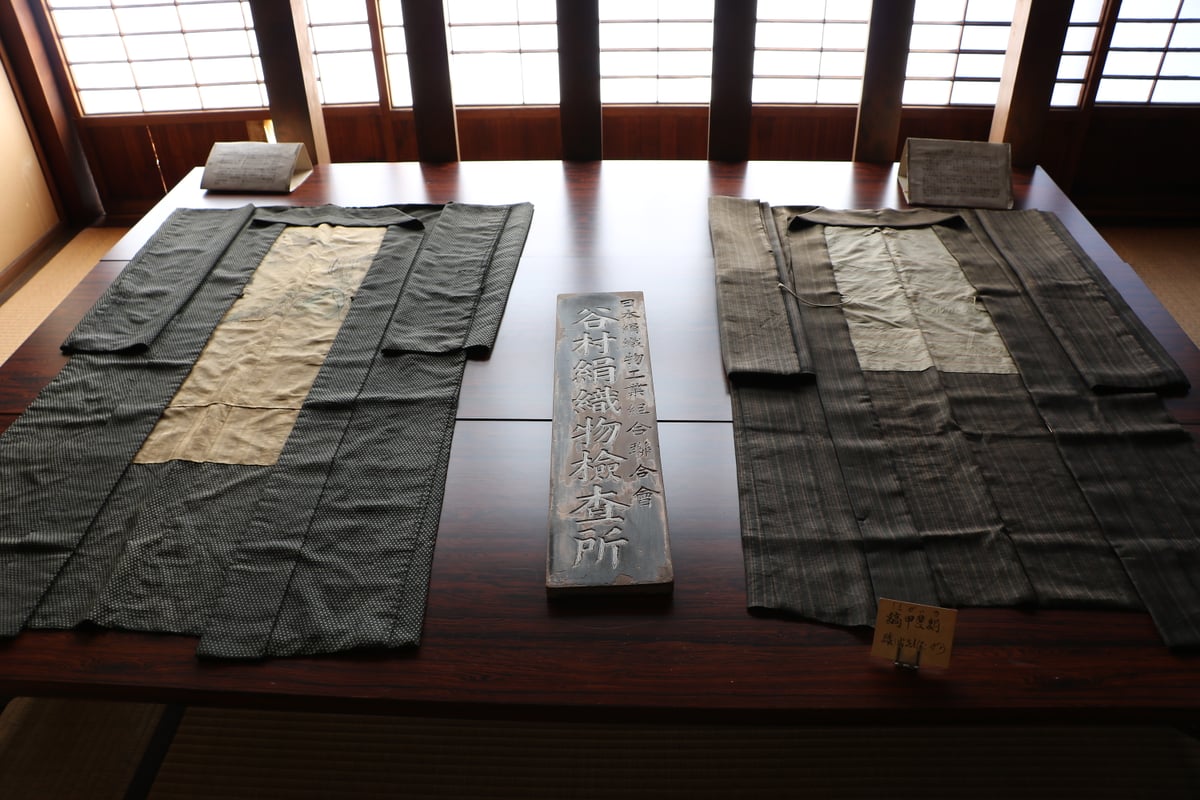
Gunnai Textiles are yarn-dyed (sakizome) fabrics that have been woven in the Gunnai region of eastern Yamanashi Prefecture, centered on Fujiyoshida City and Nishikatsura Town at the foot of Mt. Fuji. The Engishiki, a Heian-period collection of laws and regulations, lists Kai Province as a province that paid taxes in cloth, and the area is regarded as a textile-producing region with a history of more than 1,000 years. In the Edo period, silk fabrics such as Gunnai-jima (Gunnai stripes) were so well known that they appeared in the ukiyo-zoshi novels of Ihara Saikaku. Kaiki silk, which traces its roots to a fabric called 'kaiki' (海気) brought to Japan through the Nanban trade, was woven extensively from the Edo period to the early Showa period as a luxury silk used for the linings of haori jackets. Kaiki silk itself disappeared in the 1940s, but its techniques of 'yarn dyeing, fine-count yarns and high density' are still carried on today. The area now produces umbrella fabrics, necktie fabrics, apparel fabrics and interior textiles, and its fabrics are used for 40 percent of Japan's domestically made necktie fabric. Fujiyoshida, where many weaving mills (hataya) are gathered, is also called Hataori-machi (Weaving Town).
Origin
The oldest record mentioning textiles from Gunnai is said to be the Engishiki, which came into force in 967 (Koho 4). It states that 28 provinces, including Kai, were to pay the cloth made in each province as tax. This cloth is thought to have been hemp. Gunnai began producing textiles as commercial goods around the end of the Sengoku (Warring States) period, when the great consumer city of Edo was developing. Kaiki silk is said to have originated from a fabric called 'kaiki' (海気) that was brought to Japan through the Nanban trade between the Genki and Tensho eras and the Keicho era.
History
In the early Edo period, the Akimoto family, lords of Gunnai, had people pay their annual tax with money earned from selling silk fabrics because the land yielded little rice, and they promoted sericulture and the introduction of new types of looms. Around the Genroku era, Gunnai-jima appeared in works such as Ihara Saikaku's Koshoku Gonin Onna (Five Women Who Loved Love), and it became so popular that 'imitation Gunnai' circulated in Kyoto. Kaiki silk reached its peak in the Meiji period, and in 1894 (Meiji 27) the Kaiki Improvement Association was established in Nishikatsura Village. In the Showa period other products increased, and the production of Kaiki silk ceased around the time of the Pacific War.
Features
Kaiki silk is a 'pre-scoured and yarn-dyed' silk fabric in which raw silk is scoured and dyed before weaving. It uses fine, untwisted yarns and is finished as a high-density plain weave with as many as 200 to 280 weft threads beaten in per sun (about 3.8 cm). Although light and thin, it has body, along with a distinctive luster and a smooth texture. The taste for lavishing attention on unseen linings is said to have originated in the culture of Edo townspeople, which developed under sumptuary laws. Today's Gunnai Textiles also carry on these techniques of yarn dyeing, fine-count yarns and high density.
Techniques
Tamamushi Kaiki (Iridescent Kaiki)
Kaiki silk woven in plain weave using threads of different colors for the warp and weft. Like the wings of a jewel beetle (tamamushi), its color appears to change depending on the angle from which it is viewed. People used blue or purple iridescent colors for the linings of haori jackets, showing off their sense of style in parts that could not be seen from the outside.
E-gaiki (Picture Kaiki)
Kaiki silk woven after patterns are applied by hand painting or with paper stencils to the warp threads set on a hand loom. It was painstaking work in which the painting was repeated each time a patterned section had been woven. This distinctive technique of stencil dyeing on the loom is said to have been born around Meiji 10.
Hogushi-ori (Unraveled Weave)
A technique in which a design is applied to warp threads that have first been temporarily woven, the temporary weft is then unraveled, and only the warp is reset on the loom before the final weaving. Because the warp threads shift slightly, the pattern takes on a soft, blurred look. It is still used today for umbrella fabrics and other products.
Materials Used
Production Process
- 1
Hezukuri (Warp Preparation)
The warp threads are arranged using a warp frame (hewaku) and made into warp balls (hedama).
- 2
Scouring
The gummy substance (sericin) on the raw silk is removed to make it supple.
- 3
Dyeing and Drying
The threads are dyed before weaving and dried thoroughly.
- 4
Sizing
Size is applied to the threads to prepare them for easier weaving.
- 5
Reeding and Wet Winding
The warp threads are passed through the reed (osa) and wound up while being moistened.
- 6
Weaving
The weft is beaten in at high density. For E-gaiki, weaving proceeds in parallel with the painting.
- 7
Kinuta (Fabric Beating)
The woven fabric is beaten to finish it.
| Main Production Areas |
|
|---|
Artisans & Workshops
槙田商店
A maker of umbrella and apparel fabrics in Nishikatsura Town (西桂町小沼), founded in 1866 (Keio 2). It specializes in fabrics woven on jacquard looms from yarn-dyed threads, expressing patterns in three dimensions. It is one of the Gunnai weaving mills that have continued since the days of Kaiki silk.
羽田忠織物
A weaving mill in Kamikurechi, Fujiyoshida City, that specializes in neckties. It makes neckties from sha-ori (gauze weave) fabric, which is rare even in Japan, and sells colorful products at its factory shop.
山梨県絹人繊織物工業組合
The production-area textile association to which the weaving mills of the Gunnai region belong. It promotes the appeal of Gunnai Textiles through channels such as 'Hataori-machi Shotengai' (Weaving Town Shopping Street), which gathers information on the area's textiles and factory direct sales.
Official site →How to Buy
- 槙田商店 Shop
- A shop attached to the company's factory at 西桂町小沼1717 in Nishikatsura Town. It sells umbrellas as well as clothing and fabrics made from Makita Shoten's textiles, and visitors can pick up and choose fabrics with patterns woven in three dimensions.
- OPEN FACTORY
- A factory direct-sales event in which many of Fujiyoshida's weaving mills have opened their own shops on the third Saturday of every month. Visitors can shop while watching looms in operation. The participating mills for each month can be checked at places such as the Hataori-machi Information Center.
Hands-on Experiences
ハタオリマチ案内所
山梨県富士吉田市上吉田2丁目5-1
An information center at Fujisan Station on the Fujikyu Line, with free admission. Open from 10:00 to 16:30. It displays fabrics made in Fujiyoshida and introduces the history of the textile industry, and visitors can also get information on factory tours. Reservation-only workshops, such as making covered buttons, are also offered.
FAQ
Q. Is Kaiki silk still made today?
A. Kaiki silk is said to have been woven for the last time in the 1940s, disappearing with the end of the era when haori jackets and other Japanese clothing were everyday wear. It is thought that the method of weaving it by skilled craftsmen on hand looms became difficult to sustain amid mechanization. However, its techniques have been passed down to today's Gunnai Textiles.
Q. Where does the name 'Kaiki' (甲斐絹) come from?
A. The fabric 'kaiki' brought to Japan through the Nanban trade was written with various characters, such as 海気, 海機 and 改機, and until around Meiji 30 the characters 海気 were used locally as well. The characters 甲斐絹 (Kai silk) spread after the Meiji era, and there are two theories: one that the name was given by Fujimura Shiro, the first governor of the prefecture, and another that it spread among the general public.
Q. What is the connection between Yoshida Udon and textiles?
A. In the area around Fujiyoshida City, many women worked in the textile industry, so men prepared the meals. For this reason, it is said that udon that could be made quickly and had firm, chewy noodles came to be made often. The local dish Yoshida Udon is a flavor born from life in Hataori-machi.