Craft Genre
Textiles
A cross-regional look at Textiles from across Japan.
Region(multiple selection allowed)
59 items

Kiryu-ori (Kiryu textile)
Kiryu-ori
Kiryu-ori is a silk textile woven mainly in Kiryu, Gunma Prefecture, and a METI-designated Traditional Craft (Japan). Its history goes back to the Nara period: the Shoku Nihongi records that in 714, a silk textile called 'ashiginu (あしぎぬ)' was presented to the imperial court. During the Edo period it developed by adopting techniques from Nishijin and the West, and received favorable treatment from the shogunate, growing into a major production center known by the saying 'Nishijin in the west, Kiryu in the east.' Its defining feature is yarn-dyed patterned weaving (Jacquard weave), in which thread is dyed before being woven, using seven techniques: Omeshi-ori, Nuki-nishiki-ori, Tate-nishiki-ori, Futsu-ori, Uki-tate-ori, Tate-gasuri-mon-ori, and Mojiri-ori. It was designated a Traditional Craft in 1977, and today, centered on the Kiryu Textile Industry Cooperative, a wide range of products continues to be made, from kimono and obi fabric to gold-brocade cloth, clothing fabric, and Japanese and Western accessories.
Nishijin-ori
Nishijin-ori
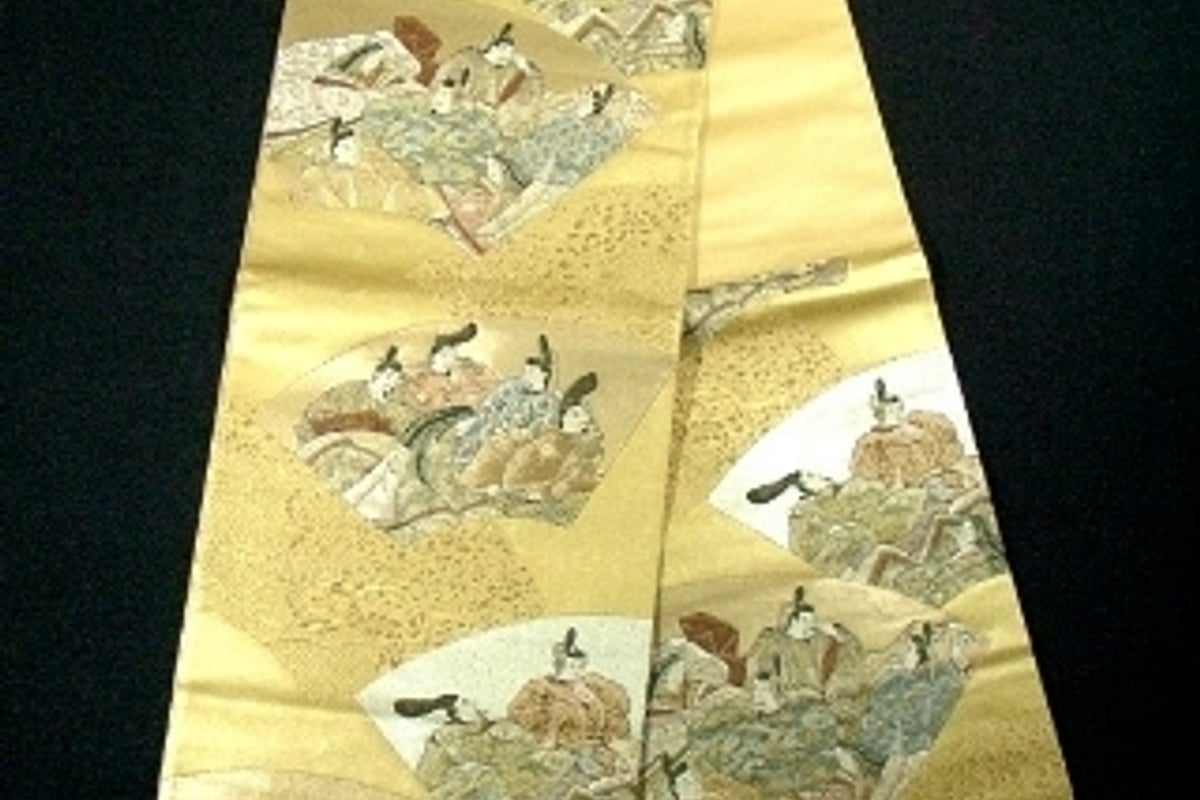
Nishijin-ori is the general term for high-grade, yarn-dyed silk textiles produced mainly in the Nishijin district of northern Kyoto City. It is a "mon-orimono" patterned weave in which the thread is dyed before being woven into designs, and 12 techniques designated as national Traditional Crafts have been passed down, including tsumekaki-hon-tsuzureori, tateshiki, nukishiki, donsu, shuchin, and shoha. Its origins are said to trace back to weaving techniques brought from the continent around the 5th to 6th centuries, and it developed in the Heian period under the court's Oribe no Tsukasa weaving bureau. It is said to take its name "Nishijin" ("western encampment") from the fact that weavers who had fled during the Onin War later resumed weaving on the site of the Western Army's former encampment. In the Edo period it established a reputation as a luxury textile favored by feudal lords and wealthy merchants, and it continues today to support Japanese kimono culture, mainly through obi sashes. A major characteristic is that many specialized artisans are involved through a division of labor, from design creation to dyeing and weaving, maintaining a system of producing many varieties in small quantities.
Oitama Tsumugi
Oitama Tsumugi
Oitama Tsumugi is the collective name for tsumugi silk textiles woven in the Oitama region of southern Yamagata Prefecture (Yonezawa City, Nagai City, and Shirataka Town in Nishiokitama District). It traces its origins to Uesugi Yozan, lord of the Yonezawa domain, who encouraged the weaving industry as part of a policy to promote local industry and rebuild the domain's finances. From this beginning, three production areas -- Yonezawa Tsumugi, Nagai Tsumugi, and Shirataka Tsumugi -- each developed their own distinctive techniques. Yonezawa Tsumugi is known for the beauty of its dyeing with safflower (benibana) and other plant dyes; Nagai Tsumugi for the intricate patterns of its weft ikat and combined warp-and-weft ikat weaves; and Shirataka Tsumugi for the delicate small ikat patterns created by 'itajime-gasuri' (board-clamp ikat dyeing), a technique passed down only among weavers in Shirataka Town nationwide. In 1976 (Showa 51), the tsumugi of these three production areas were jointly designated a Traditional Craft Designated by the Minister of Economy, Trade and Industry under the unified name 'Oitama Tsumugi.' Its rustic, warm texture and the handcrafted beauty of its ikat patterns continue to attract many kimono enthusiasts.
Ojiya Chijimi (ramie crepe)
Ojiya Chijimi
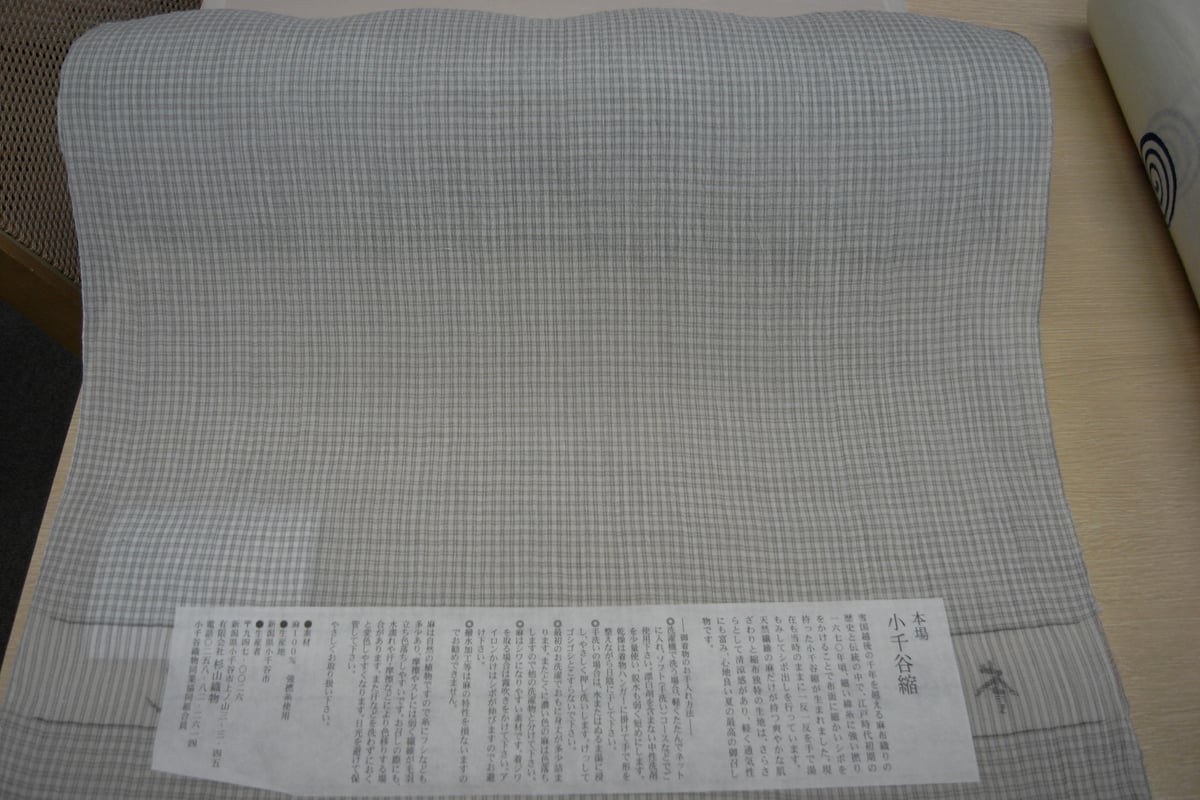
Ojiya Chijimi is a bast-fiber textile made from ramie (choma), woven mainly in Ojiya City, Niigata Prefecture. Choma is a plant also known as ramie, and its fibers are long, with firmness and body. The weft is given a hard twist before weaving, and the cloth is finished with yumomi (kneading in hot water), which brings out fine wrinkles on the surface of the fabric called shibo (fine crinkles). Thanks to this shibo, the cloth does not cling to the skin, and it has long been cherished as a summer kimono fabric with excellent breathability and moisture absorption. It is said to have begun in the early Edo period, when Hori Jiro Masatoshi (Akashi Jiro), who is said to have come from Akashi in Harima Province (Banshu), made improvements to the bast-fiber cloth of Echigo. On clear days from February to March, the woven bolts of cloth are spread out on snowfields for snow bleaching (yuki-zarashi), a seasonal sight in Ojiya. It was designated an Important Intangible Cultural Property in 1955 and a Traditional Craft Designated by the Minister of Economy, Trade and Industry in 1975. In 2009, it was inscribed on the UNESCO Intangible Cultural Heritage list together with Echigo Jofu.
Shinshu Tsumugi (Pongee Silk)
Shinshu Tsumugi
Shinshu Tsumugi is the collective name for the silk fabrics woven in many parts of Nagano Prefecture. It brings together the tsumugi (pongee silk) that developed in each area, such as Ueda Tsumugi, Matsumoto Tsumugi, Iida Tsumugi and Ina Tsumugi, as well as Ariake Tsumugi (Azumino Tsumugi) and Yamamayu Tsumugi, which use tensan (wild silkworm) thread. Since ancient times, sericulture flourished so much in Shinshu that it was called 'the land of silkworms.' Shinshu Tsumugi is said to have begun in the early Edo period, when each domain encouraged sericulture and farmers began, as a side job, to turn cocoons unsuitable for raw silk into silk floss, spin it and weave it. The thread is dyed with plant dyes before weaving, and the fabric is woven by hand, with the weft beaten in using a tenagehi (hand-thrown shuttle), to produce stripes, checks, kasuri (ikat) and solid-toned designs. The main products are kimono fabric, obi and haori, and in recent years Western clothing, bags and stoles are also made. In 1975 it became a Traditional Craft Designated by the Minister of Economy, Trade and Industry. At workshops in Ueda City and Komagane City, visitors can try hand weaving on a loom.
Chichibu Meisen
Chichibu Meisen
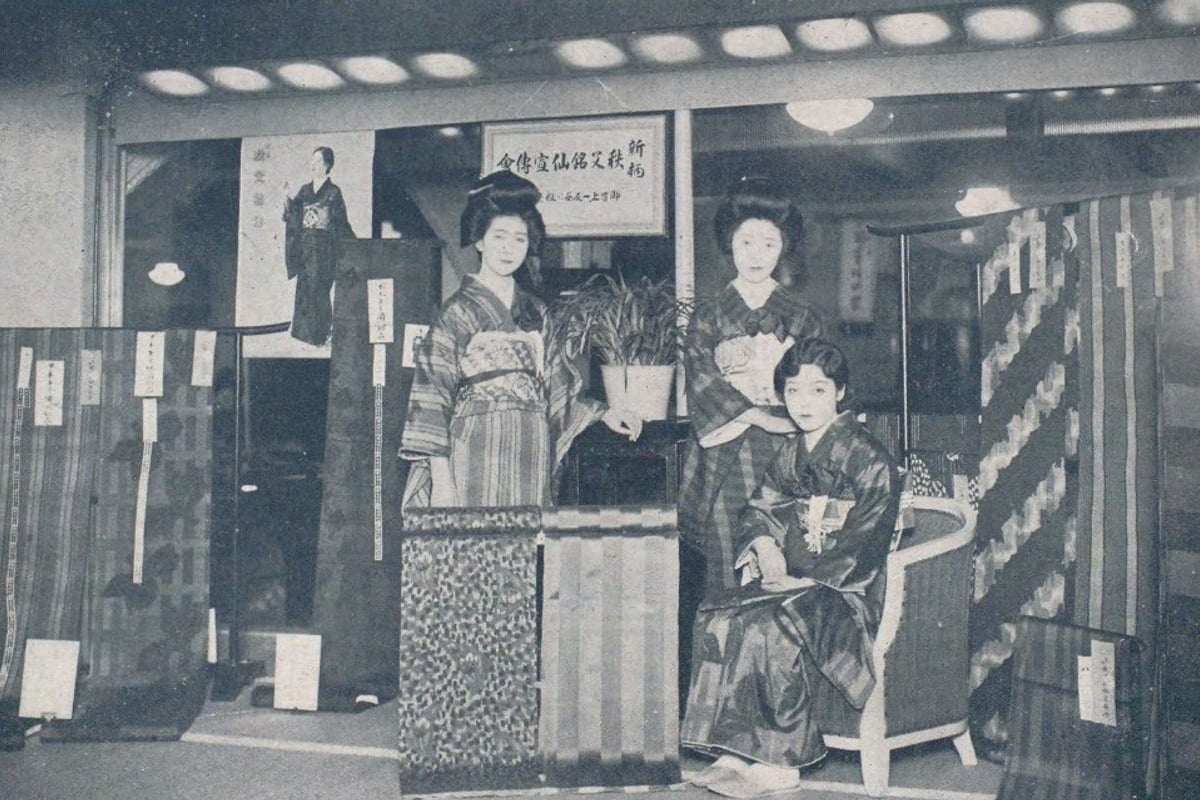
Chichibu Meisen is a plain-weave silk fabric produced mainly in Chichibu City, Saitama Prefecture, designated a Traditional Craft Product by the Minister of Economy, Trade and Industry (METI) in 2013. Tradition holds that it began in the reign of Emperor Sujin, when Chichibuhikonomikoto taught the local people the arts of sericulture and weaving. It was originally a sturdy work garment called 'futoori,' made from cocoons that did not meet standard grades, and was so durable it earned the nickname 'Oni Chichibu' ('Demon Chichibu'). The turning point came in 1908, when Sakamoto Sotaro devised the distinctive 'hogushi-nassen' technique: the warp threads are loosely pre-woven into a sheet, stencil-dyed, and then woven with the weft, so that the pattern of the warp and the color of the weft overlap to create patterns with a sense of depth. Because the dye penetrates without a clear front and back, the fabric can be used on either side — a feature that helped it become a nationally popular, fashionable, modern garment during the Taisho and Showa eras. Today, weaving houses in Chichibu City continue to pass on this technique.
Hakata-ori
Hakata Ori
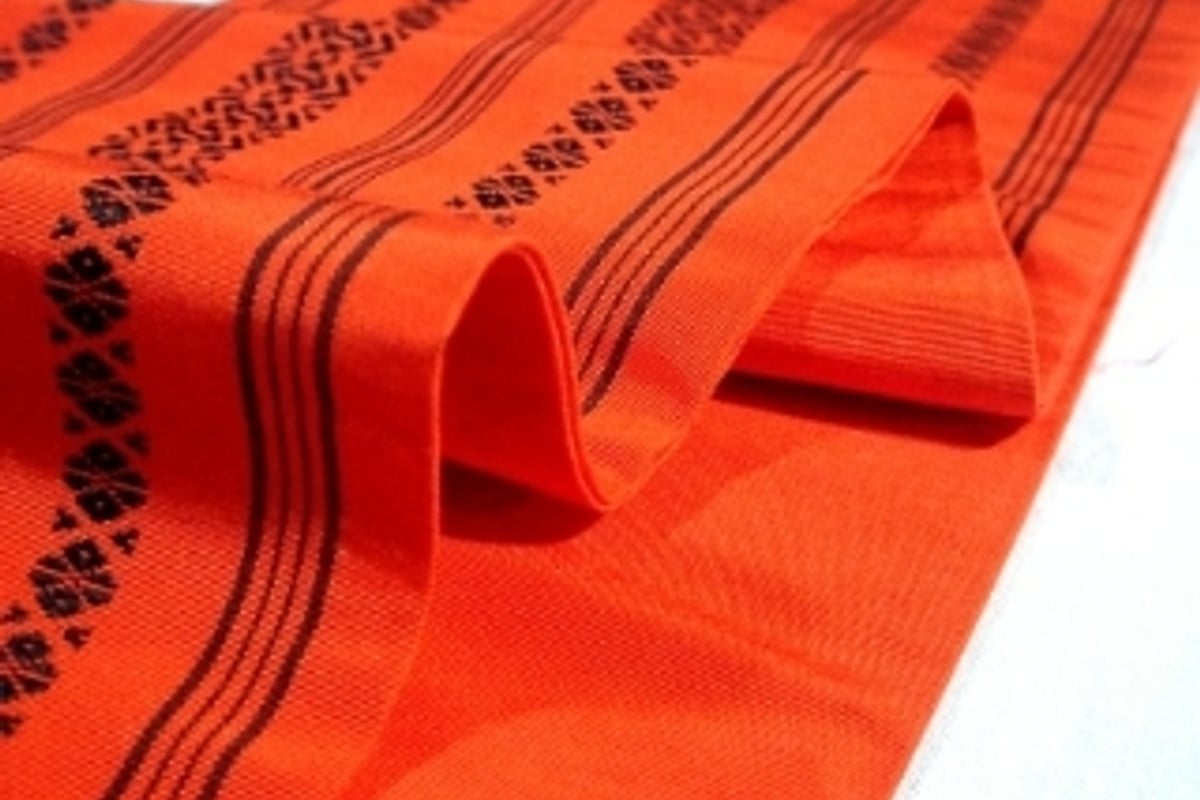
Hakata-ori is a silk textile woven in the Hakata district of Fukuoka City and is a Traditional Craft Designated by the Minister of Economy, Trade and Industry. Its origins are said to date back to 1241, when the Hakata merchant Mitta Yazaemon traveled to Song-dynasty China together with the Zen monk Enni (Shoichi Kokushi) and brought back weaving techniques. In 1600, at the start of the Edo period, Kuroda Nagamasa, who ruled Chikuzen, chose Hakata-ori as a tribute to the shogunate, beginning the annual custom of presenting obi fabric—giving rise to the name 'Kenjo Hakata-ori' ('tribute Hakata-ori'). Its representative design, the kenjo pattern, combines a motif based on the dokko and hanazara (Buddhist ritual implements) with 'oyako-jima' stripes symbolizing a parent protecting a child and 'koko-jima' stripes symbolizing a child's devotion to a parent. A distinctive weaving method—densely arranging warp threads and beating the weft in firmly—produces fabric with thickness and firmness, and the resulting obi have long been prized for staying tightly tied once fastened. Designated a national Traditional Craft in 1976, Hakata-ori has produced two Living National Treasures to date.
Isezaki-gasuri (Isezaki kasuri)
Isezaki-gasuri
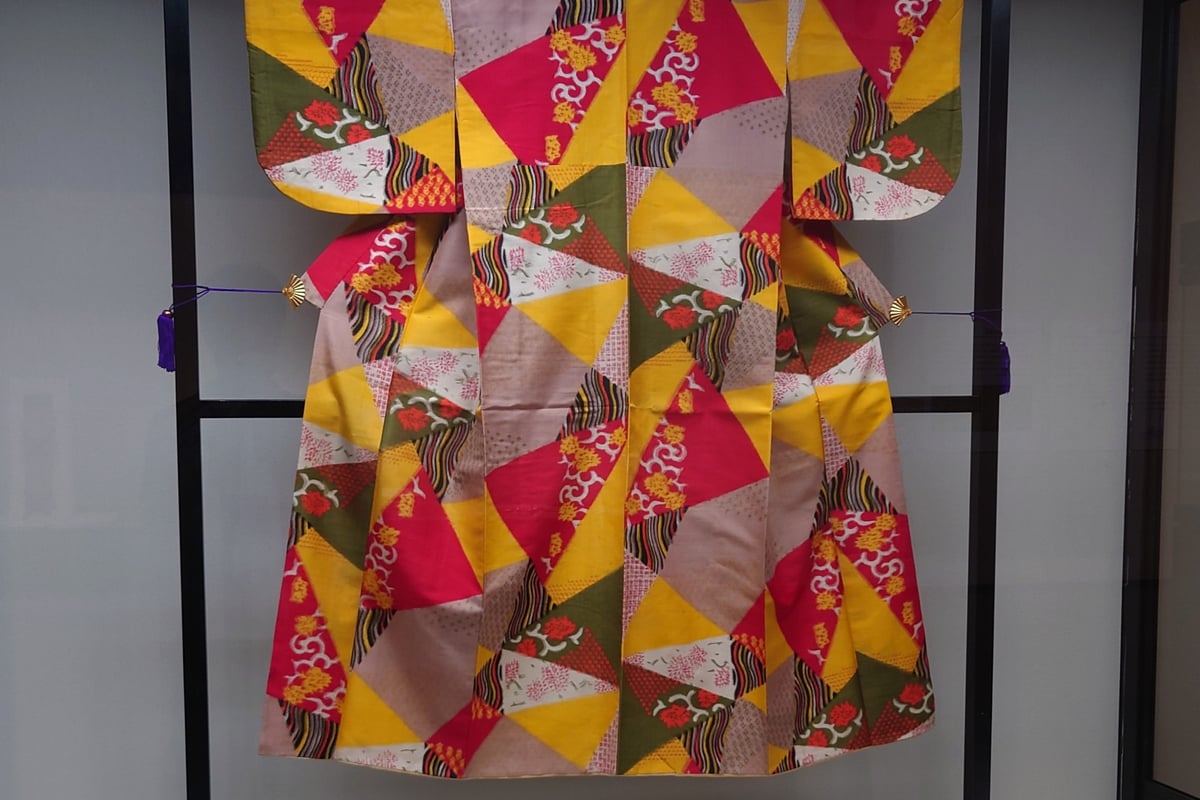
Isezaki-gasuri is a silk textile produced in and around Isesaki, Gunma Prefecture, and a METI-designated Traditional Craft (Japan). The history of the production area is said to go back as far as the Kofun period, based on excavated hemp textiles, and commercial production began in earnest in the late Edo period. In 1880, the Isesaki Futori Company was established, improving both quality and output, and from the Taisho era into the early Showa era the area enjoyed a golden age in which production of the patterned meisen textile known as 'Isesaki meisen' accounted for roughly half of the nation's total. The region excels in ikat (kasuri) techniques using thread dyed in sections by hand-binding or itajime (board-clamp) methods, and in particular Combined kasuri, which uses ikat-dyed thread in both the warp and weft to weave intricate patterns, is considered a technique that developed only in Isesaki. It was designated a Traditional Craft in 1975, and the techniques continue to be passed down today, centered on the Isesaki Textile Cooperative and the Isesaki Textile Industry Association.
Omi-jofu (Omi Ramie/Hemp Textile)
Omi-jofu
Omi-jofu is a hemp textile woven mainly in the Koto region on the eastern shore of Lake Biwa, in what are now Aisho Town and Higashiomi City. It was designated a Traditional Craft by the Minister of Economy, Trade and Industry in 1977. The production area is said to date back to hemp weaving traditions from the Muromachi period, and in the Edo period it was distributed nationwide by Omi merchants as a luxury hemp fabric called 'Takamiya cloth,' ranked alongside Nara-zarashi and Echigo-chijimi. There are two main lines: kibira, woven using hand-spun hemp or ramie weft threads, and kasuri, woven to create ikat patterns. Both have long been prized as luxury fabrics for kimono worn in the height of summer. Thanks to hemp's characteristic crisp, cool touch and breathability, the fabric was also widely used in the modern era for mosquito netting, supporting the everyday life of the Omi region. Today the craft is carried on by a small number of certified master artisans, centered on the Omi-jofu Traditional Industry Hall in Aisho Town.
Shiozawa Tsumugi (silk pongee)
Shiozawa Tsumugi
Shiozawa Tsumugi is a yarn-dyed (dyed before weaving) silk textile woven mainly in the Shiozawa district of Minamiuonuma City, Niigata Prefecture. Yarn-dyeing is a method in which the thread is dyed first and then woven into cloth. Bast-fiber textiles have been woven in the Shiozawa area since ancient times, and bast-fiber cloth woven here during the Tenpyo era of the Nara period survives in the Shosoin Repository. Shiozawa Tsumugi is said to have been born around the Meiwa era (1764–1771) in the mid-Edo period by bringing the techniques of this bast-fiber textile, namely Echigo Jofu, to silk. Raw silk or tamaito is used for the warp and thread hand-spun from silk floss (mawata) for the weft, and kasuri (ikat) threads dyed by hand-binding or hand-rubbing (te-surikomi) are aligned one by one as the cloth is woven. Extremely fine kasuri called kagasuri (mosquito kasuri) and the delicate patterns of cross (juji) kasuri and tortoiseshell (kikko) kasuri create an elegant, understated character. It became a Traditional Craft Designated by the Minister of Economy, Trade and Industry in February 1975. The same Shiozawa production area is also home to Hon-Shiozawa, long known by the name 'Shiozawa Omeshi,' which was designated as a separate Traditional Craft in December 1976.
Iga Kumihimo (Iga Braided Cords)
Iga Kumihimo (Iga Braided Cords)
Iga Kumihimo is kumihimo (braided cord) made mainly in Iga City, Mie Prefecture. Kumihimo are cords made by crossing many threads diagonally and braiding them together, and they are characterized by being more elastic than woven fabrics. Mainly silk thread is used, along with gold and silver thread, and the cords are braided on braiding stands such as the marudai, the square stand (角台), the 綾竹台 and the takadai. The origins of braided cords in Iga are said to go back to before the Nara period, and in early times they were made as cords for Buddhist ritual implements and for arms and armor. It developed greatly as a regional industry only after 廣澤徳三郎 brought back the techniques of Edo kumihimo in Meiji 35 (1902). Since then, Iga has become a major production center of obijime (kimono sash cords) and haori-himo (haori jacket ties), accounting for most of Japan's hand-braided kumihimo. In 1976 (Showa 51), it was designated a Traditional Craft Designated by the Minister of Economy, Trade and Industry. Today, production with braiding machines has also advanced, and products other than kimono accessories, such as key chains and accessories, are also made.
Tokamachi Gasuri (silk kasuri)
Tokamachi Gasuri
Tokamachi Gasuri is a yarn-dyed (dyed before weaving) silk textile woven in Tokamachi City and Tsunan Town, Niigata Prefecture. Yarn-dyeing is a method in which the thread is dyed first and then woven into cloth. It inherited the techniques of traditional Echigo Chijimi (a bast-fiber textile) and was born in the mid-19th century when these techniques were applied to silk weaving. The weaver proceeds while aligning the patterns of warp and weft threads that have been partially dyed in advance, creating delicate designs that freely combine warp kasuri (ikat) and weft kasuri. Its appeal lies in the distinctive luster of silk and a calm, understated texture, and it is worn widely, from everyday kimono to stylish outing wear. Tokamachi has long been a weaving town and was known in the Edo period as a production area for Echigo Chijimi. From the Meiji period onward, it built its foundation as a silk textile production area with summer fabrics such as Tokamachi Akashi Chijimi, and from the Showa 30s (1955–1964) it also expanded into dyeing, represented by Tokamachi Yuzen. Today it is one of Japan's leading comprehensive kimono production areas, with techniques for both yarn-dyeing and piece-dyeing (dyeing after weaving), and Tokamachi Gasuri became a Traditional Craft Designated by the Minister of Economy, Trade and Industry in November 1982.
Choshi Chijimi
Choshi Chijimi
Choshi Chijimi is a crimped cotton fabric (chijimi) woven in Choshi City, Chiba Prefecture. It is said to have originated when fishermen's wives began weaving it while praying for their husbands' safe voyages and a bountiful catch, and it has long been cherished as a summer kimono fabric prized for its distinctive texture. Its defining feature is the fine crinkled surface called 'shibo,' which is created by tightly twisting the weft threads, fixing the twist with starch, weaving the cloth on a loom, and then washing out the starch. The craft is said to date back to the Edo period, but production was interrupted in the late Taishō era, to the point that it came to be called a 'phantom textile.' It was later revived through the efforts of Tsuneyoda Shinjirō, who ran a cotton-processing business in Choshi, and in 1954 Choshi Chijimi was designated an Intangible Cultural Property of Chiba Prefecture, followed by its designation as a Chiba Prefecture-designated Traditional Craft in 1984. Today, third-generation weaver Tsuneyoda Shin'ichirō carries on the technique, exhibiting and selling products and offering indigo-dyeing experiences at the Choshi Chijimi Traditional Crafts Hall.
Saga-nishiki (Saga brocade)
Saga-nishiki
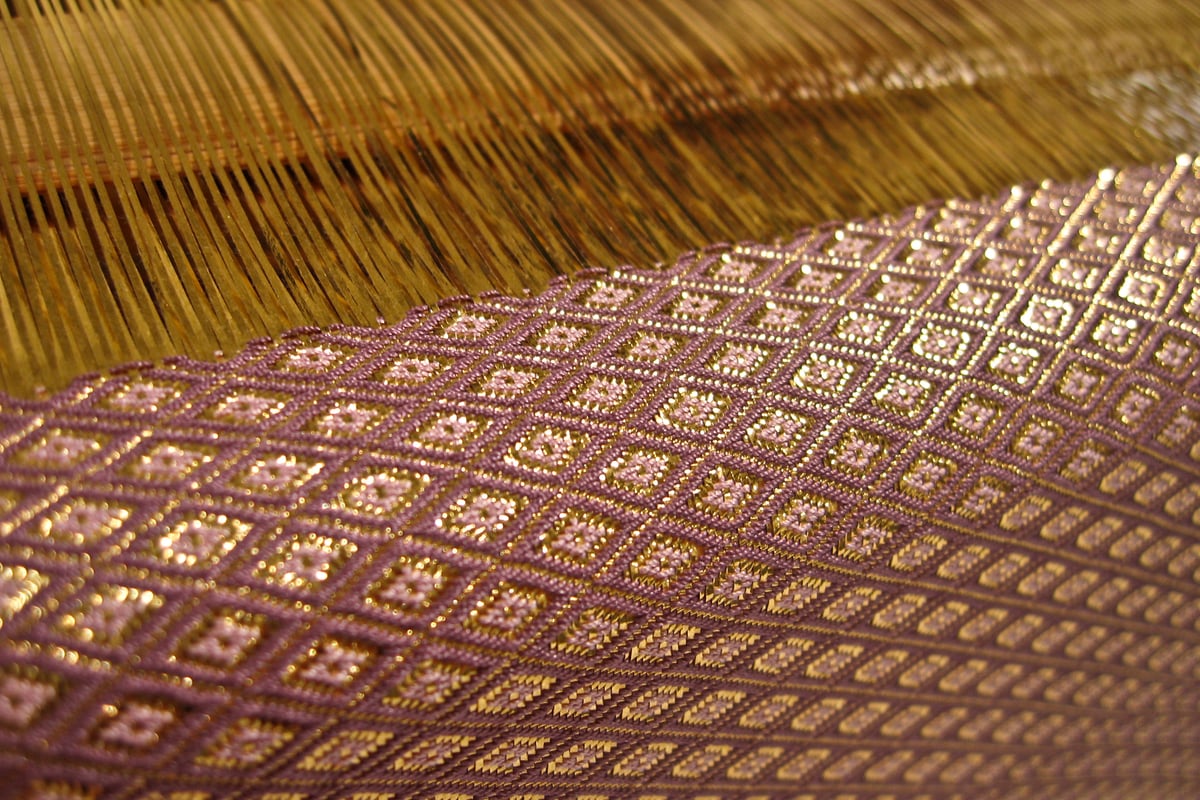
Saga-nishiki is a hand-woven silk textile in which the warp is made of 'foil thread'—gold and silver leaf glued onto washi paper with lacquer and cut into fine strips—while the weft is silk thread. It is said to originate in the Bunsei era (1818-1830) of the late Edo period, when Lady Kashiwaoka, wife of the 9th lord of the Kashima-Nabeshima family of Hizen Kashima Domain, was inspired by the beauty of the ajiro lattice pattern on the ceiling above her sickbed. Lady Yanagioka, wife of the 11th lord, and Kuzuko, wife of the 13th lord, developed it further as a pastime craft woven with paper and cotton threads, and it was later refined into a luxury textile using gold and silver foil thread together with silk. For a long time it was known by names such as 'okumimono,' 'kumi-nishiki,' and 'Kashima-nishiki,' but after it was exhibited to great acclaim at the 1910 Japan-British Exhibition in London, it came to be known uniformly as 'Saga-nishiki,' a name that identifies its place of origin. Its defining feature is the shimmer of gold and silver woven into intricate geometric patterns, used for obi sashes and small accessories.
Uetsu Shinafu (bark-fiber cloth)
Uetsu Shinafu
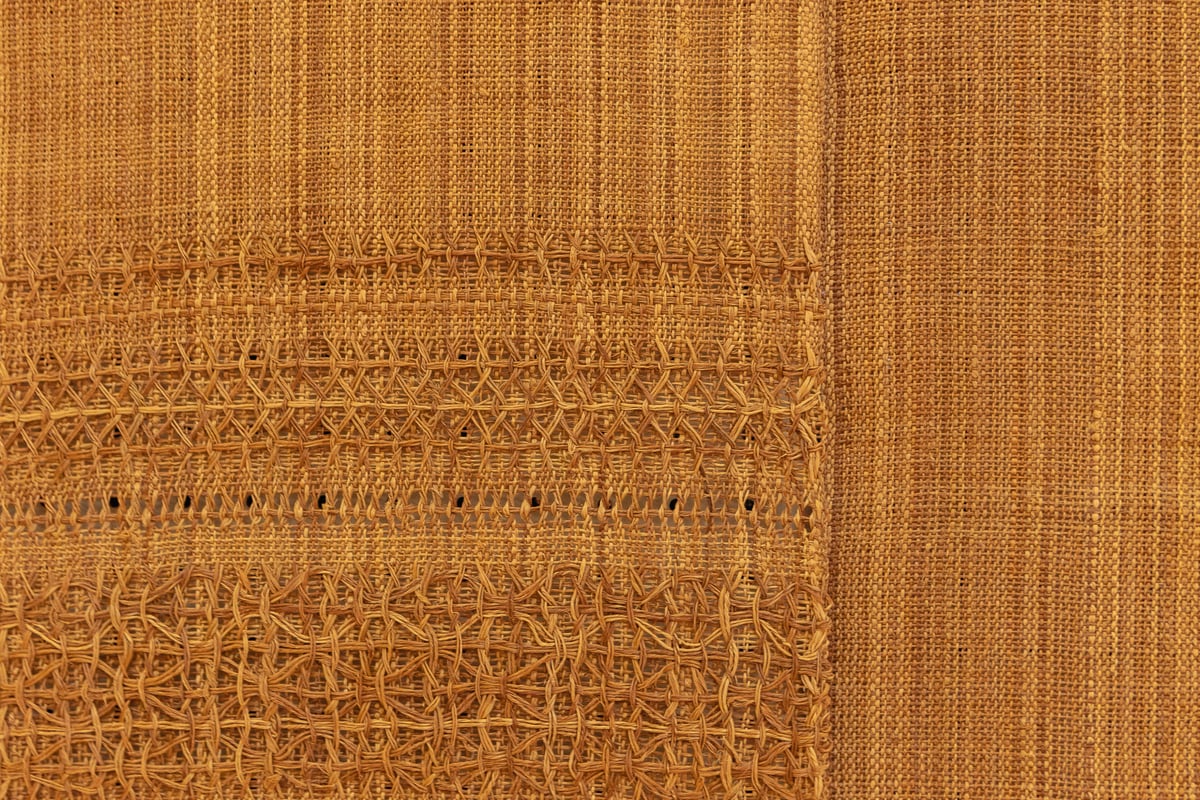
Uetsu Shinafu is a cloth handed down in the Sekigawa district of Tsuruoka City, Yamagata Prefecture, and the Yamakumada and Kaminari districts of Murakami City, Niigata Prefecture, made by spinning thread from the bark fibers of trees such as the Japanese linden and the giant-leaved linden and weaving it into cloth. As a textile made from tree bark, it is considered the oldest of its kind in Japan, and as one of the 'primitive cloths' said to date back to the Jomon period, it is counted among Japan's three great ancient cloths, alongside Okinawa's bashofu (banana-fiber cloth) and Shizuoka's kuzufu (kudzu-fiber cloth). Every step, from thread-making to weaving, is done entirely by hand, and the cloth takes about a year to complete through roughly 22 processes. It is durable and water-resistant, and grows more supple in texture the more it is used. It was once used for work clothes, rice sacks, and fishing nets, but today it lives on in the form of hats, bags, obi sashes, and other items. In 2005, the shina cloth of the three production areas spanning Yamagata and Niigata was designated a Traditional Craft Designated by the Minister of Economy, Trade and Industry under the name 'Uetsu Shinafu.'
Gyoda Tabi
Gyoda Tabi
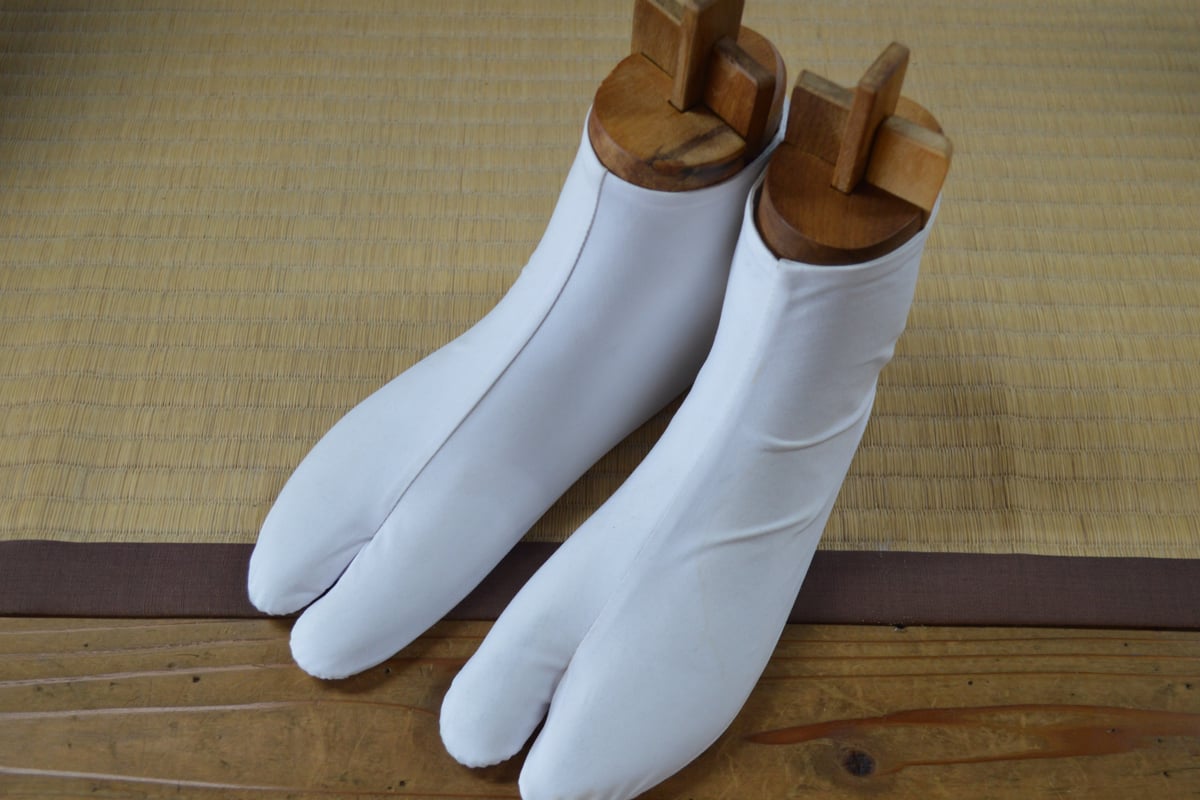
Gyoda Tabi is the traditional technique of tabi (split-toe sock) making handed down in Gyoda City, Saitama Prefecture, and is a Traditional Craft Product designated by the Minister of Economy, Trade and Industry (METI). Lying between the Tonegawa and Arakawa rivers, Gyoda has sandy alluvial soil, abundant water, and a hot, humid summer climate well suited to growing cotton and indigo, and in the Edo period it became a major production center for the indigo-dyed cotton cloth known as 'aojima.' Building on this cotton cloth and its sewing techniques, tabi making is said to have begun around the Jokyo-Kyoho era (late 17th to early 18th century), and by the Tenpo era the town had grown to house 27 tabi shops side by side. When sewing machines were introduced in the Meiji era, production expanded dramatically, and by 1938 Gyoda accounted for 80% of the nation's tabi output, making it Japan's leading tabi-producing area. Numerous 'tabi-gura' storehouses built of earthen walls and brick, which convey the prosperity of that era, still remain throughout the city, and in 2017 the city was certified as a Japan Heritage site under the title 'Tabi-gura Town of Gyoda, Supporting the Feet of Japanese Kimono Culture.' A collection of 5,484 related items has also been designated a Nationally Designated Important Tangible Folk Cultural Property, and local makers continue to produce a wide range of tabi today, from those for kimono wear to festival and running tabi.
Koshu Oishi Tsumugi (Pongee Silk)
Koshu Oishi Tsumugi
Koshu Oishi Tsumugi is a hand-woven silk fabric that has long been woven in the Oishi district of Fujikawaguchiko Town, Yamanashi Prefecture, and its official name in the prefectural designation is 'Koshu Oishi Tsumugi Orimono.' In this area on the northern shore of Lake Kawaguchi, everything from sericulture to thread making and weaving has been done by hand in one continuous process. The warp uses thread from honmayu (single cocoons), each spun by one silkworm, and the weft uses thread from tamamayu (double cocoons), spun jointly by two silkworms. The thread is drawn out of the cocoons by hand with a tool called a zaguri. The fabric is characterized by a texture that is strong, light and soft, with the smoothness unique to silk. For textiles of the Gunnai region, there is a record of silk being presented to the imperial court in 915. In the late Edo period, the fabric was sold widely by members of the Fuji-ko (Mt. Fuji worship groups) and by peddlers. In 1994 it was designated a Yamanashi Prefecture Designated Local Traditional Craft. At the Oishi Tsumugi Traditional Craft Museum, visitors can watch weaving and try hand weaving.
Kurume Kasuri (Kurume ikat cotton weave)
Kurume Kasuri
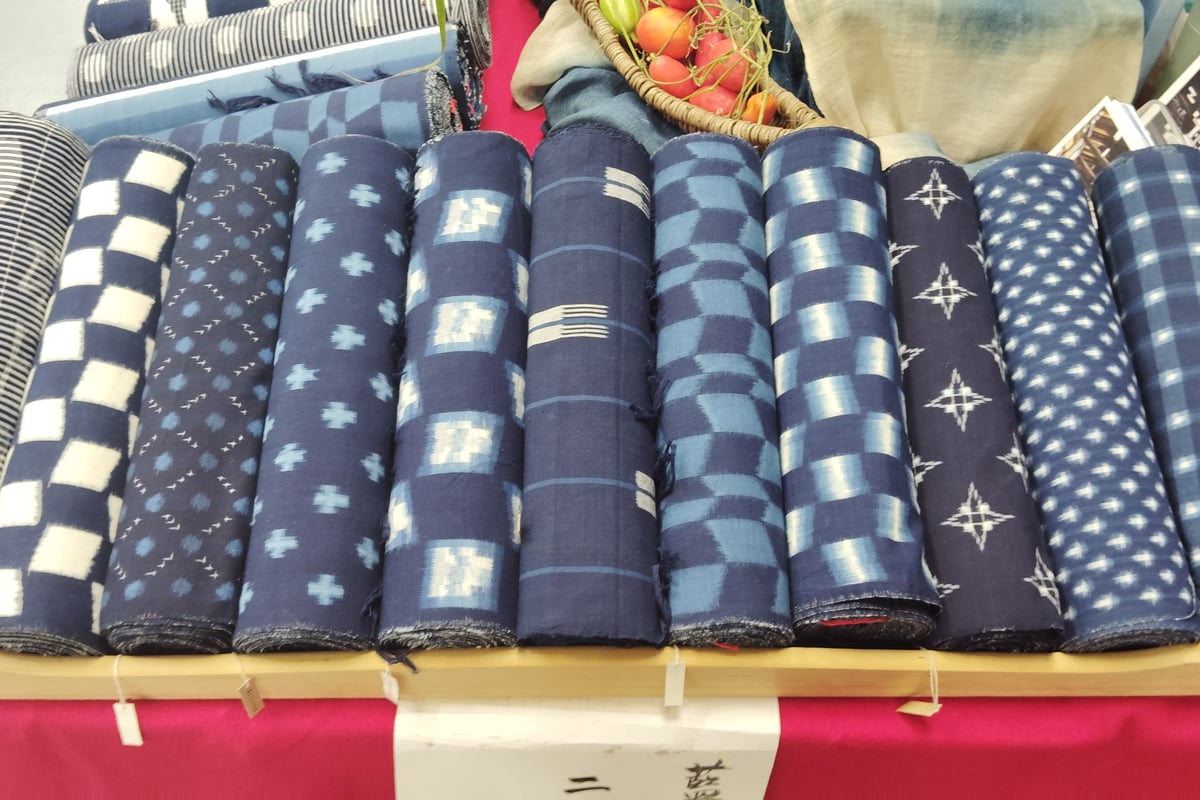
Kurume Kasuri is an indigo-dyed cotton ikat cloth woven in the area of the former Kurume domain, centered on present-day Kurume City in Fukuoka Prefecture, and is one of Japan's three major ikat weaves alongside Iyo Kasuri and Bingo Kasuri. It is said to have been created by a woman named Inoue Den in the late Edo period. At the age of 13, she noticed white speckles on the faded parts of a worn indigo-dyed kimono and devised a technique of binding threads beforehand to dye them selectively, producing an ikat pattern of mottled navy and white threads that came to be called 'Kasuri.' From binding the threads to resist the dye and dyeing them in indigo ('kukuri'), to untying the dyed threads and weaving them while matching the pattern, the cloth still passes through around 30 processes even today, when mechanization has advanced, and takes several months to complete. It is known for its rustic, warm texture with softly blurred outlines. It was designated an Important Intangible Cultural Property in 1957 and a national Traditional Craft in 1976.
Nabeshima Dantsu (Nabeshima carpet)
Nabeshima Dantsu
Nabeshima Dantsu is Japan's oldest cotton dantsu (hand-woven rug), originating in Ōgimachi village, Kase district, on the outskirts of the Saga castle town. It is said to have begun during the Genroku era of the Edo period (1688-1704), when a farmer named Koga Seiemon learned the art of dantsu weaving from a Chinese craftsman in Nagasaki and wove the first pieces as 'Ōgimachi mosen.' Although the technique is believed to have traveled from Central Asia through Turkey and China before reaching Japan, Nabeshima Dantsu differs from overseas dantsu, which typically use wool, in that it uses high-quality cotton—such as that produced in Shiroishi, Saga Prefecture—for both the warp and the weft. When Nabeshima Tsunashige, the third lord of Saga Domain, took a liking to its reputation, he granted the weaver a stipend of rice and placed it under the domain's protection, making it an official product of the domain; sale to the general public was forbidden for a long time as a result. General sale began in the Meiji era, and it was even exhibited at the 1873 Vienna World's Fair. Today it is still handed down as a precious craft, woven piece by piece with care by artisans using hand looms that remain unchanged for centuries.
Okuaizu Showa Karamushi-ori (Karamushi Ramie Weaving)
Okuaizu Showa Karamushi-ori
Okuaizu Showa Karamushi-ori is a traditional textile woven in Showa Village, Onuma District, Fukushima Prefecture, using thread spun from the fibers of karamushi (ramie), and it is a Traditional Craft Designated by the Minister of Economy, Trade and Industry. Karamushi cultivation in Showa Village is said to date back to the Muromachi period, and tradition holds that it was encouraged as an industry under the Aizu domain lord Gamō Ujisato. A document known as the 'Aoso-hatake Shomon' (blue-ramie field deed) dating to 1756 in the Edo period survives today, attesting to nearly 600 years of continuous cultivation. Karamushi is a plant fiber prized for its excellent moisture absorption and quick-drying properties, and it is also known as a raw material for premium textiles such as Ojiya-chijimi and Echigo-jofu. In Showa Village, every step from harvesting to fiber extraction, thread spinning, and weaving is still done by hand today, and since 1994 the village has run the 'Karamushi Weaving Trainee (Orihime/Hikoboshi)' program, inviting young people from outside the village to help pass the techniques on to the next generation. At the Michi-no-Eki Karamushi-ori no Sato Showa roadside station, visitors can learn about the process from cultivation to weaving at the Karamushi Craft Museum and try their hand at weaving.
Shuri-ori
Shuri-ori
Shuri-ori is a general term for the textiles developed in Shuri, the town that flourished as the castle town of the Ryukyu Kingdom, and it comprises five techniques: hana-ori, doton-ori, tejima, hanakura-ori, and ayanunaka. Around the 14th-15th centuries, weaving techniques were cultivated through active trade with China and Southeast Asia, and in Shuri, seat of the Ryukyu royal government, weavers produced textiles of the highest refinement in both color and pattern, worn as formal attire by the royal family and the shizoku (samurai-class gentry) and presented as tribute to investiture envoys from China. Among these, hanakura-ori and doton-ori were reserved exclusively for the royal family and nobility, developing as techniques that only Shuri was permitted to weave, unlike anywhere else. The main material is silk thread, supplemented with cotton, hemp, and basho (banana fiber) thread, dyed with plant dyes such as Ryukyu indigo and fukugi (Garcinia subelliptica). Shuri-ori became a Traditional Craft designated by the Minister of Economy, Trade and Industry in 1983, and the techniques continue to be passed down today, centered on the Naha Traditional Textile Industry Cooperative.
Tateyama Tozan
Tateyama Tozan
Tateyama Tozan is a cotton textile in which fine cotton threads are dyed with plant dyes such as indigo and yamamomo (Japanese bayberry) bark and woven into stylish striped patterns. It traces its roots to a striped fabric called 'tōzandome,' brought from India in the Momoyama period, which was beloved by ordinary townspeople in the Edo period as a fashionable kimono fabric. Production in Tateyama began in the early Meiji era, when the first-generation Saitō Mosuke learned the technique from Kawagoe Tozan artisans at a vocational training center in Tokyo and, in 1890, moved to Tateyama to set up his own workshop. Since then the technique has been passed down solely within the Saitō family, from one generation to the next, making it a rare traditional textile nationwide with no other line of successors. Extremely fine 40- to 80-count cotton threads are dyed by artisans who check the dye concentration by tasting it on the tongue, then carefully plain-woven on a high-warp loom (takabata), before a final process of pounding the cloth with a wooden mallet, called 'kinuta-uchi,' gives the fabric its distinctive sheen and supple feel. Today, fourth-generation weaver Saitō Yūji alone carries on the entire process at his workshop in Nagasuka, Tateyama City.
Gunnai Textiles (Kaiki Silk)
Gunnai Textiles (Kaiki Silk)
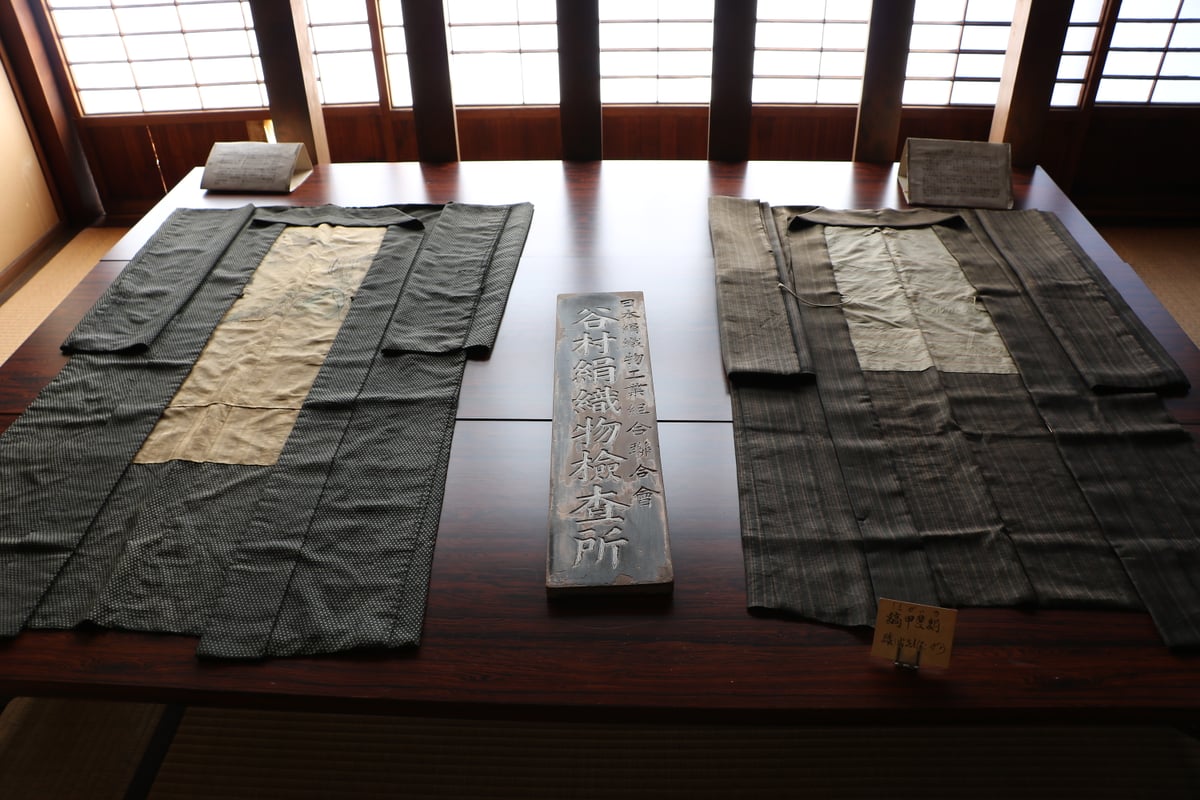
Gunnai Textiles are yarn-dyed (sakizome) fabrics that have been woven in the Gunnai region of eastern Yamanashi Prefecture, centered on Fujiyoshida City and Nishikatsura Town at the foot of Mt. Fuji. The Engishiki, a Heian-period collection of laws and regulations, lists Kai Province as a province that paid taxes in cloth, and the area is regarded as a textile-producing region with a history of more than 1,000 years. In the Edo period, silk fabrics such as Gunnai-jima (Gunnai stripes) were so well known that they appeared in the ukiyo-zoshi novels of Ihara Saikaku. Kaiki silk, which traces its roots to a fabric called 'kaiki' (海気) brought to Japan through the Nanban trade, was woven extensively from the Edo period to the early Showa period as a luxury silk used for the linings of haori jackets. Kaiki silk itself disappeared in the 1940s, but its techniques of 'yarn dyeing, fine-count yarns and high density' are still carried on today. The area now produces umbrella fabrics, necktie fabrics, apparel fabrics and interior textiles, and its fabrics are used for 40 percent of Japan's domestically made necktie fabric. Fujiyoshida, where many weaving mills (hataya) are gathered, is also called Hataori-machi (Weaving Town).
Ushikubi Tsumugi Silk
Ushikubi-tsumugi
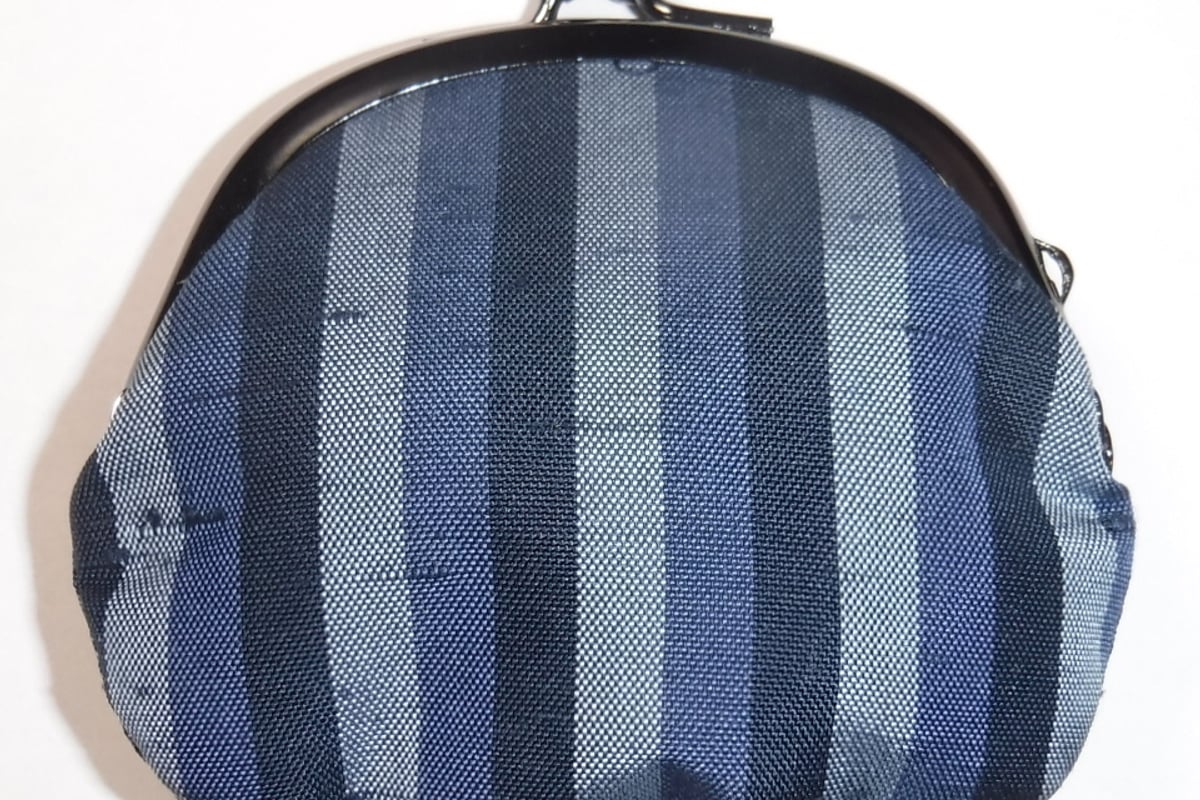
Ushikubi Tsumugi is a silk fabric that has been woven for about 800 years in Shiramine (the former village of Ushikubi), at the foot of the sacred Mount Hakusan in Hakusan City, Ishikawa Prefecture. Its greatest characteristic is the use of 'tamamayu,' double cocoons spun jointly by two silkworms, as raw material; the thread is drawn out by hand from cocoons boiled in hot water, a traditional reeling method called 'zaguri.' This tamaito thread contains irregular slubs yet is rich in elasticity and stretch, producing fabric with a distinctive supple sheen and durability. It is strong enough to resist tearing even when caught on a nail, earning it the nickname 'nail-puller tsumugi,' and its high practicality, able to withstand everyday use, has long been valued. In Shiramine, a heavy snowfall region with steep terrain and little farmland, sericulture became a valuable source of cash income from early times, and tsumugi weaving was carried on as women's handiwork. Today the tradition continues to be preserved, centered on weaving workshops in Shiramine.
Yomitanzan Hanaori
Yomitanzan Hanaori
Yomitanzan Hanaori is a patterned textile handed down in Yomitan Village, in central Okinawa Island, characterized by geometric floral motifs created by floating the warp and weft threads as they are woven. It is said to have originated when the float-weave technique, introduced from the continent during the 14th-15th centuries - the Great Trade Era when the Ryukyu Kingdom flourished through trade with China and Southeast Asia - developed uniquely in Yomitanzan (present-day Yomitan Village). The fabric was prized as tribute cloth presented to the Ryukyu royal government and as clothing for shizoku (samurai-class) families. The craft declined after the Meiji era and was nearly lost during the Battle of Okinawa in World War II, but in 1964 volunteers from Yomitan Village worked to revive it, drawing on the memories of elders and surviving old fabrics, and the technique was restored after a gap of roughly 90 years. Those who led the revival went on to form the Yomitanzan Hanaori Cooperative Association, which now trains successors and passes on the techniques. The patterns feature three basic motifs - jinbana (coin flower), ojibana (fan flower), and kajimayabana (windmill flower) - each embodying wishes for wealth, descendants' prosperity, and longevity. Designated a national Traditional Craft in 1976, the textile is used today in a wide range of products, from cotton and silk obi sashes and kimono cloth to minsa obi.
Kumejima Tsumugi
Kumejima Tsumugi
Kumejima Tsumugi is a silk textile from Kumejima Island, off the west coast of the Okinawan mainland, in which a single weaver handles every stage of the process by hand, from raising silkworms through dyeing to weaving. Sericulture is thought to have already been practiced on Kumejima by around the 15th century, and after the textile was designated a tribute cloth to the Ryukyu royal government in 1637, its intricate techniques were refined further. Japan's tsumugi kasuri weaving techniques are said to have spread from Kumejima to the Okinawan mainland and Amami Oshima and on to mainland Japan, and it is considered one of the origins of tsumugi textiles nationwide, including Oshima Tsumugi and Yuki Tsumugi. Its defining feature is that a single weaver carries out every stage from spinning the thread to choosing the pattern, dyeing, and weaving. After repeated dyeing with plant materials such as fukugi and gūru (sarsaparilla) and tekachi (Chinese hawthorn), the cloth is iron-mordanted through mud dyeing using the island's soil, producing a deep, subdued blackish-brown sheen. It was designated a national Traditional Craft in 1975 and a national Important Intangible Cultural Property in 2004. The Kumejima Tsumugi Cooperative leads the transmission of the technique, and the Kumejima Tsumugi no Sato Yuimaru Hall offers tours of the production process and weaving and dyeing experiences.
Matsusaka Momen (Matsusaka Cotton)
Matsusaka Momen (Matsusaka Cotton)
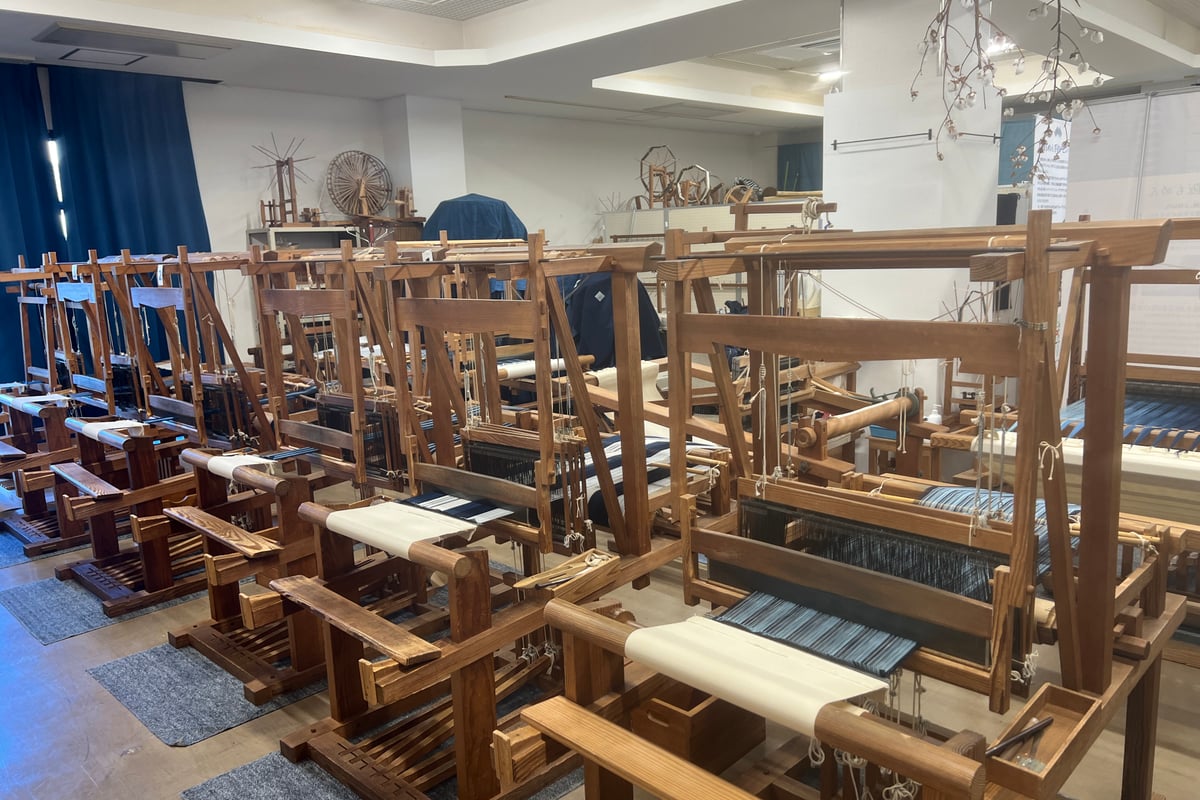
Matsusaka Momen is a cotton textile made in Matsusaka City and Meiwa Town, Mie Prefecture. It is characterized by being woven into fine stripes using yarn dyed beforehand with natural indigo. These stripes are also called 松阪縞 (Matsusaka stripes). The area around Matsusaka has long been known for spinning and weaving, and when cotton arrived around the 15th century, those skills were carried over into cotton weaving. In the Edo period it was woven extensively as a side job by farming households, and Matsusaka merchants such as the Mitsui, 長谷川 and 小津 families spread its sales in Edo. The pattern, which looks plain from a distance but reveals stripes up close, was prized as 'iki' (understated chic) in an era of sumptuary edicts. It is said that at its height, 500,000 to 600,000 tan (bolts) were sold in Edo in a single year. Today, 御絲織物 continues production by machine weaving, and the hand-weaving techniques are passed on by groups such as 松阪もめん手織り伝承グループゆうづる会. It is a Mie Prefecture Designated Traditional Craft.
Bashofu
Bashofu
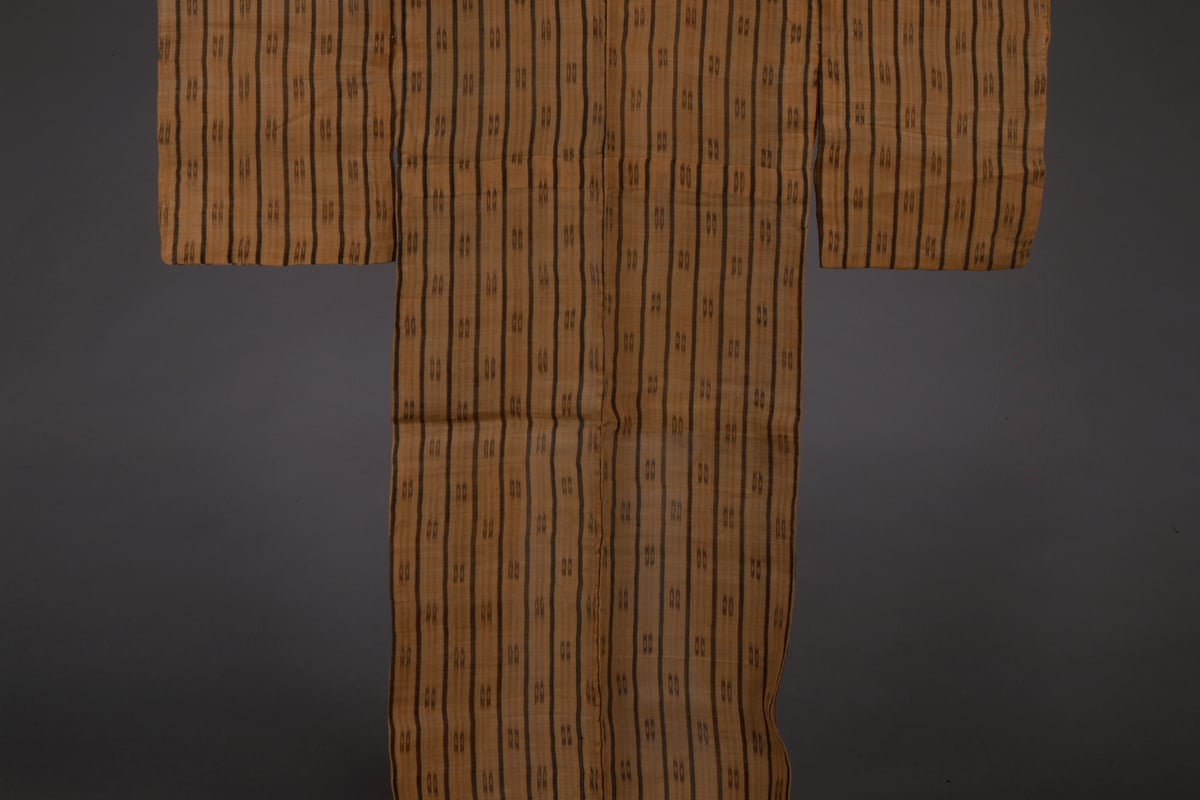
Bashofu is a representative summer textile of Okinawa, woven from thread made of fiber taken from the stalk of the ito basho (Japanese fiber banana) plant. Old records suggest it was already being woven by around the 13th century, and it is said that by around the 15th century a production method almost identical to today's had been established. During the Ryukyu Kingdom era, it was grown in banana gardens directly managed by the royal government, and as a cloth used everywhere from royal garments to the everyday clothing of commoners, it was the fabric most familiar to the people of Okinawa. Kijoka, in Ogimi Village, Kunigami District, has long been known as a leading production area for bashofu. Production suffered devastating damage in the Battle of Okinawa during World War II, but soon after the war, Taira Toshiko began working to revive the craft, reestablishing the technique in Kijoka. In 1974, it was designated a national Important Intangible Cultural Property as "Kijoka no Bashofu," and the Kijoka Bashofu Preservation Society, centered on Taira Toshiko, was certified as the holding organization. Its defining feature is a taut, cool texture achieved through a process spanning about three years, from growing the ito basho plant to spinning the thread, kasuri binding, dyeing, and weaving; Taira Toshiko herself was certified as a Living National Treasure (holder of an Important Intangible Cultural Property) in 2000.
Kakegawa Kuzufu (Kudzu Cloth)
Kakegawa Kuzufu (Kakegawa Kudzu Cloth)
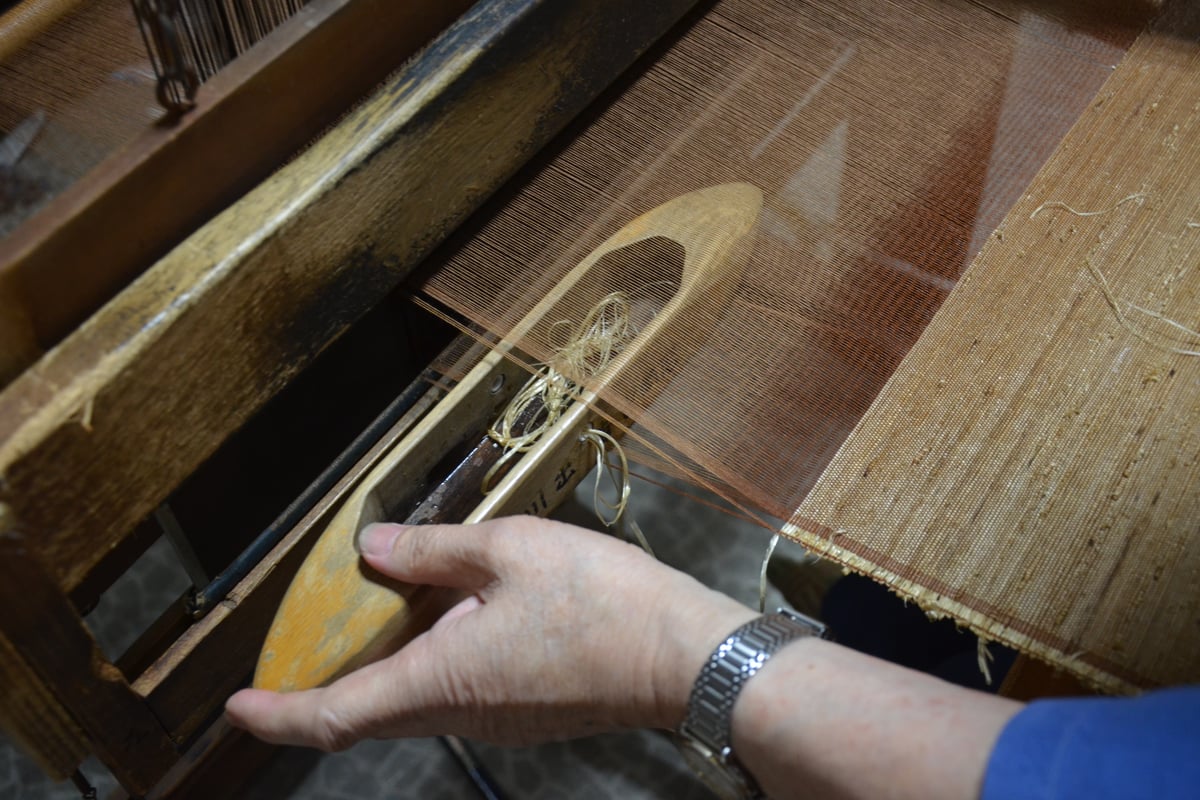
Kakegawa Kuzufu is cloth that has been woven for generations in Kakegawa City, Shizuoka Prefecture. Fibers are taken from the vines of kudzu, which grows wild in the hills and fields, made into thread, and hand-woven in as the weft. Its appeal lies in a gentle, subdued luster and an understated refinement that differ from silk or hemp. It is said to have already been used for samurai attire and other garments in the Kamakura period. In the Edo period, under the protection and encouragement of the Kakegawa Domain, it was prized as fabric for kamishimo, hakama and kappa raincoats. It also became a souvenir for daimyo traveling on sankin-kotai through Kakegawa-juku, a post town on the Tokaido. When samurai demand was lost in the Meiji era, it was revived by shifting its use to fabric for fusuma sliding doors. From around Meiji 30, it was exported to the United States as wallpaper. Today two weaving houses preserve the traditional handwork, from gathering the vines to weaving by hand. It is a Shizuoka Prefecture Designated Local Traditional Craft under the name Kakegawa Hand-woven Kuzufu (Kakegawa Teori Kuzufu).
Kyo-kumihimo (Kyoto Braided Cords)
Kyo-kumihimo
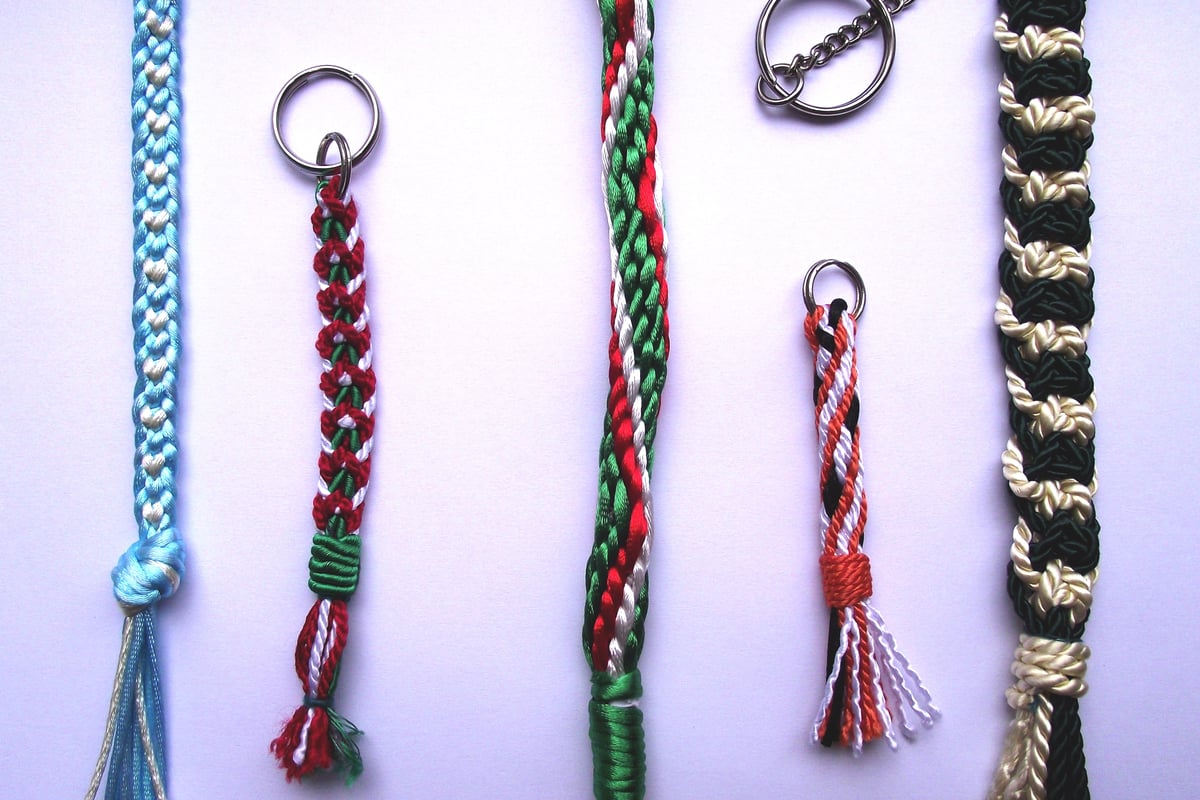
Kyo-kumihimo is braided cord made around Kyoto City and Uji City, in which artisans use multiple types of braiding stands — maru-dai, kaku-dai, and taka-dai — to hand-braid dozens of silk threads into a single cord. The techniques are remarkably varied: roughly 40 basic braiding patterns exist, and including pattern variations there are said to be more than 3,000, producing intricately braided, delicate weave patterns with an elegant sheen. It was once used for the cords of ritual and Buddhist implements, weapon fittings, and personal accessories, and today it is used mainly for kimono obijime sashes and haori cords, as well as a wide range of accessories. It received national Traditional Craft designation in 1976.
Enshu Cotton Tsumugi
Enshu Men Tsumugi (Enshu Cotton Pongee)
Enshu Cotton Tsumugi (Enshu Men Tsumugi) is a cotton textile that has been woven in the Enshu region of western Shizuoka Prefecture. Enshu is warm with long hours of sunshine, and from the Edo period it flourished as a cotton-producing area alongside Mikawa and Senshu. Hand-woven cotton textiles spread as a side job for farming households, and the striped cotton came to be called Enshu stripes (Enshu-jima). Using uneven nep yarn and slub yarn for both warp and weft and weaving slowly on traditional shuttle looms produces a rustic texture like that of tsumugi (pongee). Another feature is that with each wash the twist of the yarn loosens and takes in air, making the cloth softer to the touch. From the Meiji era onward, helped by loom inventions by Toyoda Sakichi and others, Enshu grew into one of Japan's leading textile-producing areas. Today ぬくもり工房 in Hamamatsu City produces fabrics and small items, with more than 100 patterns available at any given time. Said to be a root of Hamamatsu's textile design, it is cherished as a textile that represents the region.
Kaga Embroidery
Kaga-nui
Kaga-nui is an embroidery craft of Ishikawa Prefecture that uses silk thread along with gold and silver thread to raise designs into vivid, three-dimensional relief. It is said to have begun in the early Muromachi period, transmitted from Kyoto as a decorative technique for altar cloths and priests' vestments alongside the spread of Buddhism into the Kaga region. During the Edo period, it received generous protection from successive lords of the Kaga domain and came to be used to decorate samurai battle coats and Noh costumes, developing independently as one of Kaga's traditional dyeing and weaving crafts alongside Kanazawa gold leaf and Kaga Yuzen. Its greatest characteristic is the ability to render painting-like delicacy and dimensionality in thread, using a range of techniques such as 'kusarinui' (chain stitch), 'matsurinui,' and 'suganui.' In May 1991, it was designated a national Traditional Craft by the Minister of International Trade and Industry (now the Minister of Economy, Trade and Industry), and today it is produced mainly in Kanazawa, Hakusan, and Nomi, with a wide range of items made — from ceremonial garments to contemporary accessories.
Miyako Jofu
Miyako Jofu
Miyako Jofu is a ramie textile woven on Miyako Island, ranked alongside Echigo Jofu and Ojiya Chijimi as one of the finest, lightest, and most lustrous summer textiles in Japan. According to tradition, it began in the 16th century when a woman named Inaishi presented a woven cloth called 'ayasabi-nuno' to the King of Ryukyu. After being designated in 1637 as one of the tribute textiles owed by the Miyako and Yaeyama regions under the Ryukyu royal government's poll tax system, extremely fine and precise weaving was demanded of the cloth, and that technical tradition has been passed down to the present day. The raw material is ramie grown on the island; the fiber is patiently split by hand into fine strands without knots and twisted together into thread in a process called 'teumi' (hand-spinning). The textile is best known for its design of fine cross-shaped kasuri patterns woven into a deep indigo-dyed ground, and after weaving, the cloth is beaten with a wooden mallet in a finishing process called 'kinuta-uchi,' which gives it its distinctive supple sheen. Another characteristic is that thread-making, indigo dyeing, weaving, washing (finishing), and repair are each carried out by specialized artisans working in a division of labor. Miyako Jofu was designated an Important Intangible Cultural Property of Japan in 1978, and in 2003 the hand-spinning technique for ramie thread was recognized as a nationally Selected Conservation Technique.
Otsu Kumihimo (Otsu Braided Cords)
Otsu Kumihimo
Otsu Kumihimo is a traditional craft of braided cords (kumihimo) passed down mainly in the Ōsaka district (逢坂) of Otsu City. Kumihimo braiding was introduced to Japan along with Buddhism, and was originally used as cords for binding sutra scrolls and Buddhist vestments, as well as decorative cords for the robes of court nobles and samurai. In Otsu, the craft is said to have begun during the Edo period, when samurai and townspeople traveling the Tokaido road into Kyoto had the cords on their sword scabbards and inro cases repaired locally. Using several types of braiding stands — including the maru-dai (round stand), kaku-dai (square stand), aya-take-dai, and naiki-dai — artisans braid threads by hand into a single cord, with high-grade products using thread dyed with plant-based dyes. Today, Tozaburo Himo, founded in 1867 (Keio 3), remains the only kumihimo workshop in the Ōsaka district, producing a wide range of items from obi-jime sashes and haori cords to small accessories such as straps.
Sendai-hira
Sendai-hira
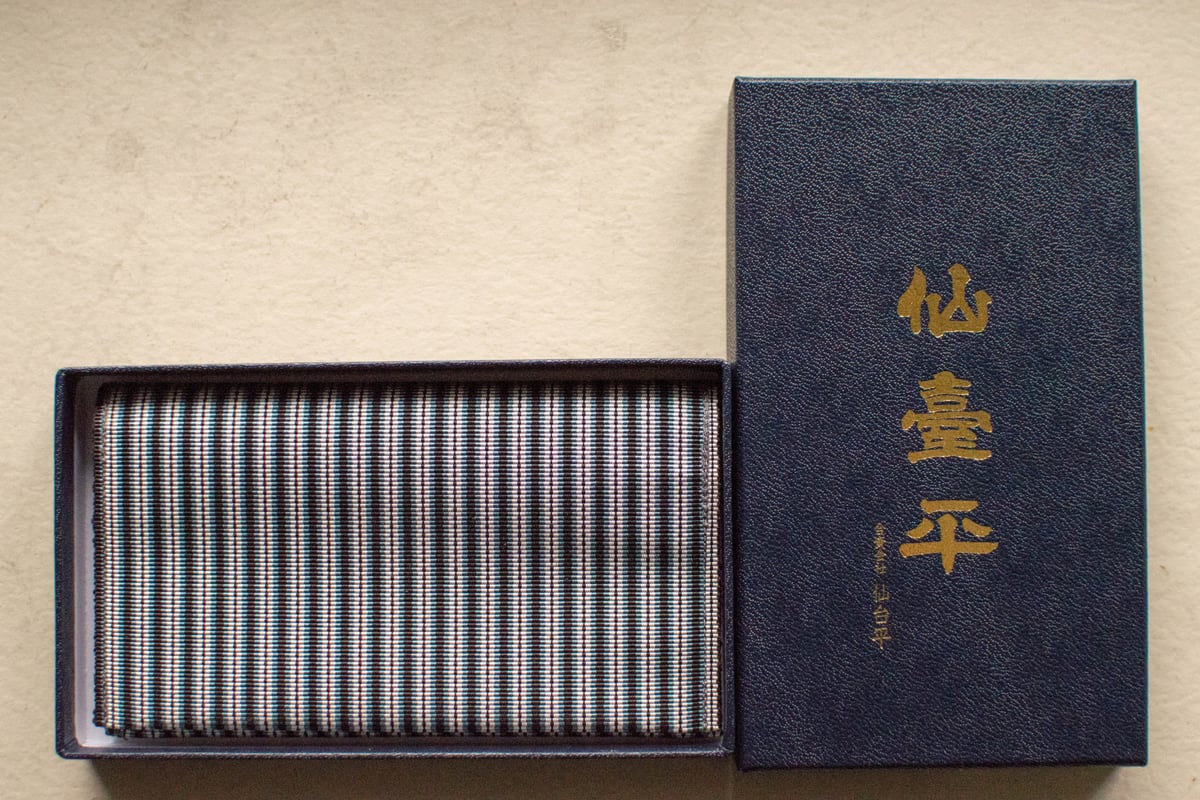
Sendai-hira silk is a woven silk fabric for men's hakama produced in Sendai City. According to tradition, its origins date to the Joukyo and Genroku eras of the mid-Edo period (roughly the 1680s to 1704), when Date Tsunamura, the fourth lord of the Sendai Domain, retained official weavers to produce hakama fabric and Noh costumes. The fabric is woven by twisting raw silk for the warp threads and forcefully beating in weft threads of near-raw silk while dampening them with water, producing cloth that is supple yet firm, resists wrinkling, and has a distinctive sheen and rustling sound as it moves. From the Edo period through the Meiji and Taisho eras, Sendai-hira was renowned as the finest of all hakama fabrics, reaching an annual production of as much as 30,000 tan (bolts) at its peak. As demand declined, the number of weaving houses gradually dwindled, and today Sendaihira Co., Ltd. is the sole workshop preserving the tradition. Its finest grade, known as seigo Sendai-hira, was designated an Important Intangible Cultural Property by the national government in 2002, and its head, Koda Yoshio, has been recognized as a Living National Treasure. In 1985 (Showa 60), it was also designated a Traditional Craft by the Governor of Miyagi Prefecture.
Aizu Momen (Aizu Cotton Textiles)
Aizu Momen
Aizu Momen is a cotton textile that has been woven in the Aizu region of Fukushima Prefecture for roughly 400 years. It is said to have begun in the Tensho era (1573-1592) of the Azuchi-Momoyama period, when the Aizu domain lord Gamō Ujisato encouraged cotton cultivation alongside his development of the castle town of Wakamatsu, and production expanded in earnest after 1627, when the domain lord Kato Yoshiaki is said to have invited weavers from his former domain of Iyo-Matsuyama to pass on their techniques. As a sturdy cotton textile with simple striped patterns that grows softer with washing, it has been used since the Edo period for everyday clothing and work wear among ordinary people. At its peak in the Taisho era, around 30 weaving workshops lined the area around Aizuwakamatsu, but today only two remain within Aizuwakamatsu City and one in Aizubange Town. Designated as a Prefecturally Designated Traditional Craft of Fukushima Prefecture, the surviving workshops still use old-style looms from the early Showa era to weave fabrics centered on vertical and check stripe patterns.
Akita Hachijo
Akita Hachijo
Akita Hachijo is a silk textile woven with striped and checkered patterns based on a reddish-brown 'tobi-iro' color, using silk thread dyed with plant dyes such as the root bark of hamanasu (rugosa rose), kariyasu (a type of grass), and rengetsutsuji (a species of azalea). Its origin is said to date to around 1784 (Tenmei 4), when Ishikawa Takiuemon and others brought the weaving technique to the region; building on plant-dyeing techniques related to 'Honba Kihachijo' of the Izu Islands, further improvements were made during the Bunka era, when a craftsman was invited from Kiryu in Joshu. Production reached its peak around 1903-1904 (Meiji 36-37), but the number of producers gradually declined afterward, and the craft was once interrupted when the Namekawa Textile Factory (Akita City), the last remaining producer, closed in 2003. In 2006, Toshiko Narada, a former employee of that factory, took over its equipment and set up a workshop in Kitaakita City, single-handedly reviving the technique. In 2023, the workshop relocated and was renamed 'Akita Hachijo Hamanasu Workshop'; today Narada remains the sole producer, handling everything from dyeing the thread to weaving, while also working to pass on the technique to members of the local Community Revitalization Cooperator program.
Fukui Habutae Silk
Fukui Habutae
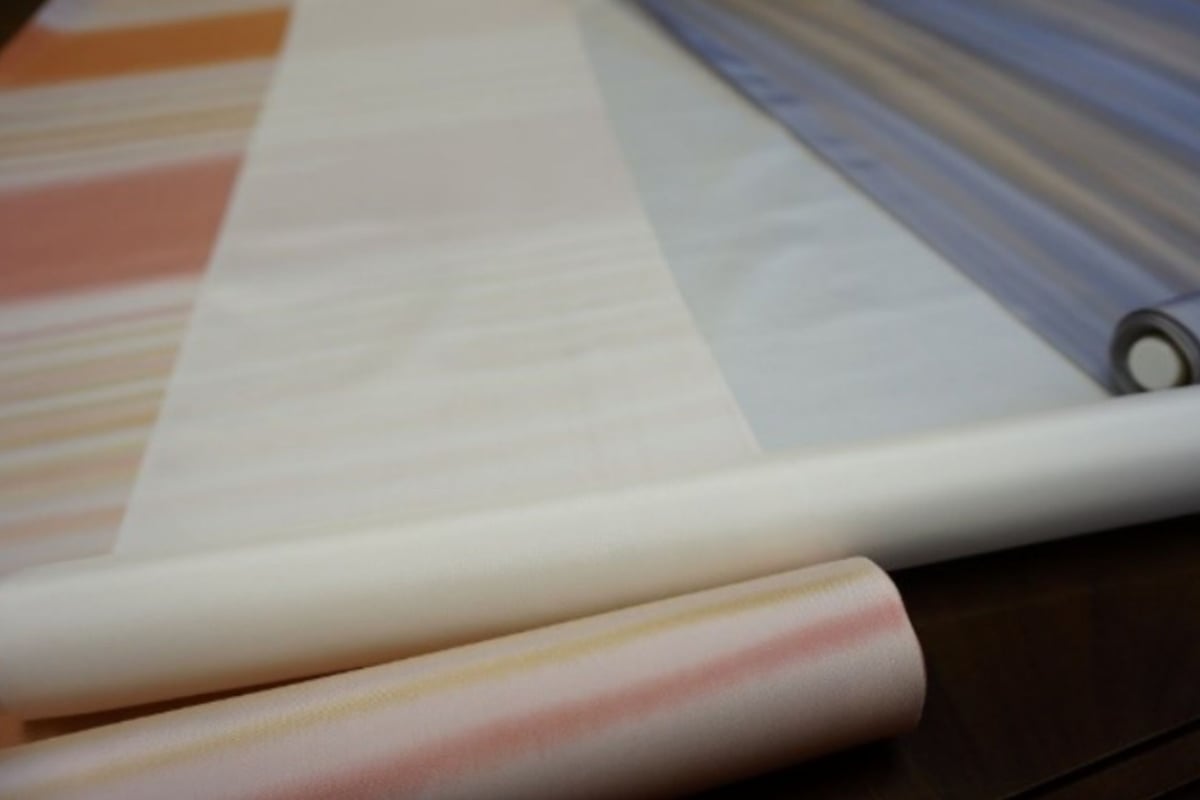
Fukui Habutae is a silk fabric that was woven extensively in Fukui Prefecture for export during the Meiji era. Habutae is a plain-woven fabric made by drawing together two fine, untwisted warp threads, and it is light and soft with a beautiful white luster. In Fukui, research into new silk fabrics began in the early Meiji era, including sending trainees to Kyoto. In the late 1880s, habutae weaving techniques were introduced by inviting engineers from the advanced weaving center of Kiryu. The techniques spread throughout the prefecture, and in the early 1890s Fukui Prefecture's silk fabric output became the highest in Japan. Electric power looms spread by the early Taisho era, and the Hokuriku region grew into one of the country's leading producers of export habutae. The area later shifted to rayon (artificial silk) and synthetic fibers, and Fukui remains one of Japan's foremost textile-producing regions today. In Katsuyama City, 'nure-yoko habutae', woven with wet weft threads, is still produced. Habutae Mochi, a famous Fukui confection, was also named after this habutae weave.
Mikawa Momen (Mikawa Cotton Textiles)
Mikawa Momen
Mikawa Momen is the general term for cotton textiles that have long been grown and produced in the Mikawa region of eastern Aichi Prefecture (around Nishio City, Gamagori City, and Toyokawa City). According to tradition, cotton cultivation in Japan began in 799 (Enryaku 18), when a person from Konron (said to have been Indian) drifted ashore and introduced cotton seeds, in a place identified as Hazu District, Mikawa Province (present-day Nishio City). The earliest documentary reference dates to 1510 (Eisho 7), when the record 'Eisho-nenchuki' of Kofuku-ji Temple's Daijo-in notes that 'Mikawa momen' was paid as a tax tribute. During the Edo period, cotton growing and cotton weaving flourished throughout the Mikawa region, and the textiles were shipped to Edo as one of the 'three white products' (sanpaku momen). From the Meiji era onward, the industry developed by adopting Western spinning and weaving technology, and it became known nationwide under the brand names 'Mikawa Momen' and 'Mikawa-jima.' Products include 'Mikawa-jima,' known for its distinctive vertical stripes and pale indigo color, and multi-layered woven gauze prized for its warmth and absorbency. It was registered as a Regional Collective Trademark in 2007.
Sakai Teori Dantsu (Hand-Woven Carpets)
Sakai Teori Dantsu (Hand-Woven Carpets)
Sakai Teori Dantsu is a hand-woven floor covering that began in Sakai in the late Edo period. Dantsu (pile carpet) refers to thick woven floor coverings; the technique is said to have come from China and spread via the Nabeshima Domain of Hizen to Ako in Banshu and Sakai in Senshu. In Sakai, it began in Tenpo 2 (1831), when the thread merchant 藤本庄左衛門 had 泉利兵衛 weave dantsu and sold them as 'Sakai Dantsu.' It became widely known after being exhibited at the 1st National Industrial Exhibition (Naikoku Kangyo Hakurankai) in Meiji 10 (1877). 藤本荘太郎, 藤本庄左衛門's grandchild, who was called the 'Dantsu King,' improved the techniques and personally traveled to the United States to spread it overseas. In the mid-Meiji era, they were shipped in large numbers both in Japan and abroad, and production reached its peak. Woven by hand using techniques that require great skill, the carpets are durable and have a substantial, weighty finish. In 1986 (Showa 61), it was designated an Osaka Prefecture-designated Traditional Craft. In 2006 (Heisei 18), its techniques were also designated an Osaka Prefecture Intangible Folk Cultural Property.
Kyo-nui (Kyoto Embroidery)
Kyo-nui
Kyo-nui (Kyoto embroidery) is a traditional Kyoto embroidery craft in which patterns are sewn onto fabric using a single needle and multicolored silk, gold, and silver threads. It began when the "Nuibe no Tsukasa" bureau, responsible for court clothing decoration, was established with the relocation of the capital to Heian-kyo, and it developed alongside garments such as juni-hitoe court robes, warlords' dobuku coats, Noh costumes, and kosode kimono. Alongside dyeing and weaving, it holds an important place in the history of Japanese textile arts, and it is characterized by the way overall composition, thread color coordination, and embroidery techniques and methods combine to create three-dimensional, evocative expression on flat fabric. About 30 techniques survive today, of which 15 — including nuikiri, komazukai-nui, and matsui-nui — are recognized as designated techniques of the Traditional Craft certified by the Minister of Economy, Trade and Industry. In recent years it has been applied beyond kimono-related items to framed works and accessories, opening up new demand.
Ecchu Fukuoka no Sugegasa
Ecchu Fukuoka no Sugegasa
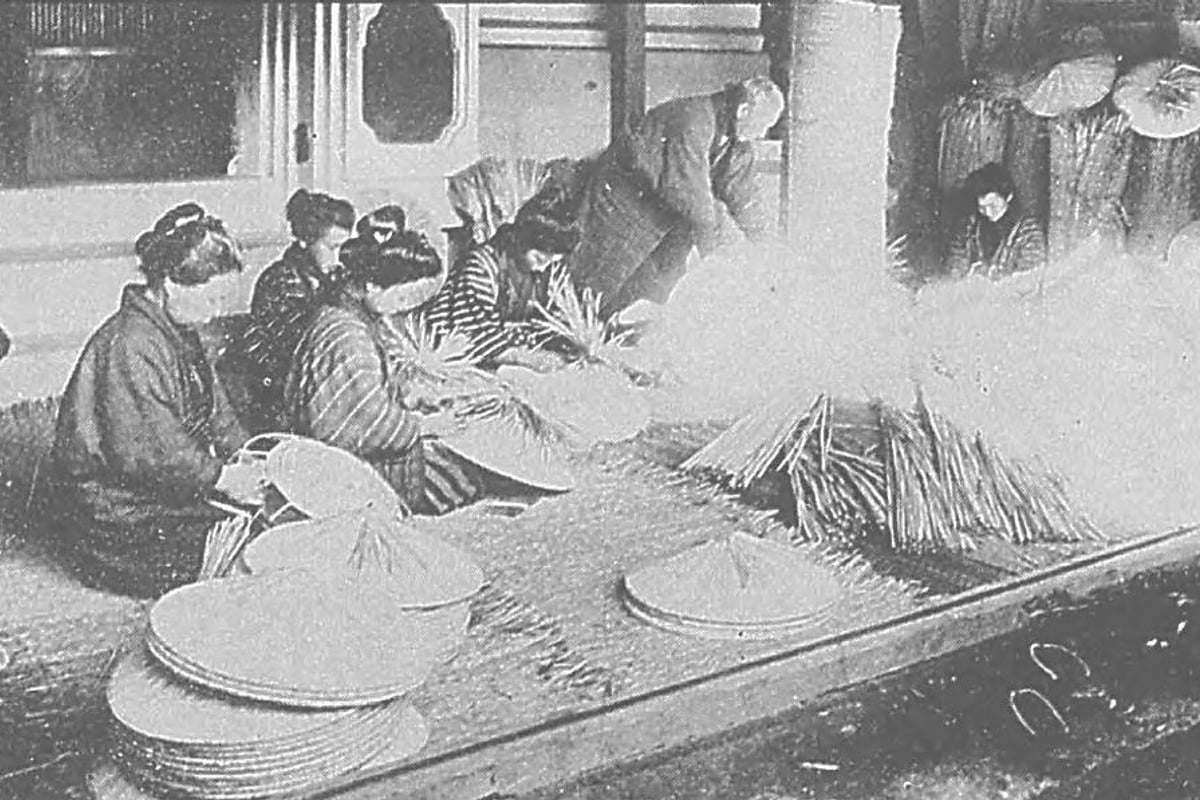
Ecchu Fukuoka Sugegasa is a sedge-woven hat made throughout the Fukuoka-machi area of Takaoka City, Toyama Prefecture, with a history of over 400 years as sun and rain protection used in farm work and festivals across Japan. Its origin is said to lie in the flooding of the Oyabe River more than 400 years ago, which turned the coastal area into a marsh where good-quality sedge began to grow wild, leading local villagers to start making hats as a side business. Around 1670, in the mid-Edo period, the craft developed into a full-fledged industry under the protection and encouragement of the Kaga Domain lord Maeda Tsunanori, and in the late Edo period, hat wholesalers emerged in Fukuoka-machi and began selling directly across Japan. At its peak in 1864, as many as 2.1 million sedge hats are said to have been shipped. Its distinctive feature is that men and women divide the labor between 'kasabone-zukuri' (making the conical bamboo frame from bamboo cut into thin strips) and 'kasanui' (sewing sedge grown specifically for the hats onto the frame), with the entire process from cultivation to finishing and shipping completed within the region. It still accounts for about 90% of domestic sedge hat production today. It was designated a nationally designated Important Intangible Folk Cultural Property in 2009 and a METI-designated Traditional Craft in 2017.
Honba Kihachijo
Honba Kihachijo
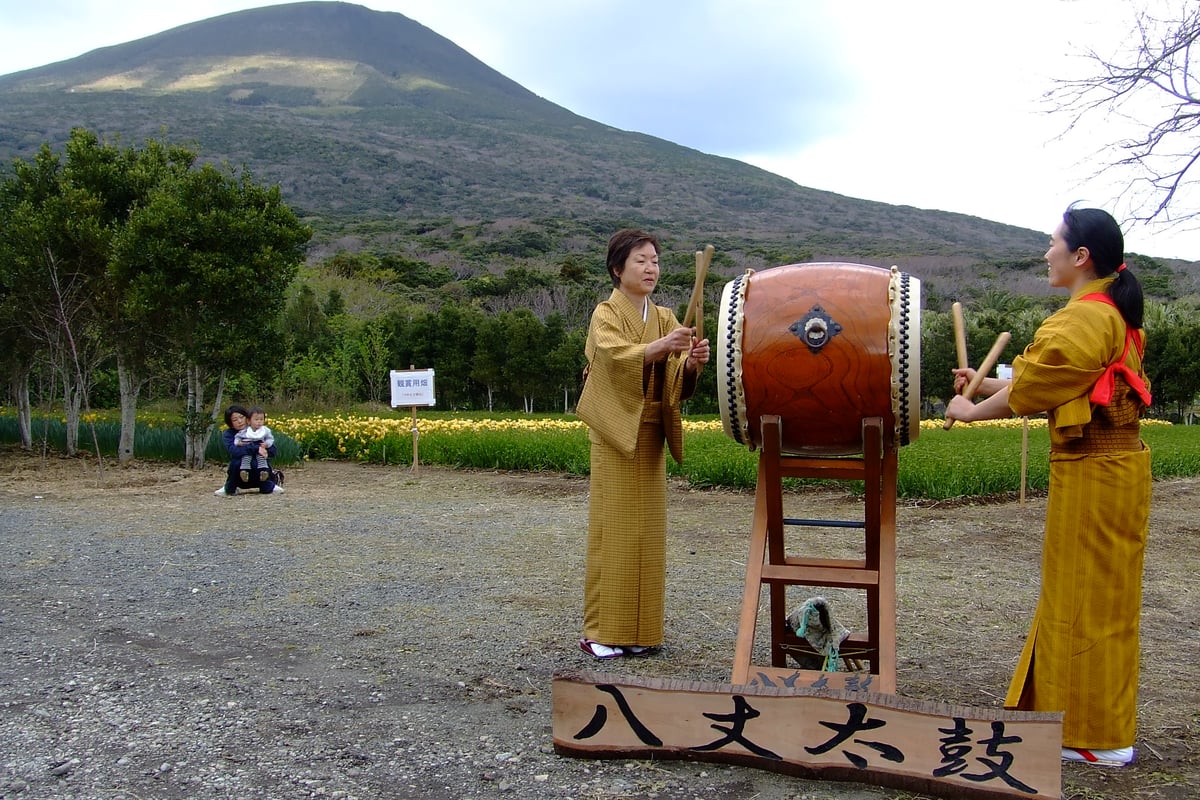
Honba Kihachijo is a plant-dyed silk textile handed down on Hachijojima, a remote island about 290 kilometers south of central Tokyo. Once called 'the island no bird visits,' Hachijojima is said to have paid plain pongee as tribute as early as the Muromachi period, and the dyeing techniques still used today are believed to have been established around the Kansei era (1789-1801) of the Edo period. Thread is dyed using only plants native to the island: yellow from hachijo-kariyasu (a type of grass), kaba-iro (russet brown) from the bark of madami (machilus trees), and black through mud-dyeing with the bark of chinquapin trees. The dyed thread is woven on a hand-thrown shuttle into extremely simple designs -- plain, striped, or checkered -- and the fabric is said to grow softer with wear and its colors more vivid with washing. Dyeing black requires a painstaking process of soaking the thread in a decoction of chinquapin bark and sun-drying it as many as 40 times, producing a deep, lustrous black. From the mid-Edo period onward, striped and checkered patterns also came to be woven, and the craft survives today as handwork passed down through generations of women on the island. It was designated a Traditional Craft Designated by the Minister of Economy, Trade and Industry in 1977 (Showa 52).
Iwate Homespun
Iwate Homespun
Iwate Homespun is a woolen textile made from hand-spun yarn and finished by hand weaving. It is said to have begun around 1881, when sheep farming was introduced to the Ninohe region and a British missionary stationed there taught the local people how to spin and weave the wool. The craft was later developed into an industry by the mother-and-son team of Umehara Otoko and Goro in the former town of Towa (now part of Hanamaki City), and the techniques spread to several workshops and companies in and around Morioka, including Michinoku Akane-kai and Nippon Homespun. The hand-spun yarn gives the fabric a distinctive elasticity and resistance to wrinkling, along with a light, comfortable feel, and its muted, elegant colors from plant dyes are another highlight. Iwate is said to be the only production area in Japan where hand-spinning techniques are still practiced today, and its stoles, mufflers, and other products are prized as durable textiles that can be used across three generations of a family.
Kojima Denim
Kojima Denim
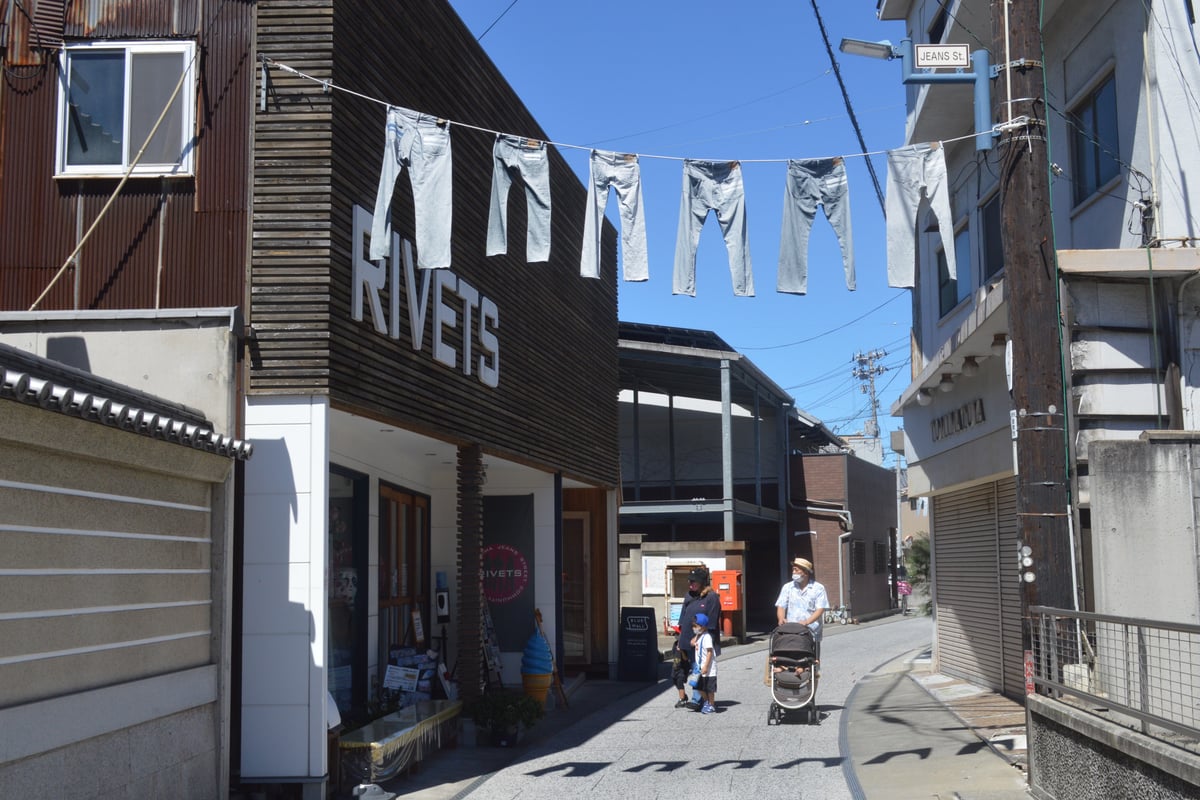
Kojima Denim is the general term for denim fabric and jeans produced in the Kojima district of Kurashiki City, Okayama Prefecture, known as the 'birthplace of Japan-made jeans.' In the Edo period, cotton farming resistant to salt thrived on land reclaimed from the shallow sea, and the cotton-weaving industry that grew from it gave rise to kokura-ori weaving and sanada-himo braided cords. In the Meiji and Taisho eras, the area developed as a center for tabi socks and school uniforms, and the techniques and know-how of this textile industry were later carried over into the denim and jeans industry. In 1965, Kotaro Ozaki of Maruo Seifuku (now Big John) used denim fabric imported from the United States, applying the sewing techniques used for school uniforms to manufacture and sell Japan's first domestically made jeans. In 1973, Kurashiki Spinning succeeded in producing domestic denim fabric, and Kojima developed into a production area capable of handling everything from yarn to fabric, sewing, and wash processing in one place. Today, about 40 specialty jeans shops line 'Kojima Jeans Street,' which runs from Kojima Station, and it has become a sightseeing spot visited by many people from Japan and abroad.
Kurashiki Dantsu (Kurashiki woven rug)
Kurashiki Dantsu
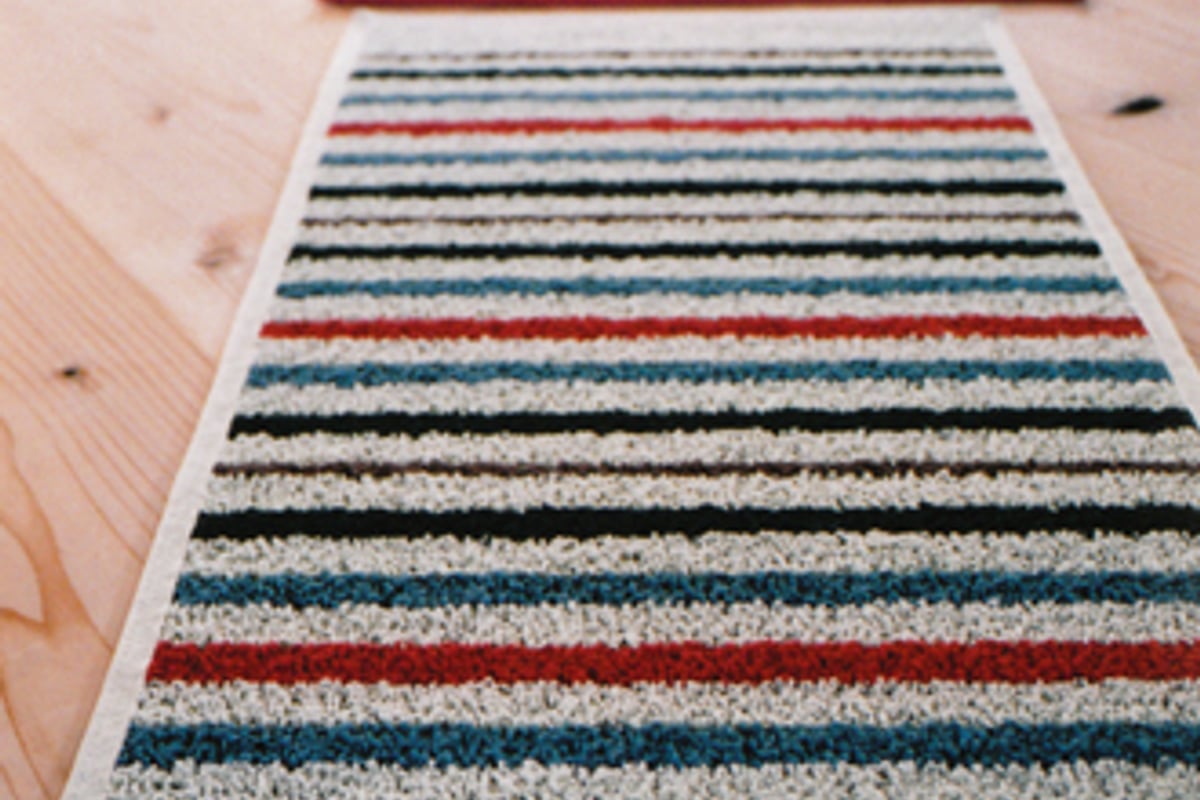
Kurashiki Dantsu is a hand-woven rug made in Kurashiki City, Okayama Prefecture, characterized by combining rush (igusa), Japanese paper (washi), and hemp or cotton thread. Kurashiki had been known since the Edo period as a production area for tatami facing and hanagoza (patterned rush mats), and it is said to have begun when Yabuki Kan'ichirō, an inventor from Hayashima Town, devised 'Kinpa-ori' in the early Shōwa era as a rug suited to Western-style architecture. In 1932, the folk-craft movement leader Yanagi Sōetsu discovered the rug, commissioned the designer Serizawa Keisuke to create striped patterns for it, and named it 'Kurashiki Dantsu'. After the war it reached its peak while remaining hand-woven, popular enough to be exported overseas, but rising raw-material costs and the aging of its artisans brought production to a halt in 1986. Takiyama Yūichi, who joined the Traditional Industry Revival Study Group founded in 1991, taught himself the technique and resumed production in 1993. Today he continues to be almost the sole maker, producing the rugs at his workshop in Hayataka, Kurashiki City.
Kurashiki Hanpu (Canvas)
Kurashiki Hanpu
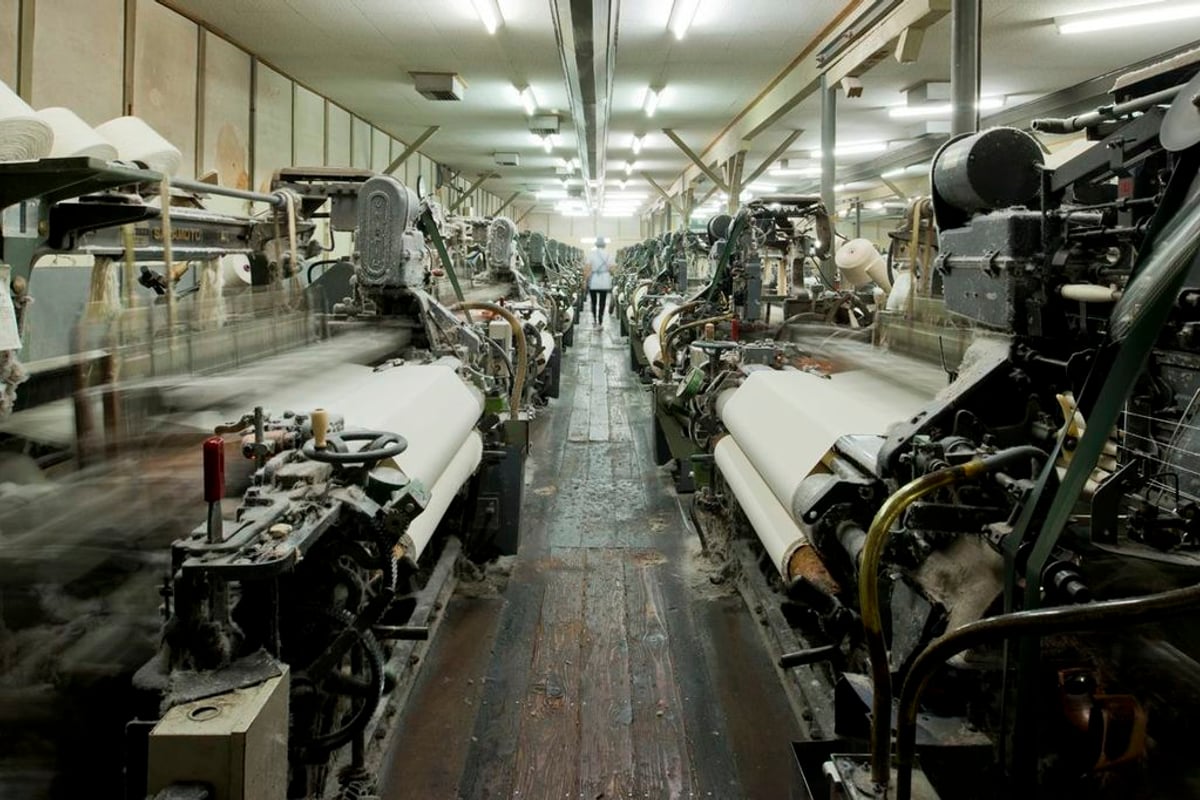
Kurashiki Hanpu is a thick cotton canvas fabric made in the Kojima district of Kurashiki City, Okayama Prefecture, with a history rooted in its development as sailcloth for ships. Kojima, land reclaimed in the Edo period, was suited to growing salt-resistant cotton, and its cotton industry flourished to the point that the area became known for 'Kojima's three whites'—cotton, together with the whiteness of the local sand-lance fish and salt. The transmission of a loom technique developed by Kuraku Matsuemon of Banshu Takasago, which used thick thread, is said to have laid the foundation for producing sturdy, thick canvas. The direct roots of modern Kurashiki Hanpu trace back to 1888, when the husband-and-wife weavers Ishigoro and Ume Butakiri founded a textile mill in Kurashiki, and business expanded after Ume's hand-woven cloth earned a reputation among local cotton wholesalers. Today it remains a rare production area capable of weaving extra-thick canvas from No. 1 to No. 3 weight using a thread-twisting technique that twines together several strands of pure cotton yarn and old-style shuttle looms. It is characterized by the beautiful selvedge unique to shuttle looms and a warm, textured feel, and its uses have expanded to everyday items such as bags and sundries.
Mamada Himo
Mamada Himo
Mamada Himo is a braided cord (kumihimo) technique said to have been passed down since the Kamakura period in Mamada, Oyama City, Tochigi Prefecture. Using a technique in which weights are attached to both ends of the threads to keep them constantly taut while crossing many strands, it produces cords with intricate, finely detailed patterns. Its beautiful finish, achieved with gold and silver thread and plant-dyed pure silk thread, is a hallmark, and it was once used for the cords of samurai armor and sword sageo (hanging cords). The area's modern history as a production center began in 1922 (Taisho 11), when first-generation Watanabe Asaichi returned to Mamada after completing an apprenticeship in kumihimo braiding in Kinshicho, Tokyo, and opened a shop. In 1954, Yanagi Muneyoshi of the Mingei (Folk Craft) Movement named the technique 'Mamada Himo,' and it was designated an Intangible Cultural Property of Oyama City in 1964 and of Tochigi Prefecture in 1973. The Watanabe family has carried on the technique across generations, and today it is enjoyed as a kimono accessory and everyday item, used for obi cords, haori cords, and loop ties.
Murayama Oshima Tsumugi
Murayama Oshima Tsumugi
Murayama Oshima Tsumugi is a kasuri (ikat-patterned) silk textile that has been woven in and around Musashimurayama City, Tokyo, along with Mizuho Town and Akishima City. It traces its roots to two textile traditions: 'Murayama Kon-gasuri,' a striped cotton fabric that began around the Genroku era (1688–1704) of the Edo period, and 'Sunagawa Futoori,' a coarse silk weave made from silk thread spun from double cocoons. As demand for silk textiles grew from the mid-Meiji era onward, these two traditions merged into a silk fabric around 1920, giving birth to Murayama Oshima Tsumugi. Despite carrying 'Oshima' in its name, it is entirely distinct from Honba Oshima Tsumugi, woven on Amami Oshima island; the key difference lies in the dyeing technique used for the kasuri threads. While Amami's Honba Oshima Tsumugi achieves its intricate kasuri patterns through labor-intensive methods such as mud-dyeing with a shime-bata (binding loom), Murayama Oshima Tsumugi uses a technique called itajime dyeing, introduced from Isesaki, Gunma Prefecture, in 1919. By sandwiching threads between carved pattern boards and dyeing them under pressure, this method achieves intricately matched kasuri patterns in the warp and weft at a relatively accessible price. The fabric is prized for its smooth, light feel, with men's designs favoring understated, refined fine kasuri patterns and women's designs favoring chic patterns wearable at any age. It was designated a national Traditional Craft in 1975.
Nanbu Hishizashi
Nanbu Hishizashi
Nanbu Hishizashi is a sashiko stitching technique handed down mainly in Hachinohe City in Aomori Prefecture's Nanbu region, and, alongside Kogin-zashi from the Tsugaru region, is one of Aomori Prefecture's representative sashiko traditions. It is said to have begun during the Edo period, when farming women who were forbidden from wearing cotton stitched cotton thread into hemp cloth to strengthen it and guard against the cold, and it is believed to have been developed in the Nanbu region around Hachinohe roughly 200 years ago. While Kogin-zashi counts the vertical threads of the weave in odd numbers, Hishizashi is distinguished by counting even numbers as the stitching progresses, weaving elongated diamond-shaped geometric patterns known as "ume no hana" (plum blossom) and "kiji no ashi" (pheasant's foot). Today, in addition to traditional items such as aprons and table runners, the technique is applied to modern products like neckties and tapestries, with skills passed down through workshops and classes in Hachinohe City. It is also notable that Tsugaru and Nanbu, though both within Aomori Prefecture, developed distinct sashiko traditions of their own.
Nanbu Sakiori
Nanbu Sakiori
Nanbu Sakiori is a hand-weaving technique passed down mainly in Towada City, Aomori Prefecture, in which worn-out cotton cloth is torn into narrow strips to use as weft thread, woven together with hemp or cotton warp thread to create a reborn fabric. In the Edo period, cotton cloth was extremely precious in the cold Nanbu region, so worn-out cloth that could no longer be worn was torn into thread and rewoven into kimono fabric, kotatsu covers, and other items as a way to use every last scrap. After the Cannabis Control Act was enacted in 1948 (Showa 23), hemp cultivation for warp thread became impossible, and the technique nearly died out. In 1975 (Showa 50), Eiko Kanno, a native of Towada City, founded the Nanbu Sakiori Preservation Society and opened workshops, reviving the craft by rediscovering and spreading its techniques. This method of transforming worn-out cloth into new fabric without waste is now drawing renewed attention as a sustainable craft.
Nara Kumihimo
Nara Kumihimo
Kumihimo is a traditional technique of braiding multiple strands of silk thread together into cords, said to have been introduced from the continent along with Buddhism during the Asuka and Nara periods. Ancient braided cords survive among the treasures of the Shosoin and those handed down at Horyu-ji, and Nara remains essential to the history of kumihimo — one traditional braiding technique still practiced today is even called 'Nara-gumi,' named for the braiding pattern seen on an item associated with Emperor Shomu that is preserved in the Shosoin. In the Nara period, kumihimo cords were used for Buddhist implements such as sutra scrolls and priests' robes; over time they came to be used for armor cords and tea-ceremony implements, and from the late Edo period onward, widely as obijime (sash cords) for women's kimono. Today, at the Nishinokyo workshop 'Nara Kumihimo Homi' in Nara City, the tradition of kumihimo braiding using traditional stands such as the kakudai (square stand), marudai (round stand), and takadai (high stand) is carried on through classes and hands-on programs.
Nara-zarashi (Nara Bleached Hemp Cloth)
Nara-zarashi
Nara-zarashi is a high-grade hemp cloth produced mainly around Nara. A reference to bleaching appears in the 1549 (Tenbun 18) entry of the 'Tamon-in Nikki,' a record from the late Muromachi period, and in 1611 (Keicho 16) Tokugawa Ieyasu ordered that bleached hemp cloth could only be sold if it carried the red 'Nanto-aratame' stamp at its edge, after which it circulated nationwide as a product favored by the shogunate. During the Kyoho era (1716-1735) it gained such renown that people said 'the finest hemp comes from Nanto,' with annual production said to have reached 300,000 to 400,000 rolls (hiki). Thread hand-spun from ramie is woven on a loom and then bleached to a pure white finish, with every step done entirely by hand, and the cloth has long been used for prestigious items such as Buddhist priests' vestments, samurai ceremonial dress (kamishimo), and tea ceremony cloths. Since the Meiji era, production has shrunk considerably as demand has changed, but long-established weaving houses founded in the Edo period still pass on the technique by hand today.
Nibutani Attus (Bark-cloth Textile)
Nibutani Attus
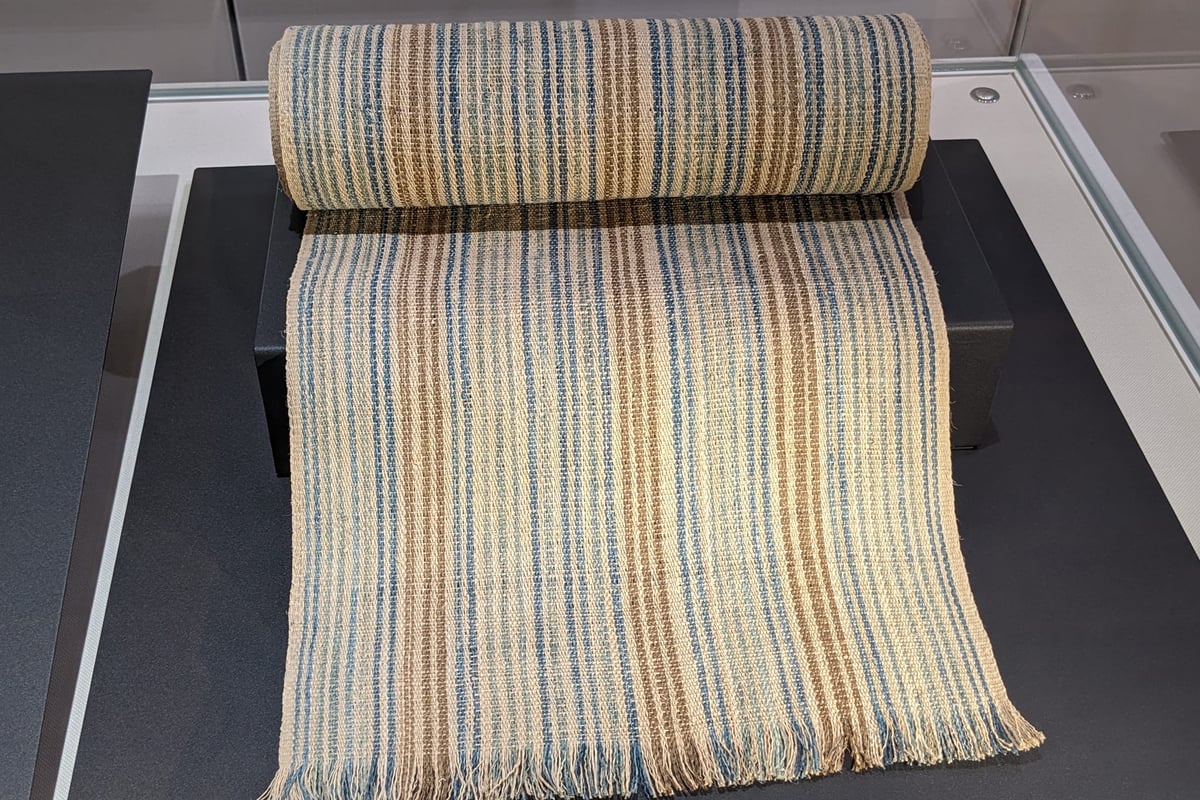
Nibutani Attus is a bark-cloth textile of the Ainu people, handed down in the Nibutani district of Biratori Town, Saru District, Hokkaido. The inner bark of trees such as Ohyo elm and Japanese linden, grown in the Saru River basin, is stripped, boiled, and dried, then torn into thin strips to make thread, which is twisted before being woven on a loom. Making the thread alone is said to account for as much as 80% of the entire process, an extremely labor-intensive task that requires a long time and much effort from the harvesting of the bark to the completion of a bolt of cloth. It is characterized by striped patterns created by the natural coloring of the bark, and is said to be water-resistant, highly breathable, and remarkably strong for a natural fiber. It was once widely used for Ainu clothing, and techniques passed down for more than 100 years continue to be carried on today. On March 8, 2013, together with Nibutani Ita, it became the first Traditional Craft Product designated by the Minister of Economy, Trade and Industry (METI) in Hokkaido.
Sakushu Kasuri (Sakushu ikat cotton weave)
Sakushu Kasuri
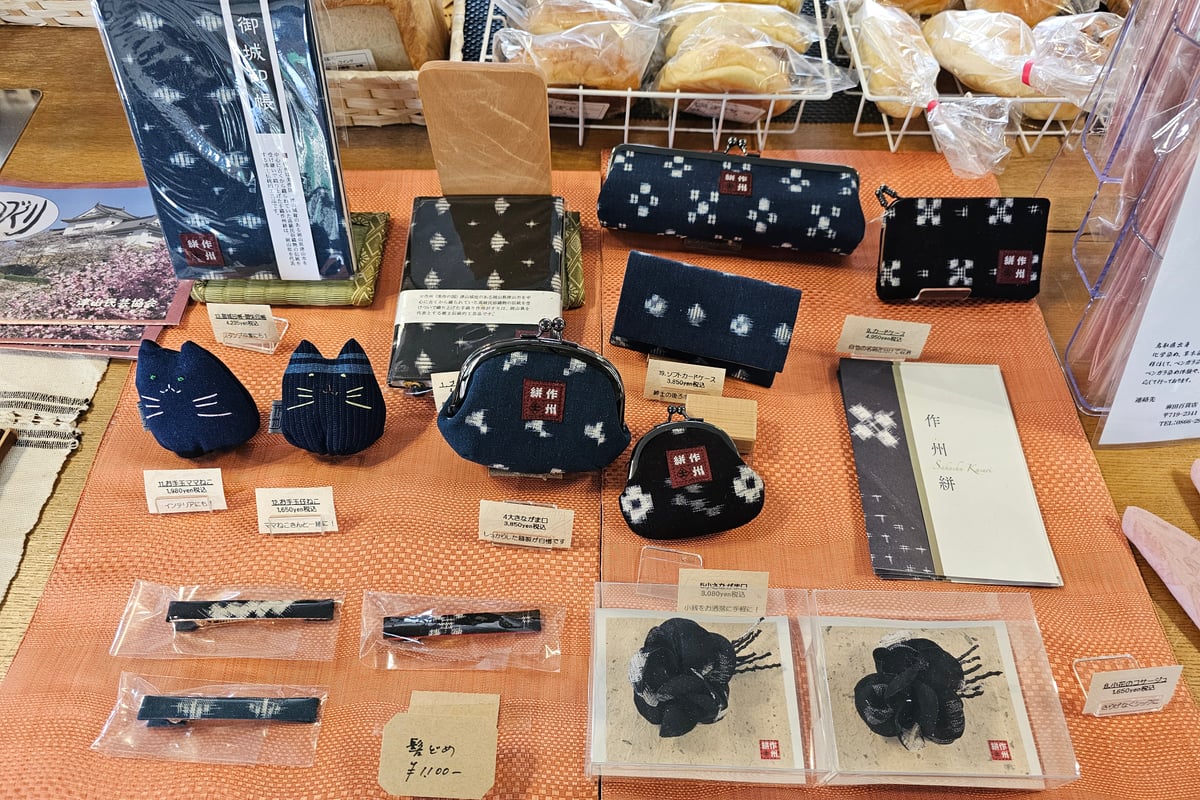
Sakushu Kasuri is a cotton ikat textile woven in the Mimasaka region centered on Tsuyama City, Okayama Prefecture. High-grade silk textiles had long been woven in the Tsuyama area, but from the early 17th century cotton cultivation spread, and hand-spun cotton thread dyed indigo by local dye houses began to be woven into solid indigo and striped cloth for commoners' clothing. In the early Meiji era, influenced by Kurayoshi Kasuri from Tottori Prefecture, indigo cotton ikat became widespread, but as mass-produced textiles from other regions gained ground, both production and technique nearly died out at one point. After the war, Sakushu Kasuri was revived as part of Tsuyama City's industrial promotion policy, gaining popularity in Tokyo around 1955, and at its peak annual production reached about 30,000 tan (bolts) combining power-loom and hand weaving. In 1981 it was designated an Okayama Prefecture Local Traditional Craft as 'Hand-woven Sakushu Kasuri', but weavers later disappeared for a time until Hinagawa Shigemi was officially certified as its successor in 2012, allowing the technique to be passed on again. The geometric patterns set against indigo blue are created through the 'kukuri' technique, in which threads are bound with cord to resist dyeing.
Tokyo Kumihimo
Tokyo Kumihimo
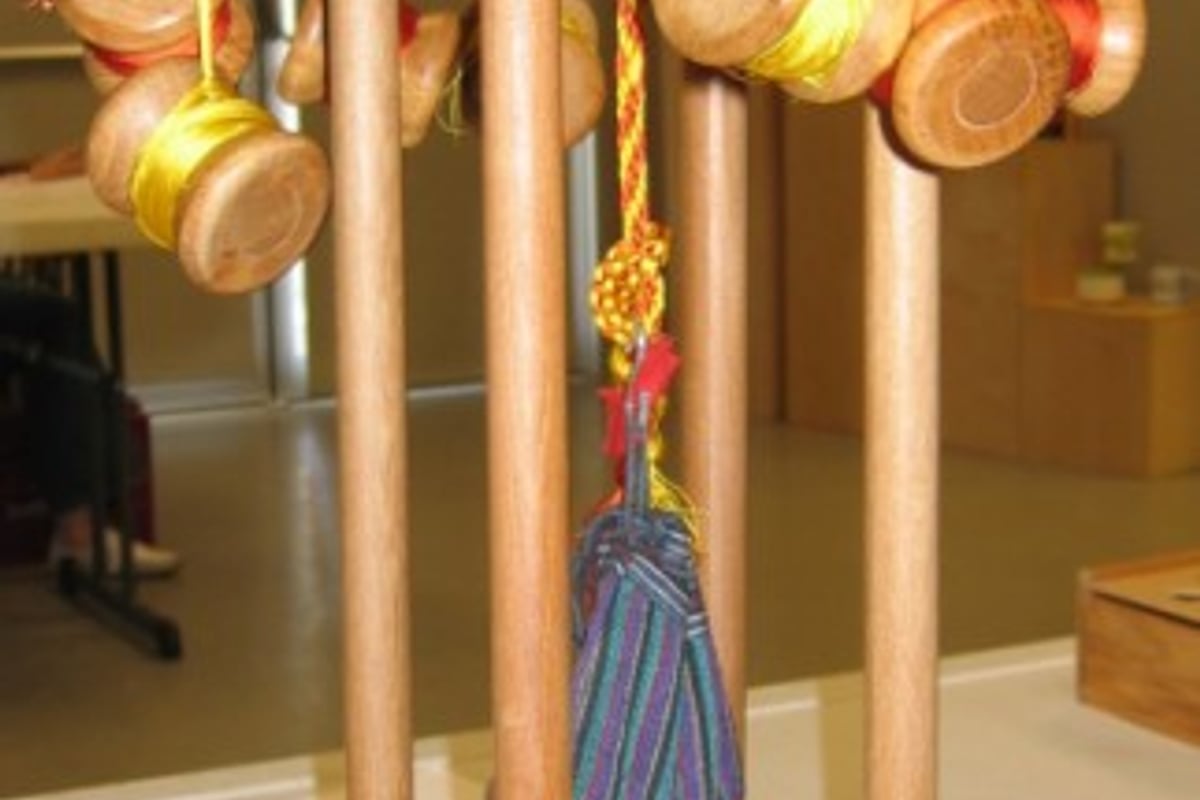
Tokyo Kumihimo is a braided cord craft made mainly from silk thread in Tokyo's Taito, Suginami, and Kita wards, produced using dedicated braiding stands such as the maru-dai (round stand), kaku-dai (square stand), aya-take-dai (twill-bamboo stand), and taka-dai (high stand). Its origins trace back to the cords used for sutra scrolls and priestly robes that arrived with the transmission of Buddhism, as well as sashes accompanying the ceremonial robes of court nobles. Under samurai society, braiding methods combining practicality and beauty developed for the lacing cords of armor and helmets and for sword hilt wrappings. In contrast to the flamboyant Kyo Kumihimo shaped by court noble culture, Tokyo Kumihimo reflects the influence of samurai society and Edo townsfolk culture, characterized by understated, muted colors and sturdy braid patterns. From the late Edo period into the Meiji era, it came into wide use among ordinary people for obi cords (waist-sash cords) and haori cords, and long-established braiding houses such as Domyo, founded in 1652, still carry on the technique today. In addition to obi cords, contemporary products such as neckties and accessories are now also made to suit modern lifestyles.
Tsugaru Kogin-zashi
Tsugaru Kogin-zashi
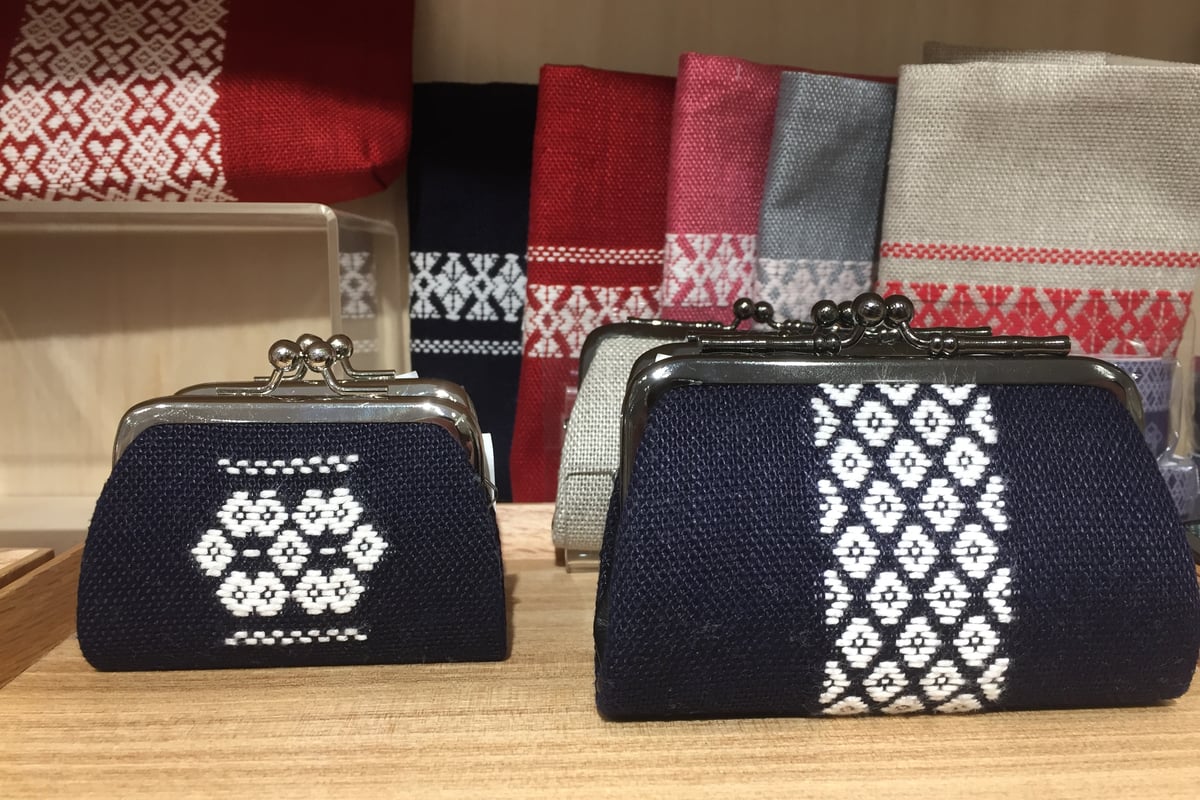
Tsugaru Kogin-zashi is a sashiko stitching technique passed down in the Tsugaru region, centered on Hirosaki City, Aomori Prefecture. During the Edo period, farmers in the Tsugaru domain were restricted to hemp clothing and forbidden from wearing cotton, so women in the harsh Tsugaru winters devised a way to strengthen and insulate their hemp work clothes by stitching the fabric densely with cotton thread. Its defining feature is the way geometric patterns are built up by counting the vertical threads of the weave in odd numbers - one, three, five - and it is divided into three regional styles: "Higashi Kogin" (East Kogin), known for large-scale patterns; "Nishi Kogin" (West Kogin), which divides patterns with horizontal stripes; and "Mishima Kogin" (Three-Stripe Kogin), marked by three thick horizontal stripes. After cotton became widely available from the Meiji era onward, the craft declined for a time, but its formal beauty was reappraised during the Mingei (folk craft) movement of the early Showa era, and the technique continues to be passed down today, centered on Hirosaki. As one of Aomori Prefecture's representative sashiko traditions, it is often compared with Nanbu Hishizashi, which is characterized by diamond-shaped patterns.
Yukara-ori
Yukara-ori
Yukara-ori is a distinctive Hokkaido textile craft founded in 1962 by Kiuchi Aya (1924-2006), a dyer and weaver born in Asahikawa. Wool is dyed into more than 200 shades, and these colored threads are woven using tapestry-weave (tsuzure-ori) and float-weave (uki-ori) techniques to depict Hokkaido's natural scenery - drift ice, the black lily (kuroyuri), and the surface of Lake Mashu - almost like painting an oil canvas in cloth. Every stage, from dyeing and spinning to weaving, is carried out entirely by hand. The name derives from the Ainu word 'yukar,' meaning 'to hand down a tradition,' reflecting the hope of passing on Hokkaido's natural heritage to future generations through craft. Kiuchi Aya earned wide international acclaim, including the Grand Prize at the Japan Folk Art Public Exhibition (1977) and a gold medal at the International Textile Biennial in Hungary (1978). After her death, however, the Hokkaido Traditional Arts and Crafts Village that had taken over the business went bankrupt in 2016, leaving the Yukara-ori Craft Museum, its base of operations, closed for an extended period (effectively shut down). Today, 'Yukara-ori Kobo LLC,' established in 2018 by Takashima Yoshiki, a former creditor, carries on the techniques and works with the cooperation of veteran weavers and dyers.
Yuki-tsumugi
Yuki-tsumugi
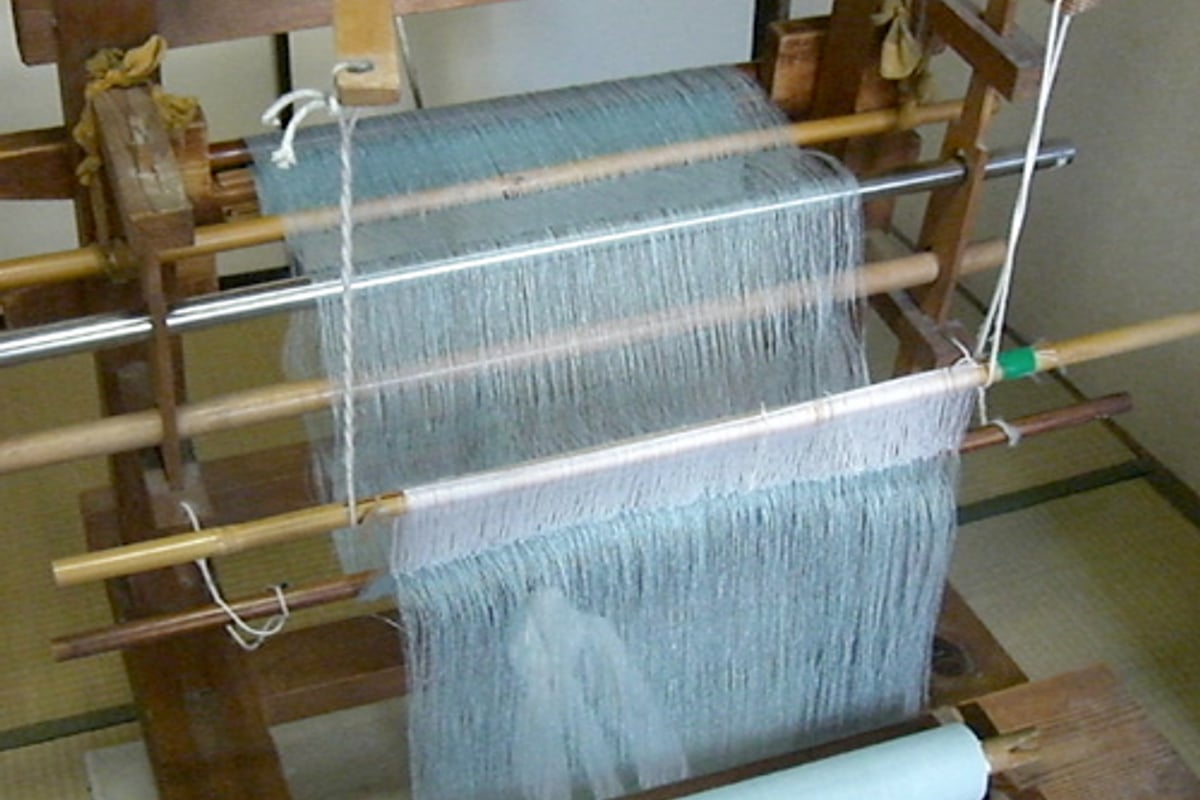
Yuki-tsumugi is a silk textile woven for centuries across present-day Yuki City in Ibaraki Prefecture and, across the Kinu River, the area around Oyama City in Tochigi Prefecture. Its prototype is said to be 'ashiginu,' a silk fabric presented to the imperial court by Hitachi Province in the Nara period; in the Kamakura period its plain, sturdy look made it popular with warriors of the Kanto region, and Yuki became the center of its production. By the Muromachi period it was known nationwide as a specialty product presented to the shogunate under the name 'Yuki-tsumugi.' During the Keicho era (1596-1615), techniques were established through improvements led by the magistrate Ina Tadatsugu, and the textile was designated a Traditional Craft by the Minister of Economy, Trade and Industry on March 30, 1977, followed by UNESCO Intangible Cultural Heritage listing in 2010. Its defining feature is the 'jibata' (ground loom) technique, in which the weaver ties the warp threads to their own waist and weaves with the whole body, using almost untwisted thread hand-spun from silk floss - producing fabric lighter than that woven with reeled silk, with a distinctively soft feel and finely detailed kasuri (ikat) patterns.