Image: Wikimedia Commons
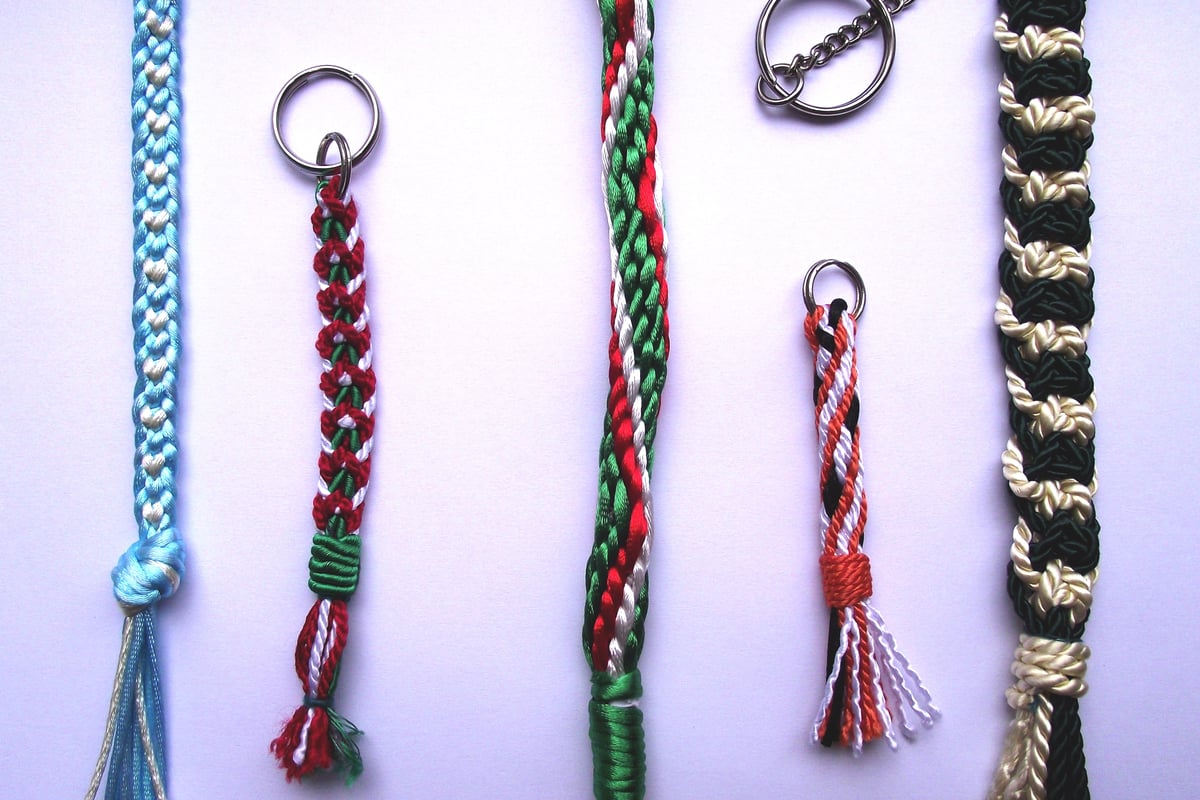
Kyo-kumihimo is braided cord made around Kyoto City and Uji City, in which artisans use multiple types of braiding stands — maru-dai, kaku-dai, and taka-dai — to hand-braid dozens of silk threads into a single cord. The techniques are remarkably varied: roughly 40 basic braiding patterns exist, and including pattern variations there are said to be more than 3,000, producing intricately braided, delicate weave patterns with an elegant sheen. It was once used for the cords of ritual and Buddhist implements, weapon fittings, and personal accessories, and today it is used mainly for kimono obijime sashes and haori cords, as well as a wide range of accessories. It received national Traditional Craft designation in 1976.
Origin
Braiding techniques are said to have already existed in simple forms in daily life during the Jomon period, and Chinese (Tang) braiding techniques are said to have been brought over through envoys to Tang China during the Nara period. Initially centered on continental-derived patterns, the craft developed into distinctly Japanese designs during the Heian period, becoming widely used for ritual and Buddhist implements, samurai armor and helmets, and sword cord fittings and other accessories and furnishings — considered the beginning of Kyo-kumihimo.
History
Having developed since the Heian period as an essential element of court and samurai attire and weaponry, braided cord spread into commoners' lives in the Edo period, and cords such as obijime and haori cords began to be actively made as kimono accessories. In Kyoto, production continued through division of labor and handwork in areas including around Uji, and in 1976 it became a Traditional Craft designated by the Minister of Economy, Trade and Industry, followed by registration as a regional collective trademark in 2007.
Features
It is characterized by the use of different braiding stands — maru-dai, kaku-dai, and taka-dai — suited to different purposes, with dozens of silk threads braided by hand; the cords are broadly divided into three types: maruuchi-himo (round), hirauchi-himo (flat), and kakuuchi-himo (square). There are said to be about 40 basic braiding patterns, and more than 3,000 including pattern variations, producing a three-dimensional effect and lustrous beauty from the intricate weave. Besides obijime and haori cords, about 80 types of products are made, including netsuke cords and accessories.
Techniques
Maru-dai braiding
One of the most basic techniques, in which threads are hung from a round stand and crossed by moving weighted bobbins to braid a rounded cord.
Kaku-dai braiding
A technique using a square stand to braid threads, suited to producing wider cords such as hirauchi-himo.
Hand braiding and machine braiding
Both "hand braiding," done thread by thread on traditional braiding stands, and "machine braiding," using cord-braiding machines, coexist today and are used depending on the application.
Materials Used
Production Process
- 1
Thread winding and dyeing
Raw silk thread is adjusted to the required thickness and dyed according to the design.
- 2
Thread allotment
The number of threads and color scheme are determined according to the braiding pattern, and the threads are wound onto bobbins accordingly.
- 3
Braiding
Using a braiding stand such as a maru-dai or kaku-dai, the bobbins are moved to cross the threads and braid them into a cord.
- 4
Tasseling and finishing
Both ends of the braided cord are gathered into tassels, and steaming and other finishing touches are applied.
| Main Production Areas |
|
|---|
Artisans & Workshops
昇苑くみひも
A Kyo-kumihimo workshop founded in Uji in 1948. It produces braided cords using both traditional "hand braiding" with old tools and "machine braiding" with cord-braiding machines, handling everything from obijime sashes to general goods.
Official site →How to Buy
- Direct workshop stores
- At Shoen Kumihimo's Uji main store (146 Uji-Myoraku, Uji City, Kyoto Prefecture), you can purchase obijime sashes, straps, and accessories. Small items such as straps start at a few hundred yen, while obijime sashes are mostly priced at several thousand yen and up.
Hands-on Experiences
昇苑くみひも 宇治本店 手組み体験
京都府宇治市宇治妙楽146番地
An experience braiding an eight-strand cord using a kaku-dai stand. Fee 2,500 yen (tax included), takes about 1 hour, reservation-only (must book at least a week in advance).
View details →