Image: Wikimedia Commons
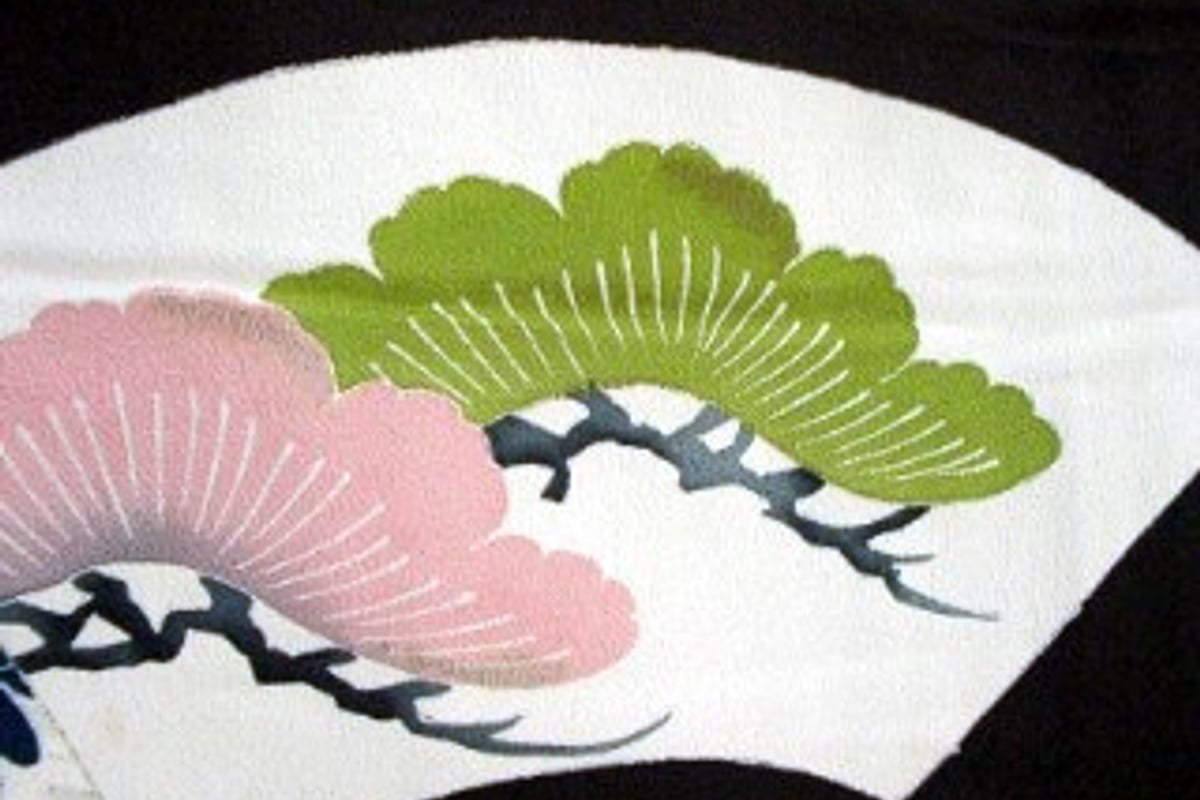
Kyo-yuzen is a patterned dyeing technique born in Kyoto during the Genroku era in the early Edo period, characterized by depicting gorgeous, elegant designs on fabric as if painted. It is said to have begun when Miyazaki Yuzensai, a popular fan painter, applied his own painting style to dyeing designs, and it spread as yuzen dyeing — a technique for dyeing pictorial patterns while resist-dyeing with paste — during an era when the shogunate's sumptuary laws restricted showy decoration such as tie-dyeing and embroidery. A single kimono is completed through many processes, including sketching, itome-nori (paste-resist outlining), color application, hikizome (immersion background dyeing), steaming, and washing (mizumoto), with each process handled by a specialized artisan under a division-of-labor system. In the Meiji era, kata-yuzen (stencil yuzen), which uses chemical dyes and paper stencils, was devised, making mass production possible. It received national Traditional Craft designation in 1976, and among Japan's three major yuzen traditions it is passed down today as the oldest dyeing technique.
Origin
Kyo-yuzen is said to have been born in Kyoto during the Genroku era (late 17th century), beginning when Miyazaki Yuzensai, who was renowned as a fan painter at the time, applied his own painting style to dyeing designs. At a time when the Edo shogunate's sumptuary laws restricted the previously popular, lavishly decorated tie-dyeing and embroidery, yuzen dyeing — which could express pictorial patterns while resist-dyeing with paste — gained popular support as a dyeing technique combining gorgeousness with formal dignity.
History
Kyo-yuzen, which developed throughout the Edo period, became capable of more efficient production than hand-painting when kata-yuzen (stencil yuzen), combining chemical dyes and paste with patterns transferred via paper stencils, was devised in the Meiji era. This allowed yuzen dyeing to spread among ordinary people as well. In 1976 it became a Traditional Craft designated by the Minister of Economy, Trade and Industry, and a division-of-labor system among specialized artisans for each process — sketching, paste application, dyeing, and finishing — continues to this day, centered on organizations such as the Kyoto Yuzen Cooperative and the Kyoto Hand-Painted Yuzen Cooperative.
Features
The greatest characteristic of Kyo-yuzen is dyeing gorgeous, elegant designs across the entire fabric as if painted. It is characterized by a division-of-labor system in which many specialized artisans are involved in completing a single kimono — sketch artists who draw the design, paste artisans who apply the itome-nori outline, and color artisans who apply the coloring — and decoration with gold leaf or embroidery is sometimes added. There are two lineages: hand-painted Kyo-yuzen, which produces one-of-a-kind pieces, and kata-yuzen, which transfers patterns using paper stencils, each with a different texture.
Techniques
Hand-painted yuzen
A technique in which itome-nori paste is applied along a sketch to resist the dye from bleeding, and color is then applied with a brush. Used for one-of-a-kind kimono, it allows for delicate, painting-like expression.
Kata-yuzen (stencil yuzen)
A technique devised in the Meiji era in which paper stencils are used to transfer paste containing chemical dye onto fabric. Because the same pattern can be dyed efficiently, it is suited to mass production.
Materials Used
Production Process
- 1
Design and sketch
The overall design of the kimono is worked out, and a sketch is drawn on the fabric using aobana (spiderwort) ink or similar.
- 2
Paste application (itome)
Itome-nori paste is applied along the lines of the sketch, creating resist lines that prevent the dye from bleeding.
- 3
Color application
Color is applied with a brush within the areas outlined by the paste lines.
- 4
Hikizome (background dyeing)
The ground color is dyed evenly or with gradation across the entire fabric using a brush.
- 5
Steaming and washing
The color is set with steam at about 100°C, after which excess dye and paste are washed out in the mizumoto rinsing process.
| Main Production Areas |
|
|---|
Artisans & Workshops
千總(ちそう)
A long-established Kyo-yuzen house said to have been founded in 1555. It began as a dealer in Buddhist vestments before shifting its main focus to yuzen dyeing in the Meiji era. Its main store is at Karasuma-Sanjo, with an attached gallery.
Official site →How to Buy
- 千總 本店
- A directly-run store of this long-established Kyo-yuzen house. Besides kimono, it also carries yuzen accessories such as fans and handkerchiefs starting in the 3,000 yen range.Where to buy →PR
Hands-on Experiences
京友禅体験工房 丸益西村屋
京都市中京区小川通御池南入る
Reservation required, takes 60-90 minutes. Handkerchief dyeing from around 1,300 yen, furoshiki wrapping-cloth experience around 4,000 yen, and more.
View details →