Image: Wikimedia Commons
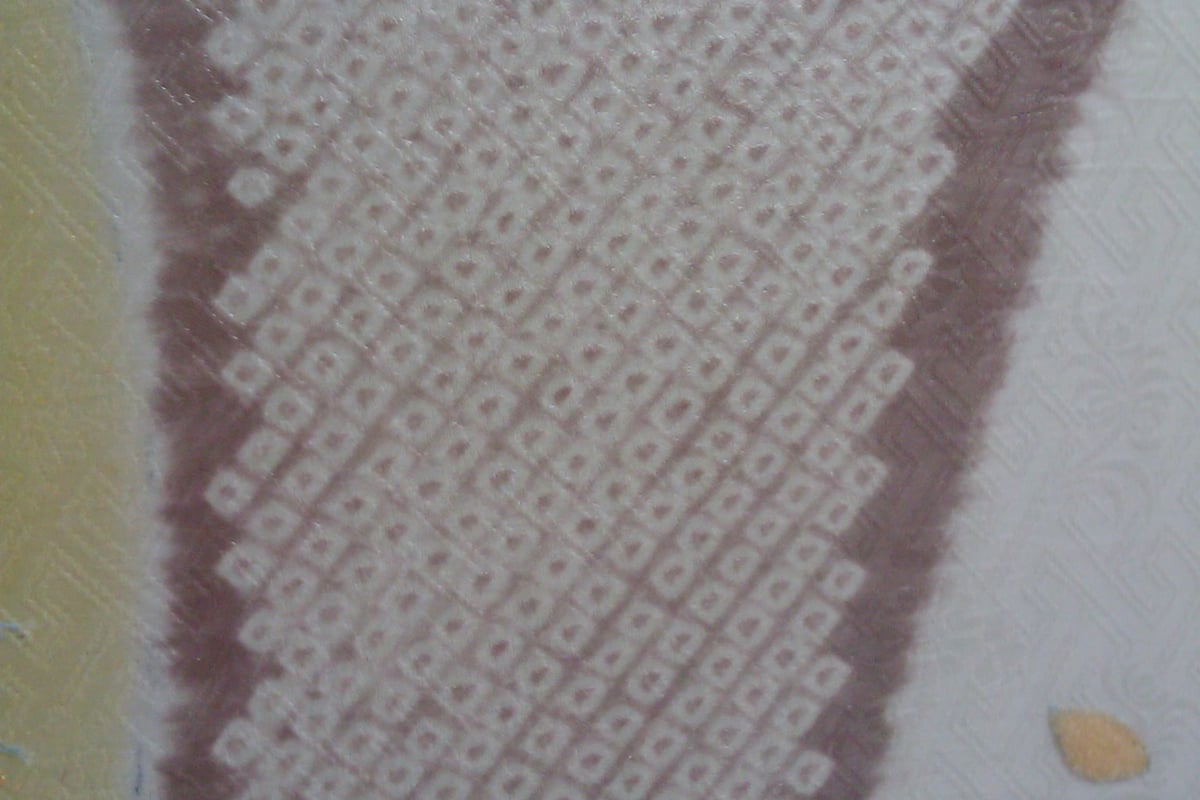
Kyo-kanoko Shibori is a Kyoto tie-dyeing craft in which fabric is bound grain by grain with thread to resist dye and create patterns; it is said to take its name from the way the finished pattern resembles the spots on a fawn's back. Combining numerous binding techniques such as hitta shibori and hitome shibori, it is characterized by the three-dimensional effect produced by finely bound grains and vivid multicolor dyeing, and because every step is done by hand, it has a distinctive richness and warmth not found in machine dyeing. It flourished as tsujigahana dyeing from the Muromachi through the early Edo period and reached its peak during the Genroku era in the mid-Edo period. Its origin is said to be India, with one theory holding it was brought to Japan around the 7th century; it has a long history, with references to tie-dyeing already found in the Nihon Shoki. It received national Traditional Craft designation in 1976.
Origin
The technique of tie-dyeing is said to have originated in India and been brought to Japan around the 7th century. The Nihon Shoki already contains references to tie-dyeing, considered Japan's oldest such record, and poems referring to tie-dyeing also appear in the Man'yoshu. In the Heian period of the 10th century it came to be used in court dress, and the technique was passed down mainly around Kyoto.
History
From the Muromachi period through the early Edo period, tsujigahana dyeing, centered on tie-dyeing, flourished and colored Kyoto's dyeing culture. In the Edo period it developed independently as "kanoko," "kanoko shibori," and "Kyo-kanoko," reaching its peak during the Genroku era at the end of the 17th century. Advanced binding techniques continued to be passed down by Kyoto artisans thereafter, and in 1976 it became a Traditional Craft designated by the Minister of Economy, Trade and Industry.
Features
It is characterized by a resist-dyeing technique that combines diverse binding methods, including hitta shibori and hitome shibori, in which fabric is bound tightly grain by grain with thread to create areas that resist dye. Its appeal lies in the precision of the binding and the three-dimensional beauty created by dyeing multiple colors, and because every stage — from drawing the design to binding and dyeing — is done by hand through a division of labor, it has a distinctive texture not found in mass-produced goods.
Techniques
Hitta shibori
A technique representative of Kyo-kanoko Shibori in which fabric is bound extremely finely, producing a pattern that emerges in neat, grid-like rows once dyed.
Hitome shibori
A basic technique of binding and dyeing fabric grain by grain, capable of expressing various patterns depending on how the grains are arranged.
Materials Used
Production Process
- 1
Design drawing
A rough sketch of the pattern is drawn on the fabric to mark the positions for binding.
- 2
Binding
Following the design, the fabric is tightly bound grain by grain with raw silk thread to create areas that resist dye.
- 3
Dyeing (immersion dyeing)
The bound fabric is immersed in dye to achieve the multicolor effect.
- 4
Untying and finishing
The binding threads on the dyed fabric are carefully untied to reveal the pattern and complete the piece.
| Main Production Areas |
|
|---|
Artisans & Workshops
株式会社京都絞美京
A Kyo-kanoko Shibori maker founded in 1937, continuing under the "Matsuoka Shibori" trade name since 1959. Third-generation Traditional Craftsman Kiichi Matsuoka established the current company in 2016 and also runs a fashion brand using traditional techniques.
Official site →How to Buy
- Purchasing at workshops and experience facilities
- Tie-dyed tenugui towels, scarves, and kimono fabric can be purchased at places such as Kyoto Shibimikyo and the tie-dyeing experience workshop Kyoto Izutsu. Tenugui start in the low thousands of yen, with silk items priced higher.
Hands-on Experiences
京都絞美京 絞り染め体験
京都市中京区壬生中川町2-3
Visitors can tie-dye a tenugui towel or scarf with guidance from a Traditional Craftsman. Multiple courses are offered, including a tenugui course for 2,000 yen (excl. tax) taking 30-50 minutes.
View details →絞り染め体験工房 京都いづつ
京都市中京区(丸太町駅より徒歩約5分)
Multiple courses are offered, from beginner level to yukata dyeing. The intermediate course takes about 1-2 hours and starts at 3,850 yen.
View details →