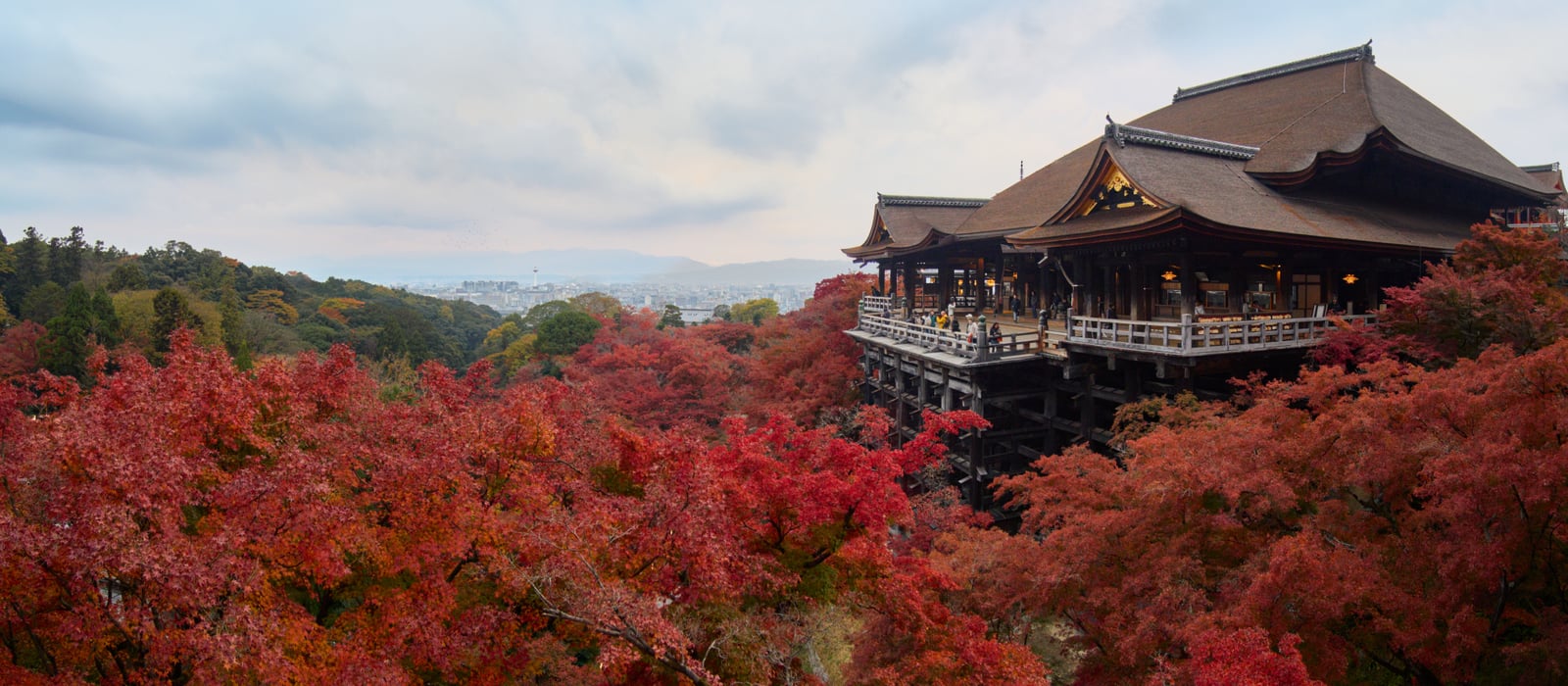
 Image: Wikimedia Commons
Kyoto Prefecture
As the imperial capital for a thousand years since the founding of Heian-kyo, Kyoto Prefecture has built up layer upon layer of culture from the court nobility, samurai, temples and shrines, and townspeople. Traditional crafts such as Nishijin-ori textiles, Kyo-yuzen dyeing, and Kiyomizu-yaki pottery were refined to the utmost under a system of specialized division of labor, while food culture such as yudofu, Kyoto pickles, and yatsuhashi remains deeply tied to Zen temples, festivals, and the daily life of the townspeople. With some of the richest craft and food traditions in Japan, simply wandering among production districts and long-established shops in areas like Gojozaka, Nishijin, Kamigamo, and Ohara is itself a highlight of visiting Kyoto.
Kyoto's Traditional Crafts
Nishijin-ori
Nishijin-ori
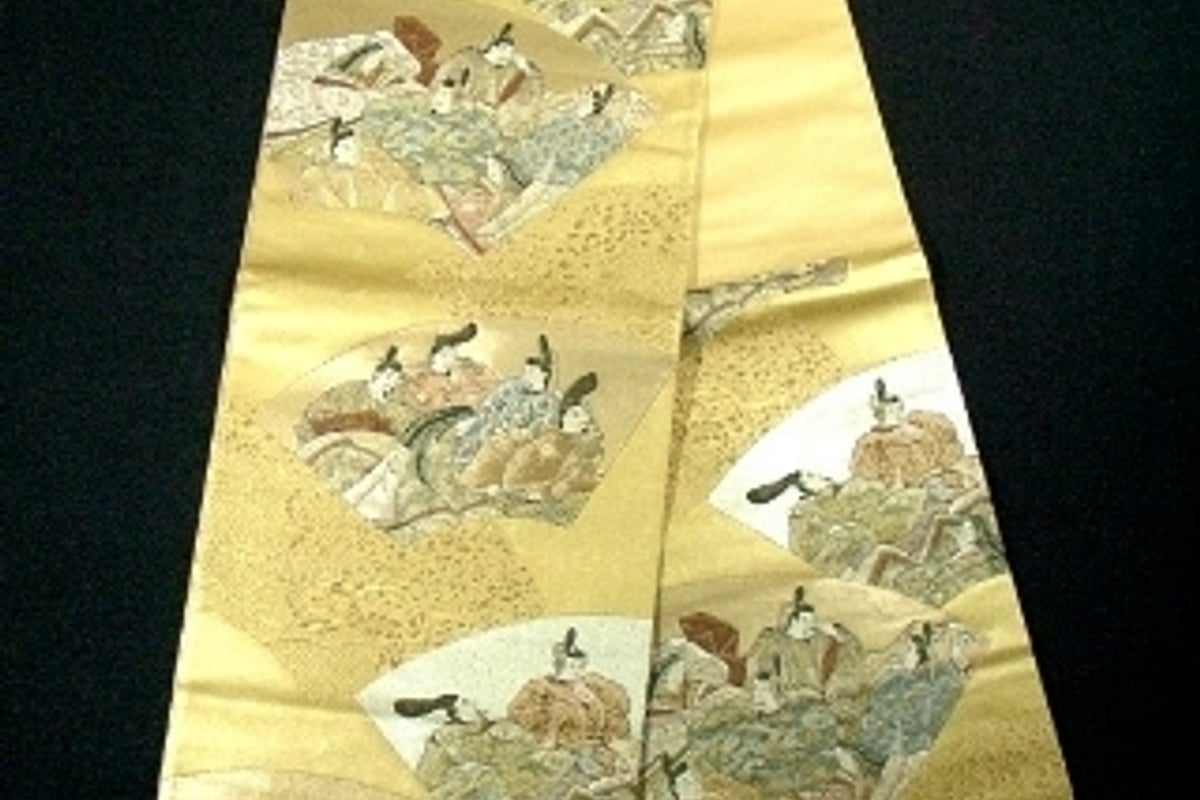
Nishijin-ori is the general term for high-grade, yarn-dyed silk textiles produced mainly in the Nishijin district of northern Kyoto City. It is a "mon-orimono" patterned weave in which the thread is dyed before being woven into designs, and 12 techniques designated as national Traditional Crafts have been passed down, including tsumekaki-hon-tsuzureori, tateshiki, nukishiki, donsu, shuchin, and shoha. Its origins are said to trace back to weaving techniques brought from the continent around the 5th to 6th centuries, and it developed in the Heian period under the court's Oribe no Tsukasa weaving bureau. It is said to take its name "Nishijin" ("western encampment") from the fact that weavers who had fled during the Onin War later resumed weaving on the site of the Western Army's former encampment. In the Edo period it established a reputation as a luxury textile favored by feudal lords and wealthy merchants, and it continues today to support Japanese kimono culture, mainly through obi sashes. A major characteristic is that many specialized artisans are involved through a division of labor, from design creation to dyeing and weaving, maintaining a system of producing many varieties in small quantities.
Kyo-yuzen
Kyo-yuzen
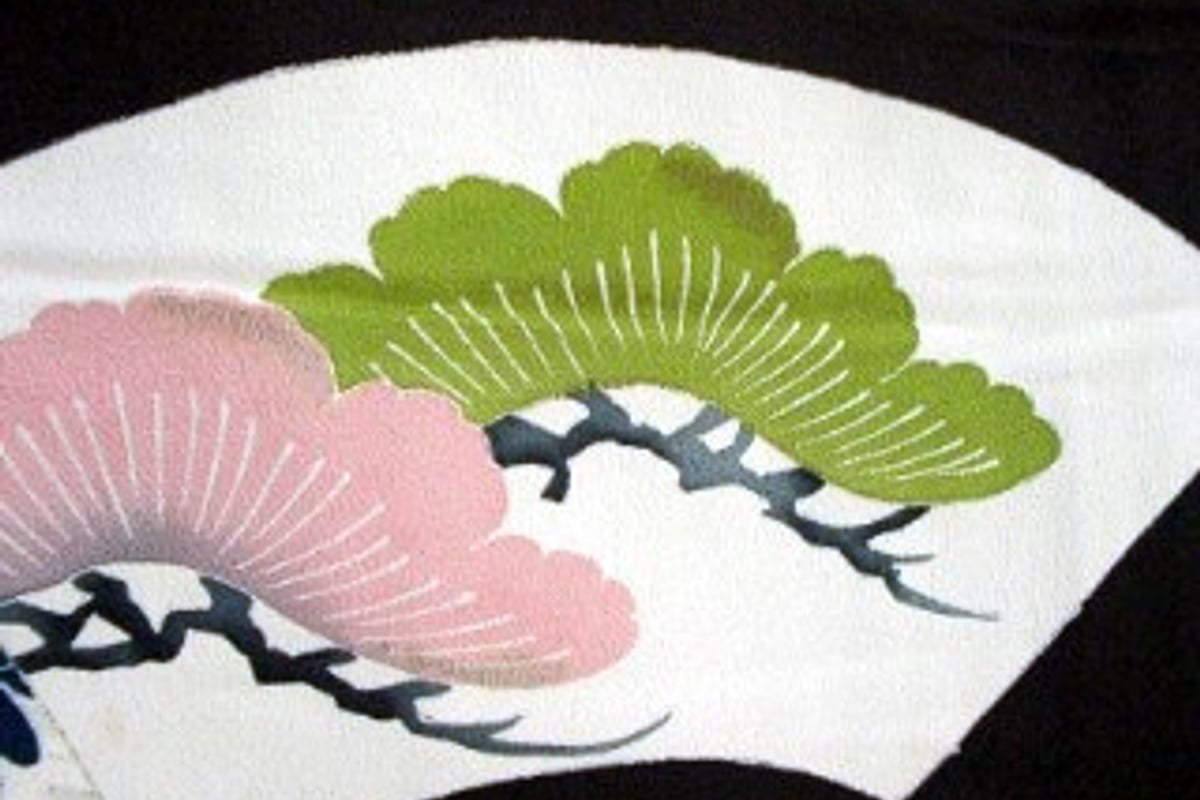
Kyo-yuzen is a patterned dyeing technique born in Kyoto during the Genroku era in the early Edo period, characterized by depicting gorgeous, elegant designs on fabric as if painted. It is said to have begun when Miyazaki Yuzensai, a popular fan painter, applied his own painting style to dyeing designs, and it spread as yuzen dyeing — a technique for dyeing pictorial patterns while resist-dyeing with paste — during an era when the shogunate's sumptuary laws restricted showy decoration such as tie-dyeing and embroidery. A single kimono is completed through many processes, including sketching, itome-nori (paste-resist outlining), color application, hikizome (immersion background dyeing), steaming, and washing (mizumoto), with each process handled by a specialized artisan under a division-of-labor system. In the Meiji era, kata-yuzen (stencil yuzen), which uses chemical dyes and paper stencils, was devised, making mass production possible. It received national Traditional Craft designation in 1976, and among Japan's three major yuzen traditions it is passed down today as the oldest dyeing technique.
Kyo-yaki / Kiyomizu-yaki
Kiyomizu-yaki
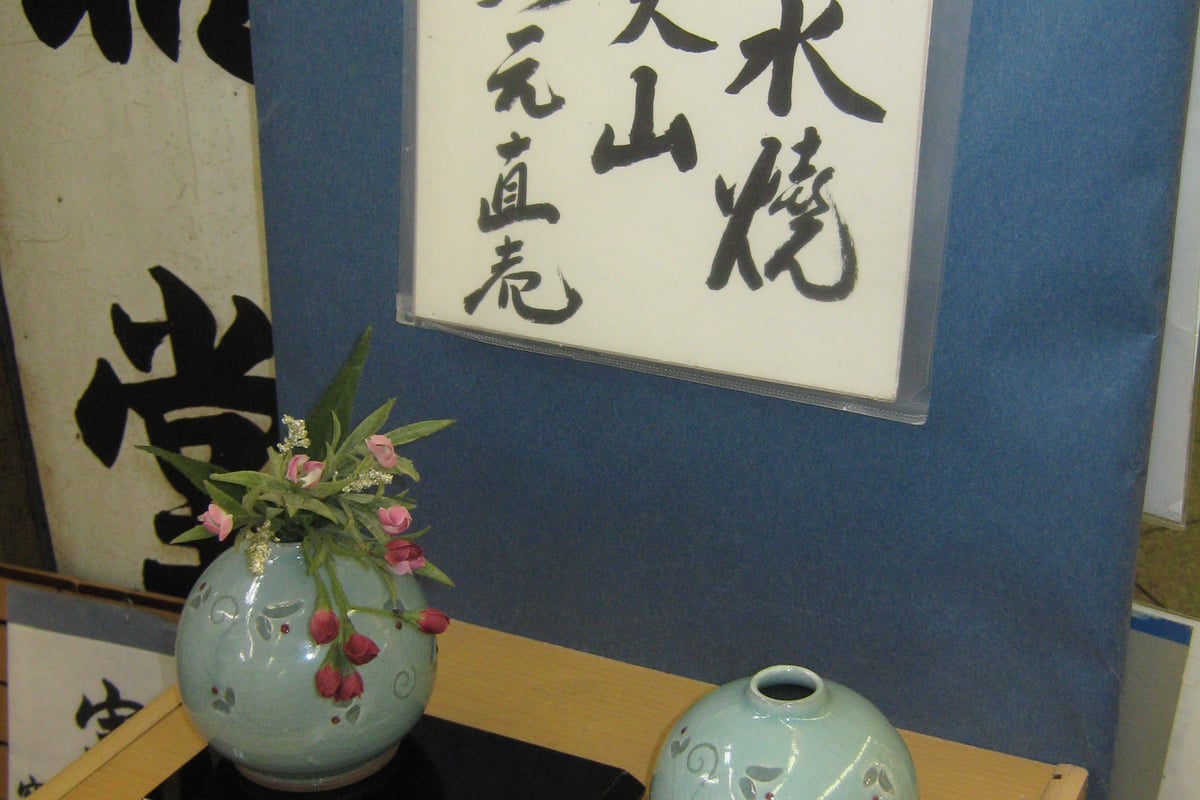
Kyo-yaki / Kiyomizu-yaki is a general term for the porcelain and pottery representative of Kyoto, and its greatest characteristic is that it is not bound to any single style, with each maker expressing their own individuality. The first pottery in Kyoto is said to have been fired around the Kan'ei era (1624-1645) at Awataguchi in Higashiyama, known as "Awataguchi-yaki." When the tea ceremony flourished during the Momoyama period, various tea utensils and vessels, including Raku ware, began to be made throughout the city. In the Edo period, master craftsmen such as Nonomura Ninsei, Ogata Kenzan, Okuda Eisen, and Aoki Mokubei appeared one after another, firmly establishing the status of Kyo-yaki. The name comes from the kilns of the Gojozaka and Kiyomizu districts along the approach to Kiyomizu-dera Temple. Unlike other pottery-producing regions, there are no strict rules governing clay, technique, or painting style, and each potter's individuality is respected. Today, the main production areas are Gojozaka and Chawanzaka in Higashiyama Ward, the Kiyomizu-yaki Danchi in Yamashina Ward, and Sumiyama in Uji City.

Kyo-shikki (Kyoto Lacquerware)
Kyo-shikki
Kyo-shikki is a Kyoto lacquer craft nurtured alongside the court culture of Heian-kyo, characterized by "hon-katachi," a meticulous undercoating technique of applying lacquer in many layers to thin wooden bases, and by the beauty of maki-e, in which designs are drawn with gold and silver powder. Its origins are said to trace back to the relocation of the capital to Heian-kyo in 794; the "makkinru" technique born in the Nara period was passed down in the Heian period and perfected as togidashi maki-e and hira maki-e. As tea ceremony culture spread, demand for tea utensils also grew, and refined designs were honed to meet the requests of court nobles, temples and shrines, and tea masters. It received national Traditional Craft designation in 1976, and is highly regarded for combining a profound, elegant appeal with the qualities of "wabi" and "sabi" not found in lacquerware from other production areas. A single vessel passes through many processes, from base-wood making to undercoating, final coating, and decoration, before completion.
Kyo-sashimono (Kyoto Joinery)
Kyo-sashimono
Kyo-sashimono is a Kyoto woodworking craft made without metal nails or other joining fittings, instead using "kumite" joinery techniques that fit wooden boards to boards and rods to boards, along with mortise-and-tenon joints. Its origins are said to trace back to the court culture of the Heian period, and it developed by incorporating culture that arrived from China and Korea into distinctly Japanese woodworking techniques of the kind seen in the Shosoin Repository. From the Muromachi period onward, specialized sashimono craftsmen emerged, and as tea ceremony culture spread, refined techniques were honed for both sashimono as furnishings and sashimono as tea utensils. It is characterized by discerning use of woods suited to their properties — lightweight, warp-resistant paulownia; soft, smooth cedar; and sturdy, luxurious zelkova — assembled with precision while making the most of the wood grain's beauty. It is used for a wide range of items including Kyo-tansu chests, shelving, tea utensils, and inkstone boxes, and it received national Traditional Craft designation in 1976.
Kyo-sensu (Kyoto Folding Fans)
Kyo-sensu
Kyo-sensu is the general term for folding fans made in and around Kyoto, said to have been invented in Kyoto in the early Heian period. Rooted in the hi-ogi (cypress fans) and paper fans used at court, its greatest characteristic is that specialized artisans divide the labor by process — fan-face making, rib processing, painting, and finishing — with a single fan said to pass through more than 80 steps before completion. In contrast to Edo-sensu, where a single artisan handles the whole process, Kyo-sensu has a history of pursuing meticulous finishing through this division-of-labor system. Its designs range widely to suit purpose — from tea-ceremony fans and dance fans for uses such as tea ceremony, Noh, and dance, to practical fans and decorative fans — and Kyoto and its surrounding area still account for the majority of domestic fan production today. It became a Traditional Craft designated by the Minister of Economy, Trade and Industry in 1977.
Kyo-uchiwa (Kyoto Flat Fans)
Kyo-uchiwa
Kyo-uchiwa is a Kyoto flat fan whose greatest characteristic is its "sashie" (inserted handle) structure, in which the handle and the fan face are made separately and the handle is inserted afterward. Unlike typical uchiwa fans in which the ribs and handle are made from a single piece of bamboo, Kyo-uchiwa's fan face has numerous bamboo ribs arranged radially, and its distinctiveness lies in attaching a separately lacquered and decorated handle afterward. Its origin is said to trace back to the Nanboku-cho period, when fans brought from the Korean Peninsula reached Fukakusa near Kyoto, and in the Edo period it developed into "gosho-uchiwa," fans painted by court painters for the imperial court. Though a practical item, it is cherished as a craft in which beautiful designs reminiscent of Japanese-style painting harmonize with precise bamboo work.
Kyo-kumihimo (Kyoto Braided Cords)
Kyo-kumihimo
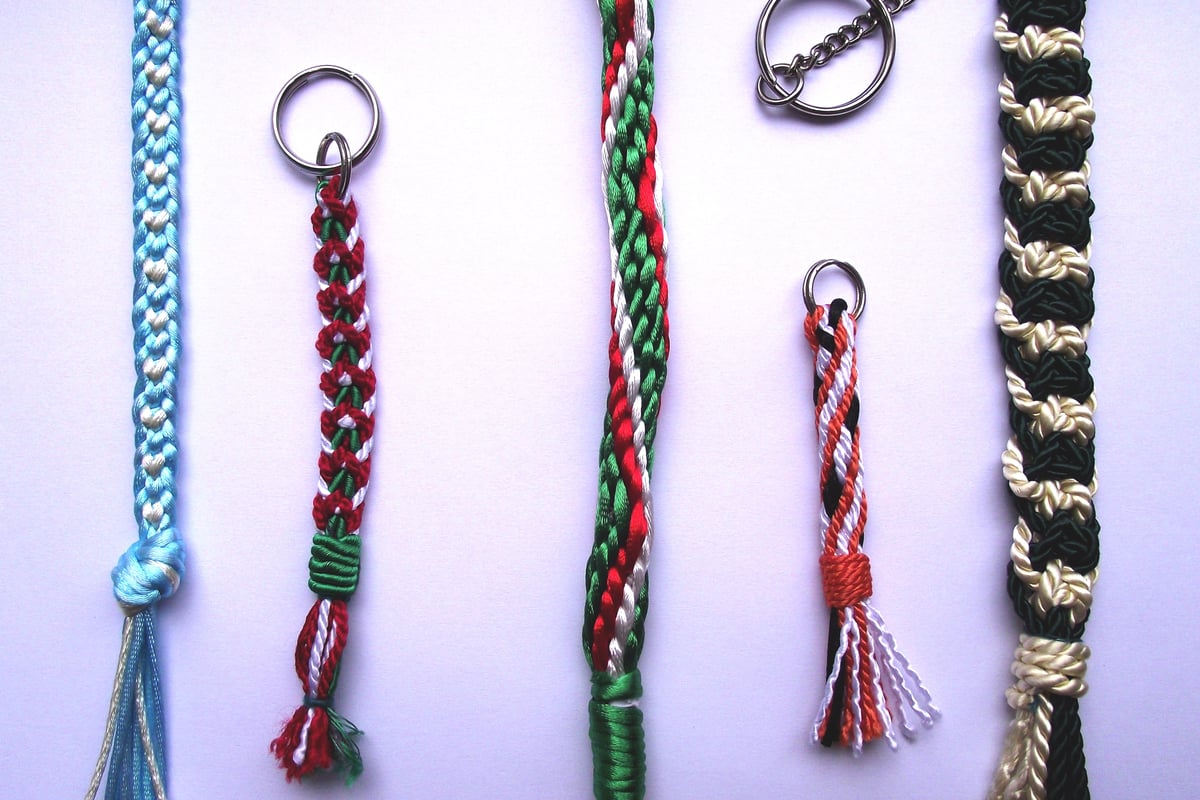
Kyo-kumihimo is braided cord made around Kyoto City and Uji City, in which artisans use multiple types of braiding stands — maru-dai, kaku-dai, and taka-dai — to hand-braid dozens of silk threads into a single cord. The techniques are remarkably varied: roughly 40 basic braiding patterns exist, and including pattern variations there are said to be more than 3,000, producing intricately braided, delicate weave patterns with an elegant sheen. It was once used for the cords of ritual and Buddhist implements, weapon fittings, and personal accessories, and today it is used mainly for kimono obijime sashes and haori cords, as well as a wide range of accessories. It received national Traditional Craft designation in 1976.
Kyo-kuromontsuki-zome (Kyoto Black Crested Dyeing)
Kyo-kuromontsuki-zome
Kyo-kuromontsuki-zome is a Kyoto dyeing technique that dyes silk fabric a deep black and precisely dyes-out the family crest, used for black tomesode kimono worn at weddings and mourning wear worn at funerals. There are two dyeing techniques: hikizome, used for patterned fabric such as black tomesode, and shinsome (immersion dyeing), used for plain fabric such as mourning wear. Dyes such as safflower red and indigo are layered to produce a distinctive black with depth and luster, not simply a flat black. The mon-sho-uwae technique of dyeing the family crest white onto the finished fabric is also indispensable. Kyoto is said to account for over 90% of the black crested fabric produced nationwide, and it received national Traditional Craft designation in 1976.
Kyo-kanoko Shibori (Kyoto Fawn-Spot Tie-Dyeing)
Kyo-kanoko Shibori
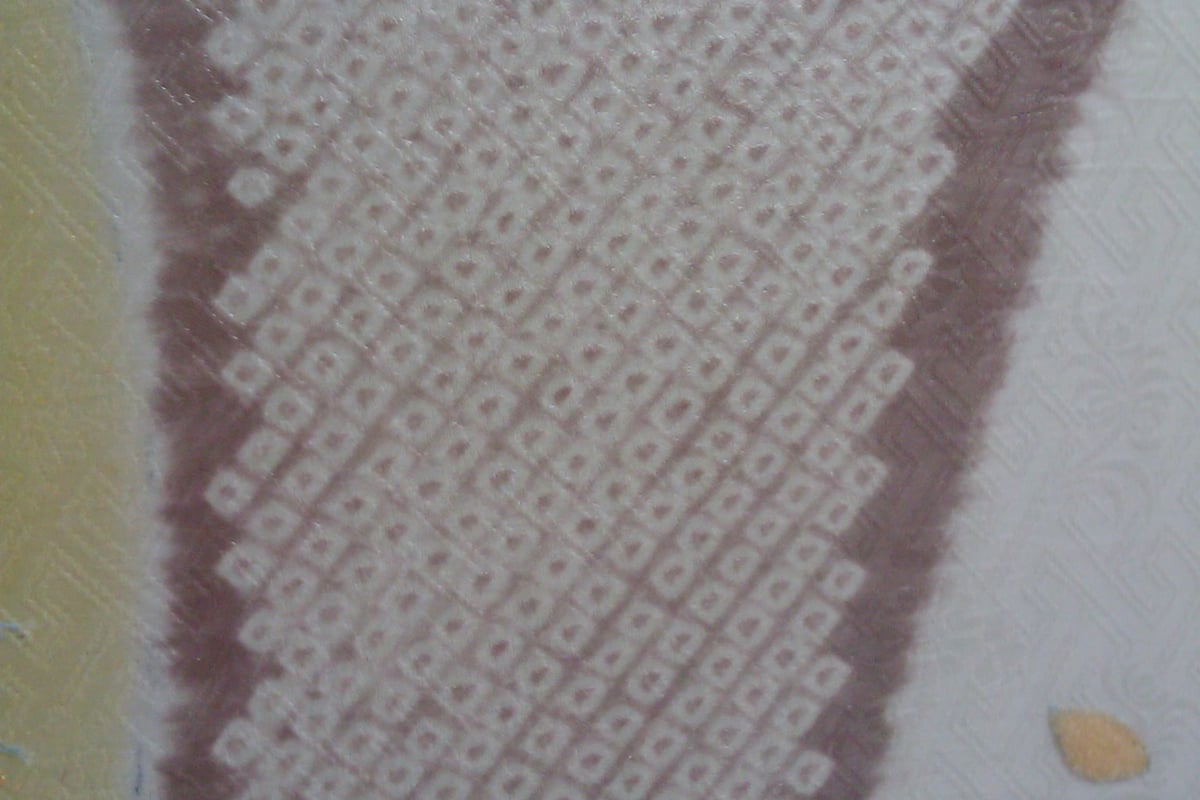
Kyo-kanoko Shibori is a Kyoto tie-dyeing craft in which fabric is bound grain by grain with thread to resist dye and create patterns; it is said to take its name from the way the finished pattern resembles the spots on a fawn's back. Combining numerous binding techniques such as hitta shibori and hitome shibori, it is characterized by the three-dimensional effect produced by finely bound grains and vivid multicolor dyeing, and because every step is done by hand, it has a distinctive richness and warmth not found in machine dyeing. It flourished as tsujigahana dyeing from the Muromachi through the early Edo period and reached its peak during the Genroku era in the mid-Edo period. Its origin is said to be India, with one theory holding it was brought to Japan around the 7th century; it has a long history, with references to tie-dyeing already found in the Nihon Shoki. It received national Traditional Craft designation in 1976.
Kyo-nui (Kyoto Embroidery)
Kyo-nui
Kyo-nui (Kyoto embroidery) is a traditional Kyoto embroidery craft in which patterns are sewn onto fabric using a single needle and multicolored silk, gold, and silver threads. It began when the "Nuibe no Tsukasa" bureau, responsible for court clothing decoration, was established with the relocation of the capital to Heian-kyo, and it developed alongside garments such as juni-hitoe court robes, warlords' dobuku coats, Noh costumes, and kosode kimono. Alongside dyeing and weaving, it holds an important place in the history of Japanese textile arts, and it is characterized by the way overall composition, thread color coordination, and embroidery techniques and methods combine to create three-dimensional, evocative expression on flat fabric. About 30 techniques survive today, of which 15 — including nuikiri, komazukai-nui, and matsui-nui — are recognized as designated techniques of the Traditional Craft certified by the Minister of Economy, Trade and Industry. In recent years it has been applied beyond kimono-related items to framed works and accessories, opening up new demand.
Kyo-butsudan (Kyoto Buddhist Altars)
Kyo-butsudan
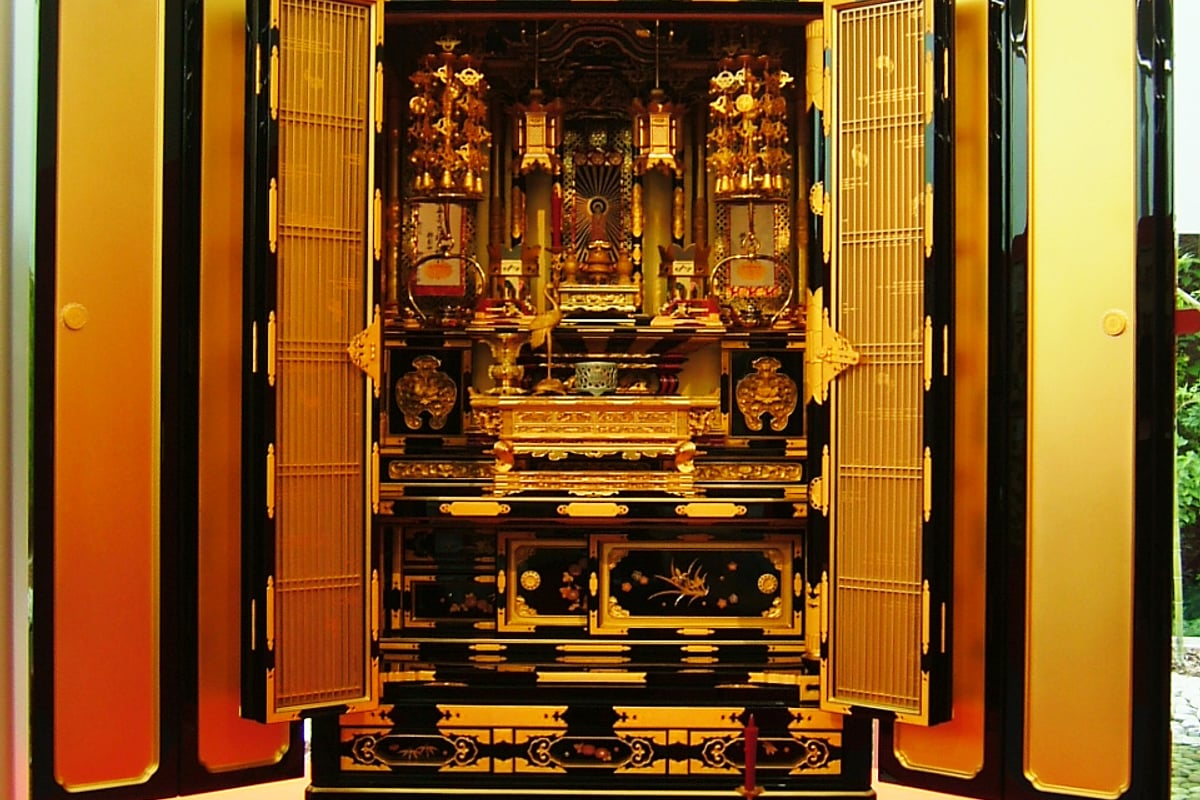
Kyo-butsudan are traditional Kyoto Buddhist altars made through a division-of-labor system involving more than forty specialized trades, including woodworking, roof (miya-den) construction, wood carving, lacquering, roiro polishing, pure gold leaf application, ornamental metal fittings, maki-e, and coloring. Buddhist altar fitting production in Kyoto is believed to have begun around the 8th century, shortly after the introduction of Buddhism, and became fully established in the early 11th century when the Buddhist sculptor Jocho set up the "Shichijo Busho" workshop in Shichijo. Demand surged in the early Edo period when the shogunate's temple registration system spread the custom of enshrining an altar in every household. Because styles of religious ornamentation differ by sect, mass production is unsuited to this craft, giving it the character of a comprehensive art form that draws together woodworking, lacquerwork, metalwork, and other traditional techniques. Today, roughly 70% of the altars and altar fittings produced in Kyoto are for temple use, and Kyoto supplies much of the temple altar equipment used nationwide. It was designated a Traditional Craft by the Minister of Economy, Trade and Industry in 1976.
Kyo-butsugu (Kyoto Buddhist Fittings)
Kyo-butsugu
Kyo-butsugu is a general term for the tools used in Buddhist rites at temples and homes, including incense burners, candlesticks, flower vases (kebyo), Buddhist statues, and other ceremonial fittings — a comprehensive art form drawing together woodworking, lacquerwork, metalwork, dyeing and weaving, and other diverse techniques. Production of Buddhist fittings is said to have begun with the introduction of Buddhism in the 6th century, and in Kyoto it became fully established in the early 11th century when the Buddhist sculptor Jocho set up the "Shichijo Busho" workshop in Shichijo, marking over a thousand years of history since. Because the design and specifications of fittings differ by Buddhist sect, mass production is unsuited to this craft, and each piece is finished by hand under a division-of-labor system involving more than forty specialized trades. Today, roughly 70% of the fittings produced in Kyoto are for temple use, and Kyoto supplies much of the Buddhist fitting equipment used in temples nationwide. It became a Traditional Craft designated by the Minister of Economy, Trade and Industry in 1976.
Raku-yaki
Raku-yaki
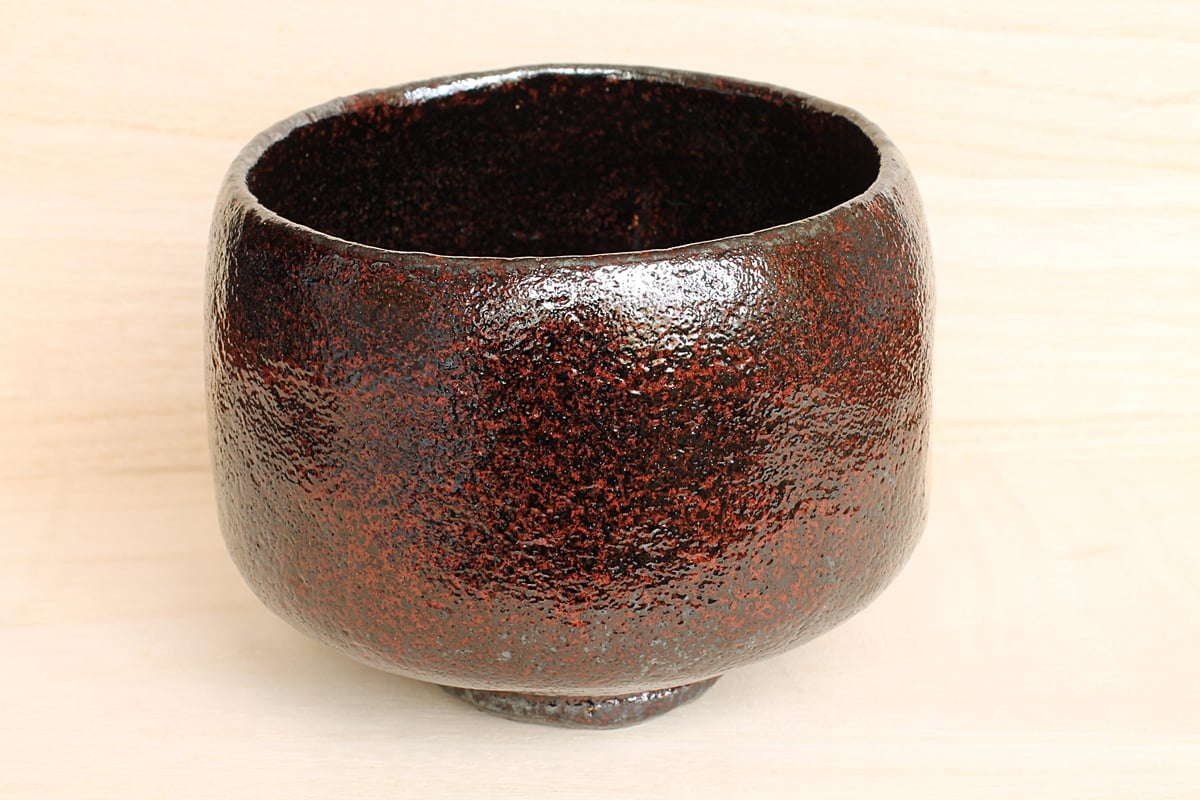
Raku-yaki is a ceramic art originating from the hand-formed tea bowls devised in the Momoyama period by Chojiro, the first-generation head of the Raku family, embodying the wabi-cha philosophy of Sen no Rikyu, and it has been passed down in Kyoto for over 450 years. Its characteristic technique is shaping each bowl one at a time by hand and spatula alone, without a potter's wheel, then firing it at a low temperature; the unadorned, generous forms and the soft texture that seems to cradle the palm have long been loved by tea practitioners. The technical roots are said to lie in Chinese sancai (three-color) ware of the Ming dynasty, believed to have been transmitted by Ameya, an immigrant craftsman said to be Chojiro's father. The Raku family has passed the craft down from father to a single chosen heir from the first-generation Chojiro to the current sixteenth generation, with each generation's head developing a distinctively individual style — a feature not seen in other ceramic traditions. Today, alongside the mainline Raku-yaki of the Raku family, several other kilns in Kyoto also produce aka-raku and kuro-raku tea bowls modeled on this tradition.
Kyo-hyogu (Kyoto Mounting and Framing)
Kyo-hyogu
Kyo-hyogu is a traditional Kyoto craft in which paintings, calligraphy, and dyed or woven textiles are mounted and preserved using fabric and Japanese paper, taking the form of hanging scrolls, folding screens, sliding doors, and framed pieces. It originates in the mounting of Buddhist sutra scrolls brought from China with the introduction of Buddhism, and in Kyoto, once the imperial capital, the technique was refined through its ties to the worship of Buddhist paintings, the tokonoma alcove culture of shoin-zukuri architecture, and the flourishing of the tea ceremony. The basin climate's high humidity is also said to have supported the craft's development, being well suited to the process of layering paste and Japanese paper before drying them. Mounters (kyoji) not only create new hanging scrolls and folding screens but also handle the repair and restoration of old paintings, calligraphy, and cultural properties, and their skills are relied upon in the restoration of National Treasures and Important Cultural Properties. It received national Traditional Craft designation in 1997 and was registered as a regional collective trademark in 2007.
Kyoto's Local Food
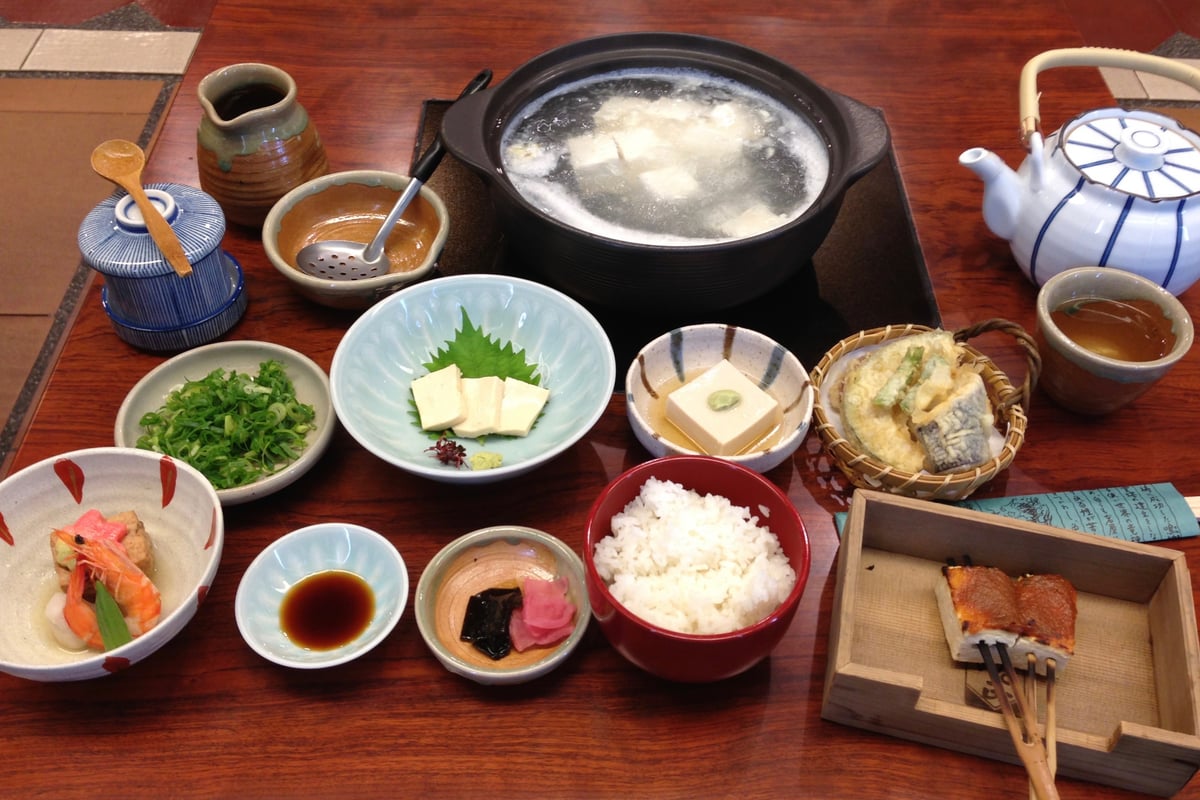
Yudofu (Simmered Tofu Hot Pot)
Yudofu
Yudofu is a simple local dish of Kyoto in which tofu is gently warmed in an earthenware pot filled with kelp dashi and served with ponzu sauce and condiments. Known to have originated at the approach to Nanzen-ji Temple in Sakyo Ward, Kyoto City, it developed as a shojin cuisine (Buddhist vegetarian cooking) dish for savoring the flavor of tofu itself. Kyoto, blessed with high-quality groundwater, has long had a thriving tofu-making tradition, and the quality of the water and soybeans is said to greatly affect the flavor. Although known as a symbol of winter, specialty shops around Nanzen-ji actually offer it year-round, and it is one of the Kyoto dishes popular with tourists as well. Though understated, its depth of appeal lies in the careful attention paid to the temperature and texture of the dashi and tofu.
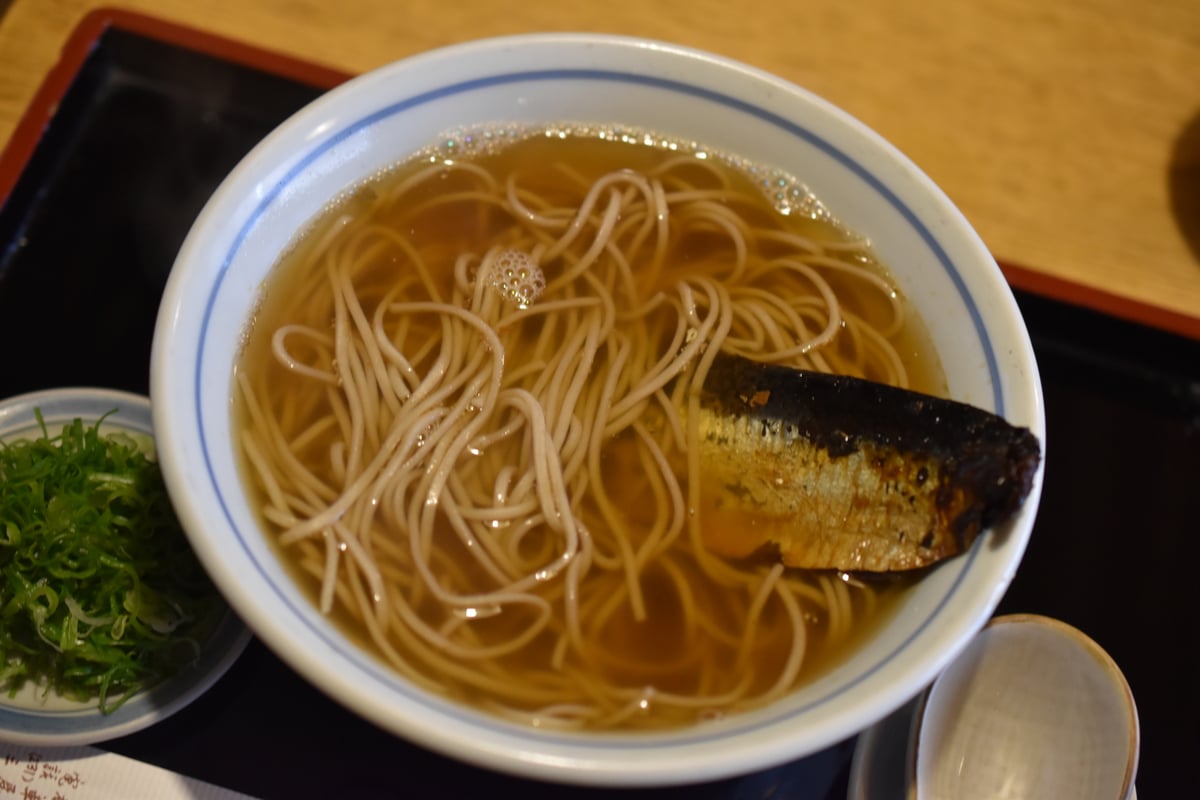
Nishin Soba (Herring Soba)
Nishin Soba
Nishin Soba is a noodle dish that originated in Kyoto, made by topping hot soba with sweet-and-savory simmered migaki-nishin (dried, filleted herring). In landlocked Kyoto, dried migaki-nishin brought from Hokkaido by kitamae-bune trading ships was prized as a valuable source of protein, and this dish was born from its combination with soba culture. It is said to have been created around 1882 (Meiji 15) by Matsuno Yosokichi, the second-generation owner of the soba shop Matsuba, founded in 1861 (Bunkyu 1), and it has been established as a Kyoto specialty ever since. Its distinctive feature is the combination of herring simmered until soft down to the bone in a kanroni-style glaze with a broth built on bonito and kelp dashi, and it is also widely known as a tourist specialty of Kyoto.
Senmaizuke (Thousand-Layer Pickled Turnip)
Senmaizuke
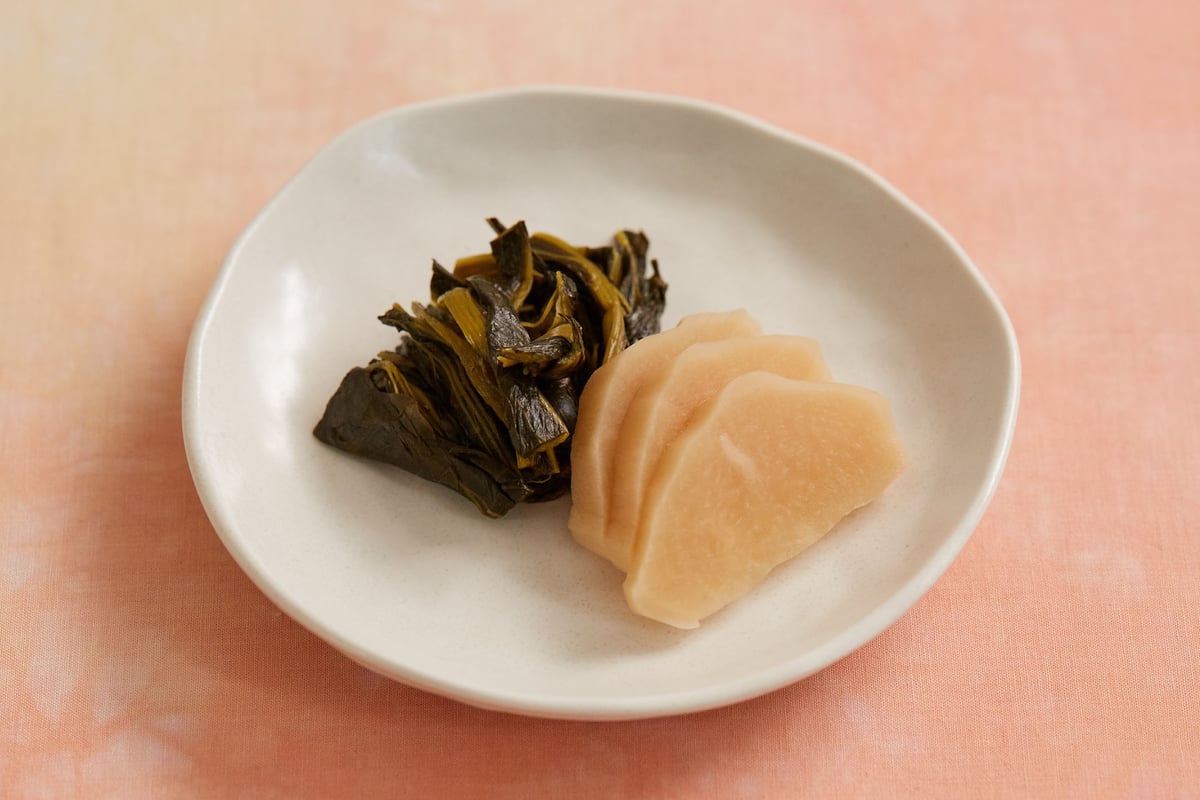
Senmaizuke is a pickle representative of Kyoto, made by salting thinly sliced Shogoin turnip (kabura) together with kelp and finishing it with a sweet-sour flavor using vinegar and mirin. Counted alongside sugukizuke and shibazuke as one of "Kyoto's three great pickles," it is especially cherished as a winter flavor of Kyoto. It is said to have originated in 1865 (Keio 1), created by the first-generation Daikokuya Tozaburo, who served as a cook at the Imperial court, and there is a sense of historical background in its design, in which the turnip represents the white gravel and the accompanying mibuna greens represent the green of the pines, evoking the scenery of the Imperial Palace. Its distinctive elegant sweetness, the umami of the kelp, and its crisp texture make it a staple Kyoto souvenir as well.
Sugukizuke (Fermented Suguki Pickles)
Sugukizuke
Sugukizuke is a pickle with a distinctive sourness, made by pickling "sugukina," a Kyoto vegetable specific to the Kamigamo area of Kyoto, using only salt and allowing it to lactic-ferment. Alongside senmaizuke and shibazuke, it is one of "Kyoto's three great pickles," and it is said that the shake (hereditary priestly families) of Kamigamo Shrine began making it in the early Edo period. It was once a valuable item whose method was passed down only among the shake families, and in the Edo period it was guarded so strictly that an official notice was issued declaring that "not a single suguki may be taken outside the village." Labor-intensive traditional methods are still carried on today, including a unique weighting method called "tenbin-zuke" and a process of placing it in a muro (heated chamber) to promote fermentation.
Shibazuke (Purple Shiso Pickles)
Shibazuke
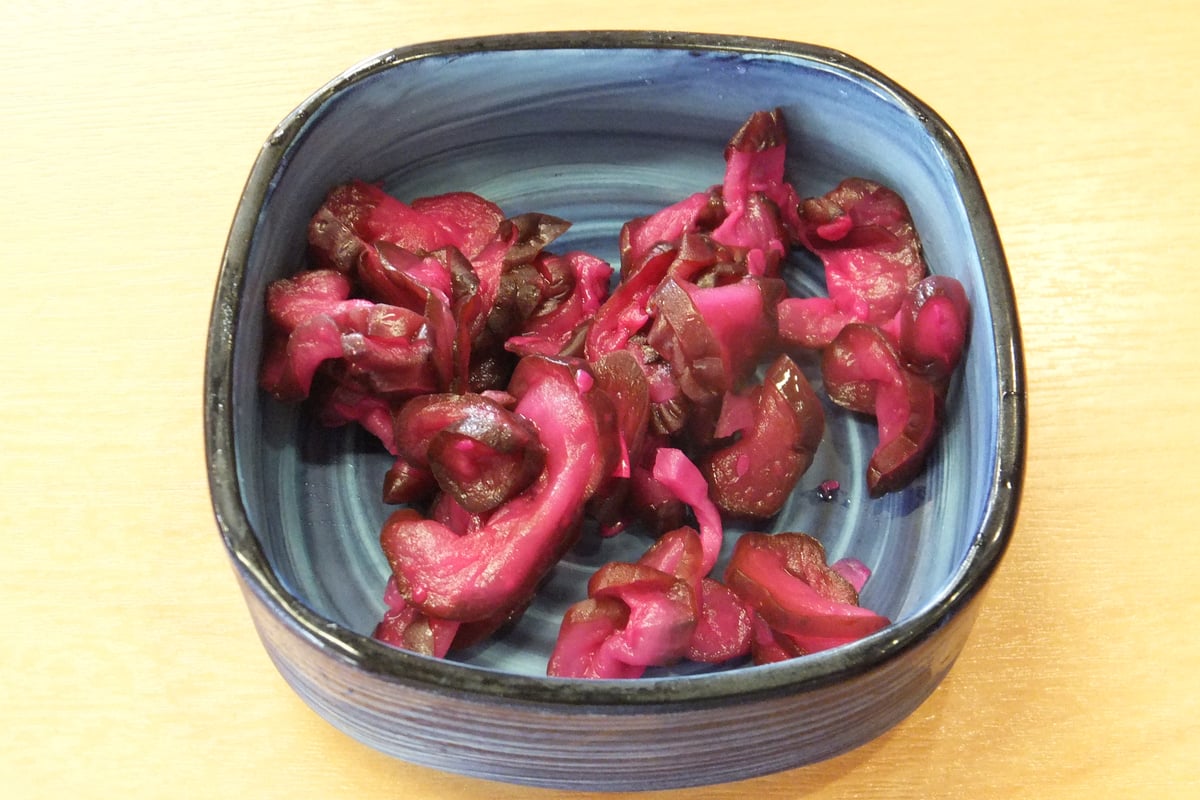
Shibazuke is a vividly purple Kyoto pickle made by salting summer vegetables such as eggplant and cucumber together with red shiso leaves and allowing them to lactic-ferment. Alongside sugukizuke and senmaizuke, it is one of "Kyoto's three great pickles," and the high-quality red shiso grown in the Ohara district of Sakyo Ward, Kyoto City, is an indispensable ingredient. The name is said to originate from an anecdote in which Kenreimon-in Tokuko, the empress consort of Emperor Takakura, spent her remaining years at Jakko-in Temple in Ohara; delighted by the beautiful purple color of the shiso pickles presented to her by local villagers, she named it "murasaki-ha-zuke" ("purple leaf pickle"). While many commercial products are pickled with seasoned vinegar, Ohara still upholds the traditional method of "nama-shibazuke," fermented with only salt and red shiso.
Yatsuhashi
Yatsuhashi
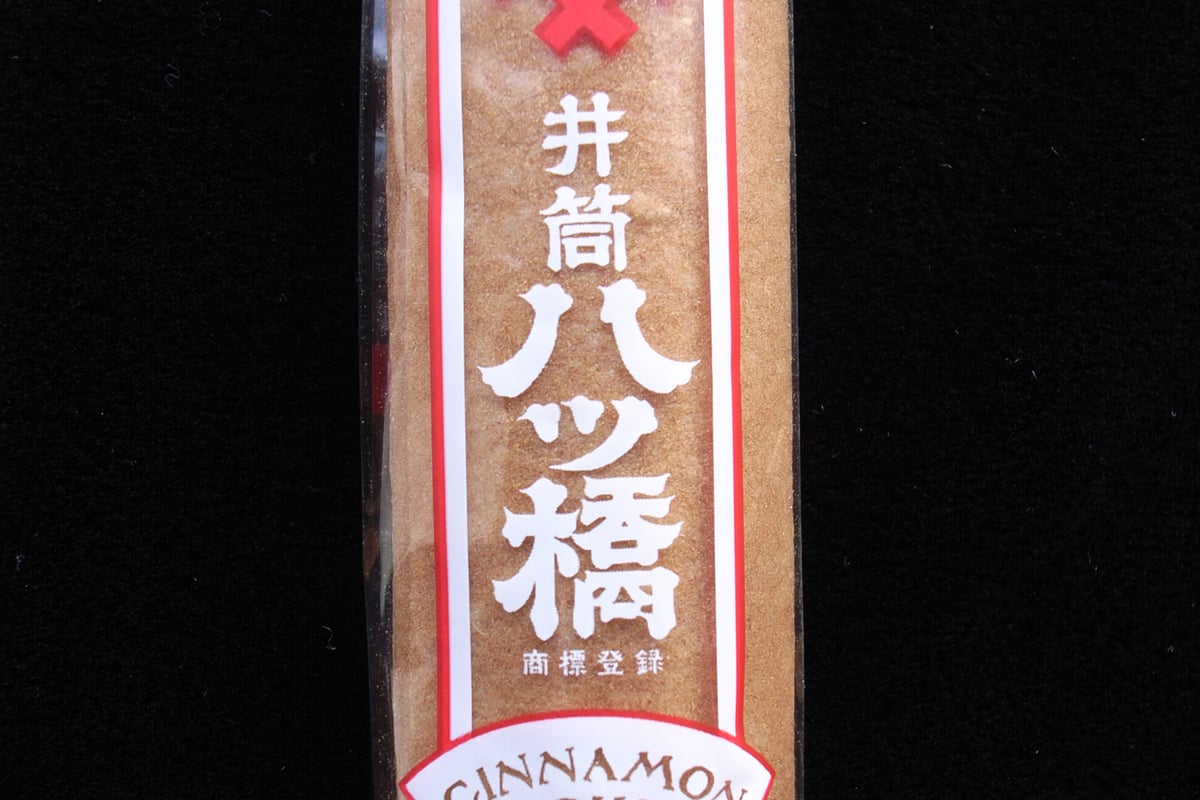
Yatsuhashi is a famous Kyoto confection made by steaming rice flour with sugar and cinnamon (nikki), then rolling it thin and baking it. Its distinctive feature is a shape curved like a crescent moon, said by one theory to be named after the Edo-period koto musician Yatsuhashi Kengyo, and by another to derive from the shape of the wooden bridge at Yatsuhashi in Mikawa Province that appears in The Tales of Ise. It was once only a hard-baked cracker, but from the Showa era onward, an unbaked, soft version called "nama-yatsuhashi" was created, and the triangular nama-yatsuhashi wrapped around bean paste became the mainstream souvenir version. Today there is a wide range of flavors, including matcha, chocolate, and seasonal strawberry, and more than a dozen companies belonging to the Kyoto Yatsuhashi Industry Cooperative Association each manufacture and sell it using their own methods.
Warabimochi (Bracken-Starch Rice Cake)
Warabimochi
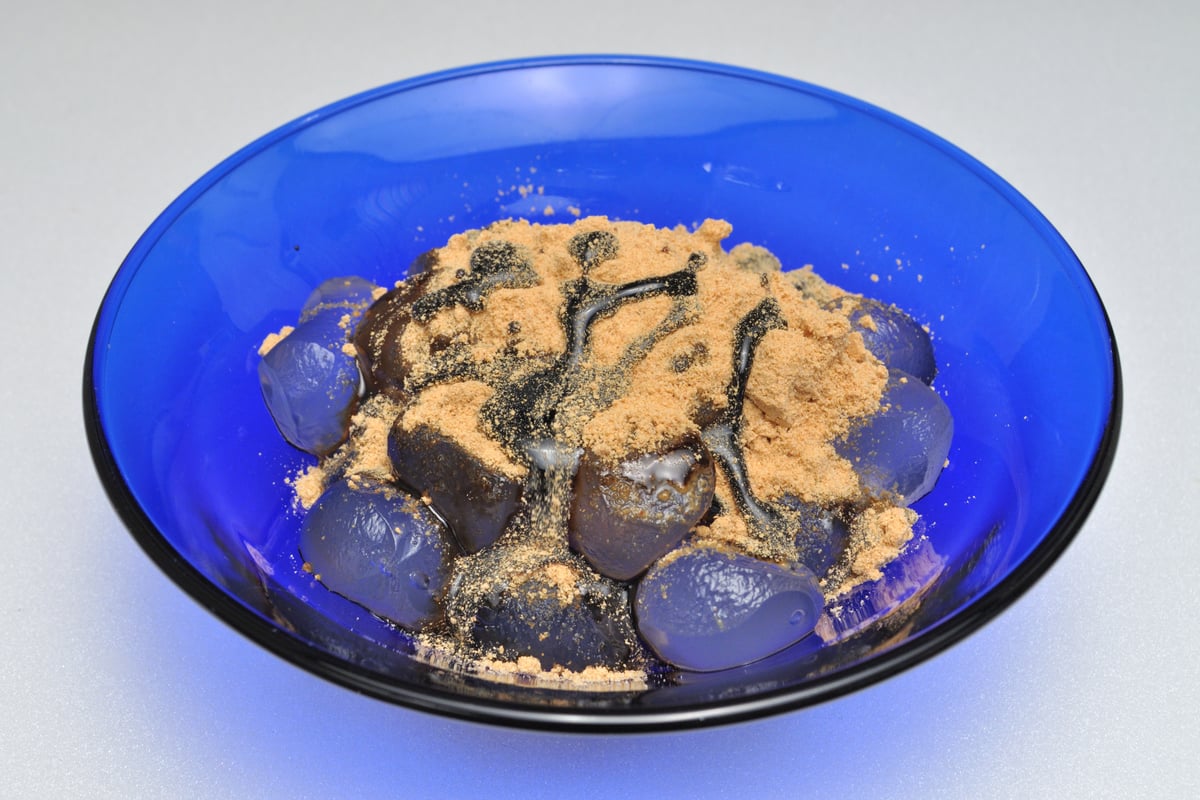
Warabimochi is a cooling sweet made by dissolving "warabiko" (bracken starch), extracted from the root of the bracken fern, in water and kneading it, then eating it topped with kuromitsu (black sugar syrup) and kinako (roasted soybean flour). Its distinctive features are a melt-in-the-mouth soft texture and a faint bitterness, and it is said to have been a luxury confection beloved by aristocrats in the Heian period. "Hon-warabiko," true bracken starch that can only be extracted from bracken roots, is extremely scarce — only a few hundred grams can be extracted from 10 kilograms of root — so inexpensive products using other starches, such as sweet potato starch, are also widely sold. Many sweets shops in Kyoto insist on kneading it fresh to order, and shops centered around Gion and Shimogamo that serve warabimochi made with true hon-warabiko are also popular with tourists.
Ajari Mochi
Ajari Mochi
Ajari Mochi is a semi-moist confection made by wrapping a chunky sweet red bean paste (tsubuan) of Tanba Dainagon azuki beans in a dough of glutinous rice flour, egg, and sugar, and baking it on a griddle. The chewy dough, its fragrant golden-brown surface, and the mild sweetness of the tsubuan combine in a balance that has made it a beloved staple of Kyoto souvenirs. Both the name and the distinctive shape, with its raised center, are said to derive from the ajiro-gasa (woven bamboo hat) worn by "ajari" — Buddhist monks who complete the thousand-day circumambulation practice (sennichi kaiho-gyo) on Mt. Hiei. Since the long-established Kyoto confectionery Mangetsu created it in the Taisho era, it has remained the shop's signature product for over a hundred years, and in recent times other confectioners have begun making similar sweets, making it one of Kyoto's representative wagashi.
Hamo Ryori (Conger Pike Eel Cuisine)
Hamo Ryori
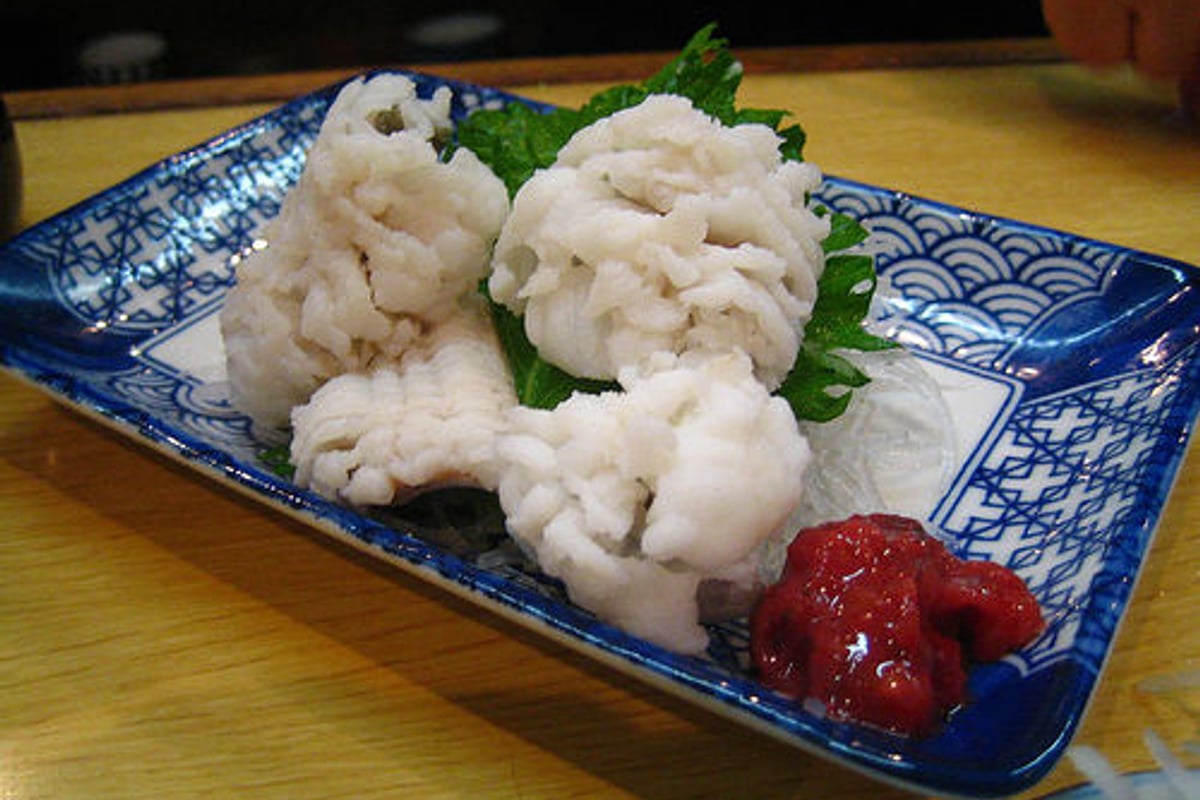
Hamo Ryori is a summer local dish of Kyoto in which conger pike eel (hamo), in season from the rainy season through midsummer, is prepared using the distinctive technique known as honekiri (bone-cutting). Even in landlocked Kyoto, hamo could be transported alive thanks to its strong vitality, making it a valued source of protein since the era before refrigeration existed. Because hamo has so many small bones that it cannot be eaten without honekiri, this technique developed into a symbol of a chef's skill, and in Kyoto it is said that "mastering honekiri makes a chef full-fledged," making it one of the most important stages of a chef's training. Preparations range widely, from hamo no otoshi — blanched hamo served with plum paste — to teriyaki, hamo shabu-shabu, and simmered dishes, and because hamo comes into season around the time of the Gion Festival, the festival is also nicknamed the "Hamo Festival," reflecting how indispensable this flavor is to a Kyoto summer.
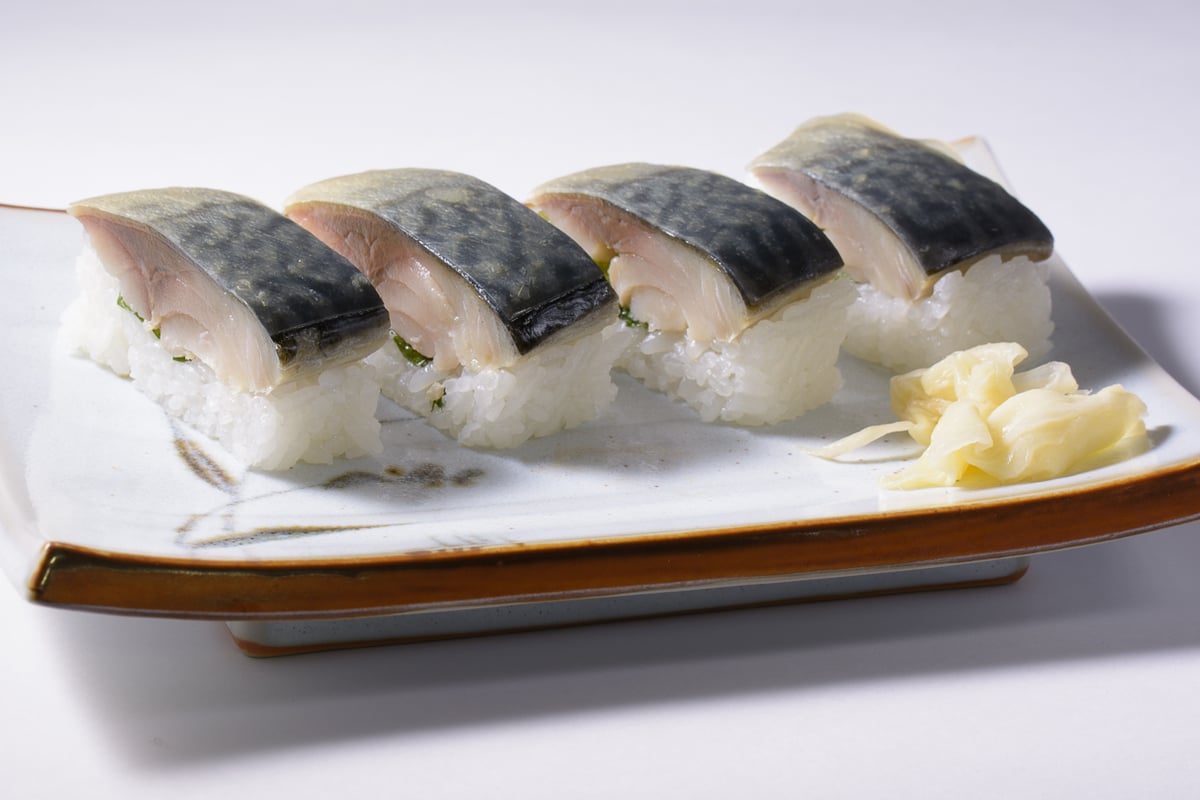
Kyo Sabazushi (Kyoto Mackerel Sushi)
Kyo Sabazushi
Kyo Sabazushi is a local sushi of Kyoto in which salt-cured mackerel is placed atop vinegared rice shaped into a bar and wrapped in kelp. It developed as a valuable opportunity to eat fresh seafood in landlocked Kyoto, and is said to have originated from mackerel caught in Wakasa Bay that was salted and carried on foot along the route known as the "Saba Kaido" (Mackerel Road) to Kyoto, becoming perfectly seasoned by the time it arrived. Even today, with refrigeration technology fully developed, the custom of eating it as a feast for "hare" (celebratory) occasions — including Kyoto's three great festivals, the Aoi Matsuri, Gion Matsuri, and Jidai Matsuri, as well as autumn festivals across the region — continues to be passed down, and it is cherished as a special dish served at home and at festival gatherings. There are two styles: "bo-zushi," pressed and shaped into a bar, and "sugata-zushi," which uses a whole mackerel as is, and each shop's individuality shows in how it is prepared.
Jako Sansho (Dried Baby Sardines with Sansho Pepper)
Jako Sansho
Jako Sansho is a tsukudani (food simmered in soy sauce) made by simmering chirimen-jako (boiled and dried baby anchovies) together with fresh sansho peppercorns in a sweet-savory mixture of soy sauce, mirin, and sake. It is one of the obanzai (everyday Kyoto home dishes) indispensable to a Kyoto table. Also known as "chirimen sansho," it has long been enjoyed as an accompaniment to rice, in ochazuke, and as a snack with sake. Originally made in individual households as something like a small gift to share with neighbors and visitors, it became widely known as a staple Kyoto souvenir after being commercialized in the mid-Showa era. Its distinctive appeal lies in the deep, layered flavor created by the sharp bite and refreshing aroma of the fresh sansho peppercorns balanced against the savory richness of the chirimen-jako, and part of the enjoyment is comparing the different blends offered by each shop.
Kamo Nanba (Duck and Green Onion Noodles)
Kamo Nanba
Kamo Nanba is a winter noodle dish cherished in Kyoto, combining duck meat and Kujo green onions with soba or udon. "Nanba" is a Kamigata (Kyoto-Osaka region) word for green onion, said to derive from the "Namba negi" once cultivated around the Namba area of Osaka. In Kyoto, locally grown Kujo negi, descended from the Namba negi lineage, is used, and the dish is characterized by a broth in which the flavor of green onion — whose sweetness increases with cooking — melds with the rich savoriness of fatty duck meat. It is also known as a dish whose name and written form differ between eastern and western Japan: in the Kanto region it is written "鴨南蛮" (kamo nanban), while in the Kamigata region it is called "鴨なんば" (kamo nanba). At long-established soba shops in Kyoto, it is often offered as a winter-only menu item, cherished as a bowl to enjoy during the cold season.
Kuzukiri (Kudzu Starch Noodles)
Kuzukiri
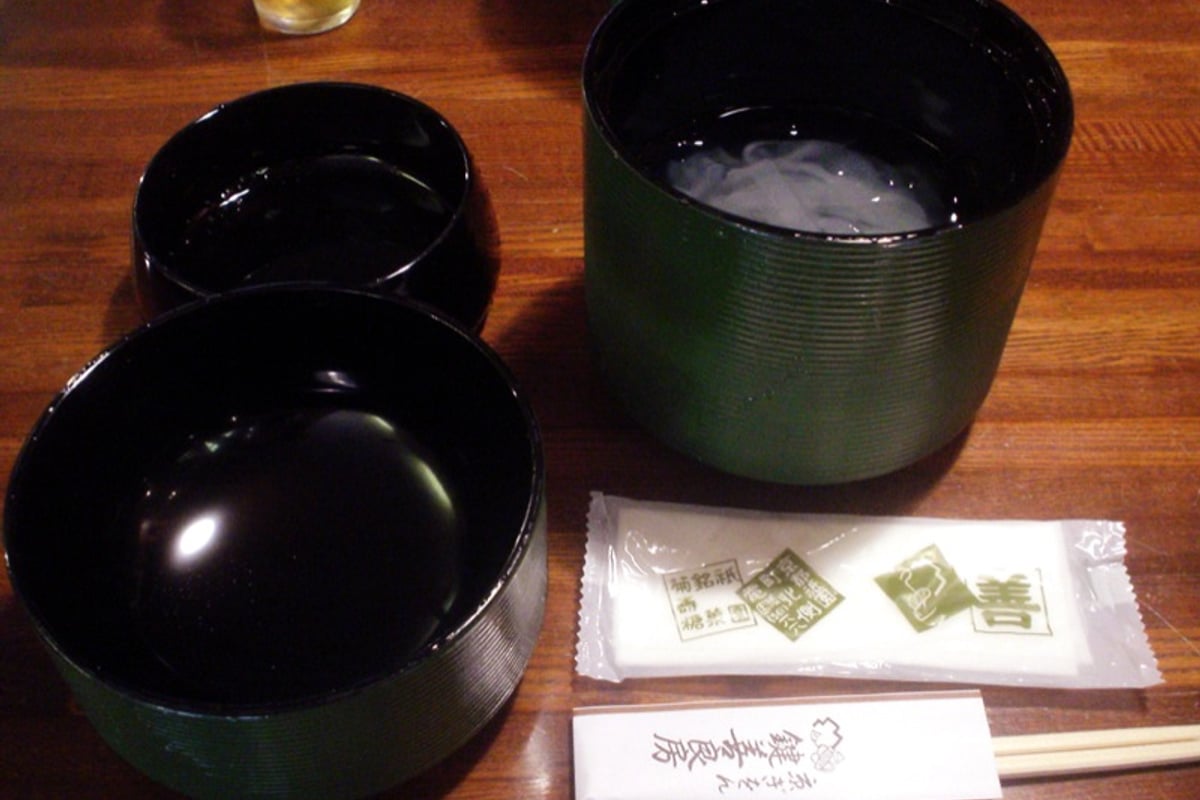
Kuzukiri is a summer sweet from Kyoto made by dissolving kudzu starch in water, steaming it firm, and cutting it into thin, noodle-like strips. It is chilled in ice water and enjoyed for its smooth, slippery texture, dipped in kuromitsu (black sugar syrup), shiromitsu (white syrup), or kinako (roasted soybean flour). Widely known as a specialty of sweets shops such as the long-established Gion shop Kagizen Yoshifusa, it is often handmade to order, piece by piece, and its freshly made springiness and translucent texture are part of its charm. The ingredient most often used is hon-kuzu, high-quality kudzu starch from Yoshino, Nara, and as a delicate confection whose flavor and texture are shaped directly by the quality of the kudzu, it has become a symbol of a Kyoto summer. The long-established Gion shop Kagizen Yoshifusa is said to have been founded during the Kyoho era (1716-1736), and it continues to uphold the style of handmaking each piece only after an order is received.
Hikichigiri (Hinamatsuri Wagashi)
Hikichigiri
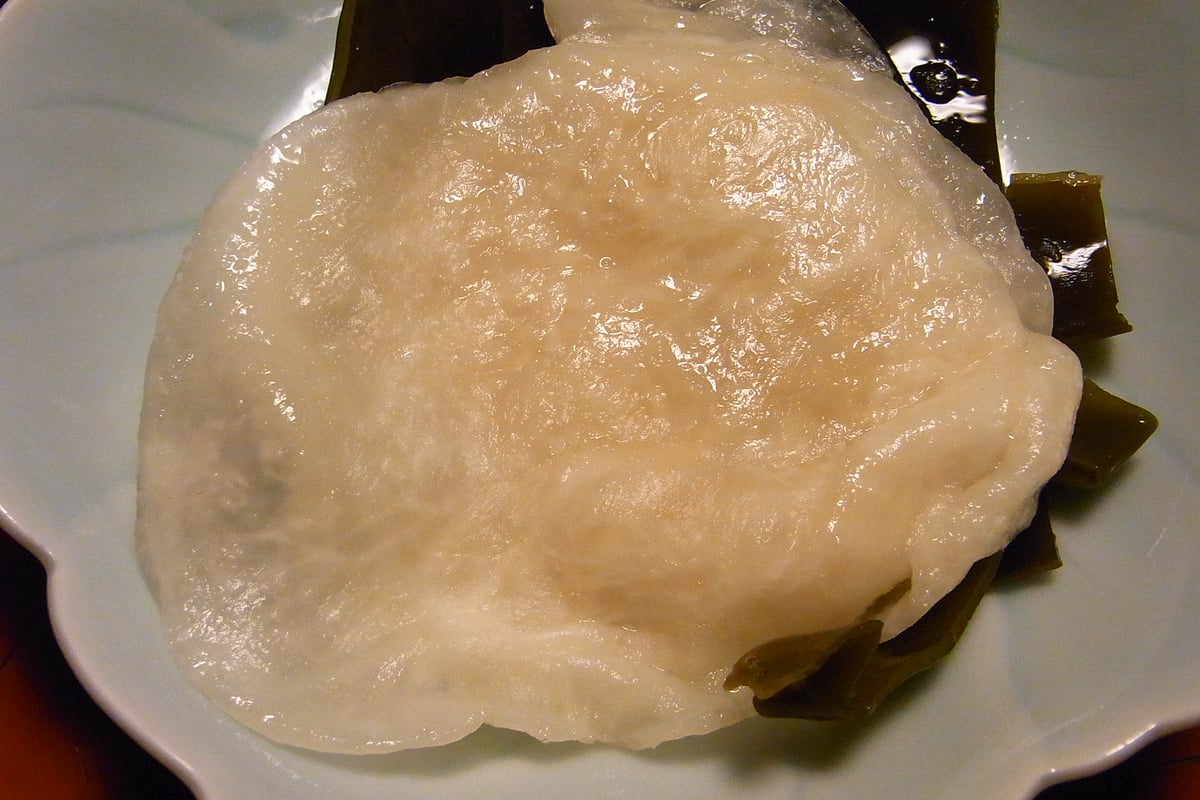
Hikichigiri is a traditional premium wagashi (jonamagashi) made in Kyoto around the time of the Hinamatsuri (Doll's Festival). Dough such as mugwort mochi is stretched into a ladle-like shape, finished with an edge that looks as though it has been torn off, and topped with sweet bean paste or kinton (sweetened mashed bean paste) in the central hollow. Said to derive from a court ritual confection, it has long been cherished in Kyoto as a special sweet displayed alongside the Hinamatsuri dolls. The name is said to come from an anecdote in which, being too busy to properly round the mochi, someone simply tore it apart; and because its distinctive shape resembles an akoya pearl oyster, it is also said to carry a wish to protect and nurture a child's growth like a pearl. Its roots are traced to "itadaki-mochi," a rice cake used in court rituals for childbirth and the ceremony of the maternity sash, and many versions are colored green by mixing mugwort into the dough.
Kamonasu Dengaku (Grilled Kamo Eggplant with Miso)
Kamonasu Dengaku
Kamonasu Dengaku is a local dish representative of a Kyoto summer, made using "kamonasu," a traditional Kyoto vegetable. Whole, round kamonasu eggplants are cut into rounds or halves and slowly deep-pan-fried in oil, then generously topped with dengaku miso — a paste made by blending white or red miso with mirin, sugar, and sake. Kamonasu has firm flesh that holds its shape well when cooked and pairs well with oil, making it a vegetable well suited to dengaku preparation. Around July, the time of the Gion Festival, it is served as a seasonal delicacy not only at home but also in Kyoto's traditional restaurants (ryotei) and eateries, and it is cherished as a dish that adds color to a Kyoto summer. Kamonasu has a long history of cultivation, appearing in the 1684 (Joukyou 1) text Yoshu Fushi, and it is said to have once been grown in the Yoshida and Tanaka districts of Sakyo Ward.
Model Course
Half-day Higashiyama course: Kiyomizu-yaki, yudofu, and kuzukiri
Spend the morning exploring the kilns around Gojozaka and the Kiyomizu-yaki Danchi, then visit Kiyomizu-dera Temple before enjoying the famous yudofu along the approach to Nanzen-ji Temple. Head on to Gion to finish with kuzukiri at a sweets shop such as Kagizen Yoshifusa - a classic route through the Higashiyama area.
Full-day course: Traditional crafts in Nishijin and Kitano
After watching the weaving process for obi sashes and kimono at the Nishijin Textile Center, visit long-established Kyo-sensu fan and Kyo-kumihimo braid workshops to experience the dyeing and weaving culture handed down through Kyoto's specialized division of labor. Combine with a visit to Kitano Tenmangu Shrine for a half-day to full-day itinerary.
Full-day course: Pickles and Kyoto vegetable dishes in Kamigamo and Ohara
Visit long-established sugukizuke pickle shops around Kamigamo Shrine, then head to the village of Ohara to tour shibazuke producers - a course tracing Kyoto's pickling culture. Stopping at a restaurant serving Kyoto-vegetable dishes such as kamonasu dengaku (grilled Kamo eggplant) is also recommended.
Events
Gion Matsuri
Every year, July 1-31 (float processions: Saki-matsuri on July 17, Ato-matsuri on July 24) / Around Yasaka Shrine and Shijo-Karasuma
Gojo Wakamiya Pottery Festival (Kyoto Pottery Festival)
Every year, August 7-10 / Around Gojozaka