Image: Wikimedia Commons
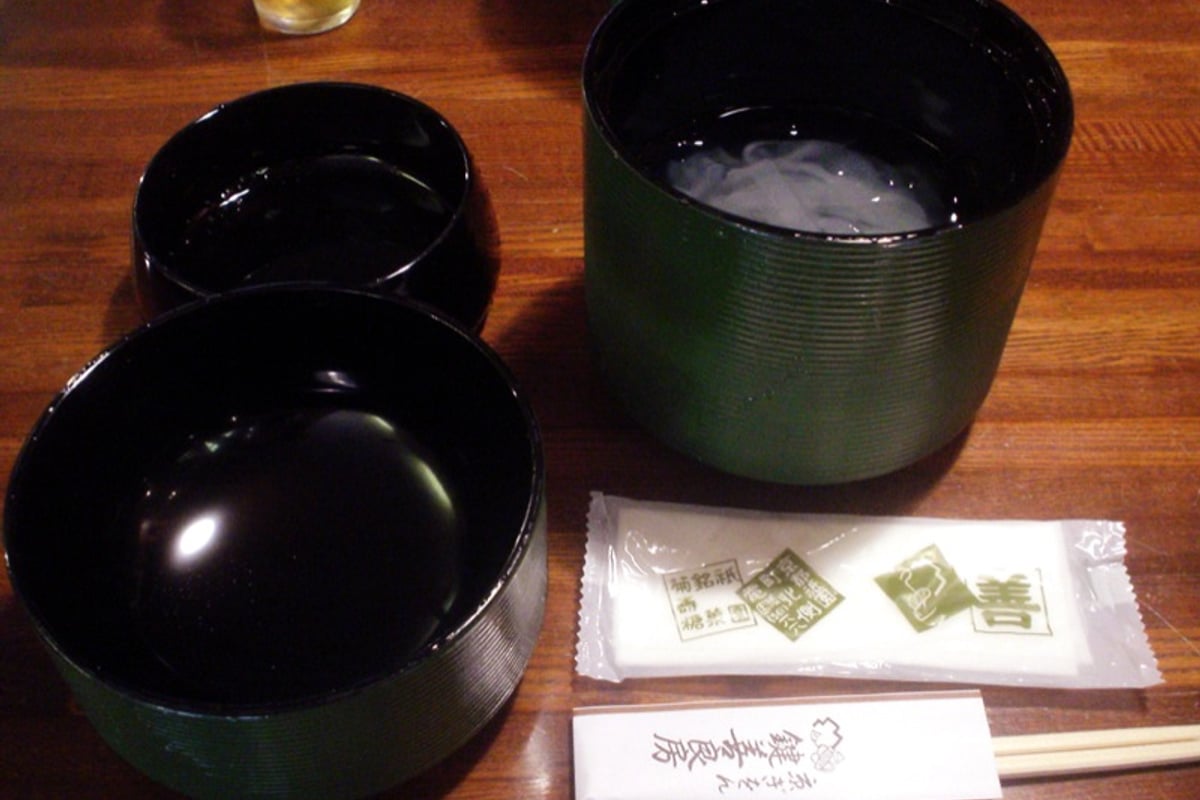
Kuzukiri is a summer sweet from Kyoto made by dissolving kudzu starch in water, steaming it firm, and cutting it into thin, noodle-like strips. It is chilled in ice water and enjoyed for its smooth, slippery texture, dipped in kuromitsu (black sugar syrup), shiromitsu (white syrup), or kinako (roasted soybean flour). Widely known as a specialty of sweets shops such as the long-established Gion shop Kagizen Yoshifusa, it is often handmade to order, piece by piece, and its freshly made springiness and translucent texture are part of its charm. The ingredient most often used is hon-kuzu, high-quality kudzu starch from Yoshino, Nara, and as a delicate confection whose flavor and texture are shaped directly by the quality of the kudzu, it has become a symbol of a Kyoto summer. The long-established Gion shop Kagizen Yoshifusa is said to have been founded during the Kyoho era (1716-1736), and it continues to uphold the style of handmaking each piece only after an order is received.
Origin
Kuzukiri is a confection made using "kuzuko" (kudzu starch), extracted from the root of the kudzu vine, a leguminous plant, and it is said to have developed alongside shojin cuisine (Buddhist vegetarian cooking) and tea ceremony culture. The method of dissolving kudzu starch in hot water, steaming it, cutting it into noodle-like strips, and firming it in cold water became established, and it came to be served at Japanese confectionery shops and ryotei in Kyoto as a cooling summer sweet. "Yoshino hon-kuzu," from Yoshino in Nara, an area famous for producing high-quality kudzu starch, has long been used.
History
Kagizen Yoshifusa, a Japanese confectionery shop in Gion, is a long-established shop said to have been founded during the Kyoho era (1716-1736), and it has long served kuzukiri as a specialty. The shop has consistently maintained its style of handmaking each piece only after an order is received, and by using only Yoshino hon-kuzu it has achieved a distinctive springiness and smooth texture. This kind of dedication among long-established shops is the background behind why this remains a taste representative of Kyoto kuzukiri to this day.
Features
Its distinctive features are a translucent appearance, a smooth, slippery texture going down, and a chewy, springy bite. The typical style is to choose between kuromitsu (often made with brown sugar from Hateruma Island, Okinawa) or shiromitsu for dipping, and the type of syrup and the kudzu blend differ from shop to shop. Many shops do not make it in advance, finishing it only after an order is placed in order to preserve its springiness and flavor.
Main Ingredients
Famous Shops
鍵善良房 祇園本店
京都市東山区祇園町北側264
Founded during the Kyoho era. Kuzukiri is about 1,400 yen, with a choice of kuromitsu or shiromitsu.
View details →FAQ
Q. What is the difference between kuzukiri and kuzumochi?
A. Kuzukiri is a Kyoto sweet made by cutting kudzu starch into noodle-like strips and eating it with syrup. "Kuzumochi," popular in the Kanto region, is mainly made from fermented wheat starch, making it a different confection with different ingredients and methods.