Image: Wikimedia Commons
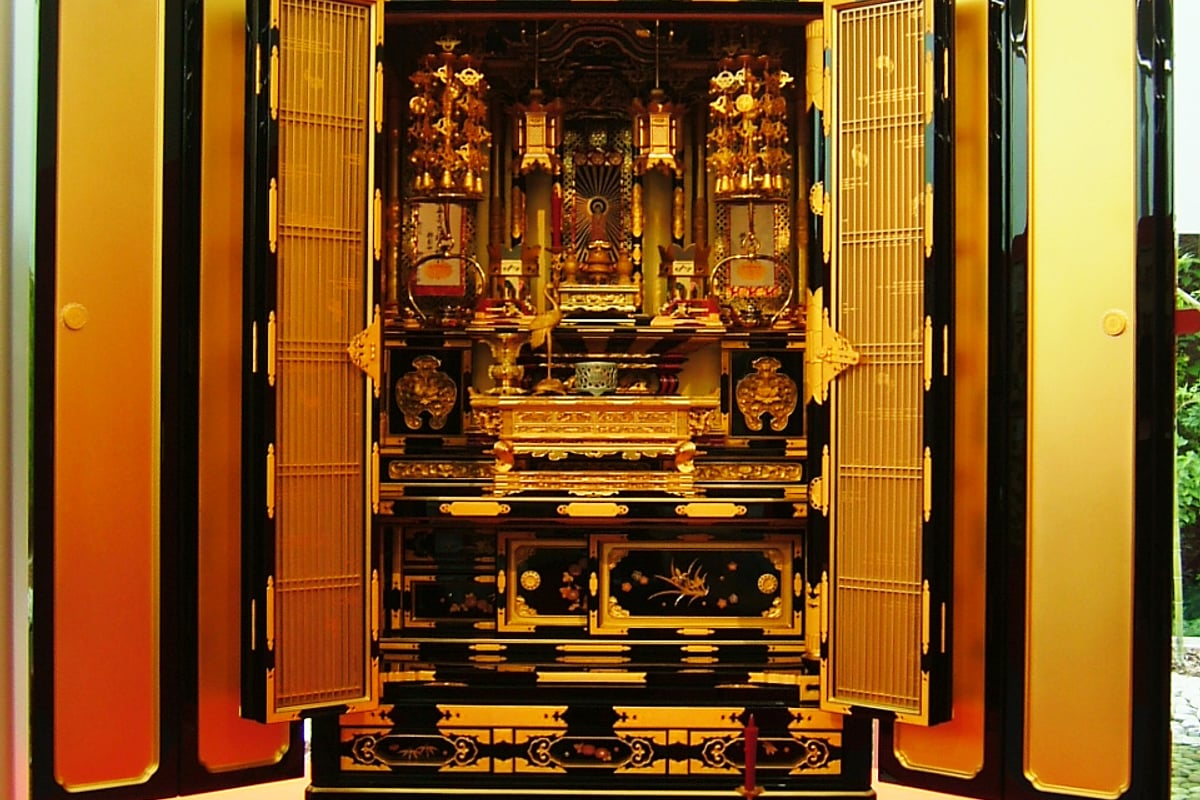
Kyo-butsudan are traditional Kyoto Buddhist altars made through a division-of-labor system involving more than forty specialized trades, including woodworking, roof (miya-den) construction, wood carving, lacquering, roiro polishing, pure gold leaf application, ornamental metal fittings, maki-e, and coloring. Buddhist altar fitting production in Kyoto is believed to have begun around the 8th century, shortly after the introduction of Buddhism, and became fully established in the early 11th century when the Buddhist sculptor Jocho set up the "Shichijo Busho" workshop in Shichijo. Demand surged in the early Edo period when the shogunate's temple registration system spread the custom of enshrining an altar in every household. Because styles of religious ornamentation differ by sect, mass production is unsuited to this craft, giving it the character of a comprehensive art form that draws together woodworking, lacquerwork, metalwork, and other traditional techniques. Today, roughly 70% of the altars and altar fittings produced in Kyoto are for temple use, and Kyoto supplies much of the temple altar equipment used nationwide. It was designated a Traditional Craft by the Minister of Economy, Trade and Industry in 1976.
Origin
Buddhist altar fitting production in Kyoto is presumed to have begun around the 8th century, shortly after the introduction of Buddhism. Following the era of Saicho and Kukai, who characterized Heian-period Buddhism, the Buddhist sculptor Jocho established the "Shichijo Busho" workshop in Shichijo in the early 11th century, laying the foundation for full-scale Buddhist fitting production.
History
In the early Edo period, the shogunate's temple registration system made every household a parishioner of a temple, spreading the custom of enshrining an altar at home and causing demand to surge. Under a division-of-labor system, craftsmen honed skills in woodworking, roof construction, wood carving, lacquering, pure gold leaf application, ornamental metal fittings, and maki-e, and in 1976 the craft was certified as the Traditional Craft "Kyo-butsudan" designated by the Minister of Economy, Trade and Industry.
Features
Because styles of religious ornamentation differ by Buddhist sect, mass production is difficult, and the craft is characterized by a finely divided labor system involving more than forty specialized trades. It is a comprehensive art form bringing together woodworking, lacquerwork, metalwork, and other traditional techniques, and roughly 70% of the altars and altar fittings made in Kyoto are for temple use, supplying much of the temple altar equipment used nationwide.
Techniques
Pure gold leaf application
A finishing process in which a maki-e artisan carefully applies pure gold leaf sheet by sheet onto wood that a lacquer artisan has coated. It requires skilled judgment of how dry the lacquer should be.
Maki-e
A decorative technique in which a design is drawn in lacquer, then gold or silver powder is sprinkled on before the lacquer dries so it adheres. Handling the lacquer is difficult and demands great skill and experience.
Kazari-kanagu (ornamental metal fittings)
The process of making the metal fittings that decorate an altar. Base metal is carved with patterns and plated to add brilliance and solemnity to the altar.
Materials Used
Production Process
- 1
Kiji (base wood)
Raw timber such as cypress, pine, and zelkova is worked into altar components. Parts to be carved proceed to the wood-carving process; others proceed to lacquering.
- 2
Roof and miya-den (palace enclosure)
The miya-den enclosure that houses the principal Buddhist image is assembled from finely fitted components.
- 3
Wood carving
Designs such as celestial maidens and dragons are carved with blades, giving the altar three-dimensional decoration.
- 4
Lacquering
Black or vermilion lacquer is applied in layers to the surface of the base wood, creating a glossy foundation.
- 5
Roiro (lacquer polishing)
A finishing process in which the lacquered surface is ground with charcoal and polished to bring out a deep luster.
- 6
Pure gold leaf application and ornamental metal fittings
Pure gold leaf is applied using lacquer as an adhesive, and metal fittings carved with patterns are attached to each part, enhancing the altar's solemnity.
- 7
Maki-e and coloring
Maki-e, in which designs are drawn in lacquer and gold or silver powder is sprinkled on, along with coloring, are applied to add splendor to the altar.
- 8
Final assembly
The components finished by each specialized trade are brought together and assembled into a single completed altar.
| Main Production Areas |
|
|---|
Artisans & Workshops
若林佛具製作所
Founded in 1830. Its Kyoto main store houses the "Wakabayashi Kyo-butsudan Museum" on the 5th floor, displaying altars and altar fittings of high artistic value, primarily from the Meiji era.
Official site →田中伊雅佛具店
A long-established Kyo-butsugu shop said to have been founded around 885 during the Ninna era. It has carried on the craft for over a thousand years, centered on esoteric Buddhist fittings associated with Ninna-ji Temple.
Official site →How to Buy
- 若林佛具製作所 京都本店
- A specialty shop for Buddhist altars and altar fittings with its main store on Shichijo-dori east of Shinmachi in Shimogyo Ward, Kyoto. It also houses a museum and handles everything from household to temple-use items.Where to buy →PR
- 京都府仏具協同組合
- An association of businesses certified for the Kyo-butsudan and Kyo-butsugu Traditional Craft designations. It provides information on member shops and technical exhibitions.Where to buy →PR
Hands-on Experiences
若林京仏壇ミュージアム
京都市下京区七条通新町東入西境町146 若林佛具製作所京都本店5階
Displays altars, altar fittings, and craftsmanship of high artistic value, primarily from the Meiji era. Open 10:00-17:00, closed Wednesdays. Inquire directly regarding admission requirements.
View details →