Image: Wikimedia Commons
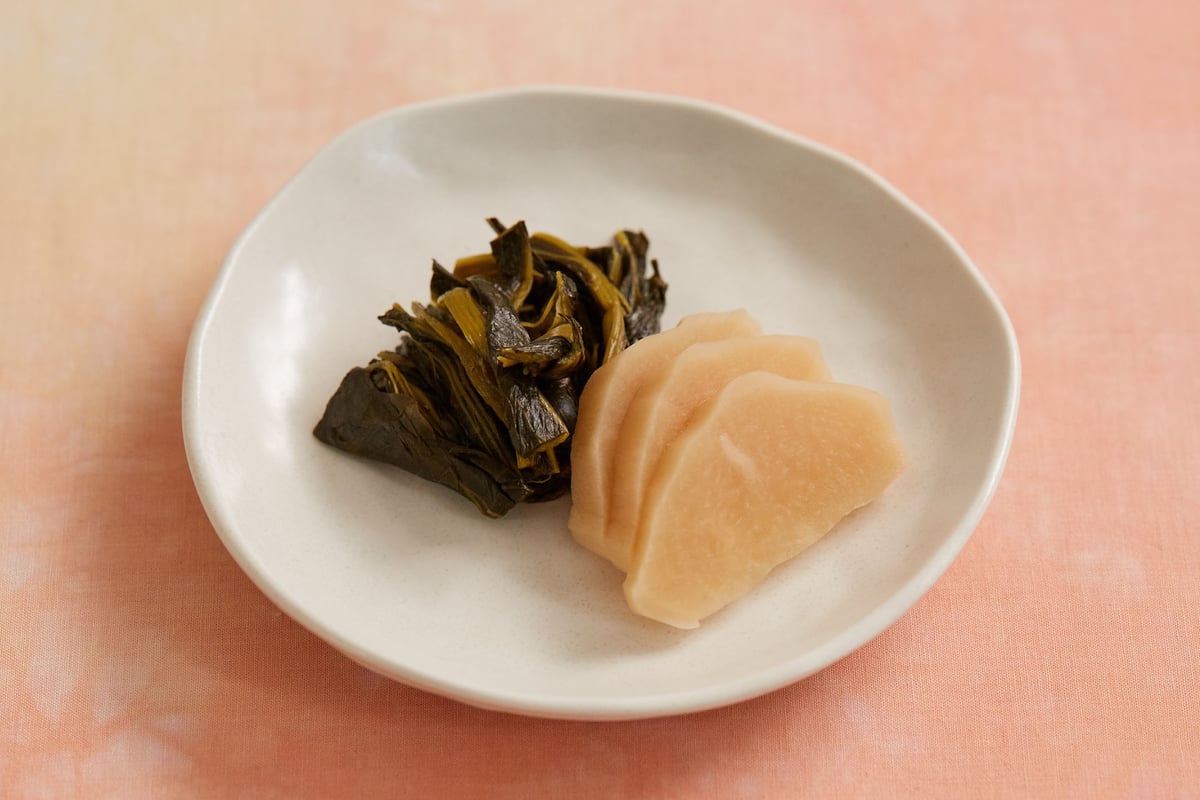
Sugukizuke is a pickle with a distinctive sourness, made by pickling "sugukina," a Kyoto vegetable specific to the Kamigamo area of Kyoto, using only salt and allowing it to lactic-ferment. Alongside senmaizuke and shibazuke, it is one of "Kyoto's three great pickles," and it is said that the shake (hereditary priestly families) of Kamigamo Shrine began making it in the early Edo period. It was once a valuable item whose method was passed down only among the shake families, and in the Edo period it was guarded so strictly that an official notice was issued declaring that "not a single suguki may be taken outside the village." Labor-intensive traditional methods are still carried on today, including a unique weighting method called "tenbin-zuke" and a process of placing it in a muro (heated chamber) to promote fermentation.
Origin
There are several theories about the origin of sugukina: one holds that in the Azuchi-Momoyama period, the shake families of Kamigamo Shrine began cultivating a type of turnip that grew wild along the Kamo River, while another holds that its seeds were a gift from the Kyoto Imperial Palace. The salting method was established in the early Edo period, and at first it was a luxury pickle made only by the shake families, also presented as a gift to the Imperial Palace.
History
In the Edo period it became established as a specialty of Kamigamo, prized as an early-summer gift sent from the shake families to the capital. At the time it was guarded so strictly that it was said never to leave the community, but the method later spread to farming households around Kamigamo Shrine, and from the Meiji era it also came to be sold to the general public.
Features
Whole sugukina is first pre-pickled and then fully pickled using only salt, then pressed using a unique method called "tenbin-zuke" ("balance-beam pickling"), which uses a long wooden beam and weights, and lactic-fermented for about a week in a muro kept at 38-40 degrees Celsius. Because fermentation progresses further than in other pickles, it develops a stronger sourness and a distinctive flavor.
Main Ingredients
Food Culture
As one of Kyoto's three great pickles alongside senmaizuke and shibazuke, it is cherished as a year-end and New Year's gift, in ochazuke, and as a snack with sake. As a lactic-fermented food, it has also drawn attention in recent years for its potential health benefits.
Famous Shops
御すぐき處 京都なり田 上賀茂本店
京都市北区上賀茂山本町35
Founded in 1804 (Bunka 1). Suguki, 100g, about 400 yen and up.
View details →すぐきや六郎兵衛
京都市北区上賀茂御薗口町69
Located in front of the torii gate of Kamigamo Shrine. Kiri-suguki (sliced suguki) is about 650 yen, among other items.
View details →FAQ
Q. Why is sugukizuke more sour than other pickles?
A. Because the method actively advances lactic fermentation in a heated chamber called a muro, the degree of fermentation is higher, producing a distinctively strong sourness.